Page 1 :
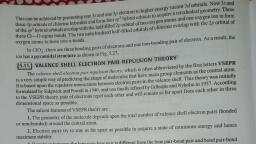
@ unacademy, , “+ VALENCE SHELL ELECTRON PAIR REPULSION (VSEPR), THEORY, Sidgwick & Powell (1940) demonstrated shapes of molecules (which, Lewis could not), based on the repulsive interactions of the electrons, , present in the valence shells of atoms., > The shape of a molecule depends upon the number of valence, shell electron pairs (bonded & non-bonded) around the central, atom., > The valence shell is taken as a sphere with the electron pairs, , localizing on the spherical surface at maximum distance from, one another.

Page 2 :
V Vv, , aayemnecec omy, Os, Paes), , Pairs of electrons in the valence shell repel one another., These pairs of electrons tend to occupy such positions, in space that minimize repulsion and thus maximize, stability of the molecule., , A multiple bond is treated as if it is a single electron, pair and the two or three electron pairs of a multiple, bond are treated as a single super pair., , Where two or more resonance structures can represent, a molecule, the VSEPR model is applicable to any such, , structure. 5 0f7), 5 of 7
Page 3 :
va UNacacemy, , > In order to predict shapes of covalent molecules, Sidgwick & Powell proposed, the shapes as influenced by the total no. of pairs electrons (both bonded &, non bonded) present on the central atom., , No. of electron pairs Shape of the Diagrammatic Bond angles, in outer shell molecule, 2 Linear <—_, 3 Plane triangle AX, 4 Tetrahedron, 5 Trigonal bipyramidal <7, 6 Octahedron Zi, , 7 Pentagonal ae, bipyramidal
Page 4 :
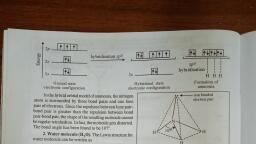
v= UNacademy, , ¢ Nyholm and Gillespie (1957) refined the VSEPR model by, explaining difference between the lone pairs and bonding pairs of, electrons., , > While the lone pairs are localized on the central atom, each bonded pair is, shared between two atoms. (Here bond pair refers to single bond), , > As a result, the lone pair electrons in a molecule occupy more space as, compared to the bonding pairs., , > This results in greater repulsion between lone pairs of electrons as, compared to the lone pair - bond pair and bond pair - bond pair repulsions., , > These repulsion effects result in deviations from ideal shapes and, alterations in bond angles in molecules., , > Double bond need more space pared to single. The repulsion order, Double bond-double bond>do nd-single bond>single bond-single 4, bond s