Page 1 :
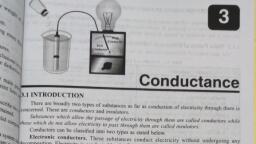
Conductance, , , , 3.1 INTRODUCTION, , There are broadly two types of substances as far as conduction of electricity through thern is, oncemed. These are conductors and insulators, Substances which allow the pe, , assage of electricity through them are called conductors while, those which do not allow ele., , ctricity to pass through them are called insulators., Conductors can be classified into two types as stated below., , Electronic conductors. These substances, decomposition. Electricity is conducted b, Ware mostly metals with the exception of, , conduct electricity without undergoing any, y the flow of electrons in this type of conductors which, graphite and certain minerals., , Electrolytic conductors (electrolytes). These substances undergo decomposition when, , electricity is passed through them. Acids, bases and salt solutions in water and fused salts come, i ory. Electricity is conducted by ions in this case., , © types :, , strong acids (H,SO,, HNO, HCl, etc), strong bases, Iten state are completely ionised and conduct electricity, , led strong electrolytes., , } weak acids (like CH,COOH), weak bases (like NH,OH),, , and hence do not conduct electricity to a great extent, , , etc do not conduct electricity at all and are called non, tic Conduction, , ty of solutions are described below :, tween the ions of the solute determine the conductivity., , Ins of the solute, smaller will be the conductivity. Such, tions., , tions between the ions of the solute and the solvent,, vent interactions (solvation of ions),, , ent interactions. Greater the, the solute ions and hence, , Our with increase of, metallic conductors, er-ionic attractions
Page 2 :
|ESTER-H! (PHYSICAL CHEMISTRY), , 70 GHEMISTRY FOR DEGREE STUDENTS SEM! : :, , 7 s into increase 0 conductance en,, , deel Viswoity ecrease wilh Te i in cot re mn doctors with temperature due tg % it!, . ‘ se of metallic >, However, we observe a decrease In conductance 0} H ‘ ow of electrons i, , : le the fic ), , Is of metal atoms, whieh impee :, , increase in the vibrations of kern! a, and Electrolytic C ‘onductors, , , , , , , , , , , , , , , , , , , , , , , , , ance Between Metallic i, 3.1.2 Main Points of Difference Betwe feonduetors are given in Table 3:1 iu, The main points of difference between the two types oF © ", Table 3.1, Metallic and Electrolytic ComductOr® s, Metallic Cond: Electrolytic Conductor, ee Rcenen bape eh | new eee ren is carried by the ‘, conducted by the flow of electrons from charged ions moving towards the one, a negative potential to a positive (or less _ oppositely charged electrodes: 5, negative) potential. i ,, 2. No chemical change takes place when a 2. Conduction of electricity by electrolytic gene, metallie (or electronic) conductor is conductors is accompanied by some, conducting electricity. No new products definite chemical process with the, are formed. evolution of some gases oF deposition of, some metals at the electrodes., 3. In metallic conduction, temperature has 3. In electrolytic conductors, the conductance, the effect of decreasing the conductance, increases with the rise of temperature. This 5, Le., conductance of a metallic conductor is due to increase in the mobility of the ions, oct ‘ \ and increase in the degree of ionisation of, : the electrolytes., a, SISTANCE AND ELECTRICAL CONDUCTANCE | ae, gives exact relationship between the resistance, the current and : ;, , states :, Btor a voltage ‘E' is applied and a current ‘I’ flows through it, then, ior is given by E / I. |, ed in amperes, whereas voltage is measured in volts. [fone ampere |, fo when a voltage of one volt is applied to it, the resistance of the, ritten £2),, , p be put as, , , , , inet, a, , ke metallic conductors obey Ohm's law., of the electrical resistance is called the conductance. It is usually, , Cirenid, , R, , eto speak of the conductance ofa solution rather thay its resistance., ce are siemen (S) or ohm! or mho (1 § = 1Q°')
Page 3 :
CONDUCTANCE 71, , 3.2.1 Specific Conductance, It is found that resistance (2) of a conductor is, () directly proportional to its length () and, , (#) inversely proportional to its area of cross-section (a), , i.e, R « l, a, or R= a (i), a, , where Pp is a constant of proportionality, called Specific Resistance or Resistivity. Its value, depends upon the material of the conductor., , “The reciprocal of resistivity is known as specific conductivity or simply conductivity.” It is, denoted by K. Thus, if K is the specific conductivity and C is the conductance of the solution, then, , , , , , , , , , , , , , , , , , , , , , wit a 1, Fithgg the 3, a le, Substituting the values of R and p in eq. (i) above 5, eM ie Mis, Cc K a, lcm, , , , <+— lon, Fig. 3.1. Specific conductivity., , ined as the conductance of a solution of 1, -section. Alternatively, it may be defined as, the electrolyte. This is illustrated in Fig. 3.1., cific conductivity of such a solution at this, , (cm)?, cm, , = ohmecmor ohm m in SI units, , , , , , , r ao!, , units
Page 4 :
TRY, 72 CHEMISTRY FOR DEGREE STUDENTS SEMESTER-III (PHYSICAL CHEMISTRY), , Relationship between equivalent conductivity and specific conductivity. i hac, conductivity of a solution ts calculated from the specific conductivity. The relationship een, equivalent conductivity and specific conductivity may be obtained as follows : a, , Consider a rectangular vessel with its two opposite walls one cm apart and made of some, metal sheets so that they act as the electrodes., , Case I. Let us suppose lcm? of the solution containing | g eq. of the electrolyte 1s taken in, the vessel (Fig. 3.2). The conductance of this solution will be its specific conductivity. Further, 1 cm? of the solution taken contains one gram equivalent of the electrolyte, the conductance of, the solution will be its equivalent conductivity (by definition). Thus, when Jem? of the solution, containing one gram equivalent of the electrolyte is considered, the equivalent conductivity becomes, equal to its specific conductivity., , Case I. Let us suppose 4 cm} of the solution containing one gram equivalent of the electrolyte, is taken in the vessel. The conductance of the solution will be still equal to its equivalent conductivity, at this dilution but now there will be four cubes each of volume lem? as shown in Fig. 3.2. The, conductance of each lem? of the solution is equal to its specific conductivity so that the total, conductance of the solution, i¢., equivalent conductivity is four times the specific conductivity., , Equivalent conductivity = Specific conductivity « V, . = Ky xV, in cm* containing one gram, , , , icm, , , , , , , , , atration of c gram equivalent, ts are present in 1000 cm> of, the solution containing one, , , , , , , , , , , , , , , , , , , , , , , . Hence, the above expression _Fig, 3.2. Relationship between, equivalent conductivity and, specific conductivity., 1000 1000, x =K*x, , = K ee, Normality, , , , = Koo., , cm?, , Gram Eq., , = ohm! cm? (g eq)! or S cm? eq”! or Q-! cm?, , i, , ohms! cm™! x, , , , , , , 1 = 104 x Scm? eq!, ar conductivity of a solution is defined as under :, , PA., pndluctivity and specific conductivity. Molar conductivity is relate, , ows.
Page 5 :
CONDUCTANCE 73, , r ivi i m> ining one mole of the, i ifi y containing, Molar conductivity = Specific conductivity * Volume in c, , electrolyte, ” A Kx th, ; rg yhOOD rg 91 1000, Cc Molarity, ; fs . : i mole, where X is the specific conductivity and V is the volume of the solution containing one, J of the electrolyte and ¢ is the molar concentration. ;, re i 4 x at dent, Units of A,, will be ohm=! cm? mot! (or S cm? mol ') or Q7! cm* mol., S.L. units, Units of A,, are S m? mol!, 1 Sm? mot! = 104 x S cm? mol"!, , 3.3. MEASUREMENT OF ELECTROLYTIC CONDUCTANCE,, SPECIFIC CONDUCTIVITY, EQUIVALENT CONDUCTIVITY, AND MOLAR CONDUCTIVITY (CONDUCTANCE), , (i) Electrolyte conductance. Conductance is the reciprocal, of resistance. Hence, the conductance can be obtained by the, measurement of the resistance and the latter can be found by, Wheatstone bridge method shown in Fig. 3.3. It consists of four, s Manner as shown in, , R is the unknown, no deflection in, , (Variable), , , , (Unknown), R,, , , , , , , , , , , , an be calculated., bf an electrolyte,, , at the solution is Fig. 3.3. Principle of, , Wheatstone bridge., , Experimental, solution