Notes of B.Sc. 1st Semester, CHEMISTRY STATES OF MATTER GASEOUS STATE - Study Material
Page 1 :
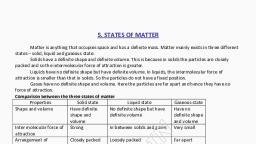
States of matter-Gaseous state, Total Sessions - 08, SESSION–1, AIM, ✓ Introduce different states of matter and explain intermolecular force., ✓ To introduce Gaseous state as a state of matter, THEORY: Matter exists in three states, viz, solid, liquid and gas. Solids have, , a definite volume and shape; liquids also have a definite volume but no, definite shape; gases have neither a definite volume nor a definite, shape., Characteristics Properties of Solid, Liquid and Gas, Solids, Particles are very Closely, packed, Voids are extremely small, Inter particle forces are, large, Particle, motion, is, restricted to vibratory, motion., Density of solids is high, , Liquids, Particles, are, loosely, packed, Voids are relatively larger, Inter particle forces are, intermediate, Particle motion is very slow, , Density is lower Than solids, higher than gases, They show definite Shape They show indefinite shapes, & definite volume, but definite volumes, Molecules, energy, , possess, , Least Molecules, have, higher, energies than that of solids, , Gases, Particles are very, loosely packed, Voids are very large, Intermediate forces, are negligible, Particle motion is, very rapid and also, random., Gases generally have, low densities., Gases have neither, definite shapes nor, volumes, Molecules are more, energetic, , They are less compressible Liquids, slightly, higher Gasses highly, and thermal expansion, compressible and thermal compressible, and, Thermal expansion, expansion, than solids.
Page 2 :
ACTIVE SITE EDUTECH, , Intermolecular forces or vander waal forces, The three states of matter differ mainly due to difference in the, intermolecular forces of attraction, i.e., forces of attraction existing, between the molecules of a substance. Greater, the intermolecular force,, higher is the melting point or boiling point and vice -versa., , It was first proposed by Dutch scientist J.D. Vander Waal, • Vander waal force molecular weight, , Vander waal force Atomic weight, Vander waal force Boiling point, • It is formed as the result of attractions of unlike charges., • Inter molecular forces does not include the forces between, , oppositely charged ions(i.e ionic bond) and the forces that hold, atoms of a molecule together (i.e covalent bond), • Strong dipole-dipole inter.actions operating between hydrogen and, more electronegative F, or O or N is called hydrogen bond, Types of intermolecular forces. Inter molecular forces devided into, • Dipole-dipole interaction exists between the permanent polar molecules, like HCI, NH3, SO2 etc., molecules having permanent dipole moment., It is represented as, , H, , +, , −, , − Cl ...H, , +, , −, , − Cl ...H, , +, , − Cl, , −, , For example, m.p and b.p of H2S are greater than those of PH3 because H2S, has higher dipole moment than PH3. This force is due to electrical, , interactions among dipoles on neighbouring molecules, ACTIVE SITE EDUTECH - 9844532971, , 2
Page 3 :
ACTIVE SITE EDUTECH, , These are two types, a) attractive forces between unlike poles, b) repulsive forces between like poles, ✓ This forces is generally weak and in the order of 3-4 KJ/mol,, significant only when molecules are in close contact, ✓ Greater the dipole moment, stronger are the dipole-dipole interactions., ✓ As the molecule is more polar, dipole-dipole interactions are, more and boiling point of substance will be more, ✓ Dipole - dipole interactions in solids 1/r3 ., ✓ Dipole-dipole interaction of rotating molecules 1/r6 is the, distance between polar molecules., • Dipole-induced dipole interactions present between the polar molecule and, non-polar neutral molecule., ✓ Greater the dipole moment of the polar molecule and the, polarizability of the nonpolar molecule, greater is magnitude of, these forces., , ✓ Permanent dipole of the polar molecule induces dipole on the, electrically neutral molecule by deforming into electric cloud, and attractive forces develop. H − Cl ...Cl − Cl, +, , −, , +, , −, , Exp- polarizability of noble gases increases with size from He to Rn,, therefore, their solubility in water increases from He to Rn., +, H, , −, Cl, , Permanent dipole, (a polar molecule), , +, H, , −, , non-polar molecule, , +, , −, , Cl, , Permanent dipole, (a polar molecule), , Induced dipole in, a non-polar molecule, , ACTIVE SITE EDUTECH - 9844532971, , 3
Page 4 :
ACTIVE SITE EDUTECH, , • Induced dipole-induced dipole interactions (London or dispersion forces), It exist b/w non - polar molecules like H2 , N2 , CH4 , CCl4 ., Here electron cloude is symmetrically distributed hence they do not have, polarity., When both non-polar molecules approach each other, the electron cloud of, a molecule becomes distorted and produce instantaneous dipole. It induces, dipole in the neighboring molecule. These dipoles then interact with each, other., , Atom A, , Atom B, , Symmetrical distribution of, electronic charge clour, (a), , Atom 'B' with, induced dipole, , Atom 'A' with, instantaneous dipole,, more electron density, on the right hand side, (b), , Atom 'B' with, induced dipole, , Atom 'A', more electron density, on the left hand side, (c), , - London forces energies are in the range 1-10 kJ/mol., - It is significant only to short distance., -Magnitude of London forces depends on polarisability and geometry, of smaller molecule(or)atom is less polarisable and has smaller, dispersion forces, - A larger molecule or heavier atom is more polarisable and has larger, disperson forces, - These are always attractive forces and proportional to 1/r6, here ‘r’, is distance between the two interactive particles., , ACTIVE SITE EDUTECH - 9844532971, , 4
Page 5 :
ACTIVE SITE EDUTECH, , - More spread out shapes possess higher dispersion forces than those, compact molecules which minimise molecular contact hence possess lower, dispersion forces, Exp : n - pentane, b.p is 309.4K( long chain), 2,2 - dimethyl propane, b.p is 282.7K (compact chain), - London dispersion forces increases with size, molecular weight,, surface area, number of electrons., e.g.,, B.p, , CH4< SiH4< GeH4, Methane Silane Germane, 112K, 161K 183K, , Thermal energy, Thermal energy of matter is responsible for different types of motion of its, constituent particles., , It is a measure of average kinetic energy of the molecules of the, substance and is directly propotional to the absolute temperature., Inter molecular forces vs Thermal Energy:, - Inter molecular forces try to bring molecules closer but thermal energy, keeps the particle away from each other., - When thermal energy of the molecules is reduced by lowering the, temperature the gases can be very easily liquified, - If thermal energy predominates over inter molecular forces the, substances would change from solid liquid gas, - If intermolecular forces predominate over thermal energy then, substance change from gas liquid solid., Predominance of thermal energy, , Solid, , Liquid, , Gas, , Predominance of interparticle interaction energy, , ACTIVE SITE EDUTECH - 9844532971, , 5
Page 6 :
ACTIVE SITE EDUTECH, , The Gaseous State- The gaseous state is the simplest and shows greatest, uniformity in behavior. Gases have the following general characteristics:, • Gases have no definite shape and Volume., • Gases are highly compressible into smaller volumes., • Gases expand without limit. A gas sample can occupy completely and, uniformly the volume of any container., • Gases exert pressure., • Gases diffuse rapidly through each other to form a homogenous mixture., Gas parameters, • Volume(V) of the container is the volume of the gas sample., Volume is expressed in liter(l),milliliter(ml)or cubic centimeter(cm3) or, cubic metre (m3), 1L = 1000 mL = 1 dm3 = 103 cm3, S. I units are m3 and C. G. S. units are cm3, •, , Pressure is the force exerted by the gas per unit area of the walls of, the Container., , P(Pressure) =, , =, A(Area), , F(Force), , Mass×Acceleration, Area, , Pressure exerted by a gas is due to kinetic energy (K.E. = ½ mv2), of the gases molecules., K.E. of the gas molecules increases, as the temperature is increased, so, pressure of a gas is directly proportional to temperature., PT, Units of Pressure: P is expressed in atm, Pa, Nm–2, bar., 1, , atm, , = 76, , cm Hg, , = 760, , mm Hg, , = 760, , torr =, , 1.013 × 10⁵, , N/m2, , = 1.013 × 10⁵ Pa = 1.013, , ACTIVE SITE EDUTECH - 9844532971, , bar, , 6
Page 7 :
ACTIVE SITE EDUTECH, , SI unit of pressure is Pascal (Pa) which is defined as the pressure exerted, when a force of 1 newton acts on a 1 m2 area., • Temperature of the gas is measured in centigrade degree (0C) or Celsius, degree with the help of thermometers., SI unit of temperature is Kelvin (K) or absolute degree., , Other units of temperature are , 0C,, K, , 0F,, , =0C + 273, , 0F=9/5(0C+32), , • Mass(m) of gas is measured in gram or kilogram., 1 kg = 103g, The mass of the gas isexpressed in number of moles., Moles of gas (n) =, , so,, , Mass in grams, molar mass, , =, , m, M, , m=n×M, , ACTIVE SITE EDUTECH - 9844532971, , 7
Page 8 :
ACTIVE SITE EDUTECH, , SESSION – 2, AIM - To introduce Gas Laws and Ideal Gas Equation:, Gas Laws The volume of a given sample of gas depends on the, , temperature and pressure applied to it. Any change in temperature or, pressure will affect the volume of the gas. These relationships, which, describe the general behaviour of gases, are called gas laws., • Boyle's Law: It relates volume and pressure of a given mass of a gas at, constant temperature., Boyle's law states that, “At constant temperature, the volume of a, given mass of a gas is inversely with the pressure”., 1, , ∴ P ∝ V(at constant temperature and number of moles), i.e.,, , P=, , K, V, , or PV= k, , The value of the K depends on amount of a gas and the temperature., If we compare initial and final conditions,, Mathematically, Boyle's law can be written as, P1V1=P2V2, Boyle’s law can be verified by any one of the following three ways, graphically as follows., , Graphs of V vs P at constant temperature are known as isotherms., , PV, , V, , V, , P, , 1/P, , P, (A), , Temperature-constant, Mass-constant, , Temperature-constant, Mass-constant, , Temperature-constant, Mass-constant, , (B), , (C), , ACTIVE SITE EDUTECH - 9844532971, , 8
Page 9 :
ACTIVE SITE EDUTECH, , -, , 1st, , curve shows decrease in V with increase in P at constant T. The shape, of the curve is rectangular hyperbola., - 2nd curve shows, volume and reciprocal of pressure is a straight line. It, confirms the statement of Boyle's law., - 3rd curve shows a straight line parallel to pressure-axis. i.e., product of P, and V of a given mass of a gas at constant T is constant., Location of straight line and curve changes at different T, , According to Boyle’s law, PV = Constant at constant temperature, ∴log P + log V = log k, log P = log k – log V, log P, , log V, (G), , Significance of Boyle’s law, • At constant mass and temperature, density of a gas is directly, , proportional to its pressure and inversely proportional to its volume., Thus, d ∝ P ∝ V1 [∵ V = mass, ], d, or dd1 = PP1 = VV2 =. . . . . . . = K, 2, , 2, , 1, , ACTIVE SITE EDUTECH - 9844532971, , 9
Page 10 :
ACTIVE SITE EDUTECH, , • At altitudes, as P is low d of air is less. That is why mountaineers, , carry oxygen cylinders., • Charles Law: It relates the volume and temperature of a given mass of a, gas at constant pressure., Thus, all gases expand or contract by the same fraction of their volume, at 0°C per degree change of temperature., Charles law states that ‘At constant pressure, the volume of a given, mass of a gas increases or decreases by 1/273.15 of its volume at 00C, for every one degree rise or fall in temperature’., , Let V0 , Vt are the volumes of gas at 0°C and t°C. As temperature is, increased and the new volume becomes, V0, t, Thus, Vt= Vo + 273.15, × t = VO (1 +, ), 273.15, 273.15+t, , Vt = V0 (, , 273.15, , )…..(i), , - A new temperature scale was introduced known as Kelvin scale or absolute, scale. The lower limit of the scale is called absolute zero which, corresponds to –273°C., - At absolute zero or –273°C, all molecular motions would stop and the, volume of the gas would become zero. The gas would become a liquid or, solid. Thus, absolute zero is that temperature at which no substance, exists in the gaseous state., ACTIVE SITE EDUTECH - 9844532971, , 10
Page 11 :
ACTIVE SITE EDUTECH, , - The temperature in absolute scale is always obtained by adding, the temperature expressed in °C., K = (t°C + 273), By substituting T for 273 + t and T for 273 in Eq. (i)., , 273, , to, , 0, , Vt =, , Vo ×T, To, , or, , Vt, T, , =, V, T, , Vo, To, , or, , =constant k, , V = kT , if pressure is kept constant, This is the mathematical expression of Charles’ law., “At constant pressure, the volume of a given amount of a gas directly, propotional to its absolute temperature”., V ∝ T (if pressure is kept constant), Charles' law verified by plotting the values of V at absolute temperature at, constant pressure gives straight line., , It is also observed that each line(isobar) when, extrapolated cuts the T axis at -273.150C. It means all gases at -273.150C, , will have zero volume i.e., gases doesnot exist., Significance of Charles law –, , - At constant mass and pressure density of a gas is inversely, proportional to it absolute temperature., ACTIVE SITE EDUTECH - 9844532971, , 11
Page 12 :
ACTIVE SITE EDUTECH, , Thus,, , d∝, d1, , or, , d2, , 1, , ∝, , T, , =, , T2, T1, , 1, V, , =, , mass, , [∵ V =, V2, V1, , d, , ], , =. . . . . . = K, , - Use of hot air balloons in sports and meteorological observations is, an application of Charle's law., • Gay Lussac’s Law It relates the pressure and absolute temperature of a, given mass of a gas at constant volume., At constant Volume, the pressure of given mass of a gas is directly, propotional to absolute temperature., , Thus,, or, , P = KT = K(t(o C) + 273.15), , K=, , If, , P, , P1, , or, T, , t = 0o C,, , Hence,, , , at constant V, , P∝T, , T1, , =, , then, , P2, T2, , =K, , (where K is constant), , (For two or more gases), , P = P0, , P0 = K × 273.15, , K=, , P0, 273.15, , P=, , P0, 273.15, , [t + 273.15] = P0 [1 +, , t, , ] = P0 [1 + αt], , 273.15, , where is the pressure coefficient,, Thus, for every 1𝑜 change in temperature, the pressure of a, 1, 1, gas changes by 273.15, (≈ 273) of the pressure at 0o C., P, , This law fails at low temperatures, because the volume of the gas, molecules be come significant., A graph between P and T at constant V is called isochore., , ACTIVE SITE EDUTECH - 9844532971, , 12
Page 13 :
ACTIVE SITE EDUTECH, , Significance of Gay Lussac’s Law, During summer with rise in T pressure increases.If pressure is adjusted, in tyres of automobiles, they may bursts. So pressure should be, adjusted., • Avogadro’s Law: “Equal volumes of different gases at the same, temperature and pressure contain the same number of molecules.”, , Thus, at a given temperature and pressure, the volume of a gas is, directly proportional to the amount of gas., V ∝ n (at constant T and P), or V = Kn (where K is constant), or Vn1 = Vn2 =. . . . . . . = K, 1, , 2, , It has been observed that 1 mole of gas at 273 K and 1 atmosphere, pressure(STP or NTP) occupies 22.4 Litres. This is called the molar, volume of a gas. From Avogadro’s law V = Kn = K. mM, m, V, , 1, , = M, k, , d = k’M, , ACTIVE SITE EDUTECH - 9844532971, , 13
Page 14 :
ACTIVE SITE EDUTECH, , where d is the density of gas.Thus, we can conclude that density of a, gas is directional to its molar mass at constant T and P., , Ideal Gas Equation:, Boyle’s law, Charles law and Avogadro’s law can be combined as, According to Boyle’s law V ∝, , 1, P, , at constant T., , According to Charle’s law V ∝ T at constant P., According to Avogadro’s law V ∝ T [at constant T, By combining the three laws we get, V ∝ nT, P, ∴, , VP, nT, , &, , P], , = R (a constant), , PV = n RT, For 1 mole of a gas, PV = RT., This equation is called ideal gas equation., At a pressure P1 and temperature T1, the volume of a gas is V1. At, pressure P2 and temperature T2, the volume of the gas would be V2., From the above equation, , P1 V1, T1, , =, , P2 V2, T2, , is combined gas equation., , Value of universal gas constant R is SI units:, PV = RT for 1 mole of a gas R = PV, T, In S.I units P = 1 atm = 101325 Nm-2 or Pa, V = 22.4 dm3 = 0.0224m3 (1m3 = 1000 dm3), ACTIVE SITE EDUTECH - 9844532971, , 14
Page 15 :
ACTIVE SITE EDUTECH, , T=, , 273, , ∴R=, , K (Standard temperature), , 101325 ×0.0224, 273, , R = 8.314 Nm K-1 mole-1, = 8.314 JK-1mole-1, = 8.314 x 10⁷erg mol-1 K-1, = 1.987 cal.mol-1 K-1 = 2 cal. mol-1K= 0.0821 lit. atm. mol-1 K-1, = 82.1 cm3mol-1K-1, Value of R depends on the units of P,V,T employed., Relation between Molecular Mass and Gas Densities, For an ideal gas PV = nRT, PV = Mw RT, where w=mass of the gas,M = Molecular wt, PM =, or, , w, V, , RT, , PM = dRT, (where d=density of the gas), ∴ρ=, , PM, RT, , ACTIVE SITE EDUTECH - 9844532971, , 15
Page 16 :
ACTIVE SITE EDUTECH, , SESSION-3, AIM - To introduce Daltons Law of Partial Pressures, DALTON’S LAW OF PARTIAL PRESSURES, Dalton’s law of partial pressures states that, at a given temperature, and volume, the total pressure exerted by a mixture of non-reacting, gases is equal to the sum of the partial pressures of the individual gases., Mathematically, P = PA + PB + PC + ⋯, Where P is the total pressure and PA, PB, PC…. are the partial, pressures of the component gases A, B, C…Respectively., Applications of Dalton’s law:, • To determine the mole fraction of component., Let nA & nB be the no. of moles of two are gases A and B which are, filled in a container of volume ‘V’ at temperature T., So, the total pressure of container ‘P’ may be calculated as PV = (nA + nB) RT ...... (i), Partial pressure of individual gas calculates atPAV = nA RT ………(ii), PB V = nBRT ……(iii), On the addition of eq. (ii) & (iii) we get(PA + PB)V = (nA + nB)RT…..(iv), On the comparison of eq. (i) & (iv), P = PA + PB, Dividing equation (ii) by (i), we get, PA, nA, =, = XA, P, nA + nB, , PA = XA x P, , ACTIVE SITE EDUTECH - 9844532971, , 16
Page 17 :
ACTIVE SITE EDUTECH, , Where XA = mole fraction of ‘A’, Similarly dividing (iii) by (i), we get, PB =XB x P, So, partial pressure of a component = mole fraction × total pressure, • To determine the pressure of dry gas which is collected over the water, (Gas + Water vapour), , Water, , P Total = P moist air = P dry gas + Pwater vapour, (Note: Pwater vapour is called aqueous tension), So, P dry gas = Total measured pressure - Aqueous tension, (Note: Aqueous tension is directly proportional to absolute temperature), , ACTIVE SITE EDUTECH - 9844532971, , 17
Page 18 :
ACTIVE SITE EDUTECH, , SESSION -5, AIM - To introduce Graham’s Law of Diffusion, GRAHAM’S LAW OF DIFFUSION, Diffusion is the tendency of any substance to spread throughout the, space available to it., , Diffusion: mixing of gas molecules, to minimize pressure gradient, , Effusion: escape of a gas, through a pinhole, , This ability of spontaneous intermixing of gases to form a homogeneous, mixture is called Diffusion., The process in which a gas is allowed to escape under pressure through a, small aperture made in the wall of a closed container is called effusion., According to Grahams law of diffusion, ‘at constant T and P, the rate, of diffusion (or effusion) of a gas is inversely proportional to the square, root of its density’., 1, Rate of diffusion α √d, (at constant T and P), If r1 and r2 are the rates of diffusion of two gases and d1 and d2 are, r1, , their respective density, then, r1, r2, , =√, , density ofgas 2, density of hydrogen, density of gas 1, density of hydrogen, , 2×V.D ofgas, , r2, , =√, , =√, , d2, d1, , vapour density ofgas2, vapour density ofgas1, , Mol.wt.ofgas, , = √2×V.D ofgas2= √Mol.wt.ofgas2, 1, , ∴, , r1, r2, , d, , 1, , (∵ vap. den =, , density of gas, density of hydrogen, , ), , (∵2 x V.D= Mol.wt.), , M, , = √2 =√ 2, d, M, 1, , 1, , ACTIVE SITE EDUTECH - 9844532971, , 18
Page 19 :
ACTIVE SITE EDUTECH, , Effect of pressure on rate of diffusion:, When pressure is of not constant, then rate of diffusion may be taken, proportional to pressure., 1, r∝, and r ∝ p, √M, Combination of these relations gives, r ∝, , P, , r, , P1, , r2, , P2, , ∴1=, , √M, , M, , √M 2, 1, , Applications of Graham’s Law of diffusion:, - It helps in separation of gases having different densities, - It helps in separation of isotopes of certain elements (ex. U), - It helps to determine the density or molecular mass of an unknown gas by, comparing its rate of diffusion with a known gas., Example 1) 50 volume of hydrogen take 20 minute to diffuse out of a vessel., How long will 40 volume of oxygen take to diffuse out from the same vessel, under the same conditions?, Sol:, , 𝑉1 /𝑡1, 𝑉2 /𝑡2, , =√, , 𝑀2, 𝑀1, , Rate of diffusion for hydrogen, r1 =, Rate of diffusion for oxygen, r2 =, So,, , 50/20, 40/𝑡, , = √, , 50, , 20, 40, 𝑡, , 32, 2, , T = 64 minute, 2) 180mL of a hydrocarbon diffuses through a porous membrane in 15 minutes, while 120mL of SO2 under identical conditions diffuses in 20 minutes. What is, the molecular mass of the hydrocarbon?, Or, , 50, 20, , ×, , 𝑡, , 40, , =4, , Sol: r1 = rate of diffusion of hydrocarbon =, r2 = rate of diffusion of SO2 =, 𝑟1, 𝑟2, , =, , 𝑀𝑆𝑜2, 𝑀, , Thus,, , 180/18, , 180, 15, , mL min-1, , 120, , -1, mL, min, 20, , 64, , = √𝑀, 120/20, , 64, , 2 = √ 𝑀 So,m =16, ACTIVE SITE EDUTECH - 9844532971, , 19
Page 20 :
ACTIVE SITE EDUTECH, , SESSION – 6, AIM - To introduce kinetic theory of gases and Kinetic Gas Equation, The Kinetic Theory of Gases:, Based on the various gas laws facts, Maxwell proposed the following postulates:, • Each gas is made up of a large number of small (tiny) particles known, as molecules. All particles of a particular gas are identical WRT mass, and size., • Gas molecules are not in stationary state but they are in random motion, in all directions in a straight line. The direction of motion is changed by, the collision with container or with the other molecules., • The pressure of the gas is due to collision of molecules on the walls of the, container., • Gas particles considered as point masses. So actual volume of a molecule is, negligible compared to total volume of gas., • The collision between molecules is perfectly elastic i.e., there is no loss of, Kinetic energies after collision., •, , Under normal T P, there is no attractions or repulsions between the, molecules of a gas., , •, , The average kinetic energy of the gas is directly proportional to, absolute temperature., Kinetic Gas Equation:, 1, , On the basis of kinetic theory , kinetic gas equation is PV=3 mnc2, Where, P = pressure of the gas,, V = volume of the gas,, m = mass of a molecule,, ACTIVE SITE EDUTECH - 9844532971, , 20
Page 21 :
ACTIVE SITE EDUTECH, , n = number of molecules present in the given amount of a gas, c = root mean square speed., Calculation of Kinetic Energy, 1, , PV =3mnc2, For one gram mole of the gas,, PV = RT and n = N, 1, , mNC2 = RT, 3, 2, , Or, , . KE = RT or, 3, , 2 1, , 1, , . mNc2 = RT ( ) mNc2 = KE per mol, 3 2, 2, , 3, , KE =2RT, , Average kinetic energy per mol does not depend on the nature of the, gas but depends only on temperature. Thus, when two gases are mixed at, the same temperature, there will be no rise or decrease in temperature, unless both react chemically., Average kinetic energy per molecule =, , Average KE per mol, N, , =, , 3 RT, 2 N, , 3, , = kT, 2, , K = Boltzmann constant, The ratio R/N is constant is known as Boltzmann constant. Its numerical, value is 1.38 x 10⁻¹⁶ erg K-1 molecule-1., , ACTIVE SITE EDUTECH - 9844532971, , 21
Page 22 :
ACTIVE SITE EDUTECH, , SESSION –7, AIM - To introduce Distribution of Molecular Velocities, DISTRIBUTION OF MOLECULAR VELOCITIES, Maxwell and Boltzmann proposed that gas molecules are always in rapid, random motion colliding with each other and with the walls of container., Due to such collisions, their velocities always change. However, the fraction, of molecules possessing a particular velocity remains the distribution of, velocities of different gas molecules may be shown by the following curve., , The following conclusions are drawn from the above graph, • Only small fraction of molecules has either very low or very high velocity., • Most of the molecules have velocity close to a particular value. The, velocity possessed by maximum number of molecules of the gas is known as, most probable velocity (CP), • The fraction of molecules having different velocities is in the order:, CP>𝐶̅ > C, • At higher temperature, the curve becomes flat and the shifts towards, right. This indicates that at higher temperature more numbers of, molecules possess higher velocities and the average molecular velocities of, gas molecules increases., • At higher temperature, the most probable velocity increases, but the, fraction of molecules passing it decreases., , ACTIVE SITE EDUTECH - 9844532971, , 22
Page 24 :
ACTIVE SITE EDUTECH, , SESSION – 8, AIM, ✓ To explain deviation from ideal behavior of gases, ✓ To introduce Van der Waal’s equation, DEVIATIONS FROM IDEAL BEHAVIOUR, Ideal gas is one which obeys the ideal gas equation PV = RT at all pressure, and temperatures. However, no gas in nature is ideal. All gases show significant, deviations from the ideal behavior., Thus, the gases which fail to obey the ideal-gas equation are termed as nonideal or real gases., Compressibility Factor(Z):, The extent to which a real gas departs from the ideal behavior may be, depicted in terms of a new function called the compressibility factor, denoted, PV, by Z. It is defined as Z = nRT, The deviations from ideality may be shown by a plot of the compressibility, factor Z, against P., , For an ideal gas, Z = 1, it is independent of temperature and pressure., The deviations from ideal behavior of a real gas will be determined by, the value of Z being greater or less than 1., , ACTIVE SITE EDUTECH - 9844532971, , 24
Page 25 :
ACTIVE SITE EDUTECH, , Greater is the deviation of Z from unity, more is the deviation from ideal, behavior., • When Z < 1 , the attractive forces are dominating and gas is more, compressed or easily liquified as if it has been an ideal gas., • When Z > 1 , here the repulsive forces are dominating the gas is more, difficult to compress as if it had been an ideal gas. ., • When Z =1, the gas is ideal., For a real gas, the deviations from ideal behavior depend on:, (i) pressure (ii) temperature and (iii) Nature of the gas., This will be illustrated by examining the compressibility curves of some, gases discussed below with the variation of pressure and temperature., 2, , N2, H2, CO2, , Z, , Ideal gas, , 1, , 0, , P, , For N2 and CO2, Z first decreases (Z < 1). It passes through a minimum, and then increases continuously with pressure (Z > 1). For a gas like N2, CO2 the dip in the curve is greatest as it is most easily liquefied., , ACTIVE SITE EDUTECH - 9844532971, , 25
Page 26 :
ACTIVE SITE EDUTECH, , Effect of Temperature on Deviations:, 200K, 500K, 1000K, , Z, 1.0, , P (atm), , Plots of Z or PV/RT against P for N2 at different temperatures, , It is clear from the shape of the curves that the deviations from the, ideal gas behaviour become less and less with increase of temperature., • At lower temperature, the dip in the curve is large and the slope of the, curve is negative. i.e., Z < 1., • As the temperature increases, the dip in the curve decreases., • At a certain temperature, the minimum in the curve vanishes and the, curve remains horizontal for an appreciable range of pressures., At this temperature, PV/RT is almost unity and the, Boyle’s law is obeyed. Hence this temperature for the gas is called, Boyle temperature. e.g., for N2 it is 332 K., Conclusion: From the above discussions we conclude that:, • At low pressure and fairly high temperatures, real gases show nearly, ideal behavior and the ideal-gas equation is obeyed., • At low temperatures and high pressures, a real gas deviates from ideality, and the ideal-gas equation is no longer valid., • The closer the gas is to the liquefaction point, the larger will be the, deviation from the ideal behavior., Vander Waals Equation of State for a Real Gas:, ACTIVE SITE EDUTECH - 9844532971, , 26
Page 27 :
ACTIVE SITE EDUTECH, , It was observed that deviations from gas laws are more at high pressure, and low temperature. Vander Waal suggested that these deviations are, due to the two wrong assumptions in the kinetic theory of gases., • Actual volume of the gas molecule is negligible as compared to the total, volume of the gas., • The intermolecular force of attractions or repulsion between the gas, molecules are negligible., Vander Waals pointed out that in real gases, molecules do have a volume, and also exert intermolecular attractions especially when the pressure is, high and temperature is low. He applied two corrections., • Volume correction: Van der Waal assumed that molecules of a real gas are, rigid spherical particles shows a finite volume, it would be less than V., 2r, excluded, , volume, , Thus, the volume of a real gas, i.e., volume available for compression or, movement is, actual volume minus the volume occupied by gas molecules. If b is, the effective volume of the molecules per mol of the gas, the ideal volume for, the gas equation is (V- b) and not V., Corrected volume Vt = (V- b) for one mole of the gas, for n mole of the gas, Vt = (V- nb), b = excluded volume which is constant and characteristic for each gas., • Pressure correction: A molecule in the interior of the gas is attracted by, other molecules on all sides. These forces, thus, are not effective, as equal, ACTIVE SITE EDUTECH - 9844532971, , 27
Page 28 :
ACTIVE SITE EDUTECH, , and opposite forces cancel each other. However, a gas molecule which is, just going to strike the wall of the vessel experiences an inward pull due, to unbalanced attractive forces. Therefore, it strikes the wall with less, momentum and the observed pressure will be less than the ideal pressure., , Pideal = Pobs + P ', Where P ' is the pressure correction., P ' total attractive force ∝ n2 ∝ d2 ∝ V12 Or P′ = 𝑉𝑎2, Where ‘a’ is a constant depending upon the nature of the gas and V is, the volume of 1 mole of the gas., Thus, corrected pressure, Pideal = Pobs +, , a, V2, , Making both the correction, the gas equation PV =RT may be written as:, a, (P + V2 )(V – b) = RT, The equation is called van der Waals’ equation,, 2, van der Waals’ equation for n moles of the gas is (P + nV2a)(V – nb)= nRT, The constant a and b:, Vander Waals constant for attraction (a) and volume (b) are characteristic, for a given gas. Some salient features of ‘a’ and ‘b’ are:, • Greater the value of ‘a’, more is the intermolecular force of attraction., • Greater the value of ‘b’, greater is the size of the molecule., • The units of a = litre2 atm mole–2 and that of b = litre mole–1, • The values of a and b are in the order of, , 10–1, , to, , 10–2, , to, , 10–4, , ., , ACTIVE SITE EDUTECH - 9844532971, , 28
Page 29 :
ACTIVE SITE EDUTECH, , • Higher is the value of `a’ for a given gas, easier is the liquefaction., Explanation of deviation by Vander Wall’s Equation:, The van der Waal’s equation for 1 mole is:, [P +, , a, ] [V − b] = RT, V2, , • For H2 and He: For these two gases ‘a’ being very small because they, are difficult to liquefy. Thus, ignoring, , Or, Or, , 𝑎, 𝑉2, , term, we get, , P(V − b) = RT, PV − Pb = RT, PV = RT + Pb, Z=1+, , Pb, RT, , or, , Z>1, , Also, Z increases for, , H2, , (always), and He as P increases, , • At low pressure: At low pressure, volume of gas being appreciably more, and therefore, ‘b’ can be ignored in comparison to V. Thus,, [P +, , a, V2, , ] V = RT, , Or, , PV = RT −, , Or, , Z=1−, , a, V, , a, RTV, , ∴Z<1, , always., , • At high pressure volume of gas being low and thus, ‘b’ should not be, ignored. However, the term a/V2 may be negligible in comparison to, pressure., Thus, P(V − b) = RT, Or PV = RT + Pb, Pb, Or Z = 1 + RT, or Z > 1, • At high temperature the volume occupied by gas is appreciably high and, therefore molecules are far apart from each other.Thus, the volume, correction terms and pressure correction terms may be neglected in van, , ACTIVE SITE EDUTECH - 9844532971, , 29
Page 30 :
ACTIVE SITE EDUTECH, , der Walls’ equation. Thus by neglecting the terms, Walls’ equation, we get, , a, V2, , and b in van der, , PV = RT., , Difference between ideal and real gas:, Real gas, , Ideal Gas, , They follow all gas laws under low, pressure and high temperature, , They follow gas laws at all conditions of T, and pressures, , All the known gases are real gases, , These gases are hypothetical or, conceptual only, , The intermolecular attraction can’t be The intermolecular attraction forces are, neglected at high pressure or low negligible, temperature, Volume of the molecules is not negligible in Volume of the gas molecules is negligible in, comparison to the total volume of gas., comparison to the total volume of the gas., These gases obey the equation, (P +, , an2, V2, , These gases follow the equation PV = nRT, , ) (V − nb) = nRT, , Liquefaction of gases and critical phenomenon:, The phenomenon of converting a gas into liquid is known as liquefaction of, gases. A gas may be liquefied by controlling two factors:, a), Lowering the temperature - At lower temperature, the gas molecules lose, kinetic energy. The slow-moving molecules then aggregate due to, attractions between them and are converted into liquid, b), Increasing the pressure. The same effect is produced by the increase of, pressure. The gas molecules come closer by compression and coalesce to, form the liquid., , ACTIVE SITE EDUTECH - 9844532971, , 30
Page 31 :
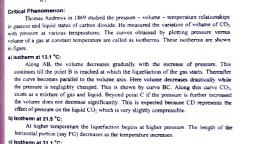
ACTIVE SITE EDUTECH, , Pressu, re, , Andrews Experiment, Andrews’ derived the third factor responsible for liquefaction of gases, from his studies on isotherms of CO2 . This was called the critical, temperature of gas., , Volume, , The isotherms of CO2 have shapes different from those implied by, Boyle’s law particularly at high pressure and low temperature., • Experimental isotherms of CO2 resemble the perfect gas isotherms, at high temperature and low pressure., • At 310C the gaseous state of CO2 transforms continuously into, the condensed state and there is no stage between the liquid and, gas. This temperature is known as critical temperature (Tc), • Critical temperature of a gas is the highest temperature at which, liquification of gas first occurs, • At critical temperature liquid phase passes into gaseous state, indistinguishable and continuously, • A gas below the critical temperature can be liquified by, applying pressure is called vapour of the substance., • A gas cannot be liquefied by the application of only pressure, without cooling it below the critical temperature., • The isotherm at critical temperature is critical isotherm., ACTIVE SITE EDUTECH - 9844532971, , 31
Page 32 :
ACTIVE SITE EDUTECH, , • At critical temperature, density of vapour phase equal to density, , of liquid phase, • Pressure required to liquefy a gas at its critical temperature is, called critical pressure. (Pc), • The volume occupied by 1 mole of the gas at critical temperature, and critical pressure is critical volume ., , ACTIVE SITE EDUTECH - 9844532971, , 32
Page 33 :
ACTIVE SITE EDUTECH, , SESSION – 8, , Liquid State, ◼ The liquid molecules are relatively close together., ◼ The intermolecular forces of attraction in case of liquids are much, larger than in gases., ◼ Unlike gases, liquids have a definite volume although no definite, shape (similarity with gases)., ◼ The molecules are in constant random motion., ◼ The average kinetic energy of molecules in a given sample is, proportional to the absolute temperature., Liquids have important properties, let’s study, Vapour Pressure: The pressure exerted by vapours when there is an, equilibrium state between the liquid phase and vapour phase is, called equilibrium vapour pressure (or) saturated vapour pressure, • Free vapourisation through out the liquid is called boiling., • At 1 atmosphere pressure boiling temparature is called normal, boiling point, • At 1 bar pressure it is called standard boiling point of the liquid., Standard boiling point of a liquid is slightly less, than the normal boiling point since 1 bar is less than 1 atm., Eg : For water, normal b.p. of is 373k and standard b.p is 372.6k, • At high altitude as the atmospheric pressure is less, the liquids boil, at low temparature., • In a closed vessel a liquid on heating doesn’t boil but its vapour, pressure increases and at a critical temparature, density of liquid, and density of vapour is going to be equal., , ACTIVE SITE EDUTECH - 9844532971, , 33
Page 34 :
ACTIVE SITE EDUTECH, , Surface Tension is the force acting along the surface of a liquid at, right angles to any line of 1 unit length ., • The energy required to increase the surface area of the liquid by, 1 unit is called surface energy., • A Surface tension is numerically and dimensionally equal to, surface energy., • Units for surface tension is kg s-2 and in SI unit is N m–1., • The liquid has lowest energy when the surface area is minimum ., Hence liquid droplets exist in spherical shape., • Surface tension decreases with increase of temperature because of, increase in kinetic energy of molecules and decrease in, intermolecular forces., • At critical temperature, surface tension becomes zero because, meniscus between liquid and vapour disappears, Viscosity: Strong intermolecular forces between the molecules of, successive layers of liquid holding them together show resistance to the, flow and create friction between the layers of fluid. The measure of, this resistance to the flow of liquid is viscosity., • The regular gradation of velocity for layers in passing from one, layer to the next layer is called Laminar flow., • A force (F) is required to maintain the flow of layers is, proportional to the area (A) of contact and velocity gradient., • Viscosity coefficient is defined as the force when velocity gradient, and area of contact each is unity., • SI unit for is N m-2S (or) Pascal., • As viscosity increases, liquids flow slowly., • Hydrogen bond and vander Waals forces cause high viscosity., • Glass is an extremely viscous liquid and properties resemble solids., ACTIVE SITE EDUTECH - 9844532971, , 34



 Learn better on this topic