Page 1 :
SOME BASIC CONCEPTS, OF CHEMISTRY, UNIT - 1
Page 2 :
Chemistry is define as that branch of science which deals, with the study of composition, structure and properties of, matter and the change which the matter undergoes under, different conditions and the laws which govern these changes.
Page 3 :
Uncertainty in measurement and significant figures., Difference between Precision and accuracy., Accuracy., If the average value of different measurement is closed to the, correct value, the measurement is said to be accurate ( the individual, measurement may not be close to each other)., Precise:, If the value of different measurements are close to each other and, hence close to their average value, the measurement is said to be precise., (The average value of different measurement may not be closed to the, correct value)., The precision depends upon the measuring device as well as the skill of, the operator.
Page 4 :
For example, suppose the actual length of the room is 10.5m., Four different persons report the result of their five measurement as follows:, Measurement(m) 1, , 2, , 3, , 4, , 5, , Average(m), , Person A, , 10.3, , 10.4, , 10.5, , 10.6, , 10.7, , 10.5, , Person B, , 10.0, , 10.1, , 10.2, , 10.3, , 10.4, , 10.2, , Person C, , 10.1, , 10.3, , 10.5, , 10.7, , 10.9, , 10.5, , Person D, , 10.0, , 10.7, , 10.9, , 11.1, , 11.3, , 10.8, , Measurement by person A is both accurate and precise., Measurement by person B has poor accuracy but good precision., Measurement by person C has poor precision but good accuracy( just by, luck)., Measurement by person D has poor accuracy and poor precision.
Page 5 :
Significant Figures, Significant figures are meaningful digits which are, known with certainty. The uncertainty is indicated by, writing the certain digits and the last uncertain digit., Thus, if we write a result as 11.2 mL, we say the 11 is, certain and 2 is uncertain and the uncertainty would be, ±1 in the last digit. Unless otherwise stated, an, uncertainty of ± 1 in the last digit is always understood.
Page 6 :
Rules for determining the number of significant figures., These are stated below:, (1) All non-zero digits are significant., For example in 285 cm, there are three significant figures and, 0.25 mL, there are two significant figures., (2) Zeros preceding to first non-zero digit are not significant. Such zero, indicates the position of decimal point., Thus, 0.03 has one significant figure and, 0.0052 has two significant figures., (3) Zeros between two non-zero digits are significant., Thus, 2.005 has four significant figures., (4) Zeros at the end or right of a number are significant provided they are, on the right side of the decimal point.
Page 7 :
., For example, 0.200 g has three significant figures., But, if otherwise, the zeros are not significant. For example, 100 has, only one significant figure., (5) Exact numbers have an infinite number of significant figures., For example, in 2 balls or 20 eggs, there are infinite significant figures, as these are exact numbers and can be represented by writing infinite, number of zeros after placing a decimal i.e., 2 = 2.000000 or 20 =, 20.000000
Page 8 :
Rounding off, • Rounding off the numbers:, 1. If the rightmost digit to be removed is more than 5, the preceding, number is increased by one., For example 1.386 If we have to remove 6, we have to round it to 1.39, 2. If the rightmost digit to be removed is less than 5, the preceding, number is not changed., For example, 4.334 if 4 is to be removed, then the result is rounded, upto 4.33., 3. If the rightmost digit to be removed is 5, then the preceding number is, not changed if it is an even number but it is increased by one if it is an, odd number. For example, if 6.35 is to be rounded by removing 5, we, have to increase 3 to 4 giving 6.4 as the result., However, if 6.25 is to be rounded off it is rounded off to 6.2.
Page 9 :
Rules for determining the numbers of significant figures in answers, involving calculations., Rule 1. The result of an addition or subtraction should be reported to the, same number od decimal places as that of the term with least number of, decimal places. The number of significant figures of different numbers, have no role to play.
Page 10 :
Law of Reciprocal proportions:, The ratio of the masses of two elements A and B which combines, separately with a fixed mass of the third element C is either the same or, some simple multiple of the ratio of the masses in which A and B, combine directly with each other., e.g., Carbon dioxide contain, 27.27% carbon, carbondi sulphide contain,, 15.79% of carbon and sulphur dioxide contain 50% of sulphur. Are these, figures in Agreement with the law of reciprocal proportion?
Page 11 :
Gay Lussac’s Law of gaseous volumes, When gases reacts together, they always do so in volumes which, bear a simple ratio to one another and to the volumes of the products, if, these are also gases, provided all measurements of volumes are done, under similar conditions of temperature and pressure.
Page 12 :
e.g., Combination between hydrogen and chlorine., One volume of hydrogen and one volume of chlorine always combine, to form two volumes of hydrochloric acids gas., H2, +, Cl2, 2HCl, 1 volume, , 1 volume, , 2 volume
Page 13 :
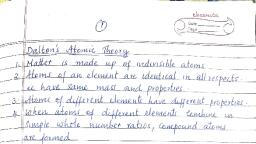
1., 2., 3., 4., 5., 6., 7., 8., , Dalton’s atomic theory:, Matter is made up of extremely small individual particles called atom., Atoms of same element are identical in all respects i.e size, shape and mass., Atoms of different elements have different masses, sizes and also possess, different chemical properties., Atoms of the same or different elements combine together to form compound, atoms ( now called as molecules)., When atoms combine with one another to form compound atoms(molecules),, they do so in simple whole number ratios, such as 1:1, 1:2, 2:3 and so on., Atoms of two elements may combine in different ratios to form more than one, compound., An atom is the smallest particle that take part in a chemical reaction., An atom can neither be created nor destroyed.
Page 14 :
Explanation of the laws of chemical combination by Dalton’s Atomic, theory:, 1. Law of conservation of mass: matter is made up of atoms ( postulate, 1) which can neither be created nor destroyed ( postulate 8). Hence,, matter can neither be created nor destroyed., 2. Law of constant Composition: It follows directly from postulate 5., 3. Law of Multiple proportions: It follows directly from postulate 6., 4. Law of reciprocal proportions: As atoms combine with each other in, simple ratio( postulate 5), therefore, all the ratios involved are simple, which may be same or some simple multiple of each other.
Page 15 :
Avogedro’s hypothesis/Law/Principle., Equal volumes of all gases under similar conditions of temperature and, pressure contain equal no of molecules., Applications of Avogedro’s Law:, (i) In the calculation of atomicity of elementary gases:, Atomicity of an elementary substance is define as the number of, atoms of the element present in one molecule of the substance, e.g., atomicity of oxygen(O2) is two while that of ozone ( O3) is three., Taking the example of oxygen, its atomicity can be calculated as, follows:, 2 volume of hydrogen combine with 1 volume of oxygen to form two, volumes of water vapours.
Page 16 :
Hydrogen, , + Oxygen, , 2 volumes, , Water vapours, , 1 volume, , 2 volumes, , Applying Avogedr’s hypothesis,, Hydrogen + Oxygen, 2n molecules, or 1 molecule, , n molecules, , ½ molecule, , Water vapours, 2n molecules, 1 molecule, , Thus, 1 molecule of water contains ½ molecule of oxygen. But 1 molecule of, water contains 1 atom of oxygen., Hence,, ½ molecule of oxygen = 1 atom of oxygen, 1 molecule of oxygen = 2 atoms of oxygen, Or, i.e. atomicity of oxygen = 2.
Page 20 :
EMPIRICAL AND MOLECULAR FORMULAE., Empirical Formula., It is the chemical formula which expresses the simplest whole number, ratio of the atoms of the various elements present in one molecule of the, compound., e.g. The empirical formula of benzene is CH, that of hydrogen peroxide is, HO and that of glucose is CH2O., Molecular Formula., It is the chemical formula which represents the true formula of its, molecule. It expresses the actual number of atoms of various elements, present in one molecule of the compound., The molecular formula of benzene is C6H6, that of hydrogen peroxide is, H2O2 and that of glucose is C6H12O6 .
Page 21 :
Relation Between Empirical and Molecular Formulae.