Page 1 :
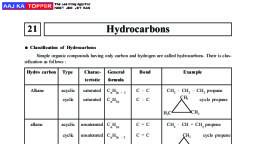
Vidyamandir Classes, , Hydrocarbons, Hydrocarbons, , Hydrocarbons, ALKANES, , Section - 1, , Hydrocarbons are the binary compounds of carbon and hydrogen only. Hydrocarbons occur in nature in, the form of coal, natural gas and petroleum. All the organic compounds (other than hydrocarbons) are, derived from hydrocarbons, by substituting hydrogen with a functional group or by adding a functional, group. Hydrocarbons are classified into two categories: Aliphatic hydrocarbons (open chains) and Cyclic, hydrocarbons (closed chains). Here, we will first study aliphatic type, which are further divided into Saturated, hydrocarbons (Alkanes) and Unsaturated hydrocarbons (Alkenes, Alkynes), and then cyclic hydrocarbons,, which are further divided into Cycloalkanes, Cycloalkenes and Aromatic Hydrocarbons., , ALKANES : [CnH2n + 2], Alkanes form a homologous series, represented by a general formula : CnH2n+2. These have a tetrahedral, structure around carbon atom or one can say that all the carbon atoms in alkanes show sp3 type of, hybridisation. The important members of alkanes are: Methane (CH4), Ethane (CH3CH3), Propane, CH3 C H CH3 , ., |, (CH3CH2CH3), n-Butane (CH3CH2CH2CH3) and its isomer, Iso-butane , , , CH3, , , Generally, alkanes are also represented as : RH, RCH3, R-R, R-R (where R and R are alkyl radical), , Preparation of Alkanes :, 1., , Reduction of Alkenes and Alkynes :, H, Ni/573 K, , 2 C H, Cn H 2n , n 2n 2, Alkane, , 2H, Pt or Ni/573 K, , 2, Cn H 2n 2 , Cn H 2n 2, , Alkane, This is known as Sabatatier-Sandern’s reaction., Note : For the reduction of alkenes, and alkynes Pd – carbon/Ethanol at 25°C (50 atm) is generally used., , CH3 2 C CH 2, , Pd C/C H OH, , 2 5 CH, , 3 2 CHCH3, , 25 C, 50 atm, , Self Study Course for IITJEE with Online Support, , Isobutane, , Section 1, , 1
Page 4 :
Vidyamandir Classes, , Hydrocarbons, , R 2CuLi R 'X , , , R R ' RCu LiX, , This is known as Corey House Synthesis, Note : (i), (ii), , R can be 1°, 2°, 3° alkyl or aromatic group., R should be 1° alkyl or 2° cycloalkyl group or even aromatic group., , Physical Properties of Alkanes :, The physical properties of alkanes such as boiling point, density and solubility depend upon the intermolecular, forces of attraction. The magnitude of these forces of attraction depend upon the surface area of contact, between adjacent molecules. Greater the surfae area, stronger are the forces of attraction., , 1., , Physical State : The normal alkanes C1 to C4 are colourless gases, C5 to C17 are colourless liquids and, from C18 onwards are colourless waxy solids., , 2., , Boiling Point : The boiling points of the unbranched alkanes show a regular increase with increasing, molecular weight. The increase is by 20 – 30°C for each –CH2 unit added to the chain. Branching of the, alkane chain, however, lowers the boiling point., , CH3CH2CH2CH2 -CH3, , n-Pentane, B.P. = 309 K, , CH3, |, CH3 C H CH 2CH3, Isopentane, B.P. = 301 K, , CH3, |, CH 3 C CH3, |, CH3, , Neopentane, B.P. = 282.5 K, , The explanation for these effects lies in the vander waals forces. With unbranched alkanes, as molecular, weight increases, so does molecular surface areas. With increasing surface area, the van der Waals forces, between molecules increase, therefore more energy is required to separate molecule from one another., Branching in the chain, on the other hand, makes a molecule more compact, reducing its surface area. As a, result, the strength of the van der waals forces operating between the molecules decreases. This results in, the lowering the boiling point.(Observe the boiling points of isomericpentanes above), , 3., , Melting point : The melting points of alkanes do not follow a very smooth gradation with the increase of, molecular size. Alkanes with even number of carbon atoms have higher melting point than the next lower and, next higher alkanes having odd number of carbon atoms., , 4, , Section 1, , Self Study Course for IITJEE with Online Support
Page 5 :
Vidyamandir Classes, , Hydrocarbons, , It is explained by the fact that alkanes with an odd number of carbon atoms have their end-carbon atoms on, the same side of the molecule and the even numbered carbon atoms alkanes have their end-carbon atoms, on the opposite sides of the molecules. Thus, alkanes with even number of carbon atoms pack closely in, such a manner as to permit greater inter molecular attraction and therefore have slightly higher melting point., , The more compact molecule, the more is the packing efficiency of a molecular solid. This results in higher, melting point. For example, neopentane when packed (in solid form) has a higher melting point as compared to n-pentane (less effective packing due to open chain structure)., Name, , Formula, , B.P. (K), , Methane, , CH4, , 111.0, , 90.5, , 0.4240, , Ethane, , CH3CH4, , 184.4, , 101.0, , 0.5462, , Propane, , CH3CH2CH3, , 230.9, , 85.3, , 0.5824, , n-Butane, , CH3(CH3)2CH3, , 272.4, , 134.6, , 0.5788, , Isobutane, , CH3 2 CH CH3, , 261.0, , 114.7, , n-Pentane, , CH3(CH2)3CH3, , 309.1, , 143.3, , Isopentane, , CH3 2 CH CH 2 CH 3, , 300.9, , 113.1, , -, , Neopentane, , CH 3 3 C CH3, , 282.5, , 256.4, , -, , Self Study Course for IITJEE with Online Support, , M.P. (K), , Density, (as liquids), , 0.6264, , Section 1, , 5
Page 6 :
Vidyamandir Classes, , Hydrocarbons, , 3., , Solubility : ‘Like dissolves like’ is the general rule of solubility. In the light of this rule, alkanes which are, predominantly non-polar are insoluble in polar solvents such as water, alcohol, etc. but are highly soluble in, non-polar solvents such as Petroleum either, Benzene, Carbon tetrachloride, etc., , 4., , Density : The density of alkanes increases with the increase in the molecular masses till the limiting value, of about 0.8 g cm3 is reached. This means that all alkanes are lighter than water., , Reaction of Alkanes :, Alkanes being saturated compounds undergo only substitution reactions, at C H bond. The hydrogen atom is, replaced by other atom(s) such as : X-(halogens), NO2 (nitro), etc., , 1., , Halogenation :, Replacement of H-atom by X-atom (X = Cl, Br, I) in presence of UV light. The substitution reaction is, explained by free radical mechanism., Cl /h, , Cl / h, , Cl / h, , Cl / h, , 2, 2, 2 CHCl , 2, CH 4 , CH3Cl , CH 2Cl2 , CCl4, 3, , The bromination is same as chlorination but it is relatively slow and high temperature favours it., The iodination is reversible reaction :, , CH4 + I2 , CH3I + HI, , Note : HI is a reducing agent, so oxidising agents, such as HIO3, HNO3, HgO are used to oxidise HI., 5HI + HIO3 , 3H2O + 3 I2, Fluorination of alkanes is too vigorous to be controlled under ordinary conditions. Further-more, fluorination brings about extensive rupture of C C and C H bonds leading to a mixture of product. Alkyl, fluorides are more conveniently prepared indirectly by heating suitable chloroalkanes with inorganic fluorides such as AsF3, SbF3, AgF, HgF2 etc. For example,, 2 CH3CH2 – F + HgCl2, 2 CH3CH 2 – Cl + Hg2F2 , , The above reaction is known as Swarts reaction., Ease of halogenation :, Reactivity of X2 :, , 3 H > 2H > 1H > CH4, F2 > Cl2 > Br2 > I2, , The reactivity decreases with the electronegativity of the halogens., Consider halogenation in Isobutane., , 6, , Section 1, , Self Study Course for IITJEE with Online Support
Page 7 :
Vidyamandir Classes, , Hydrocarbons, , Cl, |, Cl2 , h, CH3 C H CH3 , CH3 C H CH 2Cl CH3 C CH3, 25 C, |, |, |, CH3, CH 3, CH3, (63%), , (37%), , Br, |, Br2, CH3 C H CH3 , CH3 C CH 3, 127C, |, |, CH3, CH3, (99%), , The above reactions show that Bromine is less reactive toward alkanes (in general) than chlorine. But, bromine shows greater ability to identify among different types of hydrogen atom (i.e., primary, secondary, and tertiary). It gives exclusive replacement of tertiary hydrogen atom. Chlorine, on the other hand is less, selective than Bromine. Fluorine is even less selective than Chlorine and gives equal percentage of substituted, products. (We will discuss mechanism of this reaction later), Note : Laboratory chlorination of alkanes is often done with SO2Cl2 (sulphuryl chloride), instead of Cl2 and an, organic perioxide, ROOR is used as an indicator., During monchlorination, number of monochlorinated products formed are equal to number of different, types of hydrogen atoms in the alkane., , 2., , Nitration :, Lower members do not react with conc. HNO3 at ordinary temperatures but long chain members on, heating with HNO3 yield nitro-alkanes., 400C, , C6H13 H HONO2 C6H13 NO 2 H 2O, (vapour), , However, when a mixture of vapour of an alkane and nitric acid is heated at 400 - 450°C, nitroalkane is, formed readily. By this process lower as well as higher alkanes can be converted into nitroalkanes., 450C, , CH 3 H HONO 2 CH3 NO2 H 2O, , (vapour), , In alkanes having two or more carbon atoms, there is always a possibility that the C - C bonds may break, at high temperature and a mixture of nitro alkanes is formed., HNO, , 3 CH CH CH NO CH C H CH CH CH NO CH NO, CH 3CH 2CH3 , 3, 2, 2, 2, 3, 3, 3, 2, 2, 3, 2, , 400 C, |, NO2, , Self Study Course for IITJEE with Online Support, , Section 1, , 7
Page 8 :
Vidyamandir Classes, , Hydrocarbons, , 3., , Sulphonation :, Lower alkanes do not undergo sulphonation but higher member (from hexane onwards) are sulphonated, slowly when treated with fuming sulphuric acid at about 400°C., C6H13 H HOSO3H, , SO, , 3, , , C6H13SO3H, , , , H 2O, , Hexane sulphonic acid, , However lower members such as Propane, Butane, Pentane, etc., react with SO3 in vapour phase to form, Sulphonic acids., , 4., , Cracking : (Pyrolysis), The decomposition of a compound by heat is called pyrolysis. The alkanes, on heating under high temperature in absence of air, are broken down into lower alkanes, alkenes and hydrogen during cracking of, alkanes,either rupture of carbon-hydrogen bonds or rupture of carbon-carbon bonds take place resulting in, the formation of mixture of lower alkanes, alkenes and hydrogen. The rupture of C – H bonds is catalysed, by oxide of Chromium, Vandium, Molybednum, etc., and the rupture of C – C bonds is catalysed by Silica,, Alumina, Zinc oxide, etc., 500C, , C2 H 6 , CH 2 CH 2 H 2, Cr O, 2 3, , 500C, , C3H8 , CH3CH CH 2 H 2, Cr O, 2 3, , 500C, , C3H8 , CH 2 CH 2 CH 4, Al2 O3, , 5., , Reaction with Steam :, Ni, , CH 4 H 2O , CO 3H 2, 1273 K, , 6., , Combustion :, (a), , Complete Combustion :, CH4 + 2O2 , CO2 + 2H2O, 3n 1 , CnH2n + 2 + , nCO2 + (n + 1) H2O + heat, O 2 , 2 , , Note : Enthalpy of combustion increases with increase in number of carbon atoms in alkane. For isomeric alkane,, enthalpy of combustion decreases with increase in branching, , 8, , Section 1, , Self Study Course for IITJEE with Online Support
Page 9 :
Vidyamandir Classes, (b), , Hydrocarbons, , Incomplete Combustion : If the combustion of alkanes is carried out in limited supply of air or, oxygen, CO is produced along with unburnt carbon in the form of carbon black or soot., 2CH4 3O2 , 2CO 4 H2O, (limited), , CH 4 O 2 , , , C, , , , (limited), , Carbonblack, , H 2O, , Carbon black is used in the preparation of black inks, paints, polishes etc., (c), , Catalyst Oxidation : Different prodcuts are formed under different conditions., (i), , When a mixture of methane and oxygen (9 : 1 by volume) at a pressure of 100 atm. is passed, through a copper tube at 573 K, methanol is formed., 100 atm. 573 K, , 2 CH 4 O2 , 2 CH3OH, Cu tube, , Methane, , (ii), , Methanol, , When a mixture of methane and oxygen under pressure is passed over heated molybdenum, oxide, it is oxidised to methanal., Mo O, , 2 3 HCHO H O, CH 4 O2 , 2, , pressure, , Methane, , Methanal, , (iii) Higher alkanes on oxidation in presence of silver oxide give carboxylic acids., Ag O, , 2, 2 R CH3 3O 2 , 2 RCOOH 2 H 2O, , Alkane, , Carboxylic acid, , (iv) In presence of oxidising agents such as KMnO4, K2Cr2O7 etc., CH3, CH3, |, |, alk ., CH 3 C H (O) CH3 C OH, KMnO4, |, |, CH3, CH3, Isobutane, , 7., , tert-Butyl alcohol, , Aromatisation :, Cr O Al O, , 2 3, 2 3 C H (Benzene) 4 H, CH3 CH 2 4 CH3 , 6 6, 2, , 600 C /15atm, , Self Study Course for IITJEE with Online Support, , Section 1, , 9
Page 13 :
Vidyamandir Classes, , Hydrocarbons, , 500C, , CH3CH 2CH3 CH3CH CH 2 H 2, Cr2O3, , 6., , Partial Hydrogenation of Alkynes :, The hydrogenation of alkynes to an alkene is brought about by the use of special catalysts. This is an, example of “Stereospecific reaction’’., , Note : Reaction that produce a particular stereoismers of the product is called as steroselective reaction., (a), , Using Lindlar catalyst (Pd/CaCO3 or Pd/BaSO4) in quinoline to give a cis alkene., , This is also called as syn addition, as two H-atoms are added to the same side., This reaction can also be achieved by using Ni2B (called as P - 2 catalyst), , (b), , Using Lithium (or Sodium) in NH3 (or in ethyl amine) at low temperature, gives trans alkene., , This is also called as anti addition, as two H-atoms are added to the opposite side of the bond., , Stability of Alkenes :, The reactivity of different types of alkenes in decreasing order is as follows : (As per heat of hydorgenation), CH 2 CH 2 R CH CH 2 R CH CH R R 2 C CH 2 R 2 C CHR R 2 C CR 2, The heat of hydrogenation is always exothermic and experimentally it has been found that :, , Self Study Course for IITJEE with Online Support, , Section 2, , 13
Page 14 :
Vidyamandir Classes, , Hydrocarbons, , Stability of alkene , , 1, (i.e., higher is the heat of hydrogenation, higher is, Heat of hydrogenation reactivity and lower is the stability of an alkene), , Thus stability of alkenes in decreasing order is as follows :, , R 2 C CR 2 R 2 C CHR R 2 C CH 2 RCH CHR RCH CH 2 CH 2 CH 2, trans > cis, , Physical Properties of Alkenes :, 1., , Physical state and smell : The first three members of the family, i.e., Ethene, Propene and Butene, are colourless gases. The next eleven members (C5 C15) are liquids while the higher ones are solids., Except Ethene which has a pleasant smell, all other alkenes are odourless., , 2., , Melting points : The melting points of alkenes do not show regular gradation. However, the melting, points of alkenes are higher than those of the corresponding alkenes., Amongst isomer of alkenes, trans-alkenes have higher melting points than their corresponding cisisomers., , 3., , Boiling points : The boiling points of alkenes, like alkanes, show a regular gradation with the increase, in the number of carbon atoms. Amongst the alkenes which show geometrical isomerism, cis-alkenes, have higher boiling points than the corresponding trans-isomers. This is due to the reason that cisalkenes being polar have stronger dipole-dipole interactions while trans-alkenes being non-polar (or, weakly polar) have weak induced dipole interactions., , 4., , Solubility : Alkenes like alkanes being either non-polar or weakly polar molecules are practically, insoluble in water and other polar solvents but are quite soluble in non-polar solvents such as benzene,, CCl4, petroleum ether, etc. and weakly polar solvents such as ether., , 5., , Density : The densities of alkenes, like those of alkanes, increase with the increase in molecular mass, till they have a limiting value of 0.89 g cm3. Thus, all alkenes are lighter than water., Compound, Ethene, Propene, 1-Butene, cis-2-Butene, trans-2-Butene, 1-Pentene, 2-Methyl-1-butene, , 14, , Section 2, , M.P. (°C), –169, –185, –139, –106, –165, –138, , B.P. (°C), –104, –47, –6.3, 3.7, 0.9, 30, 31, , Density (g/mL), 0.384, 0.514, 0.595, 0.621, 0.604, 0.641, 0.650, , Self Study Course for IITJEE with Online Support
Page 15 :
Vidyamandir Classes, , Hydrocarbons, , Reaction of Alkenes :, Alkenes undergo mainly addition reactions., , An addition that puts the part of AB on the same face of the reactant is called as syn addition., , The opposite of syn-addition is an anti-addition. An anti-addition puts the parts of AB on opposite faces, of reactants., , The addition reaction of alkenes are usually electrophilic addition., Electrophile (E+) : An electron loving species looking for electron rich regions such as localised, pi electron in alkenes and lakynees. Important Electrophiles :, H , CI , Br , CH 3 etc., , Nucleophile (Nu) : A nucleus loving (electron rich) species looking to attack the electrophilic sites., Important Nucleophiles : X , OH , OR , CH 3 etc., , Self Study Course for IITJEE with Online Support, , Section 2, , 15
Page 16 :
Vidyamandir Classes, , Hydrocarbons, , 1., , Addition of hydrogen halides (HX) :, The addition of HX to alkene is an electrophilic addition reaction. The reactivity order follows : HI > HBr, > HCl. The addition follows Markonikov’s rule. It states that in the addition of HX to an alkene, the, hydrogen atom adds to the carbon atom of the double bond that has the greater number of hydrogen atoms,, or the negative part of reagent adds to carbon having less number of hydrogen. The following examples, illustrate Markonikov’s addition., (a), , (b), , CH 2 CH CH3 HI, , , , , CH3 C H CH3 , |, I, 2 - Iodopropane Major , , CH 3 CH 2 CH 2 I, 1 - Iodopropane Minor , , When 2-Methylpropene reacts with HI, the major product is tert. butyl iodide., CH3, CH3, |, |, CH3 C C HI , CH3 C C CH3 C H C I, |, |, CH3, I, Major, , Minor, , Anti Markonikov’s addition : When addition of HBr takes place in presence of perioxides (ROO, R or benzoyl peroxide), addition occurs in an anti-markonikov’s manner, i.e., Br is added to the carbon, having large number of H-atom., ROOR, , CH 3CH CH 2 HBr , CH3CH 2CH 2Br, In presence of peroxides, free radical addition occurs in an anti-Markonikov’s fashion unlike the electrophillic, addition in above case (i.e., Markonikov’s addition)., , Note : (i), , (ii), , 16, , Addition of HX in cycloalkenes also follows Markonikov’s addition., , Addition of HCl and HI in presence of perioxide follows Markonikov’s rule., , Section 2, , Self Study Course for IITJEE with Online Support
Page 18 :
Vidyamandir Classes, , Hydrocarbons, , Note : (i), , (ii), , The addition of Br2 to cycloalkenes also follows anti-addition., , The addition of halogens to alkene is an anti-addition and provides an illustration for a stereoselective, and stereospecific reaction. For example, cyclohexene gives trans-1, 2-Dibromocyclohexane, (geometric isomer) is an example of stereoselective reaction. Consider addition of Br2 to cis and, trans-2- Butenes, which is an example of stereospecific reaction as the reactant (2-Butene) also, shows stereochemistry)., , Note : The details of reaction mechanisms of all the addition reactions will be discuss later in the Chapter “Organic, Concepts”., , The above reaction, it is visulised as follows and remember the nature of product(s) : (Refer to the next, page), , 18, , Section 2, , Self Study Course for IITJEE with Online Support
Page 19 :
Vidyamandir Classes, , 5., , Hydrocarbons, , Addition of halogen in aqueous solution :, When halogens are added in presence of H2O / THF (tetrahydrofuran) or NBS (N-bromo succinimide),, halohydrins are formed., OH, |, |, | |, THF, C C X 2 H 2O , C C, |, Alkene, X, Halohydrins, , The above reaction follows Markovnikov’s rule. It is an anti-addition reaction., , Note : (i), , (ii), , The cycloalkenes also reacts with aqueous Br2 to give anti-addition products., , In case of unsymmetrical alkene, halogen is added to the carbon atom with greater number of Hatom, (i.e., Markonikov’s addition)., , OH, |, H 2O or THF, CH 3 C CH 2 Br2 , CH3 C C H 2, |, | |, CH3, H 3C Br, Self Study Course for IITJEE with Online Support, , Section 2, , 19
Page 20 :
Vidyamandir Classes, , Hydrocarbons, , 6., , Oxymercuration - Demercuration :, An important method of formation of alcohols from alkenes. It occurs in two steps., (i), , Alkenes react with mercuric acetate Hg (CH3COO)2 or represented as, Hg (OAc)2 in a mixture of, THF and water to give a mercury compound., O, O, |, |, ||, |, |, ||, THF/ H2 O, C C H 2O Hg(O C CH3 ) 2 , C C CH3 C OH, |, |, OH Hg OAc, , This step is known as Oxymercuration., (ii), , The mercury compound is reduced to alcohol with sodium borohydride., , |, |, , NaBH 4 , OH, C C , , , |, |, HO Hg OAc, , |, |, C C Hg CH3 COO, |, |, HO H, Alcohol, , The above reaction occurs in accordance with Markonikov’s addition. The ‘H’ becomes attached, to the carbon atom of the double bond with greater number of hydrogen atom., H H, H H, |, |, |, |, 1. Hg OAc /THF, H 2O, 2, R C C H , R, , C, , C, H, , 2. NaBH 4 , OH, |, |, OH H, 2 alcohol, , Note : Observe that in the final product, OH comes from H 2O and H comes from NaBH 4 / OH ., , 7., , Hydroboration - Oxidation :, Hydrocration-oxidation serves as an important method for synthesis of alcohol 1 & 2 . It can be represented as :, , 20, , Section 2, , Self Study Course for IITJEE with Online Support
Page 21 :
Vidyamandir Classes, , Hydrocarbons, H, | |, |, C C H B H, | |, , Alkene, , Note : (i), , , , , Boron hydride, , | |, C C, | |, H B H, |, H, Organoborane, , The addition of boron hydride is syn-addition., It is generally carried out by BH3 (boron hydride) B2H6 (diborane) in THF., BH / THF, , 3, 3CH 2 CH 2 , (C2 H5 )3 B, Triethyl borane, BH /THF, , CH CH CH, , CH CH CH, , 3, 3, 2 (n Pr) BH , 3, 2 (n Pr) B, CH 3CH CH 2 , (n Pr) BH 2 , 2, 3, , (ii), , In each addition, the boron atom becomes attached to the less substituted carbon atom of double, bond and H is transferred from boron atom to the other carbon atom of double bond. Thus it, follows Anti-Markonikoff’s addition., The organoboranes formed are oxidised and hydrolysed to alcohols by the addition of hydrogen, peroxides in an aqueous base., H O, , 2 2 3ROH + Na BO, R 3B , 3, 3, , NaOH,25° C, , H O, , 2 2 3PrOH + Na BO, (n Pr)3 B , 3, 3, , NaOH, 25°C, , Note that alcohol formed is a primary alcohol (unlike that in Markonikov’s addition), Consisder hydrobration and oxidation in 1-Methyl cyclopentene. It show syn-addition and anti-Markonikov’s, addition of H2O to alkene., Note : Observe that in the final product, OH comes from H 2O 2 / OH and H comes from BH 3 ., , Note : Compare the alcohols formed above with those formed by Oxymercuration-Demercuration., Self Study Course for IITJEE with Online Support, , Section 2, , 21
Page 26 :
Hydrocarbons, , Vidyamandir Classes, , Another intersting aspect of this reaction is that it also occurs in alkyl benzens., , 14. Polymerisation :, High Temp, , (i), , n(CH 2 CH 2 ) , (CH 2 CH 2 )n (Polyethene), High pressure, , (ii), , Polymerization of substituted ethenes : A number of polymers can be obtained by using, substituted ethenes as monomers in place of ethene. For example,, CH 2 C H Polymerisation CH 2 C H , , | , |, n, , , , , , Cl, Cl, , , , n, , , , Chloroethene, , Polyvinyl chloride PVC, , , , Vinyl chloride , CH 2 C H Polymerisation CH 2 C H , , , |, |, n, , , , , , C, H, C, H, 6 5, 6 5 n, , , Styrene, , Polystrene, , CH 2 C H Polymerisation CH 2 C H , , | , |, n, , , , , CN , CN n, , , Acrylontrile or, , Polyacrylontrile(PAN), , vinyl cyanide, , Polymerisation, , n CF2 CF2 , , Tetrafluoroethene, , CF2 CF2 n, Polytetrafluoroethene, , PTFE, Teflon , Polyvinyl chloride (PVC) is used for making plastic bottles, syringes, etc. Polyacrylontrile is used for making, Orlon and Acrilan fibres used for making clothes, carpets and blankets., 26, , Section 2, , Self Study Course for IITJEE with Online Support
Page 28 :
Vidyamandir Classes, , Hydrocarbons, , Illustration - 3, , Give the stucture of the major organic products form 3-Ethy-l-2-pentene form under, each of the following reaction conditions :, (A), , HBr in the presence of peroxide, , (B), , Br2/H2O, , (C), , Hg(OAc)2/THF/H2O, NaBH4/OH–, , SOLUTION :, , Illustration - 4, A hydrocarbon X, C6H12 decolorizes bromine water and is oxidized to an acid Y by hot, acidic potassium permanganate solution. The acid Y can be resolved into two forms. Identify X and Y., SOLUTION :, , X is terminal alkene as it gives only Y., , 28, , Section 2, , Self Study Course for IITJEE with Online Support
Page 29 :
Vidyamandir Classes, , Hydrocarbons, , Visualise the structure of Y (having a chiral centre) :, , , , Illustration - 5, , O, , X is C2H5 C H CH CH 2 , C2H5 CH COOH, |, |, CH3, CH3, , Y, , Identify A, B, C, D. . . . ., , SOLUTION :, , Illustration - 6, , Identify the products, , SOLUTION :, , Note that the dialkylated site in alkene give the same producer (Ketone) on oxidation and ozonolysis., Self Study Course for IITJEE with Online Support, , Section 2, , 29, , NOW ATTEMPT IN-CHAPTER EXERCISE-B BEFORE PROCEEDING AHEAD IN THIS EBOOK
Page 31 :
Vidyamandir Classes, , 4., , Hydrocarbons, , Kolbe’s electrolytic reaction :, Acetylene can be prepared by electrolysis of a concentrated solution of sodium or potassium salt of Maleic, acid or Fumaric acid. Thus,, , This reaction is called Kolbe’s electrolytic reaction., , Note : On electrolysis of aqueous solution of Potassium succinate, we get Ethylene (C2H4) as a product at anode., , 5., , From Graphite :, Electric arc, , 2C s H 2 g , CH CH, , 1000 C, , 6., , (Only acetylene can be formed), , From calcium carbide :, C2H2 + Ca (OH)2, CaC2 + 2H2O , , Self Study Course for IITJEE with Online Support, , (Only acetylene can be formed), , Section 3, , 31
Page 32 :
Vidyamandir Classes, , Hydrocarbons, , Note : (i), , Calcium carbide is formed as follows :, 2000C, , CaCO3 , CaO CO2, , , 2500C, , CaO C , CaC2 CO , (ii), (iii), , 7., , Carbides of Na, K, Ca, Mg, Ba are considered to be ionic and give acetylene with H2O., However, carbides of Cu and Ag are covalent and hence do not give acetylene with H2O., , Higher alkynes from Lower alkynes :, NaNH , liq. NH, , R 'X, , 2, 3 CH CNa , CH CH , CH C R ', excess, , (Terminal alkynes), , 1.0 eq., , NaNH 2 , liq. NH3, R 'X, CH CH , Na C C Na , R ' C C R ' (Non-terminal Alkynes), 2.0 eq., , excess, , NaNH , liq. NH, , , , RX, 2, 3 R C C Na , R C CH , R C C R (Non-terminal alkynes), 1.0 eq, , Note : R’ can only be 1o and 2o alkyl or cycloalkyl groups only., , Physical Properties of Alkynes:, 1., , Physical state : The first three members of this family (Ethyne, Propyne and Butyne) are colourless, gases, the next eight are liquids while the higher ones are solids., , 2., , Smell : All the alkynes are odourless. However acetylene has garlic smell due to the presence of, phosphine as impurity., , 3., , Melting and boiling points : The boiling points and melting points of alkynes are slightly higher, than those of the corresponding alkenes and alkanes. This is probably due to the reason that, because of the presence of a triple bond, alkynes have linear structures and hence their molecules, can be more closely packed in the crystal lattice as compared to those of corresponding alkenes, and alkanes., Hydrocarbon, , 33, , Ethane, , Ethene, , Ethyne, , M.P. (K), , 101, , 104, , 191, , B.P. (K), , 184.5, , 171, , 198, , Section 3, , Self Study Course for IITJEE with Online Support
Page 33 :
Vidyamandir Classes, , 4., , Hydrocarbons, , Solubility : Alkynes like alkanes and alkenes being non-polar are insoluble in water but readily, dissolve in organic solvents such as petroleum ether, benzene, carbon tetrachloride etc., , 5., , Density : Densities of alkynes increase as the molecular size increases. However, they are all, lighter than water since their densities lie in the range 0.69 0.77 g/cm3., , Reactions of Alkynes :, 1., , Electrophillic Addition Reactions :, X, |, , Y, X Y, |, | |, XY, XY, C C , C C , C C, | |, X Y, (a), , Addition of Hydrogen :, H, , H, , 2 CH CH , 2 CH CH, CH CH , 2, 2, 3, 3, Pt /573K, , Pt /573K, , Read hydrogenation of alkynes in the preparation of alkenes., (b), , Addition of Halogens : (X = Cl, Br, I), Cl Cl, |, |, 2Cl2, BaCl2 , , CH CH , H C CH , CCl 2 CHCl, solvent, |, Westrosol, |, Cl Cl, Westron, , (c), , Addition of Halogen acids : (HX), HBr, CH CH HBr , CH 2 CHBr , CH3 CHBr2 (Markonikov’s rule ), , (d), , Addition of Hypohalous acids(HOX) :, , Self Study Course for IITJEE with Online Support, , Section 3, , 33
Page 34 :
Vidyamandir Classes, , Hydrocarbons, Similarly,, , (e), , Addition of water (H2O) is presence of acid :, , Note : The addition of water to alkynes also follows Markonikow’s rule. The hydrogen atom become attached to, the carbon atom with the greater number of hydrogen atoms. Therefore, when higher terminal alkynes are, hydrated, ketones, rather than aldehydes are formed., However, if the unsymmetrical alkyne is nonterminal, a mixture of two isomeric ketones is obtained, in which the methyl ketone predominates. In case of benzene ring, phenyl ketones is major product ., , O, O, ||, ||, HgSO4 / H2 SO4, CH3CH 2CH 2 C CH3 CH3CH 2 C CH3CH3, CH3CH 2 C C CH3 , 333 K, , 2 - Pentanone (Major), , 2 - Pentanone (Minor), , , , (f), , Addition of HCN :, CH2 = CHCN, CH CHHCN , , (Vinyl cyanide also known as acrylonitrile), , Note : Acrylonitrile is used in manufacture of BuNa-S rubber and Orlon fibre., (g), , 34, , Addition of Acetic acid (CH3COOH) :, , Section 3, , Self Study Course for IITJEE with Online Support
Page 36 :
Vidyamandir Classes, , Hydrocarbons, , Note : This reaction shows the acidity of terminal alkynes and serves as a test for terminal alkynes., CuCl, , 2 Cu C C Cu, CH CH , amm., , Copper Acetylide (Red ppt.), , 5., , Oxidation of Alkynes :, (a), , Oxidation in Neutral KMnO4 :, KMnO , H O, , 4 2 CH C C CH, CH 3 C C CH3 2 (O) , 3, 3, 298 303 K, || ||, But-2-yne, O O, , Butan-2, 3-dione , , (b) Oxidation with cold dilute alkaline KMnO4 :, Alkynes are readily oxidised by cold dilute alkaline KMnO4 solution to give dicarbonyl compounds., In case of terminal alkynes, CH part is oxidised to – COOH group while in case of non-terminal, alkynes, CR part is oxidised to R C O group, For example :, |, , O, ||, 1. NaOH, KMnO 4, CH 3 C CH 3(O) , CH3 C COOH, 298 303 K, , Propyne, , 2. H, , , , 2-Oxopropanoic acid, , O O, || ||, NaOH, KMnO 4, CH 3 C C CH 3 , CH3 C C CH3, 298 303 K, , Acetylene, however, under these conditions gives oxalic acid probably due to further oxidation of, the initially formed glyoxal., KMnO , NaOH, , 2(O), , 4, HC CH 2(O) , HOOC COOH, OHC CHO , Acetylene, , 298 303 K, , Glyoxal, , H, , , , Oxalic acid, , During this reaction, the pink colour of the KMnO4 solution is discharged and a brown precipitate, of manganese dioxide is obtained. This reaction is, therefore, used as a test for unsaturation under, the name Baeyer’s test., , (c), , Oxidation by acidic KMnO4 (hot) :, KMnO, , 4 R COOH R 'COOH, R C C R ' , , H , heat, , Not that it is similar to the oxidation of alkenes., , 36, , Section 3, , Self Study Course for IITJEE with Online Support
Page 37 :
Vidyamandir Classes, , 6., , Hydrocarbons, , Ozonolysis :, (a), , For non-terminal alkynes :, O O, || ||, 1. O3, R C C R ' , R C C R ', 2. Zn, H2O, , Note : If, Zn or Pb is not used, then the product is mixture of acids., O, O, ||, ||, O3, R C C R , R C OH R C OH, mixture of acids, , (b), , For terminal alkynes :, O, , 3, H C CH , OHC CHO, Zn / H 2 O, , O, ||, O3, R C CH R C CHO, Zn /H 2 O, , 7., , Glyoxal , , alkyl glyoxal , , Polymerization Reactions of Alkynes :, Like alkenes, alkynes also undergo polymerization reactions. For example,, (a) When acetylene is passed through red hot iron tube, it rimerises to give benzene., , (b), , In presence of nickel cyanide as catalyst and under high pressure, four moelcules of acetyrene, combine to form a tetramer called cycloocta-1, 3, 5, 7-tetraene., , (c), , However, in presence of CuCl/NH4Cl, acetylene first gives vinylacetylene and then divinylacetylene., Thus,, , Self Study Course for IITJEE with Online Support, , Section 3, , 37
Page 38 :
Vidyamandir Classes, , Hydrocarbons, , CuCl/ NH Cl, , HC CH, , 4 H C C CH CH , 2 HC CH , H 2C CH C C CH CH 2, 2, CuCl/ NH 4 Cl, , Acetylene, , Vinylacetylene, , Divinylacetylene, , Vinylacetylene is widely used in the manufacture of chloroprene which is the starting material for the, synthetic rubber neoprene., Cl, |, Markonikov 's, CH 2 CH C CH HCl , CH 2 CH C CH 2, Vinylacetylene, , (d), , addition, one mole across C C, , Chloroprene, , Under suitable conditions, polymerization of acetylene produces the linear polymer polyacetylene., It is a high molecular weight conjuated polyene containing the repeating unit (CH = CH CH =, CH)n. Under proper conditions, this material conducts electricity. Since polyacetylenes have much, higher conductance than metal conductors, these can be used to prepare lighter and cheapter batteries., , Acidic character of Alkynes :, (a), , Formation of alkali metal acetylides :, 475C, , 2 HC CH 2Na , 2HC C Na H2, Ethylne, (Acetylene), , R C CH, , Sodium acetylide, , Liq. NH, , 3, NaNH 2 , R C C Na NH3, 196 K, , (A terminalalkyne), , (An acetylide), , During these reactions, the acetylenic hydrogen is removed as a proton to form stable carbanions (acetylide, ions). Sodium acetylide is decomposed by water regenerating acetylene. This shows that water is a stronger, acid than acetylene and thus displaces acetylene from sodium acetylide., HC C Na H 2O , HC CH NaOH, Acetylene, , (b), , Formation of heavy metal acetylides :, , , CH CH 2 Ag NH3 2 OH , AgC CAg 2 H 2O 4NH3, Ethylne, , Tollen's reagent, , Silver acetylide, (White ppt.), , 38, , Section 3, , Self Study Course for IITJEE with Online Support
Page 40 :
Vidyamandir Classes, , Hydrocarbons, , Illustration - 8, (a), , Identify A, B, C . . . . . . . . ., 1.NaNH, , H, , 2.EtBr, , Pd BaSO 4, quinoline, , O, , 2 A , 2 B , 3 C D, Me C CH , Zn / H 2 O, , (b), , 1. NaNH (2.0eqv.), , H, , Liq.Li, , Br /CCl, , 2,, 2, 2, 4C, HC CH , A , B , , (c), , 2. EtBr (2.0eqv.), , NH3, , SOLUTION :, , (a), , (b), , (c), , NOW ATTEMPT IN-CHAPTER EXERCISE-C BEFORE PROCEEDING AHEAD IN THIS EBOOK, , 40, , Section 3, , Self Study Course for IITJEE with Online Support
Page 41 :
Vidyamandir Classes, , Hydrocarbons, , CYCLOALKANES AND CYCLOALKENES, , Section - 4, , These are closed chain hydrocarbons having CnH2n as general formula. These are isomeric to alkenes., , Cyclo propane, , or, , C3H6, , or, , Cyclo butane, , or, , C4H8, , or, , Cyclo pentane, , or, , C5H10, , or, , Cyclo hexane, , or, , C6H12, , or, , The bond angles in lower members, i.e., in cyclopropane and cyclobutane are quite different from normal, tetrahedral bond angle of 109.5°. Hence these are unstable as compared to higher member such as, cyclopentane and cyclohexane which have bond angles nearer to tetrahedral bond angles. The two small, cycloalkanes are said to have a ring strain due to bond deformation. This is referred to as Baeyer strain, theory. Due to this strain, cyclopropane and cyclobutane are highly reactive and tend to open their rings., , Cycloalkenes : These are isomeric to alkynes and alkadienes. Some important cycloalkenes are :, Cyclo propene, , or, , C3H4, , or, , Self Study Course for IITJEE with Online Support, , Section 4, , 41
Page 43 :
Vidyamandir Classes, , Hydrocarbons, , Note that the addition of : CH 2 (carbene) is sterospecific as 2-butene exist in cis and trans forms., , 3., , Simmon - Smith Reaction :, It is another method to form cyclopropane and its derivatives. Instead of diazomethane, di-iodomethane,, CH2I2 with Zn-Cu alloy in diethyl ether is used. The rest of the reaction is same as above., , 4., , Heating calcium/barium salts of dicarboxylic acids :, By heating barium salts of discarboxylic acids, cyclic ketones are formed, which on Clemmensen’s reduction (Zn-Hg/HCl) give cyclopentane, cyclohexanes and other higher derivatives., , Self Study Course for IITJEE with Online Support, , Section 4, , 43
Page 44 :
Vidyamandir Classes, , Hydrocarbons, , 5., , Hydrogenation of benzene :, , 6., , Diel - Alder Reaction :, It is an important reaction of conjugated dienes with double bonded compounds to form unsaturated cyclic, compounds. Let us take 1, 3Butadiene as conjugated diene and consider its reaction with some unsaturated, compounds such as Ethene and Vinyl alcohol. The unsaturated compounds are called as dienophiles. This, reaction proceed beacuse of formation of six membered cyclic transition state., , Note : (i), , (ii), , 44, , ‘G’ is preferably an electron withdrawing group (electronegative in nature) such as OH, NH2, , CN, NO2, etc., Each of the product can be hydrogenated to give a saturated compound., , Section 4, , Self Study Course for IITJEE with Online Support
Page 45 :
Vidyamandir Classes, , Hydrocarbons, , Reaction of cycloalkanes :, 1. Ring opening :, , The ring of 5 carbons being stable does not open after reaction with hydrogen., 2., , Chlorination :, , 3. Oxidation :, , Note : Cyclobutane is opened in the presence of hydrogen and Ni. At ordinary temperatures, cyclobutanes resists, the action of halogens and hydrogen halides., , Reaction of Cycloalkenes :, The cycloalkenes show the reaction of alkenes. (Refer to the reaction of Alkenes). For a quick review of, the reactions, please go through the following page carefully. It shows all the typical reaction of alkenes, taking 1 - Methylcyclopentene as the substrate., , Self Study Course for IITJEE with Online Support, , Section 4, , 45
Page 46 :
Hydrocarbons, , 46, , Section 4, , Vidyamandir Classes, , Self Study Course for IITJEE with Online Support
Page 48 :
Vidyamandir Classes, , Hydrocarbons, , 2., , From isolated diols :, H SO, , 2 4 CH CH CH CH CH CH C CH, CH3 C H CH 2 C H 2 , 2, 2, 3, 2, T 170C, |, |, OH, OH, 1, 3 - Butadiene (Major), 1, 2 - Butadiene (Minor), H SO, , 2 4 CH CH CH CH CH CH CH CH CH CH, CH3 C H CH 2 CH 2 C H 2 , 3, 2, 2, 2, 2, T 170C, |, |, OH, OH, 1, 3 - Pentadiene (Major), 1, 4 - Pentadiene (Minor), , Reactions of Conjugate Dienes :, For the discussion of reactions of conjugated dienes we shall take 1, 3-Butadiene as an example., , 1., , Electrophillic Addition :, 1, 3-Butadiene when reacts with HCl show unusual behaviour to give mixture of two products :, 3-Chloro-1-butene (1, 2-addition product) and 1-Chloro-2-butene (1, 4-addition product), (a), , The formation of 1, 4-addition product is interesting., HCl, , CH 2 CH CH CH 2 , CH3 C H CH CH 2 CH3 CH CH CH 2Cl, , 25 C, |, Cl, (1, 2 - addition), , (1, 4 - addition), , Note : Usually 1, 4-addition product is major., (b), , Addition of HBr to 1, 3-Butadiene takes place differently at different temperatures to give 1, 2addition and 1, 4-addition products as follows :, , CH2 = CH – CH = CH2 + HBr , , (i), , At – 80°C (Low temperature) :, , CH3 C H CH CH 2 CH3 CH CH CH 2 Br, |, Br, (1, 2 - addition)(80%), , 48, , Section 5, , (1, 4 - addition) (20%), , Self Study Course for IITJEE with Online Support
Page 49 :
Vidyamandir Classes, (ii), , Hydrocarbons, , A 40°C (Near room temperature and above) :, , CH3 C H CH CH 2 CH3 CH CH CH 2 Br, |, Br, (1, 2 - addition)(20%), , (1, 4 - addition) (80%), , Note : At high temperatures, in case of HBr, 1, 2-addition product rearranges to give 1, 4-addition product., (c), , Addition of Br2 to 1, 3Butadiene also gives a mixture of 1, 2-addition and 1, 4-addition products., (i), , CH 2 CH CH CH 2, , Br2, , , 15C, , 1, 3 - Butadiene , (ii), , 2., , C H 2 C H CH CH 2 C H 2 CH CH CH 2 Br, |, |, |, Br, Br, Br, (1, 2 -addition) (54%), , (1,4 - addition) (46%), , Br, , 2, CH 2 CH CH CH 2 , 1, 4 addition is major, T 27 C, , Free radical addition :, In presence of perioxides, both 1, 2-addition product and 1, 4-addition products are formed. Consider, addition of BrCCl3 in presence of perioxide., , CH2 = CH – CH = CH2 + BrCCl3 , Cl3C CH 2 C H CH CH 2 Cl3C CH 2 CH CH CH 2 Br, |, Br, (1, 2 -addition), , (1, 4 - addition), , Note : Temperature dependency of products is similar to that HBr addition. Also refer to Diel - Alder reactions, (diense with alkenes) in cycloalkenes., , 3., , Reduction :, Catalytic hydrogenation of conjugated dienes in presence of H2/ Li gives a mixture of 1, 2-addition and 1, 4addition product with the 1, 4-addition products being major., , H, H, H, H, |, |, |, |, H 2 / Li, CH 2 CH CH CH 2 , CH 2 C H CH CH 2 CH 2 CH CH CH 2, Buta - 1,3 - diene, , But - 1 - ene (Minor), , But - 2 - ene (Major), , However, the chemical reduction of 1, 3-Butadiene with sodium in alcohol gives mainly the 1, 4-addition, product, i.e., But-2-ene., Self Study Course for IITJEE with Online Support, , Section 5, , 49
Page 50 :
Vidyamandir Classes, , Hydrocarbons, Na /alcohol, , CH 2 CH CH CH 2 , CH3 CH CH CH3, 1, 3-Butadiene, , But-2-ene, , Under these conditions the isolated double bonds are not reduced. This suggests that dienes are much more, reactive than simple alkenes., , 4., , Polymerization :, Peroxides, , n CH 2 CH CH CH 2 CH 2 CH CH CH 2 n, Buta-1, 3-diene, , Polybutadiene, , Since each repeating unit in polybutadiene contains a double bond, it may have either cis or trans-configuration. Actually the polybutadiene polymer obtained by free-radical polymerisation has trans-configuration., CH3, , , Peroxides, , n, |, CH C CH CH , , 2, 2, 2-Methylbuta-1, 3-diene, (Isoprene), , Cl, Cl, , , , , Peroxides, , , , , n, , |, |, CH C CH CH , CH C CH CH , , 2, 2, , 2, 2 n, 2-Chlorobuta-1, 3-diene, (Chloroprene), , Polychloroprene, (Neoprene), , Neoprene is an important substitute for natural rubber and is superior to natural rubber in being, more resistant to oil, gasoline and other organic solvents., , 50, , Section, Section 55, , Self Study Course for IITJEE with Online Support
Page 51 :
Vidyamandir Classes, , Hydrocarbons, , Illustration - 9, Isomers A, B, C, and E have a common molecular formula C4H6. Identify A, B, C……as, per given instructions., (a), (b), (c), , A reacts with RMgBr to give a hydrocarbon., B reacts with Br2 to give a mixture of two products., C, an alicyclic compound, when oxidised by hot acidic KMnO4, gives a dicarboxylic acid whose, sodium salt on electrolysis gives an alkene, D. Also identify D., , (d), , E is an alicyclic compound which is oxidized by hot KMnO4 to give 3-Oxo-1-butanoic acid., , SOLUTION :, C4H6 : can be alkyne, or alkadiene, or cycloalkene, (a), , A should be terminal alkyne as it react with Grignard reagent., , , , (A) CH3CH2C CH, , (b), , R MgBr, , RH CH3CH2C C MgBr, , B should be a conjugated diene as it gives a mixture of products., Br, , 2 C H C H CH CH C H CH CH C H, CH 2 CH CH CH 2 , 2, 2, 2, 2, |, |, |, |, (B), Br, Br, Br, Br, (1, 2 - addition), , (c), , (1, 4 - addition), , D is clearly ethene as it is the only lakene, formed by Kolbe’s electrolysis., , (d), , Self Study Course for IITJEE with Online Support, , Section 5, , 51
Page 52 :
Vidyamandir Classes, , Hydrocarbons, , Illustration - 10, , Give the products., , (a), , (b), , SOLUTION :, (a), , Note that aldehyde group is oxidised to acidic group, , (b), , NOW ATTEMPT IN-CHAPTER EXERCISE-E BEFORE PROCEEDING AHEAD IN THIS EBOOK, , 52, , Section 5, , Self Study Course for IITJEE with Online Support
Page 53 :
Vidyamandir Classes, , Hydrocarbons, , AROMATIC HYDROCARBONS, , Section - 6, , Benzene : [C6H6], Structure :, Its molecular formula is C6H6. This implies unsaturation in benzene. It shows addition reactions : addition of, 3 molecules of Hydrogen, 3 moles of Cl2 and 3 moles of Ozone (like alkenes)., This leads to idea of three double bonds. However, benzene fails to give unsaturation test (i.e., Baeyer’s test, or decolouration of bromine water). Benzene also gives substitution reactions like halogenation, nitration, etc. (like alkanes). On addition of H2, benzene forms cyclohexane (a cyclic hydrocarbon) C6H12. Kekule, (1865) proposed following structure the basis of the structure of cyclohexane. But this structure fails to, explain ozonolysis of Xylene [C6H4 (CH3)2], a derivative of benzene. So benzene is found to be a, resonance hybrid of two Kekule structures :, , This is supported by ozonolysis of o-Xylene, which gives a mixture of Glyoxal, Methyl glyoxal, Dimethyl, glyoxal which can not be explained by either of Kekule structures., Now benzene is considered as resonance hybrid of two Kekule structures. Resonance imparts stability to, the benzene due to delocalisation of electrons over entire benzene ring . Since electrons are not concentrated in any specific region, addtion reaction (electrophillic) are not common is benzene. However, in, benzene electrophillic substitution reactions are common as they are stabilized by resonance stabilisation of, intermediate Carbonium ion. When a group is introduced in benzene nucleus (ring), only one product, (monosubstitued) is obtained. On the other hand, when a group of electrophillic nature is introduced in a, mono-substituted benzene, three different isomers are possible., , In the above sequence, nature of X (group over mono-substituted benzene) is responsible for the formation, of either ‘m’ or ‘o’ & ‘p’ derivatives., , Self Study Course for IITJEE with Online Support, , Section 6, , 53
Page 54 :
Vidyamandir Classes, , Hydrocarbons, , Directive (orienting) influence of groups :, (a), , o and p directing groups : These groups direct the incoming group predominantly to the ‘o’ &, ‘p’ position. Some important groups are :, NH 2 ; NHR ;, , ;, OH, , ;, OR, , ; R, X, , All of these groups exerts +M effect over benzene and tends to increase electron-density over, benzene and make benzene strongly nucleophillic towards electrophiles. These groups are called, activating groups. -I effect (elctronegative or electron withdrawing nature) of these groups is weaker, as compared to +M effect. Halogens exerts +M effect over benzene but their -I effect is very, powerful. Though they are o and p directing (+ M effect) but are de-activating in nature and hence, it is difficult to carry out electrophillic substitution in halo benzenes. Alkyl group (R) are o and p, directing due to hyperconjugation (to be discussed later)., (b), , m-directing groups : These groups direct the incoming groups predomintly to m-positions. Some, of the important groups are :, O, ||, , OH, ||, , R, |, , H, |, , C OH ; S O ; C O ; C O ; NO 2 ; CCl3, ||, O, , All m-directing groups, (except CCl3) either possess a positive charge or the key atom of substituents, has an electronegative atom linked by a multiple bond. The benzene nucleus containing these groups, undergo strong –M, –I, effect such that the displacement of electron takes place away from the, benzene ring. These groups tends to deactivate the benzene ring and hence makes it less nucleophillic, towards electrophiles.These are called as de-activating groups. Benzene having these groups will, have greater difficulty in electrophillic substitution reactions., , Preparation of Benzene :, , 54, , 1., , Decarboxylation of Sodium Benzoate :, , 2., , From Chlorobenzene :, , Section 6, , Self Study Course for IITJEE with Online Support
Page 55 :
Vidyamandir Classes, , Hydrocarbons, , 3., , From Phenol :, , 4., , From Sulphonic Acid :, , 5., , Synthesis :, Red hot Fe tube, , 3C2 H 2 C6 H 6, , 6., , From Benzene Diazonium Chloride :, , 7., , Manufacture :, (a), , n-hexane :, Al O Cr O, , 2 3, 2 3, CH3 CH 2 4 CH3 , , 600C, pressure, , This is known as Hydroforming or catalytic Reforming or aromatisation, (b), , Coal Tar :, fraction, , Dry distillation , COAL TAR Ligt oil fraction , , of wood, , Distillation, , 80 170C, , Physical properties of Arenes :, 1., , Benzene and its homologues containing upto eight carbon atoms are colourless liquids with characteristic smell., , 2., , Due to large hydrophobic hydrocarbon part, arenes are not soluble in water but are soluble in, organic solvents., The melting points and boiling points of arenes increase with increase in the molecular size due to, a corresponding increase in the magnitude of van der Waal’s forces of attraction. Amongst isomeric, arenes, i.e., o-, m- and p-Xylenes, the p-isomer is most symmetrical, has the highest melting point., , 3., , Self Study Course for IITJEE with Online Support, , Section 6, , 55
Page 56 :
Vidyamandir Classes, , Hydrocarbons, , Reaction of Benzene :, When benzene is treated with bromine in carbon tetrachloride in the dark or with aqueous potassium in the, dark or with aqueous potassium permanganate or with dilute acids, none of the expected reactions (addition, reactions) occurs. Benzene does add hydrogen in the presence of finely divided nickel, but only at high, temperature and under high pressures., Benzene does react with bromine except in the presence of catalyst such as ferric bromide. The interesting, aspect of this reaction is that benzene show substitution not addition (like alkenes)., Substitution :, FeBr, , 3 C H Br HBr, C6H 6 Br2 , 6 5, , Addition : Benzene does not show addition reaction of Br2 or H2 at all under normal conditions., When benzene reacts with bromine, only one monobromobenzene is formed. That is, only one compound, with the formula C6H6Br is found among the products. Similarly, when benzene is chlorinated, only one, monochlorobenzene results., Two possible explanations can be given for these observations. The first is that only one of the six hydrogen, atoms in benzene is reactive toward these reagents. The second is that all six hydrogen atoms in benzene are, equivalent, and replacing any one of them with a substituent results in the same product. From the concept, of Resonance we know all six carbon atom form equivalent C – C and C – H bonds. Hence this is the, correct explanation., , Structure of Benzene, The fact that the bond angles of the carbon atoms in the benzene ring are all 120strongly suggests that the, carbon atoms are sp2 hybridized. If we accept this suggestion and construct a planar six-membered ring, from sp2 carbon atoms, a representation like and shown in figure emerges. In this model, each carbon is sp2, hybridized and has a p-orbital available for overlap with p-orbitals of its neighbouring carbons. If we consider favaourble overlap of these p-orbitals all around the ring, the result is the model shown in figure., (a), , Six sp2-hybridized carbon atoms are joined in a ring (each carbon also bears a hydrogen atom)., Each carbon has a p-orbital with lobes above and below the plane of the ring. Fig.(1), , Fig. (1), , (b), , 56, , Overlap of the p-orbitals forming pi() bonds around the ring results in the delocalisation of pi(), electrons on the ring. [Refer to Fig.(2), (3), (4)], , Section 6, , Self Study Course for IITJEE with Online Support
Page 57 :
Vidyamandir Classes, , Hydrocarbons, , Fig. (2), , Fig. (3), , Fig. (4), , The six electrons are thus delocalised and can move freely about the six carbon nuclei, instead of any two, as shown in figure (4). The delocalised electron cloud is attracted more strongly by the nuclei of the, carbon atoms than the electron cloud localised between two carbon atoms. Therefore, presence of delocalised, electrons in benzene makes it more stable than the hypothetical cyclohexatriene. X-Ray diffraction data, reveals that benzene is a planar molecule. It also indicates that all the six C – C bond lengths are of the same, order (139 pm) which is intermediate between C – C single bond (154 pm) and C – C double bond (133, pm). This absence of pure double bond in benzene accounts for the reluctance of benzene to show addition, reactions under normal conditions, thus explaining the unusual behaviour of benzene., , 1., , Addition of Hydrogen (H2) :, , Self Study Course for IITJEE with Online Support, , Section 6, , 57
Page 58 :
Vidyamandir Classes, , Hydrocarbons, , 2., , Ozonolysis :, , 3., , Oxidation :, Benzene is unreactive towards even strong oxidising agents such as : KMnO4/K2Cr2O7. However, in drastic conditions, it can be oxidised slowly to CO2 and H2O. It can be burned (i.e., combustion), to give luminous and smoky flame., (a), , Controlled oxidation with air :, Benzene on oxidation with air at 773 K in presence of V2O5 as catalyst gives Maleic anhydride., , (b), , Oxidation of alkyl benzene :, , Note : If R is a 3alkyl group, then it resists oxidation the benzene ring is destroyed., 3., , Substitution Reactions :, Most important reactions of benzene are electrophillic substitution reactions. These are also denoted as SE, reactions., , 58, , Section 6, , Self Study Course for IITJEE with Online Support
Page 64 :
Vidyamandir Classes, , Hydrocarbons, , (b), , 3., , 64, , CH3 group being o and p directing directs incoming electrophile to o and p position :, , Addition Reactions :, , Section 6, , Self Study Course for IITJEE with Online Support
Page 65 :
Vidyamandir Classes, , Hydrocarbons, , Illustration - 11 One of the benzene ring of [4] phenylene undergoes catalytic hydrongation readily under, conditions usually used for ordinary alkenes, but the other benzene ring do not. Identify which of these two, reaction correctely represent product of hydrogenation of [4] phenylen ?, , I., , II., , (A), , Only I, , (B), , Only II, , (C), , Both I and II, , (D) None, , SOLUTION, Reaction I correctly represent product of hydrogenation of [4]-phenylen beacuse of loss in anti-aromatic, characters of all four memebered rings., , Self Study Course for IITJEE with Online Support, , Section 6, , 65
Page 66 :
Vidyamandir Classes, , Hydrocarbons, , Illustration - 12 Which is the major product of the following, intramolecular F.C. acylation reaction ?, , SOLUTION, Enolic form is more stable than keto form due to more aromatic characters in enolic form., , NOW ATTEMPT IN-CHAPTER EXERCISE-F BEFORE PROCEEDING AHEAD IN THIS EBOOK, , 66, , Section 6, , Self Study Course for IITJEE with Online Support
Page 68 :
Vidyamandir Classes, , Hydrocarbons, , Example - 3, The hydrocarbon, A adds one mole of hydrogen in the presence of a platium catalyst to, form neo-hexane. When A is oxidised vigorously with KMnO4, a single carboxylic acid, B is isolated. Give the, structures of A and B., SOLUTION :, , CH3, |, CH3 C CH CH 2, |, CH3, CH3, |, CH3 C COOH, |, CH3, , Hence A is :, , Clearly B is :, , Example - 4, , What are product A, B and C in the following rection ?, H, , (O), , 2, , A , B C, Lindlarcatalyst, , SOLUTION :, , Visualise the structure of given compound as follows :, , Example - 5, , Identify the products A, B and C and the reagent R in the following reactions :, alc. KOH, , (i), , (CH 3 )2 C CH 2CH 3 A, |, Cl, , (iii), , 68, , (ii), , H O, , 2, HC CH , B, , 2, H, , / Hg, , R, , A , BC, , Subjective Solved Examples, , Self Study Course for IITJEE with Online Support
Page 69 :
Vidyamandir Classes, , Hydrocarbons, , SOLUTION :, , (i), , CH3, CH3, |, |, RO, CH3 C C HCH 3 CH3 C CHCH3 (Saytzeff’s product), |, |, (A), Cl H, , Tautomerises, , H O, , (ii), , 2, , , HC CH , CH 2 CHOH , CH3CHO, , 2, H / Hg, , (B), , (iii), , CH3, |, R, CH 3 C CHCH3 CH3CHO (C), R is clearly O3/Zn-H2O and (C) is acetone (CH3COCH3), , CH3, |, O3, CH 3 C CHCH 3 , CH3CHO (CH 3 )2 C O, Zn /H 2 O, , (A), , (B), , (C), , Example - 6, De-hydro-bromination of two compounds A and B gives the same compound C. C, regenerates A and B when reacts with HBr in the presence and absence of peroxide respectively. The hydrolysis, of A and B gives isomeric products D and E respectively. C when reacts with benzene in presence of H+ ions, gives 1, 1-Diphenylethane. Identify the compounds A to E., SOLUTION : Visualizing the flow chart of the question as follows., , Self Study Course for IITJEE with Online Support, , Subjective Solved Example, , 69
Page 70 :
Vidyamandir Classes, , Hydrocarbons, , Recall Friedal Craft alkylation, , , , C is an alkene containing a – C = C – bond, hence C is vinyl benzene. C :, , As per given reactions in question :, A:, , B:, , D:, , E:, , Example - 7, An organic compound A, C5H9Br de-colourises bromine water and alk. KMnO4. It gives, B, C5H11Br when treated with H2, Pd-carbon in methanol. The reaction of A with NaNH2 gives C with the, evolution of NH3. C does not react with sodium but reacts with Lindlar catalyst to give D. It also reacts with, Na/liquid NH3 to give E. Both D and E are isomers. Identify the compounds A to E with proper reasoning., SOLUTION :, Visualizing the flow chart of the question as follows :, , 70, , Subjective Solved Examples, , Self Study Course for IITJEE with Online Support
Page 71 :
Vidyamandir Classes, , Hydrocarbons, Hydrocarbons, , Since D and E are isomers obtained by partial hydrogenation of ‘C’ (C : an alkyne) from two different, reagents, D and E must be geometric isomers with molecular formula C5H10. “Check this as follows”, NaNH 2, (A) C5H9 Br C5H8 NH3 Br , (Dehydrobro min ation), , H, , 2, C(C5H8 ) , C5H10 (D and E), , The alkene with molecular formula, C5H10 showing geometric isomerism is only 2-Pentene, [CH3CH = CHC2H5], , Hence the compound (C) is 2-Pentyne (Non-terminal alkynes do not react with Na)., , Self Study Course for IITJEE with Online Support, , Subjective Solved Example, , 71
Page 72 :
Vidyamandir Classes, , Hydrocarbons, A can be :, CH 3 C CH C 2 H5, |, Br, , or, , CH3CH C C 2H5, |, Br, , Both will give 2-Pentyne with NaNH2., Accordingly B can be :, CH 3 C H CH C2 H5, |, Br, , or, , CH3CH 2 C HC 2 H5, |, Br, , NOW ATTEMPT OBJECTIVE WORKSHEET BEFORE PROCEEDING AHEAD IN THIS EBOOK, , 72, , Subjective Solved Example, , Self Study Course for IITJEE with Online Support
Page 73 :
Vidyamandir Classes, , My Chapter Notes, , Self Study Course for IITJEE with Online Support
Page 74 :
Vidyamandir Classes, , Illustration - 1, , Self Study Course for IITJEE with Online Support