Page 2 :
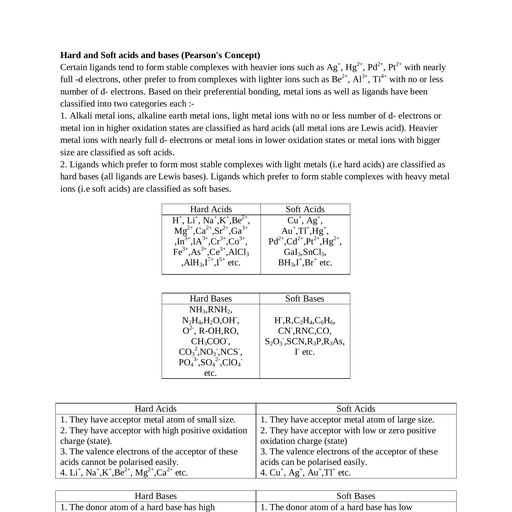
similarly, a soft acid prefers to combine with a soft base, since this type of combination gives more stable, product. The combination of hard acid and hard base occurs mainly through ionic bonding as in, Mg(OH)2, (Mg2+ = hard acid, OH- = hard base) and that of soft acid and soft base take mainly by covalent, bonding as in HgI2 (Hg2+ = soft acid, I- = soft base). This principle, however does not state that hard-soft, or soft-hard combination does not or cannot exist. It only state that if there is a choice, a hard-hard or softsoft combination would be preferred to a hard-soft or soft-hard combination., 1. Stability of a complex compound having the same ligands This application can be explained by considering an example. AgI-2 is stable while AgF-2 does not exist., We know that Ag+ is a soft acid, F- ion is a hard base and I- ion is a soft base. Thus, AgI-2 is obtained by, the combination of soft acid (Ag+) and soft base (I-) and AgF -2 results by the interaction of a soft acid, (Ag+) and a hard base (F-). Therefore, AgF-2 is stable but AgF-2 does not exist., 2. To predict the nature of bonding in complex ion given by ambidentate ligand With the help of HSAB principle, we can predict which atom of an ambidentate ligand will combine with, metal ion. SCN- is an ambidentate ligand since it can co-ordinate to the metal ion either through S-atom, or through N-atom. It has been found that Co2+ and Pd2+ both combine with 4 SCN- ligand to form, complex ion, [M(SCN)4]2- (M = Co2+, Pd2+). With HSAB principle, it can be shown that in [Co(SCN)4]2- ,, Co2+ is linked with the ligand through N-atom while in [Pd(SCN)4]2-, Pd2+ is co-ordinated with the ligand, through S-atom. Thus, the comp-lex ions given by Co2+ and Pd2+ ions should be represented as, [Co(NCS)4]2- and [Pd(SCN)4]2-. The reason is Co2+ ion is hard acid and it prefers to co-ordinate with Natom of the hard ligand NCS-. On the other hand, Pd2+ is a soft acid and hence combines with S-atom of, soft ligand,SCN-., 3. Stability of complex compounds having different ligands In the compound [Co(NH3)5F]2+, both the ligands i.e. NH3 and F- ions are hard ligands and hence is a, stable complex ion, whereas in [Co(NH3)5I]2+, NH3 is a hard ligand and I- is a soft ligand, therefore, it is, an unstable complex ion. Therefore, complex compound having the same nature of ligand i.e. hard ligand, or soft ligand are stable whereas complex compound having ligands of different nature are unstable., 4. Symbiosis Soft ligands prefer to get attached with a centre which is already linked with soft ligands. Similarly, hard, ligands prefer to get attached with a centre which is already linked with hard ligands. This tendency of, ligands is called symbiosis. It can be illustrated with an example NH3) adduct., , The formation of (BF3, , Since F- ions which are already attached with Bororn in BF3 molecules are also hard litgands. Thus F, , F, F, , B, F, , +, , NH3, , F, , B, , hard ligand, NH3, , F, , hard ligand