Page 1 :
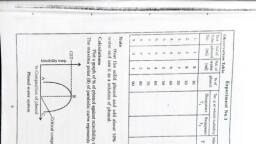
Experiment No.1, Observation Table, , , , , , , , , , , , , , , , , , , , , , , , , , , Vol. of} 9%of | Ter. at which turbidity] Miscibility temp, water | phenol, (ml) Disappears | Reappears T= Yh+Th, Ty Ty 2, 1 9 10, 2 2 8 20, 3 3 7 30, 4 4 6 40, s 5 5 50, 6 6 4 60, 7 7 3 70, | a 2 80, |e 90, , , , , , , , , , , , , , , , Note, , Heat the solid phenol and add about 10% of distilled, water and use it as a solution of phenol., , Calculations, , The maxima point (B) of parabolic curve represents CST., , B, 2, , , , Critical composition, , Miscibility temp., , % Composition of phenol, , Phenol-water system, , , , , , Plot a graph of % of phenol against miscibility temperature., , , , Semester III, Lab Course III, Paper IX, Physical Chemistry, Non-Instrumental, , Experiment No.4, , Aim: To determine the critical solution temperature of, phenol - water system., , Apparatus: Hard glass test tubes, Beaker, Standard flask (100, ml), Thermometer, Balance, Glass ring stirrer,, Phenol, etc., , Chemicals: Phenol, Distilled water., , Theory, , When phenol and water are mixed, two immiscible layers, , will be formed. The mutual solubility of two layers increases, , with increase in temperature. The temperature at which two, , layers form homogeneous phase is called critical solution, , temperature (CST) or consolute temperature (CT) and it is, , 65.8°C., , ‘Procedure, , 1. Take 9 clean test tubes and nurnber them as 1 to 9. Prepare, different mixture solutions as shown in the observation, , table and calculate the percentage of phenol in each test, tube., , Take test tube No.1, insert thermometer with ring stirrer, , in it and heat the test tube in water bath with constant, , stirring. Note the temperature at which turbidity just, disappears., , Stop the heating and take the test tube out of water bath, , and cool slowly with constant stirring. Note the temperature, at which turbidity just reappear,, , Repeat the same procedure for each test tube., , Plot a graph of percentage composition of phenol against, miscibility temperature., , Result: The CST of phenol - water system = %.
Page 2 :
OE ee ———, ee, , st scan tne, , Observations Experiment No.2, , Pudniburetie = naaH (0.05N), j 3. Indicator stted out - Benzoic acid, , 4. End Point - Phenclphthalein, ~ Colourless to pink, , , , , , , , Surette reading i, , (i [atm, , Normality | Strength, N (em/lit.), , , , , , , , , , , , , , , , , , a ae, , Calcul 2 Calc: }, ee ae Calculate the strength of CgHsCOOH at different, , , , , , , , CeHsCOOH = NaoH, NV = Nov,, Ny *10 = 0,05 « BR,, N, = 2.05 XBR,, 10, , , , Strength of benzoic acid = Normality * Eq.Wt., Ny x 122, Calculate the heat of dissolution, AH using the expressior:, 4H (T)-T}), = pee, 108 Sz -log St = RTT, Where,, R=1.987 cal/mole., S} and S2 are strengths of Cglis COOK, at T; and Tz respectively., , oo., a, , , , Graph: Plot a graph of strength, seein ee Strength, A straight line will be obtained., , AH = -2.303 * R Slope, , 10, , , , ae a es, , [_—fperiment No2, , , , To determine the solubility of ben: acid at, different temperature and determine AH of, , dissolution process., Apparatus: Thiration set, Funnel, Thermometer, Glass rod, et, , Chemicals: Benzoic acid, 0.05N NaQH so, Phenolphthalein indicator., , Aim:, , , , Theory, The dissolution of solid into solvent is accomp, , absorption or evolution of heat. The solubility of benz, | in water at different temperature is determined by titra, seturated solution against standard NaOH s, phenolphthalein as an indicator., , , , Procedure, 1. Rinse and fill the burette with 0.05N NaQH sol, , adjust its level at zero mark. |, , , , 1and, , , , 2. Take 100 ml of water in a clean beaker and heat 5°C a’, the room temperature. Add benzoic acid with co, stirring until a small amount of it remains undissolved at, the bottom., , 3. Filfer the solution in a beaker and pipette out 10 mal of thi., solution into a conical flask. Add 2-3 drops of, phenolphthalein as an indicator and titrate against NaOH, solution till faint pink colour appears., , nt, , , , 4. Note down the burette reading. Take 2 more readings at the, same temperature. This is reading at room termperature., , , , 5. Similarly, prepare saturated solution of benzoic ai, 35, 25, 20 and 15°C and determine the strength of, acid at different temperature., , , , een Heat of dissolution of benzoic acid is =, , , , , , 14
Page 3 :
r, , , , , , , , , Observations Experiment No.a, 1. Initial, , temperature of HCl or NaOH, t;=, ke, , , , Final temperature of HCl & NaOH ty, Rise in temperature, At = (t2- 4), , ", °, 9, , ", °, a, , 3, , Votal mass in the polythene bottle = 200 ml., (Density and specific heat is taken as 1), Calculations, Heat evolved during = Total mass x Sp.heat * Rise in ternp., neutralisation = 200 = a x At, , = 200 x At calories, , 100 ml of 0.5N HCl evolves 200 x At calories of heat, , 2 000, (UOD ORNCleche =e, , 100 x 0.5, = 2xdt x 2000, , = 4000x At Cal/mole., = 4xAtK.Cal/mole, , , , ‘Thermometer, Cork, , Polythene bottle, , ‘Solution, , , , , , Heat of Neutralisation, , , , , , , , , , , , , , , , , , 12, , Experiment No.3, Aim, , , , To determine the heat of neutralisation of, strong acid (HCI) and strong base (NaOH), , Apparatus: Polythene bottle, Beakers, Measuring cylinder,, Thermometer, etc., Chemicals: 0.5N HCl, 0.5N NaOH solution., Reaction: HCl] + NaOH ——-+NaCl + H20 + Heat, AH = -13.7 K.Cal/mole, (-ve sign indicates that reaction is exottermic), Theory, , Heat of neutralisation is the amount of heat evolved when, one gram equivalent of an acid is completely neutralised by, one gram equivalent of a base in dilute solution., , The heat of neutralisation of strong acid and strong base, is nearly constant and it is 13.7 K.Cal., , Procedure, , 1. Take 100 ml of 0.5N HCI solution in a clean polythene bottle, , fitted with funnel and thermometer,, , 2. Take 100 ml of 0.5N NaOH solution, , nto a clean beaker, with the help of measuring cylinder., , , , 3. Note down the initial temperature of HCl or NaOH solution, (which is nearly same), , 4. Add 100 ml of 0.5N NaOH solution into the polythene botUle, and shake well., , 5. Note down the maximum temperature of the mixture, solution., , Result, Heat of neutralisation of HCl and NaOH = _.... K.Cal/mole., , , , , , , , 13, , , , , , , , seunvena soe sar ETERS
Page 4 :
ny, —————, , , , , , Experiment No.4, Observations E a, 1. Initial temperature of CHgCOOH or NaOW, ty = ------, = %G, , 2. Final tempereture of CHg3COOH & NaOH, tz, |. Rise in temperature, At = (t2- ty), , 3. Totel mass in the polythens bottle, (Density and specific heat is taken as 1), , Calculations io, Heat evolved during = Total mass * Sp.heat * Rise in temp., neutralisation = 200 So x At, , 200 x At calories, , ‘. 100 ml of 0.5N CHgCOOH evolves 200*At calories of heat, , 200x At x1000, 100 x 0.5, = 2xdt x 2000, , = 4000x At Cal/mole., , , , -.1000 ml of 1N CH3 COOH evoives, , = 4xAtK.Cal/mole., , , , , , , ——Thermometsr, —-Gork, Polythene bottle, , , , Solution, , , , , , , , 14, , , , , , , , , , Experiment No.4, To determine the heat of neutralisation of NaOH, and CH;COCH., , Apparatus: Polythene bottle, Beakers, Measuring cylinder,, Thermometer, etc., , Chemicals: 0.5N CH3COOH, 0.5N NaOH solution., , Reaction, , CH;COOH + NaOH ——+ CHzCOONa + H,0 + Heat, , AH =~ 13.2 KC al/mole, (-ve sign indicates that reaction is exothermic), , Aim:, , Theory, Heat of neutralisation is the amount of heat evolved when, , one gram equivalent of an acid is completely neutralised by, one gram equivalent of a base in dilute solution., , The heat of neutralisation of strong acid and strong base, is nearly constant and it is 13.7 K.Cal/mole, However, in case, of weak acid like CH3COOH it is 13.2 K.Cal/mole, because a, part of heat evolved is utilised for ionisation., , Procedure, , 1, Take 100 ml of 0.5N CH3COOH solution in a ¢, polythene bottle fitied with funnel and thermomete;, , 2. Take 100 mi of 0.5N NaOH solution into a clean § aker, with the help of measuring cylinder., , 3. Note down the initial temperature of CH3COOH or }, solution (which is nearly same)., , 4. Add 100 ml of 0.5N NaOH solution into the polythene bottle, , , , , , , , and shake well., 5. Note down the maximum temperature of th ‘, solution. e mixture, Result, Heat of neutralisation of CH3COOH and NaOy —, K.Cal/mole. TS
Page 5 :
Experiment No.5, Part I, Observations for benzene layer, , , , 1, Solution in burette - NaOH (0.1N), , 2. Solution pipetted out - Benzene layer (10 ml), , 3. Indicator - Phenolphthalein, , 4. End point - Colourless to faint pink, , Observations Table, , , , , , , , , , , , , , , , , , , , | Bottle Burette reading Mean B. R., | No. 1 2 3 (ml), i., 2:, 3., 4., Calculations, , Calculate the concentration of benzene layer (Corg) for each, | bottle, using formula, N;V1= N2V2, , Benzene layer = NaOH, , NyVy = N2V2, N, x10 = 0.1*B.R., 01x BR., Ni = 10, , , , , , Experiment No.5, , Aim: To determine the partition coefficient of benzoic, acid between benzene and water., , Apparatus: Burette, Pipettes, Conical flask, 4 Stoppered, bottles, Separating funnel, Balance, etc., , Chemicals: Benzoic acid, Benzene, 0.1N NaOH solution,, 0.01N NaOH solution, Phenolphthalein indicator,, Distilled water., , Reaction: CgHjCOOH + NaOH -+ CgHsCOONa + H20, Benzoic acid Sod.benzoate, Theory, When benzoic acid is added into the mixture of two, immiscible liquids such as benzene and water then benzoic, acid tends to associate in benzene to give a dimer (CgHsCOOH)2, and partition coefficient is given by,, , Cag, Procedure, a. Take 4 clean stoppered bottles and number them as 1, 2, 3, , and 4. Weigh 1, 2, 3 and 4 gm of benzoic acid and transfer, , to bottle No.1, 2, 3 and 4 respectively., , b. Add 50 inl of benzene and 50 mi of distilled water to each, bottle. Stopper the bottles tightly and shake them, vigorously for half an hour and allow it to stand for some, time. The contents of the bottles will separate in two layers., The lower layer will be the aqueous layer and the upper, one is benzene layer., , Part I, , Procedure, , 1. Rinse aad fill the burette with 0,1N NaOH solution and, adjust its level at zero mark., , , , , , ee