Page 1 :
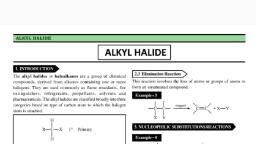
SN2 , SN1 , E2 , & E1:, Substitution and Elimination Reactions, , •, , Nucleophilic Substitution Reactions (SN2 and SN1) replace a, leaving group with a nucleophile (Nu: or Nu: - ), , •, , Elimination Reactions (E2 and E1) generate a double bond by loss, of " A+ " and " B: - ", , •, , They may compete with each other, , Nucleophilic Substitution Reactions - SN2 Reaction:, , • Reaction is:, o Stereospecific (Walden Inversion of configuration), o Concerted - all bonds form and break at same time, o Bimolecular - rate depends on concentration of both nucleophile and substrate, • Substrate:, o Best if primary (one substituent on carbon bearing leaving group), o works if secondary, fails if tertiary, • Nucleophile:, o Best if more reactive (i.e. more anionic or more basic), • Leaving Group: Best if more stable (i.e. can support negative charge well):, o TsO- (very good) > I- > Br- > Cl- > F- (poor), o RF , ROH , ROR , RNH2 are NEVER Substrates for SN2 reactions, o Leaving Groups on double-bonded carbons are never replaced by SN2 reactions, • Solvent: Polar Aprotic (i.e. no OH) is best., o For example dimethylsulfoxide ( CH3SOCH3 ), dimethylformamide, ( HCON(CH3)2 ), acetonitrile ( CH3CN )., o Protic solvents (e.g. H2O or ROH) deactivate nucleophile by hydrogen bonding, but can be used in some case, , Intro Chem Handouts, , Substitution & Elimination Reactions, , Page 1 of 3
Page 2 :
Nucleophilic Substitution Reactions – SN1 Reaction:, , •, , Reaction is:, o Non-stereospecific (attack by nucleophile occurs from both sides), o Non-concerted - has carbocation intermediate, o Unimolecular - rate depends on concentration of only the substrate, , •, , Substrate:, o Best if tertiary or conjugated (benzylic or allylic) carbocation can be formed as, leaving group departs, o never primary, , •, , Nucleophile:, o Best if more reactive (i.e. more anionic or more basic), , •, , Leaving Group:, o Same as SN2, o best if more stable (i.e. can support negative charge well), o Examples: TsO- (very good) > I- > Br- > Cl- > F- (poor), o However, tertiary or allylic ROH or ROR' can be reactive under strongly acidic, conditions to replace OH or OR, , •, , Solvent:, o Same as SN2, o Polar Aprotic (i.e. no OH) is best, o Examples: dimethylsulfoxide ( CH3SOCH3 ), dimethylformamide, ( HCON(CH3)2 ), acetonitrile ( CH3CN )., o Protic solvents (e.g. H2O or ROH) deactivate but can be used in some cases, , Intro Chem Handouts, , Substitution & Elimination Reactions, , Page 2 of 3
Page 3 :
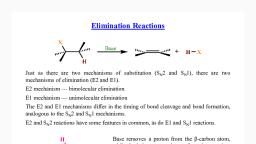
Elimination Reactions - E2 Reaction:, , •, , Reaction is:, o Stereospecific (Anti-periplanar geometry preferred, Syn-periplanar geometry, possible), o Concerted - all bonds form and break at same time, o Bimolecular - rate depends on concentration of both base and substrate, o Favoured by strong bases, , Elimination Reactions – E1 Reaction:, , •, , Reaction is:, o Non-stereospecific- follows Zaitsev (Saytseff) Rule, o Non-concerted - has carbocation intermediate - favoured for tertiary leaving, groups, o Unimolecular - rate depends on concentration of only the substrate, o Does NOT occur with primary alkyl halides (leaving groups), o Strong acid can promote loss of OH as H2O or OR as HOR if tertiary or, conjugated carbocation can be formed, , Intro Chem Handouts, , Substitution & Elimination Reactions, , Page 3 of 3