Notes of B.Sc 2nd Semester, Chemistry DIPOLE MOMENT - Study Material
Page 1 :
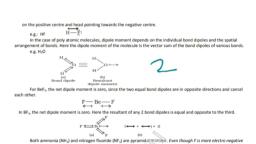
The separation of charges in any system leads to dipole moment. Both ionic and covalently, bonded compounds develop dipole moment. The main cause for the development of dipole, moment is the electronegativity difference between chemically bonded atoms or elements, a.Polar character is the separation of positive and negative charges, in a compound. This, measurement of polar character of a chemical bond in a molecule, between two atoms, is given, by bond dipole moment. Bond dipole moment is considered as a vector quantity, as it has both, magnitude and direction. For example,, , s &, H — Cl, , +—___—_>, , 6+ and 6- indicate positive and negative charges, which are separated by distance d. These, charges are equal in magnitude but opposite in sign., , Bond dipole moment differs from the total dipole moment in polyatomic molecules. e. Bond, dipole moment is the dipole moment between the single bond of a diatomic molecule, while the, total dipole moment in a polyatomic molecule is the vector sum of all the bond dipoles. Thus,, total molecular dipole moment depends on the factors like- differences in the sizes of the two, atoms, hybridization of the orbitals, direction of lone pair electrons. Dipole moment can also be, zero, when opposite two bond dipoles cancel each other. In chemistry, the representation of, dipole moment is given little differently with arrow symbol. Dipole moment is represented by an, arrow, with cross (+) on one side. The arrow side denotes the negative sign, while the + side, denotes the positive sign, , Ss 5", , V7 | Edit with WPS Office
Page 2 :
The arrow signifies the shifting of electron density in the molecule., , Dipole Moment Formula, Dipole moment definition can be given as the product of magnitude of electronic charge of the, molecule and the internuclear distance between the atoms in a molecule. It is given by the, equation: Dipole moment () = Charge (Q) x Distance of separation (d)(1) = (Q) x (d)where, pis, the bond dipole moment, Q is the magnitude of the partial charges +and -,anddis the, distance between +and_ -. It is measured in Debye units, represented by D.D = 3.33564 x1030 Cm; C = Coulomb, m = meter., , Dipole Moment Chemistry, 1.In the diatomic molecule of HCl, dipole moment of HCI molecule is same as dipole moment of, HCI bond, which is 1.03D., , s &, H —W— cl, , +>, , 2.In beryllium fluoride molecule, the dipole moment is zero. BeF2 has a linear shape. There exist, two individual bond dipole moments, which cancel each other resulting in the net dipole, moment zero. This is because in BeF2 molecule, the bond dipole moments are equal in, magnitude and opposite in direction., , F ————— Be F, ef, , 3. In the triatomic CO2 (carbon dioxide) molecule, the dipole moment is zero. Due to the linear, structure of the molecule, the dipole moment of C=O bond (2.3D) on one side of the molecule, gets cancelled by that on the other side of the molecule, resulting in net zero dipole moment., , V7 | Edit with WPS Office
Page 3 :
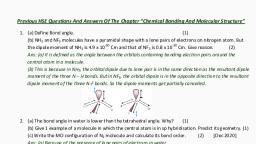
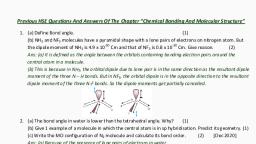
4.In triatomic H20 water molecule, the dipole moment is 1.84D. Due to the bent structure of the, water molecule, the dipole moment is not zero. This is due to the resultant dipole moments of 2, O-H bonds, inclined at 104.5 degrees, with 2 lone pairs on oxygen atoms., , NY, , 5.In tetra-atomic boron trihydride (BH3), the dipole moment is zero, but that of ammonia (NH3), is 1.49D. This is because BH3 has a symmetrical structure and the 3 B-H bonds are placed at an, angle of 120 degrees to each other. As the 3 bonds are in a single plane, dipole moments cancel, each other, with net dipole moment equal to zero. On the other hand, NH3 has a pyramidal, structure, with 3 N-H bonds and a lone pair on nitrogen atom. This gives the resultant dipole, moment as 1.49D., , , , Also, when we consider NH3 and NF3 molecules, both have with 3 N-H bonds and a lone pair on, nitrogen atom but the resultant dipole moment of NF3 is less than that of NH3. This is because, the dipole formed between the lone pair and nitrogen atom differs in both NH3 and NF3, molecules. Fluorine, being more electronegative than nitrogen, will attract all the shared, electrons towards it from nitrogen in opposite direction to net dipole moment. Thus, the, resultant dipole moment of NF3 decreases. While nitrogen being more electronegative than, , V7 | Edit with WPS Office
Page 4 :
hydrogen, it will attract all the shared electrons towards it from hydrogen in same direction to, net dipole moment due to N-H bonds. Thus, the resultant dipole moment of NH3 increases., , Ot Ot, N N, , oS fs, F, , H, Hq H, , 6.In CH4 (methane) and CCI4 (carbon tetrachloride) molecules, the dipole moments are zero., These two, CH4 and CCI4 molecules, have symmetrical tetrahedral shape. Therefore, dipole, moments of C-H bonds in CH4 cancel out each other and result in zero dipole moment, same in, CCI4 molecule dipole moment of C-Cl bonds cancel out each other and result in zero dipole, moment., , He cl, , 7 t, of \Yy oY :, , s, H, , oD, , =, ll, , V7 | Edit with WPS Office
Page 5 :
While in CH3CI (methyl chloride) molecule, even though it has a tetrahedral structure, its dipole, moment is not zero. This is because the structure of methyl chloride is not symmetrical and, the, dipole moments of bonds C-Cl and C-H are not equal. Thus, resultant dipole moment comes, to1.86 D., , Cl, , H wo (ny, , H, U= 1.86D, , e In finding the polar nature of the bond: As the magnitude of dipole moment increases,, more will be the polar nature of the bond. Molecules with zero dipole moment are nonpolar, while molecules with dipole moment are said to be polar., , e In finding the structure (shape) of the molecules: Molecules with specific dipole, moment values will be bent or angular in shape and not have symmetrical structure., While molecules with zero dipole moment will have symmetrical shape., , e In finding the percentage ionic character., , e In finding symmetry of the molecules: Molecules having two or more polar bonds would, not be symmetrical and possess some dipole moment. Examples: H20 = 1.84D; CH3CI, (methyl chloride) = 1.86 D. If similar atoms in the molecule are attached to central atom, with resultant dipole moment zero, then such molecules will have symmetrical, structures. Examples: CO2, CH4, , e In distinguishing between cis- and trans-isomers: Generally, isomer with higher dipole, moment would be trans-isomer and isomer with lower dipole moment would be cisisomer., , V7 | Edit with WPS Office



 Learn better on this topic