Notes of +2 2nd Year SCIENCE, Chemistry d- & f- block.pdf - Study Material
Page 1 :
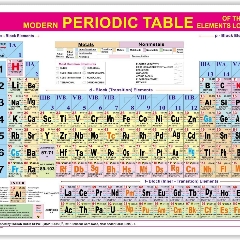
Unit, , 8, Objectives, After studying this Unit, you will be, able to, • learn the positions of the d– and, f-block elements in the periodic, table;, • know the electronic configurations, of the transition (d-block) and the, inner transition (f-block) elements;, • appreciate the relative stability of, various oxidation states in terms, of electrode potential values;, • describe, the, preparation,, properties, structures and uses, of some important compounds, such as K2Cr2O7 and KMnO4;, • understand, the, general, characteristics of the d– and, f–block elements and the general, horizontal and group trends in, them;, • describe the properties of the, f-block elements and give a, comparative account of the, lanthanoids and actinoids with, respect, to, their, electronic, configurations, oxidation states, and chemical behaviour., , The dd-- and ffBlock Elements, Iron, copper, silver and gold are among the transition elements that, have played important roles in the development of human civilisation., The inner transition elements such as Th, Pa and U are proving, excellent sources of nuclear energy in modern times., , The d-block of the periodic table contains the elements, of the groups 3-12 in which the d orbitals are, progressively filled in each of the four long periods., The f-block consists of elements in which 4 f and 5 f, orbitals are progressively filled. They are placed in a, separate panel at the bottom of the periodic table. The, names transition metals and inner transition metals, are often used to refer to the elements of d-and, f-blocks respectively., There are mainly four series of the transition metals,, 3d series (Sc to Zn), 4d series (Y to Cd), 5d series (La, and Hf to Hg) and 6d series which has Ac and elements, from Rf to Cn. The two series of the inner transition, metals; 4f (Ce to Lu) and 5f (Th to Lr) are known as, lanthanoids and actinoids respectively., Originally the name transition metals was derived, from the fact that their chemical properties were, transitional between those of s and p-block elements., Now according to IUPAC, transition metals are defined, as metals which have incomplete d subshell either in, neutral atom or in their ions. Zinc, cadmium and, 10, mercury of group 12 have full d configuration in their, ground state as well as in their common oxidation states, and hence, are not regarded as transition metals., However, being the end members of the 3d, 4d and 5d, transition series, respectively, their chemistry is studied, along with the chemistry of the transition metals., The presence of partly filled d or f orbitals in their, atoms makes transition elements different from that of, , 2018-19
Page 2 :
the non-transition elements. Hence, transition elements, and their compounds are studied separately. However,, the usual theory of valence as applicable to the nontransition elements can be applied successfully to the, transition elements also., Various precious metals such as silver, gold and, platinum and industrially important metals like iron,, copper and titanium belong to the transition metals series., In this Unit, we shall first deal with the electronic, configuration, occurrence and general characteristics of, transition elements with special emphasis on the trends, in the properties of the first row (3d) transition metals, along with the preparation and properties of some, important compounds. This will be followed by, consideration of certain general aspects such as electronic, configurations, oxidation states and chemical reactivity, of the inner transition metals., , THE TRANSITION ELEMENTS (d-BLOCK), , 8.1 Position in the, Periodic Table, , 8.2 Electronic, Configurations, of the d-Block, Elements, , The d–block occupies the large middle section of the periodic table, flanked between s– and p– blocks in the periodic table. The d–orbitals, of the penultimate energy level of atoms receive electrons giving rise to, four rows of the transition metals, i.e., 3d, 4d, 5d and 6d. All these, series of transition elements are shown in Table 8.1., In general the electronic configuration of outer orbitals of these elements, is (n-1)d1–10ns1–2. The (n–1) stands for the inner d orbitals which may, have one to ten electrons and the outermost ns orbital may have one, or two electrons. However, this generalisation has several exceptions, because of very little energy difference between (n-1)d and ns orbitals., Furthermore, half and completely filled sets of orbitals are relatively, more stable. A consequence of this factor is reflected in the electronic, configurations of Cr and Cu in the 3d series. For example, consider the, 5, 1, 4, 2, case of Cr, which has 3d 4s configuration instead of 3d 4s ; the, energy gap between the two sets (3d and 4s) of orbitals is small enough, to prevent electron entering the 3d orbitals. Similarly in case of Cu, the, configuration is 3d104s1 and not 3d94s2. The ground state electronic, configurations of the outer orbitals of transition elements are given in, Table 8.1., , Table 8.1: Electronic Configurations of outer orbitals of the Transition Elements, (ground state), 1st Series, Sc, , Ti, , V, , Cr, , Mn, , Fe, , Co, , Ni, , Cu, , Zn, , Z, , 21, , 22, , 23, , 24, , 25, , 26, , 27, , 28, , 29, , 30, , 4s, , 2, , 2, , 2, , 1, , 2, , 2, , 2, , 2, , 1, , 2, , 3d, , 1, , 2, , 3, , 5, , 5, , 6, , 7, , 8, , 10, , 10, , Chemistry 216, , 2018-19
Page 3 :
2nd Series, Y, , Zr, , Nb, , Mo, , Tc, , Ru, , Rh, , Pd, , Ag, , Cd, , 39, , 40, , 41, , 42, , 43, , 44, , 45, , 46, , 47, , 48, , 5s, , 2, , 2, , 1, , 1, , 1, , 1, , 1, , 0, , 1, , 2, , 4d, , 1, , 2, , 4, , 5, , 6, , 7, , 8, , 10, , 10, , 10, , Z, , 3rd Series, La, , Hf, , Ta, , W, , Re, , Os, , Ir, , Pt, , Au, , Hg, , Z, , 57, , 72, , 73, , 74, , 75, , 76, , 77, , 78, , 79, , 80, , 6s, , 2, , 2, , 2, , 2, , 2, , 2, , 2, , 1, , 1, , 2, , 5d, , 1, , 2, , 3, , 4, , 5, , 6, , 7, , 9, , 10, , 10, , 4th Series, Ac, , Rf, , Db, , Sg, , Bh, , Hs, , Mt, , Ds, , Rg, , Cn, , Z, , 89, , 104, , 105, , 106, , 107, , 108, , 109, , 110, , 111, , 112, , 7s, , 2, , 2, , 2, , 2, , 2, , 2, , 2, , 2, , 1, , 2, , 6d, , 1, , 2, , 3, , 4, , 5, , 6, , 7, , 8, , 10, , 10, , The electronic configurations of outer orbitals of Zn, Cd, Hg and Cn, 10, 2, are represented by the general formula (n-1)d ns . The orbitals in, these elements are completely filled in the ground state as well as in, their common oxidation states. Therefore, they are not regarded as, transition elements., The d orbitals of the transition elements protrude to the periphery of, an atom more than the other orbitals (i.e., s and p), hence, they are more, influenced by the surroundings as well as affect the atoms or molecules, n, surrounding them. In some respects, ions of a given d configuration, (n = 1 – 9) have similar magnetic and electronic properties. With partly, filled d orbitals these elements exhibit certain characteristic properties, such as display of a variety of oxidation states, formation of coloured, ions and entering into complex formation with a variety of ligands., The transition metals and their compounds also exhibit catalytic, property and paramagnetic behaviour. All these characteristics have, been discussed in detail later in this Unit., There are greater similarities in the properties of the transition, elements of a horizontal row in contrast to the non-transition elements., However, some group similarities also exist. We shall first study the, general characteristics and their trends in the horizontal rows, (particularly 3d row) and then consider some group similarities., On what ground can you say that scandium (Z = 21) is a transition, element but zinc (Z = 30) is not?, , Example 8.1, , On the basis of incompletely filled 3d orbitals in case of scandium atom, 1, in its ground state (3d ), it is regarded as a transition element. On the, 10, other hand, zinc atom has completely filled d orbitals (3d ) in its, ground state as well as in its oxidised state, hence it is not regarded, as a transition element., , Solution, , 217 The d- and f- Block Elements, , 2018-19
Page 4 :
Intext Question, 10, , 8.1 Silver atom has completely filled d orbitals (4d ) in its ground state., How can you say that it is a transition element?, We will discuss the properties of elements of first transition series, only in the following sections., , 8 . 3 General, Properties of, the Transition, Elements, (d-Block), , 8.3.1 Physical Properties, Nearly all the transition elements display typical metallic properties, such as high tensile strength, ductility, malleability, high thermal and, electrical conductivity and metallic lustre. With the exceptions of Zn,, Cd, Hg and Mn, they have one or more typical metallic structures at, normal temperatures., Lattice Structures of Transition Metals, , Sc, hcp, (bcc), Y, hcp, (bcc), La, hcp, (ccp,bcc), , Ti, , V, , Cr, , Mn, , Fe, , Co, , Ni, , Cu, , Zn, , hcp, (bcc), , bcc, , bcc, , X, (bcc, ccp), , bcc, (hcp), , ccp, (hcp), , ccp, , ccp, , X, (hcp), , Zr, , Nb, , Mo, , Tc, , Ru, , Rh, , Pd, , Ag, , Cd, , hcp, (bcc), , bcc, , bcc, , hcp, , hcp, , ccp, , ccp, , ccp, , X, (hcp), , Hf, , Ta, , W, , Re, , Os, , Ir, , Pt, , Au, , Hg, , hcp, (bcc), , bcc, , bcc, , hcp, , hcp, , ccp, , ccp, , ccp, , X, , 4, , (bcc = body centred cubic; hcp = hexagonal close packed;, ccp = cubic close packed; X = a typical metal structure)., , W, Re, Ta, 3, , Os, Ru, , Mo, , Ir, , Tc, , Hf, , 3, , M.p./10 K, , Nb, , 2, , Zr, , Cr, , Rh, , V, , Ti, , Fe, , Pt, , Co Pd, Ni, , Mn, 1, , Cu, Au, Ag, , Atomic number, , Fig. 8.1: Trends in melting points of, transition elements, , The transition metals (with the exception, of Zn, Cd and Hg) are very hard and have low, volatility. Their melting and boiling points are, high. Fig. 8.1 depicts the melting points of, transition metals belonging to 3d, 4d and 5d, series. The high melting points of these metals, are attributed to the involvement of greater, number of electrons from (n-1)d in addition to, the ns electrons in the interatomic metallic, bonding. In any row the melting points of these, 5, metals rise to a maximum at d except for, anomalous values of Mn and Tc and fall, regularly as the atomic number increases., They have high enthalpies of atomisation which, are shown in Fig. 8.2. The maxima at about, the middle of each series indicate that one, unpaired electron per d orbital is particularly, , Chemistry 218, , 2018-19
Page 5 :
a, , V, , D H /kJ mol, , –1, , favourable for strong interatomic interaction. In general, greater the, number of valence electrons, stronger is the resultant bonding. Since, the enthalpy of atomisation is an important factor in determining the, standard electrode potential of a metal, metals with very high enthalpy, of atomisation (i.e., very high boiling point) tend to be noble in their, reactions (see later for electrode potentials)., Another generalisation that may be drawn from Fig. 8.2 is that the, metals of the second and third series have greater enthalpies of, atomisation than the corresponding elements of the first series; this is an, important factor in accounting for the occurrence of much more frequent, metal – metal bonding in compounds of the heavy transition metals., , Fig. 8.2, Trends in enthalpies, of atomisation of, transition elements, , 8.3.2 Variation in, Atomic and, Ionic Sizes, of, Transition, Metals, , In general, ions of the same charge in a given series show progressive, decrease in radius with increasing atomic number. This is because the, new electron enters a d orbital each time the nuclear charge increases, by unity. It may be recalled that the shielding effect of a d electron is, not that effective, hence the net electrostatic attraction between the, nuclear charge and the outermost electron increases and the ionic, radius decreases. The same trend is observed in the atomic radii of a, given series. However, the variation within a series is quite small. An, interesting point emerges when atomic sizes of one series are compared, with those of the corresponding elements in the other series. The curves, in Fig. 8.3 show an increase from the first (3d) to the second (4d) series, of the elements but the radii of the third (5d) series are virtually the, same as those of the corresponding members of the second series. This, phenomenon is associated with the intervention of the 4f orbitals which, must be filled before the 5d series of elements begin. The filling of 4f, before 5d orbital results in a regular decrease in atomic radii called, Lanthanoid contraction which essentially compensates for the expected, 219 The d- and f- Block Elements, , 2018-19
Page 6 :
Radius/nm, , increase in atomic size with increasing atomic number. The net result, of the lanthanoid contraction is that the second and the third d series, exhibit similar radii (e.g., Zr 160 pm, Hf 159 pm) and have very similar, physical and chemical properties much more than that expected on, the basis of usual family relationship., 19, The factor responsible for the lanthanoid, contraction is somewhat similar to that observed, 18, in an ordinary transition series and is attributed, 17, to similar cause, i.e., the imperfect shielding of, one electron by another in the same set of orbitals., 16, However, the shielding of one 4f electron by, 15, another is less than that of one d electron by, 14, another, and as the nuclear charge increases, along the series, there is fairly regular decrease, 13, n, in the size of the entire 4f orbitals., 12, The decrease in metallic radius coupled with, Fe Co Ni Cu Zn, increase in atomic mass results in a general, Ru Rh Pd Ag Cd, increase in the density of these elements. Thus,, Os Ir Pt Au Hg, from titanium (Z = 22) to copper (Z = 29) the, atomic radii of, significant increase in the density may be noted, elements, (Table 8.2)., , Sc Ti V Cr Mn, Y Zr Nb Mo Tc, La Hf Ta W, , Re, , Fig. 8.3: Trends in, transition, , Table 8.2: Electronic Configurations and some other Properties of, the First Series of Transition Elements, Element, Atomic number, , Sc, , Ti, , V, , Cr, , Mn, , Fe, , 21, , 22, , 23, , 24, , 25, , 26, , Co, 27, , Ni, , Cu, , 28, , 29, , Zn, 30, , Electronic configuration, M, M, , +, , M, , 2+, , M, , 3+, , 3d 4s, , 1, , 2, , 3d 4s, , 2, , 2, , 3d 4s, , 3, , 2, , 1, , 1, , 2, , 1, , 3, , 1, , 3d 4s, 3d, , 3d 4s, , 1, , [Ar], , 3d, , 2, , 3d, , 1, , V, , Enthalpy of atomisation, ∆aH /kJ mol, 326, V, , Ionisation enthalpy/∆, ∆ iH /kJ mol, V, , 3d 4s, 3d, , 3, , 3d, , 2, , 5, , 3d 4s, , 1, , 3d 4s, , 5, , 2, , 3d 4s, , 6, , 2, , 3d 4s, , 7, , 2, , 3d 4s, , 8, , 2, , 5, , 1, , 6, , 1, , 7, , 1, , 8, , 1, , 3d, , 5, , 3d 4s, , 3d, , 4, , 3d, , 5, , 3d, , 3, , 3d, , 4, , 3d 4s, 3d, , 6, , 3d, , 5, , 3d 4s, 3d, , 7, , 3d, , 6, , 3d 4s, , 10, , 1, , 3d 4s, 3d, , 10, 9, , 10, , 2, , 10, , 1, , 3d 4s, 3d 4s, , 3d, , 8, , 3d, , 3d, , 7, , –, , –, , 339, , 126, , 3d, , 10, , –1, , 473, , 515, , 397, , 281, , 416, , 425, , 430, , –1, , I, , 631, , 656, , 650, , 653, , 717, , 762, , 758, , 736, , 745, , 906, , II, , 1235, , 1309, , 1414, , 1592, , 1509, , 1561, , 1644, , 1752, , 1958, , 1734, , III, , 2393, , 2657, , 2833, , 2990, , 3260, , 2962, , 3243, , 3402, , 3556, , 3837, , Metallic/ionic, , M, , 164, , 147, , 135, , 129, , 137, , 126, , 125, , 125, , 128, , 137, , radii/pm, , M, , 2+, , –, , –, , 79, , 82, , 82, , 77, , 74, , 70, , 73, , 75, , M, , 3+, , 73, , 67, , 64, , 62, , 65, , 65, , 61, , 60, , –, , –, , M /M, , 2+, , –, , –1.63, , –1.18, , –0.90, , –1.18, , –0.44, , –0.28, , –0.25, , +0.34, , -0.76, , M 3+/M2+, , –, , –0.37, , –0.26, , –0.41 +1.57, , +0.77, , +1.97, , –, , –, , –, , 3.43, , 4.1, , 6.07, , 7.19, , 7.8, , 8.7, , 8.9, , ∆ iH, ∆ iH, ∆ iH, , V, V, , Standard, electrode, V, , potential E /V, –3, , Density/g cm, , Chemistry 220, , 2018-19, , 7.21, , 8.9, , 7.1
Page 7 :
Why do the transition elements exhibit higher enthalpies of, atomisation?, , Example 8.2, , Because of large number of unpaired electrons in their atoms they, have stronger interatomic interaction and hence stronger bonding, between atoms resulting in higher enthalpies of atomisation., , Solution, , Intext Question, 8.2 In the series Sc (Z = 21) to Zn (Z = 30), the enthalpy of atomisation, –1, of zinc is the lowest, i.e., 126 kJ mol . Why?, , 8.3.3 Ionisation, Enthalpies, , There is an increase in ionisation enthalpy along each series of the, transition elements from left to right due to an increase in nuclear, charge which accompanies the filling of the inner d orbitals. Table, 8.2 gives the values of the first three ionisation enthalpies of the first, series of transition elements. These values show that the successive, enthalpies of these elements do not increase as steeply as in the case, of non-transition elements. The variation in ionisation enthalpy along, a series of transition elements is much less in comparison to the variation, along a period of non-transition elements. The first ionisation enthalpy,, in general, increases, but the magnitude of the increase in the second, and third ionisation enthalpies for the successive elements, is much, higher along a series., The irregular trend in the first ionisation enthalpy of the metals of, 3d series, though of little chemical significance, can be accounted for, by considering that the removal of one electron alters the relative energies, of 4s and 3d orbitals. You have learnt that when d-block elements form, ions, ns electrons are lost before (n – 1) d electrons. As we move along, the period in 3d series, we see that nuclear charge increases from, scandium to zinc but electrons are added to the orbital of inner subshell,, i.e., 3d orbitals. These 3d electrons shield the 4s electrons from the, increasing nuclear charge somewhat more effectively than the outer, shell electrons can shield one another. Therefore, the atomic radii, decrease less rapidly. Thus, ionization energies increase only slightly, n, along the 3d series. The doubly or more highly charged ions have d, configurations with no 4s electrons. A general trend of increasing values, of second ionisation enthalpy is expected as the effective nuclear charge, increases because one d electron does not shield another electron from, the influence of nuclear charge because d-orbitals differ in direction., However, the trend of steady increase in second and third ionisation, enthalpy breaks for the formation of Mn2+ and Fe3+ respectively. In both, the cases, ions have d5 configuration. Similar breaks occur at, corresponding elements in the later transition series., The interpretation of variation in ionisation enthalpy for an electronic, configuration dn is as follows:, The three terms responsible for the value of ionisation enthalpy are, attraction of each electron towards nucleus, repulsion between the, 221 The d- and f- Block Elements, , 2018-19
Page 8 :
electrons and the exchange energy. Exchange energy is responsible for, the stabilisation of energy state. Exchange energy is approximately, proportional to the total number of possible pairs of parallel spins in, the degenerate orbitals. When several electrons occupy a set of, degenerate orbitals, the lowest energy state corresponds to the maximum, possible extent of single occupation of orbital and parallel spins (Hunds, rule). The loss of exchange energy increases the stability. As the stability, increases, the ionisation becomes more difficult. There is no loss of, exchange energy at d6 configuration. Mn+ has 3d54s1 configuration and, configuration of Cr+ is d5, therefore, ionisation enthalpy of Mn+ is lower, than Cr+. In the same way, Fe2+ has d6 configuration and Mn2+ has 3d5, configuration. Hence, ionisation enthalpy of Fe2+ is lower than the Mn2+., In other words, we can say that the third ionisation enthalpy of Fe is, lower than that of Mn., The lowest common oxidation state of these metals is +2. To, 2+, form the M ions from the gaseous atoms, the sum of the first and, second ionisation enthalpy is required in addition to the enthalpy of, atomisation. The dominant term is the second ionisation enthalpy, +, which shows unusually high values for Cr and Cu where M ions, 5, 10, have the d and d configurations respectively. The value for Zn is, correspondingly low as the ionisation causes the removal of 1s, 10, electron which results in the formation of stable d configuration., The trend in the third ionisation enthalpies is not complicated by, the 4s orbital factor and shows the greater difficulty of removing an, 5, 2+, 10, 2+, electron from the d (Mn ) and d (Zn ) ions. In general, the third, ionisation enthalpies are quite high. Also the high values for third, ionisation enthalpies of copper, nickel and zinc indicate why it is, difficult to obtain oxidation state greater than two for these elements., Although ionisation enthalpies give some guidance concerning the, relative stabilities of oxidation states, this problem is very complex and, not amenable to ready generalisation., 8.3.4 Oxidation, States, , One of the notable features of a transition elements is the great variety, of oxidation states these may show in their compounds. Table 8.3 lists, the common oxidation states of the first row transition elements., Table 8.3: Oxidation States of the first row Transition Metals, (the most common ones are in bold types), Sc, , Ti, , V, , Cr, , Mn, , Fe, , Co, , Ni, , Cu, , Zn, , +2, +3, +4, +5, , +2, +3, +4, +5, +6, , +2, +3, +4, +5, +6, +7, , +2, +3, +4, , +2, +3, +4, , +2, +3, +4, , +1, +2, , +2, , +3, , +2, +3, +4, , Chemistry 222, , 2018-19, , +6
Page 9 :
The elements which give the greatest number of oxidation states, occur in or near the middle of the series. Manganese, for example,, exhibits all the oxidation states from +2 to +7. The lesser number of, oxidation states at the extreme ends stems from either too few electrons, to lose or share (Sc, Ti) or too many d electrons (hence fewer orbitals, available in which to share electrons with others) for higher valence, (Cu, Zn). Thus, early in the series scandium(II) is virtually unknown, and titanium (IV) is more stable than Ti(III) or Ti(II). At the other end,, the only oxidation state of zinc is +2 (no d electrons are involved). The, maximum oxidation states of reasonable stability correspond in value, to the sum of the s and d electrons upto manganese (TiIVO2, VVO2+,, CrV1O42–, MnVIIO4–) followed by a rather abrupt decrease in stability of, higher oxidation states, so that the typical species to follow are FeII,III,, CoII,III, NiII, CuI,II, ZnII., The variability of oxidation states, a characteristic of transition, elements, arises out of incomplete filling of d orbitals in such a way, II, III, that their oxidation states differ from each other by unity, e.g., V , V ,, IV, V, V , V . This is in contrast with the variability of oxidation states of non, transition elements where oxidation states normally differ by a unit, of two., An interesting feature in the variability of oxidation states of the d–, block elements is noticed among the groups (groups 4 through 10)., Although in the p–block the lower oxidation states are favoured by the, heavier members (due to inert pair effect), the opposite is true in the, groups of d-block. For example, in group 6, Mo(VI) and W(VI) are, found to be more stable than Cr(VI). Thus Cr(VI) in the form of dichromate, in acidic medium is a strong oxidising agent, whereas MoO3 and WO3, are not., Low oxidation states are found when a complex compound has, ligands capable of π-acceptor character in addition to the σ-bonding., For example, in Ni(CO)4 and Fe(CO)5, the oxidation state of nickel and, iron is zero., , Name a transition element which does not exhibit variable, oxidation states., Scandium (Z = 21) does not exhibit variable oxidation states., , Example 8.3, Solution, , Intext Question, 8.3 Which of the 3d series of the transition metals exhibits the, largest number of oxidation states and why?, , 223 The d- and f- Block Elements, , 2018-19
Page 10 :
8.3.5 Trends in the, 2+, M /M, Standard, Electrode, Potentials, , Table 8.4 contains the thermochemical parameters related to the, 2+, transformation of the solid metal atoms to M ions in solution and their, V, standard electrode potentials. The observed values of E and those, calculated using the data of Table 8.4 are compared in Fig. 8.4., V, The unique behaviour of Cu, having a positive E , accounts for its, inability to liberate H2 from acids. Only oxidising acids (nitric and hot, concentrated sulphuric) react with Cu, the acids being reduced. The, high energy to transform Cu(s) to Cu2+(aq) is not balanced by its hydration, V, enthalpy. The general trend towards less negative E values across the, , Fig. 8.4: Observed and calculated values for the standard, electrode potentials, (M2+ →M°) of the elements Ti to Zn, , series is related to the general increase in the sum of the first and second, V, ionisation enthalpies. It is interesting to note that the value of E for Mn,, Ni and Zn are more negative than expected from the trend., , Example 8.4, 2+, 4, 3, Cr is reducing as its configuration changes from d to d , the latter Solution, Why is Cr2+ reducing and Mn3+ oxidising when both have d4 configuration?, having a half-filled t2g level (see Unit 9) . On the other hand, the change, 3+, 2+, 5, from Mn to Mn results in the half-filled (d ) configuration which has, extra stability., , Intext Question, V, , 2+, , 8.4 The E (M /M) value for copper is positive (+0.34V). What is possible, V, V, reason for this? (Hint: consider its high ∆aH and low ∆hydH ), Chemistry 224, , 2018-19
Page 11 :
Table 8.4: Thermochemical data (kJ mol-1) for the first row Transition, Elements and the Standard Electrode Potentials for the, Reduction of MII to M., Element (M), , ∆a H, , V, , V, , (M), , V, , ∆ iH 1, , ∆ 1H 2, , ∆ hydH (M2+), , V, , E /V, , V, , Ti, , 469, , 656, , 1309, , -1866, , -1.63, , V, , 515, , 650, , 1414, , -1895, , -1.18, , Cr, , 398, , 653, , 1592, , -1925, , -0.90, , Mn, , 279, , 717, , 1509, , -1862, , -1.18, , Fe, , 418, , 762, , 1561, , -1998, , -0.44, , Co, , 427, , 758, , 1644, , -2079, , -0.28, , Ni, , 431, , 736, , 1752, , -2121, , -0.25, , Cu, , 339, , 745, , 1958, , -2121, , 0.34, , Zn, , 130, , 906, , 1734, , -2059, , -0.76, , 2+, , The stability of the half-filled d sub-shell in Mn and the completely, V, 10, 2+, filled d configuration in Zn are related to their E values, whereas, V, V, E for Ni is related to the highest negative ∆hydH ., V, , 3+, , 2+, , 8.3.6 Trends in, the M3+/M2+, Standard, Electrode, Potentials, , An examination of the E (M /M ) values (Table 8.2) shows the varying, 3+, trends. The low value for Sc reflects the stability of Sc which has a, noble gas configuration. The highest value for Zn is due to the removal, 10, 2+, of an electron from the stable d configuration of Zn . The, 2+, 5, comparatively high value for Mn shows that Mn (d ) is particularly, stable, whereas comparatively low value for Fe shows the extra stability, 3+, 5, of Fe (d ). The comparatively low value for V is related to the stability, 2+, of V (half-filled t2g level, Unit 9)., , 8.3.7 Trends in, Stability of, Higher, Oxidation, States, , Table 8.5 shows the stable halides of the 3d series of transition metals., The highest oxidation numbers are achieved in TiX4 (tetrahalides), VF5, and CrF6. The +7 state for Mn is not represented in simple halides but, MnO3F is known, and beyond Mn no metal has a trihalide except FeX3, and CoF3. The ability of fluorine to stabilise the highest oxidation state is, due to either higher lattice energy as in the case of CoF3, or higher bond, enthalpy terms for the higher covalent compounds, e.g., VF5 and CrF6., +5, Although V is represented only by VF5, the other halides, however,, undergo hydrolysis to give oxohalides, VOX3. Another feature of fluorides, is their instability in the low oxidation states e.g., VX2 (X = CI, Br or I), Table 8.5: Formulas of Halides of 3d Metals, , Oxidation, Number, + 6, , CrF6, VF5, , CrF5, , + 4, , + 5, TiX4, , VXI4, , CrX4, , MnF4, , + 3, + 2, , TiX3, III, TiX2, , VX3, VX2, , CrX3, CrX2, , MnF3, MnX2, , FeXI3, FeX2, , CoF3, CoX2, , NiX2, , II, , CuX2, , ZnX2, , III, , + 1, , CuX, , Key: X = F → I; XI = F → Br; XII = F, CI; XIII = CI → I, , 225 The d- and f- Block Elements, , 2018-19
Page 12 :
II, , and the same applies to CuX. On the other hand, all Cu halides are, 2+, –, known except the iodide. In this case, Cu oxidises I to I2:, 2Cu2 + + 4I− → Cu2I2 ( s ) + I2, However, many copper (I) compounds are unstable in aqueous, solution and undergo disproportionation., +, 2+, 2Cu → Cu + Cu, 2+, , +, , The stability of Cu (aq) rather than Cu (aq) is due to the much, V, 2+, +, more negative ∆hydH of Cu (aq) than Cu , which more than, compensates for the second ionisation enthalpy of Cu., The ability of oxygen to stabilise the highest oxidation state is, demonstrated in the oxides. The highest oxidation number in the oxides, (Table 8.6) coincides with the group number and is attained in Sc2O3, to Mn2O7. Beyond Group 7, no higher oxides of Fe above Fe2O3, are, 2–, known, although ferrates (VI)(FeO4) , are formed in alkaline media but, they readily decompose to Fe2O3 and O2. Besides the oxides, oxocations, +, IV, 2+, IV, 2+, v, stabilise V as VO2 , V as VO and Ti as TiO . The ability of oxygen, to stabilise these high oxidation states exceeds that of fluorine. Thus, the highest Mn fluoride is MnF4 whereas the highest oxide is Mn2O7., The ability of oxygen to form multiple bonds to metals explains its, superiority. In the covalent oxide Mn2O7, each Mn is tetrahedrally, nsurrounded by O’s including a Mn–O–Mn bridge. The tetrahedral [MO4], V, Vl, V, Vl, VII, ions are known for V , Cr , Mn , Mn and Mn ., Table 8.6: Oxides of 3d Metals, Groups, , Oxidation, Number, , 3, , 4, , 5, , 6, , 7, , + 7, , 9, , 8, , 10, , 12, , CuO, , ZnO, , Mn2O7, , + 6, , CrO3, , + 5, + 4, + 3, , Sc2O3, , + 2, , TiO2, , V2O5, V2O4, , CrO2, , Ti2O3, , V2O3, , Cr2O3, , TiO, , VO, , (CrO), , MnO2, Mn2O3, , Fe2O3, , Mn3O4, , *, , Fe3O4, , Co3O4, , MnO, , FeO, , CoO, , *, , *, , NiO, , + 1, *, , 11, , Cu2O, , mixed oxides, , How would you account for the increasing oxidising power in the, +, 2–, –, series VO2 < Cr2O7 < MnO4 ?, , Example 8.5, , This is due to the increasing stability of the lower species to which they, are reduced., , Solution, , Intext Question, 8.5 How would you account for the irregular variation of ionisation, enthalpies (first and second) in the first series of the transition elements?, Chemistry 226, , 2018-19
Page 13 :
8.3.8 Chemical, Reactivity, V, and E, Values, , Transition metals vary widely in their chemical reactivity. Many of, them are sufficiently electropositive to dissolve in mineral acids, although, a few are ‘noble’—that is, they are unaffected by single acids., The metals of the first series with the exception of copper are relatively, more reactive and are oxidised by 1M H+, though the actual rate at, +, which these metals react with oxidising agents like hydrogen ion (H ) is, sometimes slow. For example, titanium and vanadium, in practice, are, V, passive to dilute non oxidising acids at room temperature. The E values, 2+, for M /M (Table 8.2) indicate a decreasing tendency to form divalent, V, cations across the series. This general trend towards less negative E, values is related to the increase in the sum of the first and second, V, ionisation enthalpies. It is interesting to note that the E values for Mn,, Ni and Zn are more negative than expected from the general trend., 5, 2+, Whereas the stabilities of half-filled d subshell (d ) in Mn and completely, 10, e, o, filled d subshell (d ) in zinc are related to their E values; for nickel, E, value is related to the highest negative enthalpy of hydration., V, 3+, 2+, An examination of the E values for the redox couple M /M (Table, 3+, 3+, 8.2) shows that Mn and Co ions are the strongest oxidising agents, 2+, 2+, 2+, in aqueous solutions. The ions Ti , V and Cr are strong reducing, agents and will liberate hydrogen from a dilute acid, e.g.,, 2+, +, 3+, 2 Cr (aq) + 2 H (aq) → 2 Cr (aq) + H2(g), , Example 8.6 For the first row transition metals the Eo values are:, o, , E, V, Cr, Mn, Fe, Co, 2+, (M /M) –1.18 – 0.91 –1.18 – 0.44 – 0.28, Explain the irregularity in the above values., , Ni, – 0.25, , Cu, +0.34, , Solution The EV (M2+/M) values are not regular which can be explained from, the irregular variation of ionisation enthalpies ( ∆i H1 + ∆ i H 2 ) and also, the sublimation enthalpies which are relatively much less for, manganese and vanadium., , Example 8.7 Why is the EV value for the Mn3+/Mn2+ couple much more positive, 3+, , 2+, , than that for Cr /Cr, , 3+, , 2+, , or Fe /Fe ? Explain., , Solution Much larger third ionisation energy of Mn (where the required change, 5, , 4, , is d to d ) is mainly responsible for this. This also explains why the, +3 state of Mn is of little importance., , Intext Questions, 8.6 Why is the highest oxidation state of a metal exhibited in its oxide or, fluoride only?, 2+, 2+, 8.7 Which is a stronger reducing agent Cr or Fe and why ?, , 8.3.9 Magnetic, Properties, , When a magnetic field is applied to substances, mainly two types of, magnetic behaviour are observed: diamagnetism and paramagnetism, (Unit 1). Diamagnetic substances are repelled by the applied field while, the paramagnetic substances are attracted. Substances which are, 227 The d- and f- Block Elements, , 2018-19
Page 14 :
attracted very strongly are said to be ferromagnetic. In fact,, ferromagnetism is an extreme form of paramagnetism. Many of the, transition metal ions are paramagnetic., Paramagnetism arises from the presence of unpaired electrons, each, such electron having a magnetic moment associated with its spin angular, momentum and orbital angular momentum. For the compounds of the, first series of transition metals, the contribution of the orbital angular, momentum is effectively quenched and hence is of no significance. For, these, the magnetic moment is determined by the number of unpaired, electrons and is calculated by using the ‘spin-only’ formula, i.e.,, , µ=, , n (n + 2), , where n is the number of unpaired electrons and µ is the magnetic, moment in units of Bohr magneton (BM). A single unpaired electron, has a magnetic moment of 1.73 Bohr magnetons (BM)., The magnetic moment increases with the increasing number of, unpaired electrons. Thus, the observed magnetic moment gives a useful, indication about the number of unpaired electrons present in the atom,, molecule or ion. The magnetic moments calculated from the ‘spin-only’, formula and those derived experimentally for some ions of the first row, transition elements are given in Table 8.7. The experimental data are, mainly for hydrated ions in solution or in the solid state., Table 8.7: Calculated and Observed Magnetic Moments (BM), Ion, , Configuration, , Unpaired, electron(s), , Magnetic moment, Calculated, , Observed, , Sc3+, , 3d0, , 0, , 0, , 0, , 3+, , 1, , 3d, , 1, , 1.73, , 1.75, , Tl2+, , 3d2, , 2, , 2.84, , 2.76, , 2+, , 3, , 3, , 3.87, , 3.86, , Cr, , 4, , 3d, , 4, , 4.90, , 4.80, , Mn2+, , 3d5, , 5, , 5.92, , 5.96, , Ti, V, , 2+, , 2+, , 3d, , Fe, , 6, , 3d, , 4, , 4.90, , 5.3 – 5.5, , Co2+, , 3d7, , 3, , 3.87, , 4.4 – 5.2, , Ni2+, , 3d8, , Cu, , 2+, , Zn2+, , 2, , 2.84, , 2.9 – 3, 4, , 9, , 3d, , 1, , 1.73, , 1.8 – 2.2, , 3d10, , 0, , 0, , Calculate the magnetic moment of a divalent ion in aqueous solution, if its atomic number is 25., , Example 8.8, , With atomic number 25, the divalent ion in aqueous solution will have, 5, d configuration (five unpaired electrons). The magnetic moment, µ is, , Solution, , µ = 5 ( 5 + 2 ) = 5.92 BM, Chemistry 228, , 2018-19
Page 15 :
Intext Question, 2+, (aq), , 8.8 Calculate the ‘spin only’ magnetic moment of M, , 8.3.10 Formation, of Coloured, Ions, , ion (Z = 27)., , When an electron from a lower energy d orbital is excited to a higher, energy d orbital, the energy of excitation corresponds to the frequency, of light absorbed (Unit 9). This frequency generally lies in the visible, region. The colour observed corresponds to the complementary colour, of the light absorbed. The, frequency of the light, absorbed is determined by, the nature of the ligand., In aqueous solutions, where water molecules are, the ligands, the colours, of the ions observed are, listed in Table 8.8. A few, coloured solutions of Fig. 8.5: Colours of some of the first row, d–block elements are transition metal ions in aqueous solutions. From, left to right: V4+,V3+,Mn2+,Fe3+,Co2+,Ni2+and Cu2+ ., illustrated in Fig. 8.5., Table 8.8: Colours of Some of the First Row (aquated), Transition Metal Ions, Configuration, 0, , 3d, 3d0, 3d1, 3d1, 2, 3d, 3, 3d, 3, 3d, 4, 3d, 4, 3d, 5, 3d, 5, 3d, 6, 3d, 6, 7, 3d 3d, 3d8, 3d9, 3d10, , 8.3.11 Formation, of Complex, Compounds, , Example, , Colour, , 3+, , colourless, colourless, purple, blue, green, violet, violet, violet, blue, pink, yellow, green, bluepink, green, blue, colourless, , Sc, Ti4+, Ti3+, V4+, 3+, V, 2+, V, 3+, Cr, 3+, Mn, 2+, Cr, 2+, Mn, 3+, Fe, 2+, Fe, 3+, 2+, Co Co, Ni2+, Cu2+, Zn2+, , Complex compounds are those in which the metal ions bind a number, of anions or neutral molecules giving complex species with, 3–, 4–, characteristic properties. A few examples are: [Fe(CN)6] , [Fe(CN)6] ,, 2+, 2–, [Cu(NH3)4] and [PtCl4] . (The chemistry of complex compounds is, 229 The d- and f- Block Elements, , 2018-19
Page 16 :
dealt with in detail in Unit 9). The transition metals form a large, number of complex compounds. This is due to the comparatively, smaller sizes of the metal ions, their high ionic charges and the, availability of d orbitals for bond formation., 8.3.12 Catalytic, Properties, , The transition metals and their compounds are known for their catalytic, activity. This activity is ascribed to their ability to adopt multiple, oxidation states and to form complexes. Vanadium(V) oxide (in Contact, Process), finely divided iron (in Haber’s Process), and nickel (in Catalytic, Hydrogenation) are some of the examples. Catalysts at a solid surface, involve the formation of bonds between reactant molecules and atoms, of the surface of the catalyst (first row transition metals utilise 3d and, 4s electrons for bonding). This has the effect of increasing the, concentration of the reactants at the catalyst surface and also weakening, of the bonds in the reacting molecules (the activation energy is lowering)., Also because the transition metal ions can change their oxidation states,, they become more effective as catalysts. For example, iron(III) catalyses, the reaction between iodide and persulphate ions., –, 2–, 2–, 2 I + S2O8 → I2 + 2 SO4, An explanation of this catalytic action can be given as:, 3+, –, 2+, 2 Fe + 2 I → 2 Fe + I2, 2 Fe, , 2+, , 2–, , + S2O8, , → 2 Fe, , 3+, , + 2SO4, , 2–, , 8.3.13 Formation, of, Interstitial, Compounds, , Interstitial compounds are those which are formed when small atoms, like H, C or N are trapped inside the crystal lattices of metals. They are, usually non stoichiometric and are neither typically ionic nor covalent,, for example, TiC, Mn4N, Fe3H, VH0.56 and TiH1.7, etc. The formulas, quoted do not, of course, correspond to any normal oxidation state of, the metal. Because of the nature of their composition, these compounds, are referred to as interstitial compounds. The principal physical and, chemical characteristics of these compounds are as follows:, (i) They have high melting points, higher than those of pure metals., (ii) They are very hard, some borides approach diamond in hardness., (iii) They retain metallic conductivity., (iv) They are chemically inert., , 8.3.14 Alloy, Formation, , An alloy is a blend of metals prepared by mixing the components., Alloys may be homogeneous solid solutions in which the atoms of one, metal are distributed randomly among the atoms of the other. Such, alloys are formed by atoms with metallic radii that are within about 15, percent of each other. Because of similar radii and other characteristics, of transition metals, alloys are readily formed by these metals. The, alloys so formed are hard and have often high melting points. The best, known are ferrous alloys: chromium, vanadium, tungsten, molybdenum, and manganese are used for the production of a variety of steels and, stainless steel. Alloys of transition metals with non transition metals, such as brass (copper-zinc) and bronze (copper-tin), are also of, considerable industrial importance., , Chemistry 230, , 2018-19
Page 17 :
Example 8.9 What is meant by ‘disproportionation’ of an oxidation state? Give an, example., , Solution When a particular oxidation state becomes less stable relative to other, oxidation states, one lower, one higher, it is said to undergo disproportionation., For example, manganese (VI) becomes unstable relative to manganese(VII) and, manganese (IV) in acidic solution., VI, , 3 Mn O4, , 2–, , +, , VII, , –, , IV, , + 4 H → 2 Mn O 4 + Mn O2 + 2H2O, , Intext Question, +, , 8.9 Explain why Cu ion is not stable in aqueous solutions?, , 8 . 4 Some, Important, Compounds of, Transition, Elements, , 8.4.1 Oxides and Oxoanions of Metals, These oxides are generally formed by the reaction of metals with, oxygen at high temperatures. All the metals except scandium form, MO oxides which are ionic. The highest oxidation number in the, oxides, coincides with the group number and is attained in Sc2O3 to, Mn2O7. Beyond group 7, no higher oxides of iron above Fe2O3 are, V, +, IV, known. Besides the oxides, the oxocations stabilise V as VO2 , V as, 2+, IV, 2+, VO and Ti as TiO ., As the oxidation number of a metal increases, ionic character, decreases. In the case of Mn, Mn2O7 is a covalent green oil. Even CrO3, and V2O5 have low melting points. In these higher oxides, the acidic, character is predominant., Thus, Mn2O7 gives HMnO4 and CrO3 gives H2CrO4 and H2Cr2O7., 3–, V2O5 is, however, amphoteric though mainly acidic and it gives VO4 as, +, well as VO2 salts. In vanadium there is gradual change from the basic, V2O3 to less basic V2O4 and to amphoteric V2O5. V2O4 dissolves in acids, 2+, to give VO salts. Similarly, V2O5 reacts with alkalies as well as acids, to give VO34− and VO+4 respectively. The well characterised CrO is basic, but Cr2O3 is amphoteric., Potassium dichromate K2Cr2O7, , Potassium dichromate is a very important chemical used in leather, industry and as an oxidant for preparation of many azo compounds., Dichromates are generally prepared from chromate, which in turn are, obtained by the fusion of chromite ore (FeCr2O4) with sodium or, potassium carbonate in free access of air. The reaction with sodium, carbonate occurs as follows:, 4 FeCr2O4 + 8 Na2CO3 + 7 O2 →8 Na2CrO4 + 2 Fe2O3 + 8 CO2, The yellow solution of sodium chromate is filtered and acidified, with sulphuric acid to give a solution from which orange sodium, dichromate, Na2Cr2O7. 2H2O can be crystallised., +, , +, , 2Na2CrO4 + 2 H → Na2Cr2O7 + 2 Na + H2O, 231 The d- and f- Block Elements, , 2018-19
Page 19 :
In the laboratory, a manganese (II) ion salt is oxidised by, peroxodisulphate to permanganate., 2–, +, –, 2–, 2+, 2Mn + 5S2O8 + 8H2O → 2MnO4 + 10SO4 + 16H, Potassium permanganate forms dark purple (almost black) crystals which, are isostructural with those of KClO4. The salt is not very soluble in water, (6.4 g/100 g of water at 293 K), but when heated it decomposes at 513 K., 2KMnO4 → K2MnO4 + MnO2 + O2, It has two physical properties of considerable interest: its intense colour, and its diamagnetism along with temperature-dependent weak, paramagnetism. These can be explained by the use of molecular orbital, theory which is beyond the present scope., The manganate and permanganate ions are tetrahedral; the πbonding takes place by overlap of p orbitals of oxygen with d orbitals, of manganese. The green manganate is paramagnetic because of one, unpaired electron but the permanganate is diamagnetic due to the, absence of unpaired electron., Acidified permanganate solution oxidises oxalates to carbon dioxide,, iron(II) to iron(III), nitrites to nitrates and iodides to free iodine., The half-reactions of reductants are:, , COO–, 5, , 10 CO2 + 10e–, , –, , COO, 5 Fe2+ → 5 Fe3+ + 5e–, 5NO2– + 5H2O → 5NO3– + 10H+ + l0e–, 10I– → 5I2 + 10e–, The full reaction can be written by adding the half-reaction for, KMnO4 to the half-reaction of the reducing agent, balancing wherever, necessary., If we represent the reduction of permanganate to manganate,, manganese dioxide and manganese(II) salt by half-reactions,, MnO4– + e– → MnO42–, (EV = + 0.56 V), –, +, –, MnO4 + 4H + 3e → MnO2 + 2H2O, (EV = + 1.69 V), MnO4– + 8H+ + 5e– → Mn2+ + 4H2O, (EV = + 1.52 V), We can very well see that the hydrogen ion concentration of the, solution plays an important part in influencing the reaction. Although, many reactions can be understood by consideration of redox potential,, kinetics of the reaction is also an important factor. Permanganate at, +, [H ] = 1 should oxidise water but in practice the reaction is extremely slow, unless either manganese(ll) ions are present or the temperature is raised., A few important oxidising reactions of KMnO4 are given below:, 1. In acid solutions:, (a) Iodine is liberated from potassium iodide :, –, –, +, 2+, 10I + 2MnO4 + 16H → 2Mn + 8H2O + 5I2, 2+, 3+, (b) Fe ion (green) is converted to Fe (yellow):, 2+, –, +, 2+, 3+, 5Fe + MnO4 + 8H → Mn + 4H2O + 5Fe, 233 The d- and f- Block Elements, , 2018-19
Page 20 :
(c) Oxalate ion or oxalic acid is oxidised at 333 K:, –, +, 2+, 2–, 5C2O4 + 2MnO4 + 16H ——> 2Mn + 8H2O + 10CO2, (d) Hydrogen sulphide is oxidised, sulphur being precipitated:, +, 2–, H2S —> 2H + S, 2–, –, +, 2+, 5S + 2MnO 4 + 16H ——> 2Mn + 8H2O + 5S, (e) Sulphurous acid or sulphite is oxidised to a sulphate or, sulphuric acid:, 2–, –, +, 2+, 2–, 5SO3 + 2MnO4 + 6H ——> 2Mn + 3H2O + 5SO4, (f) Nitrite is oxidised to nitrate:, –, –, +, 2+, –, 5NO2 + 2MnO4 + 6H ——> 2Mn + 5NO3 + 3H2O, 2. In neutral or faintly alkaline solutions:, (a) A notable reaction is the oxidation of iodide to iodate:, –, –, –, –, 2MnO4 + H2O + I ——> 2MnO2 + 2OH + IO3, (b) Thiosulphate is oxidised almost quantitatively to sulphate:, 2–, –, 2–, –, 8MnO4 + 3S2O3 + H2O ——> 8MnO2 + 6SO4 + 2OH, (c) Manganous salt is oxidised to MnO2; the presence of zinc sulphate, or zinc oxide catalyses the oxidation:, –, 2+, +, 2MnO4 + 3Mn + 2H2O ——> 5MnO2 + 4H, Note: Permanganate titrations in presence of hydrochloric acid are, unsatisfactory since hydrochloric acid is oxidised to chlorine., , Uses, Uses: Besides its use in analytical chemistry, potassium permanganate is, used as a favourite oxidant in preparative organic chemistry. Its uses for the, bleaching of wool, cotton, silk and other textile fibres and for the decolourisation, of oils are also dependent on its strong oxidising power., , THE INNER TRANSITION ELEMENTS ( f-BLOCK), The f-block consists of the two series, lanthanoids (the fourteen elements, following lanthanum) and actinoids (the fourteen elements following, actinium). Because lanthanum closely resembles the lanthanoids, it is, usually included in any discussion of the lanthanoids for which the, general symbol Ln is often used. Similarly, a discussion of the actinoids, includes actinium besides the fourteen elements constituting the series., The lanthanoids resemble one another more closely than do the members, of ordinary transition elements in any series. They have only one stable, oxidation state and their chemistry provides an excellent opportunity to, examine the effect of small changes in size and nuclear charge along a, series of otherwise similar elements. The chemistry of the actinoids is, on, the other hand, much more complicated. The complication arises partly, owing to the occurrence of a wide range of oxidation states in these, elements and partly because their radioactivity creates special problems, in their study; the two series will be considered separately here., , 8 . 5 The, Lanthanoids, , The names, symbols, electronic configurations of atomic and some, ionic states and atomic and ionic radii of lanthanum and lanthanoids, (for which the general symbol Ln is used) are given in Table 8.9., , Chemistry 234, , 2018-19
Page 21 :
It may be noted that atoms of these elements have electronic, 2, configuration with 6s common but with variable occupancy of 4f level, (Table 8.9). However, the electronic configurations of all the tripositive, ions (the most stable oxidation state of all the lanthanoids) are of the, form 4f n (n = 1 to 14 with increasing atomic number)., , 8.5.1 Electronic, Configurations, , 8.5.2 Atomic and, Ionic Sizes, , The overall decrease in atomic and ionic radii from lanthanum to, lutetium (the lanthanoid contraction) is a unique feature in the, chemistry of the lanthanoids. It has far reaching, consequences in the chemistry of the third, Sm, 110, transition series of the elements. The decrease, Eu, in atomic radii (derived from the structures of, metals) is not quite regular as it is regular in, La, 3+, M ions (Fig. 8.6). This contraction is, of, Ce, course, similar to that observed in an ordinary, transition series and is attributed to the same, Pr, cause, the imperfect shielding of one electron, 100, Nd, by another in the same sub-shell. However, the, Pm, shielding of one 4 f electron by another is less, Sm, Eu, than one d electron by another with the increase, Tm, Gd, in nuclear charge along the series. There is, Yb, Tb, Ce, fairly regular decrease in the sizes with, Dy, increasing atomic number., Pr, Ho, 90, The cumulative effect of the contraction of, Er, Tm, the lanthanoid series, known as lanthanoid, Yb, contraction, causes the radii of the members, Lu, Tb, of the third transition series to be very similar, to those of the corresponding members of the, second series. The almost identical radii of Zr, (160 pm) and Hf (159 pm), a consequence of, 57 59 61 63 65 67 69 71, the lanthanoid contraction, account for their, Atomic number, occurrence together in nature and for the, Fig. 8.6: Trends in ionic radii of lanthanoids, difficulty faced in their separation., 2+, , 2+, , 3+, , 3+, , 3+, , 3+, , Ionic radii/pm, , 3+, , 3+, , 3+, , 2+, , 3+, , 2+, , 3+, , 4+, , 3+, , 4+, , 3+, , 3+, , 3+, , 3+, , 3+, , 4+, , 8.5.3 Oxidation, States, , In the lanthanoids, La(II) and Ln(III) compounds are predominant, species. However, occasionally +2 and +4 ions in solution or in solid, compounds are also obtained. This irregularity (as in ionisation, enthalpies) arises mainly from the extra stability of empty, half-filled, IV, or filled f subshell. Thus, the formation of Ce is favoured by its, noble gas configuration, but it is a strong oxidant reverting to the, o, 4+, 3+, common +3 state. The E value for Ce / Ce is + 1.74 V which, suggests that it can oxidise water. However, the reaction rate is very, slow and hence Ce(IV) is a good analytical reagent. Pr, Nd, Tb and Dy, 2+, also exhibit +4 state but only in oxides, MO2. Eu is formed by losing, 7, the two s electrons and its f configuration accounts for the formation, 2+, of this ion. However, Eu is a strong reducing agent changing to the, 2+, 14, common +3 state. Similarly Yb which has f, configuration is a, IV, reductant. Tb has half-filled f-orbitals and is an oxidant. The, behaviour of samarium is very much like europium, exhibiting both, +2 and +3 oxidation states., 235 The d- and f- Block Elements, , 2018-19
Page 22 :
Table 8.9: Electronic Configurations and Radii of Lanthanum and Lanthanoids, Electronic configurations*, Atomic, Number, , Name, , Symbol, , 2+, , Ln, 1, , Ln, , 2, , 57, , Lanthanum, , La, , 5d 6s, , 58, , Cerium, , Ce, , 4f 5d 6s, , 1, , 3+, , Ln, , 1, , 4f, , 0, , 4f, , 2, , 4f, , 1, , 5d, , 1, , 2, , Ln, , 3+, , Ln, , 187, , 106, , 4f, , 0, , 183, , 103, , 4f, , 2, , 4f, , 1, , 182, , 101, , 4f, , 3, , 4f, , 2, , 181, , 99, , 59, , Praseodymium, , Pr, , 4f 6s, , 4f, , 60, , Neodymium, , Nd, , 4f 6s, , 4, , 2, , 4f, , 4, , Pm, , 5, , 2, , 4f 6s, , 4f, , 5, , 4f, , 4, , 181, , 98, , 6, , 2, , 4f, , 5, , 180, , 96, , 4f, , 6, , 199, , 95, , 4f, , 7, , 4f, , 8, , Promethium, , 2, , Ln, , 3, , 61, , 3, , Radii/pm, 4+, , 62, , Samarium, , Sm, , 4f 6s, , 4f, , 6, , 63, , Europium, , Eu, , 4f 6s, , 7, , 2, , 4f, , 7, , 7, , 1, , 9, , 2, , 2, , 64, , Gadolinium, , Gd, , 4f 5d 6s, , 65, , Terbium, , Tb, , 4f 6s, , 66, , Dysprosium, , Dy, , 4f, , 10, , 2, , 6s, 6s, , 91, , 4f, , 4f, , 176, , 89, , 2, , 4f, , 12, , 4f, , 11, , 175, , 88, , 2, , 4f, , 13, , 4f, , 12, , 174, , 87, , 2, , 4f, , 14, , 4f, , 13, , 173, , 86, , 4f, , 14, , 4f, , 14, , –, , –, , 4f, , 12, , 6s, 6s, , 4f, , 14, , 4f, , 14, , 71, , Lutetium, , Lu, , 4f, , 177, , 4f, 4f, , 92, , 8, , 10, , Er, Yb, , 178, , 4f, , Ho, Tm, , 94, , 7, , 11, , Erbium, Ytterbium, , 180, 4f, , 4f, , Holmium, Thulium, , 9, , 2, , 6s, , 68, 70, , 4f, , 9, , 67, 69, , 4f 5d, , 1, , 10, , 11, , 13, , 7, , 1, , 2, , 5d 6s, , 1, , 5d, , –, , * Only electrons outside [Xe] core are indicated, , 8.5.4 General, Characteristics, , All the lanthanoids are silvery white soft metals and tarnish rapidly in air., The hardness increases with increasing atomic number, samarium being, steel hard. Their melting points range between 1000 to 1200 K but, samarium melts at 1623 K. They have typical metallic structure and are, good conductors of heat and electricity. Density and other properties, change smoothly except for Eu and Yb and occasionally for Sm and Tm., Many trivalent lanthanoid ions are coloured both in the solid state, and in aqueous solutions. Colour of these ions may be attributed to, 3+, 3+, the presence of f electrons. Neither La nor Lu ion shows any colour, but the rest do so. However, absorption bands are narrow, probably, because of the excitation within f level. The lanthanoid ions other, 0, 3+, 4+, 14, 2+, 3+, than the f type (La and Ce ) and the f, type (Yb and Lu ) are, all paramagnetic., The first ionisation enthalpies of the lanthanoids are around, –1, –1, 600 kJ mol , the second about 1200 kJ mol comparable with those, of calcium. A detailed discussion of the variation of the third ionisation, enthalpies indicates that the exchange enthalpy considerations (as in, 3d orbitals of the first transition series), appear to impart a certain, degree of stability to empty, half-filled and completely filled orbitals, f level. This is indicated from the abnormally low value of the third, ionisation enthalpy of lanthanum, gadolinium and lutetium., In their chemical behaviour, in general, the earlier members of the series, are quite reactive similar to calcium but, with increasing atomic number,, V, they behave more like aluminium. Values for E for the half-reaction:, 3+, –, Ln (aq) + 3e → Ln(s), , Chemistry 236, , 2018-19
Page 23 :
are in the range of –2.2 to –2.4 V, except for Eu for which the value is, – 2.0 V. This is, of course, a small, variation. The metals combine with, hydrogen when gently heated in the, gas. The carbides, Ln3C, Ln2C3 and LnC2, are formed when the metals are heated, with halogen, Ln, with carbon. They liberate hydrogen, heated with S, s, LnX 3, Ln2S3, from dilute acids and burn in halogens, to form halides. They form oxides M2O3, and, hydroxides, M(OH)3., The, hydroxides are definite compounds, not, just hydrated oxides. They are basic, like alkaline earth metal oxides and, LnN, LnC2, Ln(OH)3 + H2, hydroxides. Their general reactions are, depicted in Fig. 8.7., Fig 8.7: Chemical reactions of the lanthanoids., The best single use of the, lanthanoids is for the production of alloy steels for plates and pipes. A, well known alloy is mischmetall which consists of a lanthanoid metal, (~ 95%) and iron (~ 5%) and traces of S, C, Ca and Al. A good deal of, mischmetall is used in Mg-based alloy to produce bullets, shell and, lighter flint. Mixed oxides of lanthanoids are employed as catalysts in, petroleum cracking. Some individual Ln oxides are used as phosphors, in television screens and similar fluorescing surfaces., Ln2O3, , s, , wi, th, , ac, , rn, bu, , id, s, , H2, , in, , with C, 2773 K, , wi, th, , d, , O, H2, , he, at, e, , th, wi, , N, , O2, , 8 . 6 The Actinoids, , The actinoids include the fourteen elements from Th to Lr. The names,, symbols and some properties of these elements are given in Table 8.10., , Table 8.10: Some Properties of Actinium and Actinoids, Electronic conifigurations*, Atomic, Number, 89, , Name, Actinium, , Symbol, , 3+, , M, , M, , Ac, , 6d 7s, , 1, , 2, , 2, , 2, , 90, , Thorium, , Th, , 6d 7s, , 91, , Protactinium, , Pa, , 5f 6d 7s, , 92, , Uranium, , 93, , Neptunium, , 94, , Plutonium, , Radii/pm, 4+, , M, , 5f, , 0, , 5f, , 1, , 5f, , 2, , 3+, , M, , 4+, , M, , 111, 5f, , 0, , 99, , 5f, , 1, , 96, , 5f, , 2, , 103, , 93, , 5f, , 3, , 101, , 92, , 2, , 1, , 2, , 3, , 1, , 2, , 5f, , 3, , 4, , 1, , 2, , 5f, , 4, , Pu, , 6, , 5f 7s, , 2, , 5f, , 5, , 5f, , 4, , 100, , 90, , 7, , 5f, , 6, , 5f, , 5, , 99, , 89, , 5f, , 7, , 5f, , 6, , 99, , 88, , U, , 5f 6d 7s, , Np, , 5f 6d 7s, , 95, , Americium, , Am, , 5f 7s, , 2, , 96, , Curium, , Cm, , 5f 6d 7s, , 7, , 1, , 9, , 2, , 97, , Berkelium, , Bk, , 5f 7s, , 98, , Californium, , Cf, , 5f, , 99, , Einstenium, , Es, , 5f, , 8, , 5f, , 7, , 98, , 87, , 2, , 5f, , 9, , 5f, , 8, , 98, , 86, , 2, , 5f, , 10, , 7s, , 5f, , 11, , 7s, 7s, , 7s, , 100, , Fermium, , Fm, , 5f, , 12, , 101, , Mendelevium, , Md, , 5f, , 13, , 102, , Nobelium, , No, , 5f, , 14, , 103, , Lawrencium, , Lr, , 5f, , 14, , 2, , 5f, , 10, , 2, , 5f, , 11, , 2, , 5f, , 12, , 2, , 7s, , 1, , 6d 7s, , 2, , 9, , –, , –, , 5f, , 10, , –, , –, , 5f, , 11, , –, , –, , 5f, , 13, , 5f, , 12, , –, , –, , 5f, , 14, , 5f, , 13, , –, , –, , 237 The d- and f- Block Elements, , 2018-19
Page 24 :
The actinoids are radioactive elements and the earlier members have, relatively long half-lives, the latter ones have half-life values ranging from, a day to 3 minutes for lawrencium (Z =103). The latter members could be, prepared only in nanogram quantities. These facts render their study, more difficult., 2, , 8.6.1 Electronic, Configurations, , All the actinoids are believed to have the electronic configuration of 7s, and variable occupancy of the 5f and 6d subshells. The fourteen electrons, are formally added to 5f, though not in thorium (Z = 90) but from Pa, onwards the 5f orbitals are complete at element 103. The irregularities in, the electronic configurations of the actinoids, like those in the lanthanoids, 0, 7, 14, are related to the stabilities of the f , f and f occupancies of the 5f, 7, 2, orbitals. Thus, the configurations of Am and Cm are [Rn] 5f 7s and, 7, 1, 2, [Rn] 5f 6d 7s . Although the 5f orbitals resemble the 4f orbitals in their, angular part of the wave-function, they are not as buried as 4f orbitals, and hence 5f electrons can participate in bonding to a far greater extent., , 8.6.2 Ionic Sizes, , The general trend in lanthanoids is observable in the actinoids as well., 3+, There is a gradual decrease in the size of atoms or M ions across the, series. This may be referred to as the actinoid contraction (like lanthanoid, contraction). The contraction is, however, greater from element to element, in this series resulting from poor shielding by 5f electrons., , 8.6.3 Oxidation, States, , There is a greater range of oxidation states, which is in part attributed to, the fact that the 5f, 6d and 7s levels are of comparable energies. The, known oxidation states of actinoids are listed in Table 8.11., The actinoids show in general +3 oxidation state. The elements, in the, first half of the series frequently exhibit higher oxidation states. For example,, the maximum oxidation state increases from +4 in Th to +5, +6 and +7, respectively in Pa, U and Np but decreases in succeeding elements (Table, 8.11). The actinoids resemble the lanthanoids in having more compounds, in +3 state than in the +4 state. However, +3 and +4 ions tend to hydrolyse., Because the distribution of oxidation states among the actinoids is so, uneven and so different for the former and later elements, it is unsatisfactory, to review their chemistry in terms of oxidation states., Table 8.11: Oxidation States of Actinium and Actinoids, , Ac, , Th, , Pa, , U, , Np, , Pu, , Am, , Cm, , Bk, , Cf, , Es, , Fm, , Md, , No, , Lr, , 3, 4, 5, , 3, 4, 5, 6, , 3, 4, 5, 6, 7, , 3, 4, 5, 6, 7, , 3, 4, 5, 6, , 3, 4, , 3, 4, , 3, , 3, , 3, , 3, , 3, , 3, , 4, , 3, , 8.6.4 General, Characteristics, and Comparison, with Lanthanoids, , The actinoid metals are all silvery in appearance but display, a variety of structures. The structural variability is obtained, due to irregularities in metallic radii which are far greater, than in lanthanoids., , Chemistry 238, , 2018-19
Page 25 :
The actinoids are highly reactive metals, especially when finely divided., The action of boiling water on them, for example, gives a mixture of oxide, and hydride and combination with most non metals takes place at, moderate temperatures. Hydrochloric acid attacks all metals but most are, slightly affected by nitric acid owing to the formation of protective oxide, layers; alkalies have no action., The magnetic properties of the actinoids are more complex than those, of the lanthanoids. Although the variation in the magnetic susceptibility, of the actinoids with the number of unpaired 5 f electrons is roughly, parallel to the corresponding results for the lanthanoids, the latter have, higher values., It is evident from the behaviour of the actinoids that the ionisation, enthalpies of the early actinoids, though not accurately known, but are, lower than for the early lanthanoids. This is quite reasonable since it is to, be expected that when 5f orbitals are beginning to be occupied, they will, penetrate less into the inner core of electrons. The 5f electrons, will therefore,, be more effectively shielded from the nuclear charge than the 4f electrons, of the corresponding lanthanoids. Because the outer electrons are less, firmly held, they are available for bonding in the actinoids., A comparison of the actinoids with the lanthanoids, with respect to, different characteristics as discussed above, reveals that behaviour similar, to that of the lanthanoids is not evident until the second half of the, actinoid series. However, even the early actinoids resemble the lanthanoids, in showing close similarities with each other and in gradual variation in, properties which do not entail change in oxidation state. The lanthanoid, and actinoid contractions, have extended effects on the sizes, and, therefore, the properties of the elements succeeding them in their, respective periods. The lanthanoid contraction is more important because, the chemistry of elements succeeding the actinoids are much less known, at the present time., , Example 8.10 Name a member of the lanthanoid series which is well known, to exhibit +4 oxidation state., , Solution Cerium (Z = 58), Intext Question, 8.10 Actinoid contraction is greater from element to element than, lanthanoid contraction. Why?, , 8.7 Some, Applications, of d- and, f-Block, Elements, , Iron and steels are the most important construction materials. Their, production is based on the reduction of iron oxides, the removal of, impurities and the addition of carbon and alloying metals such as Cr, Mn, and Ni. Some compounds are manufactured for special purposes such as, TiO for the pigment industry and MnO2 for use in dry battery cells. The, battery industry also requires Zn and Ni/Cd. The elements of Group 11, are still worthy of being called the coinage metals, although Ag and Au, 239 The d- and f- Block Elements, , 2018-19
Page 26 :
are restricted to collection items and the contemporary UK ‘copper’ coins, are copper-coated steel. The ‘silver’ UK coins are a Cu/Ni alloy. Many of, the metals and/or their compounds are essential catalysts in the chemical, industry. V2O5 catalyses the oxidation of SO2 in the manufacture of, sulphuric acid. TiCl4 with A1(CH3)3 forms the basis of the Ziegler catalysts, used to manufacture polyethylene (polythene). Iron catalysts are used in, the Haber process for the production of ammonia from N2/H2 mixtures., Nickel catalysts enable the hydrogenation of fats to proceed. In the Wacker, process the oxidation of ethyne to ethanal is catalysed by PdCl2. Nickel, complexes are useful in the polymerisation of alkynes and other organic, compounds such as benzene. The photographic industry relies on the, special light-sensitive properties of AgBr., , Summary, The d-block consisting of Groups 3-12 occupies the large middle section of the periodic, table. In these elements the inner d orbitals are progressively filled. The f-block is placed, outside at the bottom of the periodic table and in the elements of this block, 4f and, 5f orbitals are progressively filled., Corresponding to the filling of 3d, 4d and 5d orbitals, three series of transition, elements are well recognised. All the transition elements exhibit typical metallic properties, such as –high tensile strength, ductility, malleability, thermal and electrical conductivity, and metallic character. Their melting and boiling points are high which are attributed, to the involvement of (n –1) d electrons resulting into strong interatomic bonding. In, many of these properties, the maxima occur at about the middle of each series which, indicates that one unpaired electron per d orbital is particularly a favourable configuration, for strong interatomic interaction., Successive ionisation enthalpies do not increase as steeply as in the main group, elements with increasing atomic number. Hence, the loss of variable number of electrons, from (n –1) d orbitals is not energetically unfavourable. The involvement of (n –1) d electrons, in the behaviour of transition elements impart certain distinct characteristics to these, elements. Thus, in addition to variable oxidation states, they exhibit paramagnetic, behaviour, catalytic properties and tendency for the formation of coloured ions, interstitial, compounds and complexes., The transition elements vary widely in their chemical behaviour. Many of them are, sufficiently electropositive to dissolve in mineral acids, although a few are ‘noble’. Of the, first series, with the exception of copper, all the metals are relatively reactive., The transition metals react with a number of non-metals like oxygen, nitrogen,, sulphur and halogens to form binary compounds. The first series transition metal oxides, are generally formed from the reaction of metals with oxygen at high temperatures. These, oxides dissolve in acids and bases to form oxometallic salts. Potassium dichromate and, potassium permanganate are common examples. Potassium dichromate is prepared from, the chromite ore by fusion with alkali in presence of air and acidifying the extract., Pyrolusite ore (MnO2) is used for the preparation of potassium permanganate. Both the, dichromate and the permanganate ions are strong oxidising agents., The two series of inner transition elements, lanthanoids and actinoids constitute, the f-block of the periodic table. With the successive filling of the inner orbitals, 4f, there, is a gradual decrease in the atomic and ionic sizes of these metals along the series, (lanthanoid contraction). This has far reaching consequences in the chemistry of the, elements succeeding them. Lanthanum and all the lanthanoids are rather soft white, metals. They react easily with water to give solutions giving +3 ions. The principal, oxidation state is +3, although +4 and +2 oxidation states are also exhibited by some, Chemistry 240, , 2018-19
Page 27 :
occasionally. The chemistry of the actinoids is more complex in view of their ability to, exist in different oxidation states. Furthermore, many of the actinoid elements are radioactive, which make the study of these elements rather difficult., There are many useful applications of the d- and f-block elements and their, compounds, notable among them being in varieties of steels, catalysts, complexes,, organic syntheses, etc., , Exercises, 8.1, , Write down the electronic configuration of:, (i) Cr3+, (iii) Cu+, (v) Co2+, 3+, 4+, (ii) Pm, (iv) Ce, (vi) Lu2+, 2+, , (vii) Mn2+, (viii) Th4+, 2+, , 8.2, , Why are Mn, +3 state?, , 8.3, , Explain briefly how +2 state becomes more and more stable in the first half, of the first row transition elements with increasing atomic number?, , 8.4, , To what extent do the electronic configurations decide the stability of, oxidation states in the first series of the transition elements? Illustrate, your answer with examples., , 8.5, , What may be the stable oxidation state of the transition element with the, following d electron configurations in the ground state of their atoms : 3d3,, 5, 8, 4, 3d , 3d and 3d ?, , 8.6, , Name the oxometal anions of the first series of the transition metals in, which the metal exhibits the oxidation state equal to its group number., , 8.7, , What is lanthanoid contraction? What are the consequences of lanthanoid, contraction?, , 8.8, , What are the characteristics of the transition elements and why are they, called transition elements? Which of the d-block elements may not be, regarded as the transition elements?, , 8.9, , In what way is the electronic configuration of the transition elements different, from that of the non transition elements?, , 8.10, , compounds more stable than Fe, , towards oxidation to their, , What are the different oxidation states exhibited by the lanthanoids?, , 8.11, , Explain giving reasons:, (i) Transition metals and many of their compounds show paramagnetic, behaviour., (ii) The enthalpies of atomisation of the transition metals are high., (iii) The transition metals generally form coloured compounds., (iv) Transition metals and their many compounds act as good catalyst., , 8.12, , What are interstitial compounds? Why are such compounds well known for, transition metals?, , 8.13, , How is the variability in oxidation states of transition metals different from, that of the non transition metals? Illustrate with examples., , 8.14, , Describe the preparation of potassium dichromate from iron chromite ore., What is the effect of increasing pH on a solution of potassium dichromate?, , 8.15, , Describe the oxidising action of potassium dichromate and write the ionic, equations for its reaction with:, (i) iodide, (ii) iron(II) solution and, (iii) H2S, 241 The d- and f- Block Elements, , 2018-19
Page 28 :
8.16, , Describe the preparation of potassium permanganate. How does the acidified, permanganate solution react with (i) iron(II) ions (ii) SO2 and (iii) oxalic acid?, Write the ionic equations for the reactions., , 8.17, , For M /M and M /M systems the E values for some metals are as follows:, 2+, 3, 2+, Cr /Cr, -0.9V, Cr /Cr, -0.4 V, 2+, 3+, Mn /Mn, -1.2V, Mn /Mn2+, +1.5 V, 2+, 3+, 2+, Fe /Fe, -0.4V, Fe /Fe, +0.8 V, Use this data to comment upon:, (i) the stability of Fe3+ in acid solution as compared to that of Cr3+ or Mn3+ and, (ii) the ease with which iron can be oxidised as compared to a similar process, for either chromium or manganese metal., , 8.18, , Predict which of the following will be coloured in aqueous solution? Ti , V ,, +, 3+, 2+, 3+, 2+, Cu , Sc , Mn , Fe and Co . Give reasons for each., , 8.19, , Compare the stability of +2 oxidation state for the elements of the first, transition series., , 8.20, , Compare the chemistry of actinoids with that of the lanthanoids with special, reference to:, (i) electronic configuration, (iii) oxidation state, (ii) atomic and ionic sizes and, (iv) chemical reactivity., , 8.21, , 2+, , 3+, , 2+, , V, , 3+, , 3+, , How would you account for the following:, (i) Of the d4 species, Cr2+ is strongly reducing while manganese(III), is strongly oxidising., (ii) Cobalt(II) is stable in aqueous solution but in the presence of, complexing reagents it is easily oxidised., (iii) The d1 configuration is very unstable in ions., , 8.22, , What is meant by ‘disproportionation’? Give two examples of disproportionation, reaction in aqueous solution., , 8.23, , Which metal in the first series of transition metals exhibits +1 oxidation, state most frequently and why?, , 8.24, , Calculate the number of unpaired electrons in the following gaseous ions: Mn ,, 3+, 3+, 3+, Cr , V and Ti . Which one of these is the most stable in aqueous solution?, , 8.25, , Give examples and suggest reasons for the following features of the transition, metal chemistry:, (i) The lowest oxide of transition metal is basic, the highest is, amphoteric/acidic., (ii) A transition metal exhibits highest oxidation state in oxides, and fluorides., (iii) The highest oxidation state is exhibited in oxoanions of a metal., , 3+, , 8.26, , Indicate the steps in the preparation of:, (i) K2Cr2O7 from chromite ore., (ii) KMnO4 from pyrolusite ore., , 8.27, , What are alloys? Name an important alloy which contains some of the, lanthanoid metals. Mention its uses., , 8.28, , What are inner transition elements? Decide which of the following atomic, numbers are the atomic numbers of the inner transition elements : 29, 59,, 74, 95, 102, 104., , 8.29, , The chemistry of the actinoid elements is not so smooth as that of the, lanthanoids. Justify this statement by giving some examples from the, oxidation state of these elements., , 8.30, , Which is the last element in the series of the actinoids? Write the electronic, configuration of this element. Comment on the possible oxidation state of, this element., , Chemistry 242, , 2018-19
Page 29 :
3+, , 8.31, , Use Hund’s rule to derive the electronic configuration of Ce, its magnetic moment on the basis of ‘spin-only’ formula., , 8.32, , Name the members of the lanthanoid series which exhibit +4 oxidation states, and those which exhibit +2 oxidation states. Try to correlate this type of, behaviour with the electronic configurations of these elements., , 8.33, , Compare the chemistry of the actinoids with that of lanthanoids with reference to:, (i) electronic configuration, , (ii) oxidation states and, , ion, and calculate, , (iii) chemical reactivity., , 8.34, , Write the electronic configurations of the elements with the atomic numbers, 61, 91, 101, and 109., , 8.35, , Compare the general characteristics of the first series of the transition metals, with those of the second and third series metals in the respective vertical, columns. Give special emphasis on the following points:, (i) electronic configurations, and (iv) atomic sizes., , (ii) oxidation states, , (iii) ionisation enthalpies, 2+, , 2+, , 8.36, , Write down the number of 3d electrons in each of the following ions: Ti , V ,, 3+, 2+, 2+, 3+, 2+, 2+, 2+, Cr , Mn , Fe , Fe , Co , Ni and Cu . Indicate how would you expect the five, 3d orbitals to be occupied for these hydrated ions (octahedral)., , 8.37, , Comment on the statement that elements of the first transition series possess, many properties different from those of heavier transition elements., , 8.38, , What can be inferred from the magnetic moment values of the following complex, species ?, Example, , Magnetic Moment (BM), , K 4[Mn(CN) 6), [Fe(H2O)6]2+, K2[MnCl4], , 2.2, 5.3, 5.9, , Answers to Some Intext Questions, 8.1 Silver (Z = 47) can exhibit +2 oxidation state wherein it will have, incompletely filled d-orbitals (4d), hence a transition element., 8.2 In the formation of metallic bonds, no eletrons from 3d-orbitals are involved, in case of zinc, while in all other metals of the 3d series, electrons from, the d-orbitals are always involved in the formation of metallic bonds., 8.3 Manganese (Z = 25), as its atom has the maximum number of unpaired, electrons., 8.5 Irregular variation of ionisation enthalpies is mainly attributed to varying, 0, 5, 10, degree of stability of different 3d-configurations (e.g., d , d , d are, exceptionally stable)., 8.6 Because of small size and high electronegativity oxygen or fluorine can, oxidise the metal to its highest oxidation state., 2+, 2+, 8.7 Cr is stronger reducing agent than Fe, 4, 3, 2+, Reason: d → d occurs in case of Cr to Cr3+, But d6 → d5 occurs in case of Fe2+ to Fe3+, 3, , 5, , In a medium (like water) d is more stable as compared to d (see CFSE), 8.9 Cu+ in aqueous solution underoes disproportionation, i.e.,, 2+, +, 2Cu (aq) → Cu (aq) + Cu(s), 0, The E value for this is favourable., 8.10 The 5f electrons are more effectively shielded from nuclear charge. In other, words the 5f electrons themselves provide poor shielding from element to, element in the series., 243 The d- and f- Block Elements, , 2018-19



 Learn better on this topic