Page 1 :
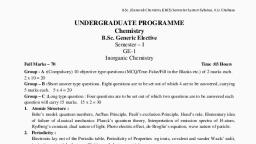
B.Sc. (General) Chemistry (CBCS) Semester System Syllabus, K.U. Chaibasa, , UNDERGRADUATE PROGRAMME, Chemistry, B.Sc. Generic Elective, Semester – I, GE-1, Inorganic Chemistry, Full Marks – 70, , Time :03 Hours, , Group - A :(Compulsory) 10 objective type questions (MCQ/True-False/Fill in the Blanks etc.) of 2 marks each., 2 x 10 = 20, Group – B :Short answer type questions. Eight questions are to be set out of which 4 are to be answered, carrying, 5 marks each. 5 x 4 = 20, Group – C :Long type question : Four questions are to be set out of which two questions are to be answered each, question will carry 15 marks. 15 x 2 = 30, 1. Atomic Structure :, Bohr’s model, quantum numbers, Aufbau Principle, Pauli’s exclusion Principle, Hund’s rule, Elementary idea, of failure of classical mechanics. Planck’s quantum theory, Interpretation of emission spectra of H-atom,, Rydberg’s constant, dual nature of light, Photo electric effect, de-Broglie’s equation, wave nature of paricle., 2. Periodicity :, Electronic lay out of the Periodic table, Periodicity of Properties :eg ionic, covalent and vander Waals’ radii,, ionization potential, electron affinities and electro negativity., 3. Ionic bond :, Lattice energy, Born-Haber cycle, factors favouring ionic bonds, variable valency, properties of ionic, compounds., 4. Covalent bonds :, Formation of sigma and pi bonds, hybridization and directional bonding (Valence Bond Theory), structures, and shapes of BF3, PCl5, SF6, ICl, ClF3, SnCl2, H2O and NH3, properties of covalent compounds., 5. General Chemistry of groups : 1B, IIA, II B, III A, IVA and VA., 6. Extraction of the following elements :, Extraction, Properties, Compounds and uses of the following :, Silver, Gold, Boron, Tin, Lead, Chromium, Manganese and Nickel., 7. Preparation, Properties and uses of the following :, Hydrogen peroxide, Ozone, Silicone, Lunar caustic, Purple of Cassius, Fulminating Gold, Stannous Chloride,, White lead, Diborane, Red lead, Hydrazine, Hydrazoic acid, Hydroxyl amine, Oxyacids of Phosphorus., 8. Co-ordination Chemistry :, Double salt and complex salt, Werner’s theory, Nomenclature of co-ordination compounds, EAN concepts,, VB theory in complexes., Books Recommended, Inorganic Chemistry, 1. Pradeep’s Inorganic Chemistry, Vol.- I, II and III, 2. Dinesh Inorganic Chemistry, Vol.- I, II and III, 3. Text Book of Inorganic Chemistry by P.L. Soni, 4. Selected Topics in Inorganic by Satyaprakash, Malik, Madan and Tuli, 5. Bio Inorganic Chemistry by K. Hussain Reddy, 6. Advanced Inorganic Chemistry by Gurdeep and Harish, 7. Principles of Inorganic Chemistry by Puri, Sharma and Kalia, 8. Inorganic Chemistry, by Moiller., , 1|Page
Page 3 :
B.Sc. (General) Chemistry (CBCS) Semester System Syllabus, K.U. Chaibasa, , UNDERGRADUATE PROGRAMME, Chemistry, B.Sc. Generic Elective, Semester – II, GE-2, Organic Chemistry, Full Marks – 70, , Time :03 Hours, , Group - A :(Compulsory) 10 objective type questions (MCQ/True-False/Fill in the Blanks etc.) of 2 marks each., 2 x 10 = 20, Group – B :Short answer type questions. Eight questions are to be set out of which 4 are to be answered, carrying, 5 marks each. 5 x 4 = 20, Group – C :Long type question : Four questions are to be set out of which two questions are to be answered each, question will carry 15 marks. 15 x 2 = 30, 1. (a) Shape and structure of organic compounds. Tetracovalency of carbon, Hybridization (sp, sp2 and sp3)., (b) Classification and nomenclature of organic compounds, Detection and estimation of elements,, determination of molecular weight., (c) Elementary idea of electron displacement effect : Inductive effect, electrometric effect, resonance and, mesomeric effect., (d) Isomerism : Structural and stereoisomerism , racemic mixtures and Geometrical Isomerism., 2., , Alcohols : Definition, Classification and Distinction between different types of alcohols. Trihydric, alcohol-glycerol : (i) Total Synthesis from C and H (ii) Reactions., Aldehydes and Ketones : General Methods of Preparation, Properties, Electronic nature of C = 0 Group., Carboxylic acids : General methods of Preparation, Properties of monocarboxylic acid and their, derivatives (ester, acid chloride, an-hydride and amide). Origin of acidic properties and electronic nature of, Carboxylic group and its derivatives., Hydroxyacids : Lactic acid, tartaric acid and citric acid-their isolation synthesis, properties, constitution., Isomerism of lactic acid and tartaric acid., Aromatic compounds : Benzene and its mono-substituted derivatives : Toluene, Nitrobenzene, Aniline,, Benzene diazonium chloride, Phenol, Benzaldehyde. Benzene sulphonic acid, benzoic acid (preparation,, properties and uses) Elementary idea of electrophilic substitution in benzene ring., Important reactions : Perkin reaction, Friedel Crafts reaction, Cannizzaro’s reaction, Kolbe’s reaction,, Sandmeyer’s reaction, Reformatsky reaction, Reimer-Tiemann reaction., , 3., 4., , 5., 6., , 7., , Books Recommended, Organic Chemistry, 1., 2., 3., 4., 5., 6., , Advanced Organic Chemistry by Bahl and Bahl, Pradeep’s Organic Chemistry by Pradeep Publication, Dinesh Organic Chemistry, Text Book of Organic Chemistry, Vol.- I and II by I.L. Finar, Text Book of Organic Chemistry, Vol.- I and II by P.L. Soni, Reactions and Reagents by O.P. Agarwal, , 3|Page
Page 4 :
B.Sc. (General) Chemistry (CBCS) Semester System Syllabus, K.U. Chaibasa, , Chemistry, B.Sc. Generic Elective, Semester – II, GE (P)-2, Organic Chemistry (Practical), Full Marks – 30, , Time :04 Hours, , 1. Detection of element [N, S, P and halogens] and detection of functional group in organic compounds, containing one functional group including monosaecharides., – COOH, Phenolic – OH, Aldehydic, Ketonic, Nitro, Amino and amides., 2. Organic preparations :, (i), , Aspirin from salicylic acid., , (ii), , P-methylacetanilide from p-toluidine., , (iii) Acetanilide from aniline., One experiment:, Experiment = 15 Marks, Notebook and Regularity = 10 Marks, Viva-voce = 5 Marks, , 4|Page
Page 5 :
B.Sc. (General) Chemistry (CBCS) Semester System Syllabus, K.U. Chaibasa, , UNDERGRADUATE PROGRAMME, Chemistry, B.Sc. Generic Elective, Semester – III, GE-3, Physical Chemistry, Full Marks – 70, , Time :03 Hours, , Group - A :(Compulsory) 10 objective type questions (MCQ/True-False/Fill in the Blanks etc.) of 2 marks each., 2 x 10 = 20, Group – B :Short answer type questions. Eight questions are to be set out of which 4 are to be answered, carrying, 5 marks each. 5 x 4 = 20, Group – C :Long type question : Four questions are to be set out of which two questions are to be answered each, question will carry 15 marks. 15 x 2 = 30, 1. Gaseous State :, Kinetic theory of gases Postulates, Kinetic gas equation, Deduction of gas laws from kinetic gas equation,, R.M.S. Velocity, Aver-age velocity and Kinetic Energy of Gas molecules, Deviations from ideal behaviour., Vender Waal’s equation of state, 2. Chemical Equilibrium, Law of mass Action and its kinetic derivation, equilibrium constant relation between Kp, Kc and Kx, LeChetelier’s principle., 3. Chemical kinetics, Rate of reaction, order and molecularity of reaction.First and second order reaction.Determination of order of, reaction effect of temperature on reaction rate.Activation enrgy., 4. Thermodynamics- I, System & surrounding, types of system, heat, work and internal energy.First law of Thermodynamics,, Enthaply, Heat Capacities, Relation between Cp and Cv. Calculation of W, Q, E and H in isothermal and, adiabatic expansion of gases., Thermochemistry, Hess’s law, Kirchoff’s law, Bond energies and their calculation., Thermodynamics- II, Second law of thermodynamics.Conversion of heat into work.Carnot theorem and Carnot cycle. Entropy,, entropy changes in reversible and irreversible processes Entropy of expansion of ideal gases. Entropy of, mixing of gases., 5. Dilute solution, Colligative properties, Osmosis and Osmotic pressure, lowering of vapour pressure. Elevation of boiling, point, depression in freezing point., , 5|Page
Page 6 :
B.Sc. (General) Chemistry (CBCS) Semester System Syllabus, K.U. Chaibasa, , 6. Catalysis, Characteristics of catalysts, types of catalysts, enzyme catalyst.Theory of catalysis, autocatalysis., 7. Colloidal chemistry, Classification, preparation, purification and properties of colloidal solution.Peptization of colloids.Protection, of colloids.Origin of charge on colloids.Electrophoresis, coagulation, dialysis, Brownian movement, Gold, number., 8. Electrochemistry, Specific,, , Equivalent, , and, , molecular, , conductivities.Effect, , of, , dilution, , on, , different, , types, , of, , conductivities.Experimental determination of conductivities.Conductivity cell and cell constant.Ionic, mobilities, Kohlrausch’s law, Transference number.Arrhenius theory of electrolytes.Dissociation of weak and, strong electrolytes., , Books Recommended, Physical Chemistry, 1., 2., 3., 4., 5., , Pradeep’s Physical Chemistry, Vol.-I, II and III, Dinesh Physical Chemistry, Vol.-I, II and III, Text Book of Physical Chemistry by Puri Sharma and Pathania, Advanced Physical Chemistry by D.N. Bajpai, UGC Advanced Physical Chemistry by J.N. Gurtu and A. Gurtu, Vol.-I, II and III, , 6|Page
Page 7 :
B.Sc. (General) Chemistry (CBCS) Semester System Syllabus, K.U. Chaibasa, , Chemistry, B.Sc. Generic Elective, Semester – III, GE (P)-3, Physical Chemistry (Practical), Full Marks – 30, 1., 2., 3., 4., 5., , Time :04 Hours, , Determination of surface tension of liquids using stalagmometer., Determination of co-efficient of viscosity liquids using Ostwalds viscometer., Determination of Heat of solution., Determination of Heat neutralization of strong acid and strong base., Determination of Partition co-efficient of solute between two immiscible liquids., e.g. Iodine between carbon tetrachloride and water., One experiment:, Experiment = 15 Marks, NB and Regularity = 10 Marks, Viva-voce = 5 Marks, , 7|Page
Page 8 :
B.Sc. (General) Chemistry (CBCS) Semester System Syllabus, K.U. Chaibasa, , Chemistry, B.Sc. Generic Elective, Semester – IV, GE-4, Analytical Chemistry, Full Marks – 70, , Time :03 Hours, , Group - A :(Compulsory) 10 objective type questions (MCQ/True-False/Fill in the Blanks etc.) of 2 marks each., 2 x 10 = 20, Group – B :Short answer type questions. Eight questions are to be set out of which 4 are to be answered, carrying, 5 marks each. 5 x 4 = 20, Group – C :Long type question : Four questions are to be set out of which two questions are to be answered each, question will carry 15 marks. 15 x 2 = 30, 1. Qualitative analysis of Inorganic salts :, Principle involved in the separation of cations. Application of solubility product and common ion, effect.Detection and removal interfering radicals (eg.PO43-, BO33-)., Special tests for the mixture of acid radicals –, (i), , Carbonate in presence of sulphite, , (ii), , Nitrate in presence of Nitrite., , (iii), , Nitrate in presence of bromide and iodide., , (iv), , Chloride, Bromide and Iodide in presence of each other., , 2. Principles involved in volumetric analysis –, (i), , Acidimetry and alkalimetry., , (ii), , Principles involved in the red-ox titrations : uses of KMnO4 and K2Cr2O7, , (iii), , Iodometry and iodimetry., , 3. Detection of elements and functional groups in the organic compounds., Elements : N, P, S and halogens., Functional groups : Hydroxyl, -OH (alcoholic), Nitro, -NO2, Amide – CONH2,, Ketonic =C=O, Aldehydic – CHO, Carboxylic – COOH, Phenolic – OH, Amino – NH2, 4. Spectroscopy :, Ultraviolet and visible spectra (electronic spectra).Uses of UV and visible spectra. Infra-red (IR), Nuclear, magnetic resonance (NMR) uses of IR and NMR spectra., 5. Organic reagents in inorganic analysis :, (i), (iv), (vii), (x), , Dimethyl glyoxime, , (ii), , – Furil dioxime, , - nitroso – -naphthol (v) Cupron, Alizarin, – Dipyridyl, , (viii) Salicylaldoxime, (xi) Nitron, , (iii) 8-hydroxy quinoline, (vi) Cupferron, (ix)Dihydroxy tartaric acid, (xii)Dithiazone, 8|Page
Page 10 :
B.Sc. (General) Chemistry (CBCS) Semester System Syllabus, K.U. Chaibasa, , Chemistry, B.Sc. Generic Elective, Semester – IV, GE(P)- 4, Chemistry Practical, Full Marks – 30, , Time :04 Hours, , 1. Gravimetric estimation of Ag+, Ba2+, Cl- and SO422. Preparation of potash alum., 3. Preparation of chrome alum., , One experiment :, Experiment = 15 Marks, NB and Regularity = 10 Marks, Viva-voce = 5 Marks, , 10 | P a g e