Page 2 :
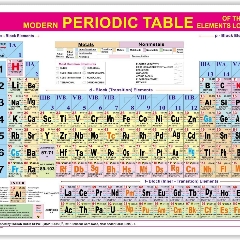
x a, , Dee f, 4. The anguiar momentum of an electron in a given stationary Values | Name of Val f : z 6 4, falues of m No. of | No.9!, nl, state can be expressed as mvr = Ll where n=1, 2, 3... of ¢ | Sub shell orbitals | eleSPOns, 20, 0, . Dual behavior of matter 1 < 2 : :, ‘ sss 1,0,1 6, (Louis de Broglie Principle) Radiation almyeonic S.emlanzenag 2 ; 2 :, enna Matter go Particle-ocgargo WaVe-ar@ jo eat misicuemnd stb ae $ L, 203m} 3 f 3, -2,-10, +1, 42,43) 7 14, , , , , , , , , , , , , , iv. Spin quantum number (s), , A is wavelength of matt Ss, M i, 9) ler waves, m is the It helps to explain the magnetic properties of substances., , It indicates the direction of spin of the electron, i.e., clockwise or anti clockwise (+% or -%)., , , , mass of particle, V is the velocity and p is its momentum., , ._Heisenberg’s Uncertainty Principle 17. Aufbau Principle, 8G MIDe G3 Peise(s2amlocj manIMaVYo (position) momentum In the ground state of the atoms the orbitals are filled in the, Do G)O)2IT AgRZaiS1e0j36 GrMIuyaIeN order of their increasing energies., h, Ax. Ap > = 18. Pauli’s exclusion Principle, 7, a No two electrons in an atom can have the same set of four, Ax is the uncertainty in position, Ap uncertainty in momentum quantum numbers., and 'h'is the pianks, pl constant. 19. Hunds rule of maximum multiplicity, , . Quantum Numbers Pairing of electrons in an orbitals of same energy will not take, , 603 ERYTDOA DaseS2nZe0g8.09}o2a8 aluasmid (location, place until each orbital is singly filled., , , , , , , , energy, the type of orbital occupied shape and orientation of Shape of Orbitals, that orbital etc) mm@agand mamaleazm mel mnejaogwat | i, NemMyav' agang aisleagmer. \ oy =, i, Principal quantum number (n) we * fee ae AS, It determines the size of the orbital and energy of Te Arey (avert tes Es ss, electron., n=1,2,3,4,...., K,L, M,N., The maximum number of electrons present in any shell is, given by 2n? wnere n is the number of principal shell., ii. Azimuthal quantum number (1), {t determines the three dimensional shape of the orbital *, and the angular momentum ef the electron. 20. Mandeleev's periodic law das mal, TeOwigel) It states that the physical and chemical properties of elements ¥, n=1, ¢=0 are the periodic function of their atomic mass., n=2, ¢=0,1 21. Modern periodic law, n=3, ¢é=0,1,2 It states that the physical and chemical properties of elements, . _— are periodic functions of their atomic numbers,, , =4, = ,, n=4, é=0,1,2,3 22 Blocks in the periodic table, , , , , , Value of ¢ o;1}|2) 3 General electronic configuration, , Blocks in the periodic, table, , , , , , , , , , Designation of Subshell | s | p | d | f, , , , , , , , , , , , , , iti, Magnetic quantum number (m), , It determines the number of preferred orientations of the, electrons present in the subshell,, , m=-60,+¢, , , , , , , (n-t)d 140g to2, (n-2)f# (n- 4)d0-ns?, , __|




 Learn better on this topic