Page 1 :
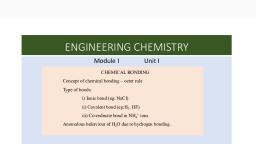
Chemical Bonding, Kossel Lewis approach to chemical bonding:, According to this theory, the valency of an element is the number of electrons that, its atom can gain, lose or share to acquire stable nearest noble gas configuration., Depending upon the mode of acquiring nearest noble gas configuration, there are, three common types of bonds:, 1. Ionic bond, 2. Covalent bond, 3. Coordinate or Dative or Co-ionic bond, Apart from these chemical bonds, there are some physical bonds(which are, electrostatic in nature). The main types of physical bonds are:, 1. Hydrogen bond, 2. Metallic bond, 3. Vander Waal’s interactions., Electrovalent bond : The electrostatic force of attraction developed between two, oppositely charged ion formed due to the transfer of electrons from a highly, electropositive atom to a highly electronegative atom, results into a bond called, electrovalent bond. Since the bond is formed between the oppositely charged ion,, it is also called ionic bond. The compounds formed as a result of ionic bond is, termed as ionic compounds or electrovalent compounds. The number of, electrons which an atom loses or gains while forming an ionic bond is known as its, electrovalency., Lewis or Dot structure of Ionic compounds:, Sodium chloride(NaCl)
Page 2 :
Lithium oxide(Li2O), , Ignore the shells and draw only the electrons to represent the Lewis dot structure, , Magnesium oxide(MgO), , Calcium oxide(CaO)
Page 3 :
Sodium sulphide(Na2S), , Q. Draw the Lewis dot structure of Magnesium fluoride(MgF2), Conditions necessary for the formation of ionic bond:, 1. Low ionisation energy: During the formation of an ionic bond one atom has, to lose electron to form cation, for which it has to gain or absorb energy.This, energy is termed as ionisation energy., Na + energy → Na+ + eLower the ionisation energy higher will be the tendency to lose electron and, undergo ionic bond formation., 2. High electron gain enthalpy of nonmetals: During the formation of an, ionic bond one atom has to gain electron to form an anion. This is, accompanied by the release of energy known as electron gain enthalpy., Cl - e- → Cl- + energy, Since the energy is released during the formation of an anion, therefore,, greater the value of electron gain enthalpy, greater will be the ease of, formation of anion and more will be the tendency of an atom to undergo, ionic bond formation., 3. High lattice energy: Lattice energy is the amount of energy releasedwhen, oppositely charged ions get packed closely to form one mole of crystalline, solid. Higher the lattice energy higher will be the stability of ionic crystals, and greater attraction between cations and anions., It depends on the following:, Size of cation:, Strength and stability of ionic bond α, , 1, 𝑠𝑖𝑧𝑒 𝑜𝑓 𝑐𝑎𝑡𝑖𝑜𝑛𝑠, , Charge on ions:, Strength and stability of ionic bond α Charge on ions, 4. Electronegativity difference between the reacting atoms: For the, formation of ionic bond there should be large electronegativity difference, between the combining atoms.
Page 4 :
Variable electrovalency:, Heavier p-block elements(with high atomic number), transition and inner transition, elements exhibit more than one valency.eg Iron exhibits an electrovalency of 2 and, 3, tin 2 and 4 and copper 1 and 2. These elements are said to possess variable, valency., Reason for variable electrovalency: Elements show variable electrovalency due, to the following reasons:, Unstable electronic configuration of an ion, Inert pair effect, Unstable electronic configuration of an ion:, When an atom loses valence electrons, the cation called kernel or core is left, behind. This cation exhibits variable valency if it has more than 8 electrons in its, outermost energy level. This happens in case of transition and inner transition, elements., For eg:, 26Fe, , = [Ne]3s23p63d64s2, , Fe2+ = [Ne]3s23p63d6 Fe3+ = [Ne]3s23p63d5, , 29Cu, , = [Ne]3s23p63d104s1, , Cu+ = [Ne]3s23p63d10 Cu2+ = [Ne]3s23p63d9, , Fe3+ and Cu2+ does not lose more electrons because of increase in effective nuclear, charge. Due to this the force of attraction between the nucleus and the remaining, electrons increases and the energy required to overcome this force is not available, in ordinary chemical reactions. Thus these elements do not exhibit higher, valencies., Inert pair effect:, There are certain elements particularly the heavier ones which show lower valency, also. It is due to the non participation of their s-electrons in bonding. Such a pair of, electrons which do not participate in bonding is known as inert pair and the, reluctance of an electron pair to take part in bonding is known as inert pair effect., Thus due to inert pair effect only p-electrons are lost and the ions formed have, lower positive charge, For eg:
Page 5 :
s-electrons penetrate more closer to the nucleus. Therefore these electrons being, nearer to the nucleus are more tightly held by it. Consequently, the energy required, to ionise these electrons is very high and therefore s-electrons have less tendency, to participate in bonding., Characteristics of electrovalent bond:, 1. All ionic compounds are usually crystalline solids and are composed of ions, even in solid state., 2. Ionic solids have high melting and boiling points., 3. Ionic compounds have low volatility, high density and high stability., 4. These are highly soluble in polar solvents like water., 5. In molten or in aqueous state they are good conductors of electricity., 6. In solution, ionic compounds undergo ionic reactions, which are very fast., 7. Crystals of certain ionic compounds have similar arrangement of atoms as, well as geometry. Such crystalline compounds are called isomorphs. Eg, ZnSO4.7H2O etc., 8. Ionic compounds are non directional as a result of which it does not exhibit, isomerism., 9. Ionic crystals are hard and brittle., Covalent Bond:, The bond formed between two or more atoms of the same or different elements by, mutual sharing of electrons in order to complete their octets or duplets (in case of, hydrogen) is called a covalent bond. It may be single, double or triple depending, upon their number of sharing the electrons., Examples:
Page 6 :
Polar character of covalent bond
Page 7 :
A non polar covalent bond is formed between two similar atoms having the same, electronegativity or zero electronegativity difference. For example: H2, O2, F2,, Cl2 etc. such molecules are called non polar molecules., A polar covalent bond is a covalent bond formed between two dissimilar atoms, having different electronegativity. The molecules like HF, H2O, NH3 are called, polar molecules. Greater the electronegativity difference, more polar is the bond, Dipole Moment(μ), The magnitude of polarity of a molecule is expressed quantitatively by its dipole, moment (μ) which is equal to the amount of charge (q) on either end of the, molecules, multiplied by the distance between the charge (d).ie.,, μ=q×d, As ‘q’ is inthe order of 10-10 esu and ‘d’ is in the order of 10-8 cm, μ is in the order, of 10-18 esu cm. Dipole moment is measured in Debye unit(D)., 1D = 10-18 esu cm = 3.33 × 10⁻³⁰ coulomb metre, Dipole moment is indicated by an arrow head (, ) pointing towards more, electronegative atom. Dipole moment of a particular covalent bond in polyatomic, molecules is referred to as bond dipole or bond moment. Bond dipoles can be, treated as vectors., Application of Dipole moment, i), , ii), , To decide the extent of polarity in covalent bond, Greater the magnitude of dipole moment, greater will be the polarity of, molecule. Molecules having zero dipole moment are said to be non-polar, molecules and those having μ ≠ 0 are polar in nature., To determine the percentage of ionic character, Percentage of ionic character =, 𝐸𝑥𝑝𝑒𝑟𝑖𝑚𝑒𝑛𝑡𝑎𝑙 𝑣𝑎𝑙𝑢𝑒 𝑜𝑓 𝑑𝑖𝑝𝑜𝑙𝑒 𝑚𝑜𝑚𝑒𝑛𝑡, 𝑇ℎ𝑒𝑜𝑟𝑒𝑡𝑖𝑐𝑎𝑙 𝑣𝑎𝑙𝑢𝑒 𝑜𝑓 𝑑𝑖𝑝𝑜𝑙𝑒 𝑚𝑜𝑚𝑒𝑛𝑡, , iii), iv), , × 100, , Predicting the shape of molecules and their symmetry, If the molecule contains similar atoms linked to the central atom with, polar bonds and the net dipole moment is zero, it implies that the shape, of the molecule is symmetrical. For example:
Page 8 :
Boron trifluoride molecule, , Water molecule, , Methane molecule, , Ammonia molecule
Page 9 :
Formation of molecules, , Ethane molecule, , Ethene molecule, , Ethyne molecule, , Ammonia molecule
Page 10 :
Draw the lewis dot structure for the formation of methane and carbon dioxide., Sigma (σ) Bond, This type of bonds are formed by the head on overlapping of the half filled atomic, orbitals along the inter nuclear axis. It may involve s-s, s-p or p-p overlapping. It is, a strong bond because extent of overlapping is large.
Page 11 :
Pi (π) Bond, This type of bond is formed by the sidewise overlapping of half filled atomic, orbitals in a direction perpendicular to the inter nuclear axis. It involves p-p, overlapping. It is a weak bond because extent of overlapping of atomic orbitals is, very small. These bonds do not affect the shape of the molecules., , Characteristics of covalent compounds, i), ii), iii), iv), , v), vi), , Covalent compounds exist as discrete molecules. They exist as solid,, liquid and gaseous state., They have low melting and boiling points. There are few exceptions like, diamond, silica, etc., These compounds do not conduct electricity in solid, molten or in, solution due to the absence of free ions., Covalent compounds are generally soluble in non-polar solvents such as, CCl4, CHCl3, C6H6 etc., but soluble in polar solvents like water. Glucose,, sugar, urea, methanol, acetone., are water soluble because they form, hydrogen bonds with water molecule., Covalent bond has directional character. They have definite molecular, geometry. They may exhibit stereoisomerism., Covalent compounds show molecular reactions which are slow reactions., , Variable covalency, The number of valence electrons which an atom can share with electrons of other, atoms to form covalent bonds is called its covalency. Covalency can also be, defined as the number of covalent bonds made by an atom of the element with
Page 12 :
other atoms. The elements having vacant d-orbitals in their valency shell like P, S,, Cl, Br, I show variable covalency by unpairing the paired and shifting the electrons, to vacant d-orbitals., Valency of Phosphorus = 3 and 5, Valency of Sulphur = 2, 4 and 6, Valency of Chlorine = 1, 3, 5 and 7, Formal charge of ions, Formal Charge = [Total number of valence electrons on free atom] - [Total number, of electrons as lone pairs] -, , 1, 2, , [Total number of shared electrons], , F.C = V – L -, , 𝑆, 2, , Calculation of formal charge of C in carbon dioxide, , Calculation of formal charge of O in Ozone molecule
Page 13 :
Deviation from octet rule, Sidgwick’s maximum covalence rule – According to this rule, the maximum, covalency of an element is limited according to the period in the periodic table in, which it occurs. For example it is 1 for hydrogen, 4 for the elements of the second, period 6 for those of the third and the fourth periods and 8 for the rest., Sugden’s view of the singlet linkage – According to Sugden, the octet rule is never, violated but in certain molecules the atoms are linked not only by covalent bonds, but also by other type of bond known as singlet linkage or simply singlet which, involves sharing of one electron between two atoms. It is also called single, electron linkage or half bond., , Fajan’s Rule: Polarizing power and Polarizability, Due to the difference in electronegativity of bonded atoms, polar character arises, ina covalent bond. Similarly, it has been observed that some covalent character is, also present in an ionic bond. For example, Li+Cl- is expected to be purely ionic.
Page 14 :
However, its solubility in organic solvents indicates that it possesses covalent, character too. Covalent character of an ionic compound can be explained on the, basis of Fajan’s rules., The power of an ion to distort the electron cloud of another ion is called its, polarizing power and the tendency of an ion to get polarised by the other ion is, called its polarizability., As the size of anion is larger than cation, and its electrons are less tightly bonded to, the nucleus, it possesses high polarizability. Greater the polarisation or distortion,, greater is the covalent character., Factors affecting polarization or covalent character of ionic bonds, 1. Small size of cations: Smaller the size of cation, greater the attraction for the, electrons of anions. Hence, greater will be its polarizing power. For, example, polarizing power of Li+ is greater than that of Na+., 2. Large size of anion: Larger the size of an anion, less tightly its electrons will, be held by the nucleus. Hence, large anions can be polarised more easily., Thus I- can be polarised more easily by a cation as compared to Cl- ion., NaI > NaBr > NaCl, 3. Large charge on either of the two ions: With the increase in charge on the, ions, electrostatic attraction of the cation for the outer electrons of the anions, also increases. Consequently, the covalent character of the bond increases., Al3+Cl-3 > Mg2+Cl-2 > Na+Cl4. Electronic configuration of the cation: Out of the two ions having same size, and charge, the ion with a pseudo noble gas configuration (having 18, electrons in its outermost shell) will have higher polarising power than a, cation with a noble gas configuration (having 8 electrons in the outermost, shell), 5. Presence of medium: Polar medium keeps the ions separated from one, another and hence prevents polarisation., Comparison between Electrovalency and Covalency, Electrovalency, Favoured by low positive charge, on cation., , Covalency, Favoured by high charge on, cation.
Page 15 :
Favoured by large size of cation., Favoured by low charge on, anion., Favoured by small size of anion., Favoured by cations having 8, electrons or noble gas electronic, configuration., , Favoured by small size of cation., Favoured by high negative, charge on anion., Favoured by large size of anion., Favoured by cations having 18, electrons or pseudo noble gas, configuration., , Hybridisation and shapes of molecules, Hybridization is the concept of intermixing of the orbitals of an atom having nearly, the same energy to give exactly equivalent orbitals with same energy, identical, shapes and summetrical orientations in space., Hybridization involving s, p and d orbitals, , Note: sp2d is not included in the syllabus.
Page 19 :
VSEPR Theory (Valence shell electron pair repulsion theory), The main postulates of this theory are:, i), , ii), iii), , iv), v), , The unpaired electrons in the valence shell of control atom form bond, pairs with the unpaired electrons of surrounding atoms while paired, electron remain as lone pairs., Being similarly charged, the bond pairs as well as the lone pairs tend to, tend to repel one another., Electron pairs around the central atom can adjust themselves with respect, to one anotherin such a way that the force of repulsionamong them is, maximum., The force of repulsion is minimum when the electron pairs are far away, from one another., The force of repulsion among the bond pairs and the lone pairs is not the, same. The order of force of repulsion is as follows
Page 20 :
Lone pair-lone pair repulsion > Lone pair-bond pair repulsion > Bond pair-bond, pair repulsion., The bond angle in methane with sp3 hybridisation is 109˚28’ or 109.5˚. Ammonia, and water which also exhibit sp3 hybridisation has a bond angle 107.5˚ and 104.5˚, respectively. Explain., Molecular orbital theory:, Limitations of valence bond theory:, This theory does not give any evidences of the formation of a coordinate, bond in which one of the bonding atoms furnishes both the electrons., The two atoms of oxygen molecule should have close electronic shells, resembling those of neon which would give no unpaired electronsto the, molecule and thus will make it diamagnetic. Actual experiments show that, oxygen molecule is paramagnetic, indicating the presence of unpaired, electronin oxygen molecules., This theory does not consider the formation of odd electron molecules or, ions where no pairing of electrons occur., It fails to explain the bonding in metals and intermetallic compounds., Molecular orbital theory(MOT), According to this theory, the atomic orbitals of the bonded atoms lose their, identity. They mix up or coalesce to form molecular orbitals. The salient features, of molecular orbital theory are:, i), ii), iii), iv), v), , Molecular orbitals may be defined as the regions in space in which, electrons are more likely to be formed., The wave function of an electron in a molecule is called molecular, orbital., Molecular orbitals are obtained by combining atomic orbitals of, comparable energies., When a set of atomic orbitals combine to form molecular orbitals , the, number of molecular orbitals equals to the number of atomic orbitals., The atomic orbitals combine to produce two molecular orbitals, one of, these possesses lower energy and is termed as bonding molecular, orbital,while the other with higher energy is termed as antibonding, molecular orbital.
Page 21 :
vi), vii), , Each molecular orbital can accomodate two electrons with opposite spins, The molecular orbitals are arranged in the increasing order of their, energies. These are filled in the same way as the atomic orbitals are filled, in case of atoms., viii) Electron pairing in degenerate molecular orbitals cannot take place unless, each degenerate molecular orbital is singly occupied.
Page 22 :
Molecular orbital diagrams, O2 (Oxygen molecule), , Bond Order =, , 10−6, 2, , = 2, , Magnetic property: Paramagnetic (Due to the presence of unpaired electrons)
Page 23 :
O2+ (Dioxygenyl ion), , Write the electronic configuration of O2+, calculate the bond order and state its, magnetic property, , Calculate the BO and state the magnetic property, O2-, , Calculate the BO and state the magnetic property
Page 26 :
Question, , , , , , Draw the molecular orbital diagram of N22Write its electronic configuration, Calculate the bond order, State its magnetic property., , Coordinate Bond or dative covalent bond:, Coordinate bonding is a special type of covalent bonding where the shared pair of, electrons is supplied only by one of the atoms forming the bond. The atom A, which supplies the shared pair of electrons is known as donor while the atom B, which only uses the shared pair of electrons is known as acceptor., The dative bond is shown by (→) sign. Head of the arrow is towards acceptor, atom, ie., A → B. Dative bond is directional bond.
Page 28 :
Hydrogen Bonding, Electrostatic force of attraction between hydrogen atom of one molecule and a, highly electronegative element (such as N, O or F) present within the same, molecule or another molecule of the same or different compounds is known as, hydrogen bond., Only nitrogen, oxygen and fluorine form strong hydrogen bonds because they have, high value of electronegativity and small atomic size., It is a weak bond because it is merely an electrostatic force and not a chemical, bond. Its strength depends upon the electronegativity of atom to which H atom is, covalently bonded. Since electronegativity of F > O > N, the strength of H – bond, is in the orderH – F......H > H – O......H > H – N......H, Conditions of hydrogen bonding:, i), ii), , High electronegativity of the atom bonded to hydrogen atom so that bond, is sufficiently polar., Small size of the atom bonded to hydrogen so that it is able to attract the, bonding electron pair effectively., , Types of Hydrogen bonds, There are two different types of hydrogen bonds
Page 29 :
i), , Intermolecular hydrogen bonding: This type of bond is formed between, the two molecules of the same or different compounds.
Page 30 :
ii), , Intramolecular hydrogen bonding: This type of bond is formed between, hydrogen atom and N, O or F atom of the same molecule.Intramolecular, hydrogen bonding (chelation) decreases the boiling point of the, compound and also its solubility in water by restricting the possibility of, intermolecular hydrogen bonding.