Page 1 :
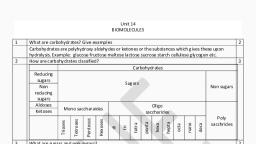
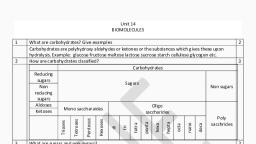
5.2 Classification and Nomenclature of Carbohydrates, bydodha, 5.2 Classification and Nomenclature of Carbohydrate., everse of, The names of most of carbohydrates are characterised by the ending-ose', Thus we have, glucose, fructose, sucrose, cellulose, and so on., or not, The carbohydrates are divided into three major classes depending upon whether, they undergo hydrolysis, and if they do, on the number of products formed., are polyhydroxy aldehydes or, polyhydroxy ketones which cannot be decomposed further by hydrolysis to oiue, simpler carbohydrates. Examples are glucose and fructose, both of which bo, molecular formula, C,H12O6, 1., Monosaccharides:The monosaccharides, Ht, No reaction, C,H1206, + H,O, Glucose of Fructose, hne, Oligosaccharides: The oligosaccharides (Greek, Oligo, few) are carbohydrates, which yield a definite number (2-9) of monosaccharide molecules on hydrolysis., They include, disaccharides, which yield two monosaccharide molecules on, hydrolysis. Examples are sucrose ,maltose, lactose,cellobiose etc. So, if sucrose has, molecular formula, C2H2O1, it upon hydrolysis gives a pair of two compounds., 2., H*, G2H22O1 + H20, → C,H12O6 + C6H12O6, Sucrose, leuran, Glucose, Fructose, Even trisaccharide is a type of oligosaccharide, and it yields three monosaccharide, molecules upon hydrolysis. Example is, raffinose, which has molecular formula., GHO16, vfoninat, H+, C8H32O16 +2H2O, CH12O6 + CgH12O, + C,H12O6, Raffinose, Glucose, Fructose, Galactose
Page 2 :
those carbohydrates which have the ability to reduce Fehling's solution and Tollen's, An interesting fact is that the monosaccharides and oligosaccharides are crystalline, and cellulose, both of which have molecular formula, (CH1005)n, The carbohydrates may also be classified as either reducing or non-reducing sugars. All, ragent are referred to as reducing sugars. Whereas others are non-reducing sugars because, 5.2.1 Sugars and Non-Sugars e 1, 5.2.2 Reducing and Non Reducing Sugars, solids, soluble in water and sweet to taste. They are collectively known as sugars.", on the other hand, are amorphous, insoluble in water and tasteless., Polysaccharides: The polysaccharides a, 2 Ketose, which contains a ketone group along with hydroxyl group., which yield many monosaccharide molecules on hydrolysis. Examples are starch, 185, carbohydrates of high molecular weight, are, nH,O, → nCH12O6, (CH10O5)n +, Cellulose, Glucose, grade, 21 Sugars and Non-Sugars, e air, polysaccharides,, called, The, non-sugars., They are, ve, Dt, on not reduce a Fehling solution or a Tollen's reagent. All monosaccharides and the, icacharides other than sucrose are reducing sugars., aabhedboseonoM to nolisugino) 12, 5.3 Monosaccharides, The monosaccharides are the most fundamental unit of carbohydrate chemistry, it is, because all carbohydrates are either monosaccharides or are finally converted into, aldenydes or polyhydroxy ketones. So, on this basis, there are two main classes of, monosaccharides., monosaccharides upon hydrolysis. The monosaccharides are either polyhydroxy, e noceo (Inir), * Aldose, which contains an aldehyde group along with hydroxyl group., bom bik be le, a, are, ketohexoses, etc., Loral formulae,