Page 1 :
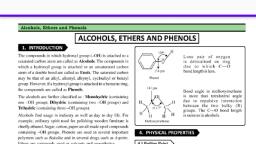
ALCOHOLS, PHENOLS AND EHTERS;, , aapTER ALDEHYDES AND KETONES, CHAPTER, , INTRODUCTION, , Alcohols, phenols and ethers are oxygenated organic compounds as they contain oxygen, atoms. Alcohols and phenols are organic compounds Containing one or more hydroxyl aie, When the hydroxy! group is attached to an alkyl radical, it is called an alcohol and when, it is directly attached to an aromatic ring, it is called a phenol. Compounds in which an, oxygen atom is bonded to two alkyl or aryl radicals are called ethers., , Aldehydes and ketons are organic compounds containing carbonyl group in which a, carbon atom is linked to an oxygen atom through a double bond., , 6.1 ALCOHOLS, , Alcohols are regarded as hydroxy derivatives of alkanes., CH, —sy> CH,OH, Methane Methanol, , Although alcohols contain one or more hydroxyl groups, all organic compounds containing, hydroxyl groups are not alcohols. In alcohols carbon atom carrying the —OH groups is not, , linked to other atom, except carbon and hydrogen., , f i, |, CH,—C—OH CH,—C—OH, H, Ethanol (alcohol) Ethanoic acid (not alcohol), , In alech, \ dye, p bigots, both oxygen and the carbon atom attached to it are sp hybridized. Two, Cay orbitals of O-atom linearly overlap with 1s orbital of H-atom and sp’ hybrid orbital, , een forming O—H and C—O sigma bonds, while the remaining two sp> hybrid, WY ntain lone pairs of electrons. In methanol C—O—H bond angle is 108.5° and, , nd | :, Sngth is 142 pm. (Figure 6.1), , Scanned with CamScanner
Page 2 :
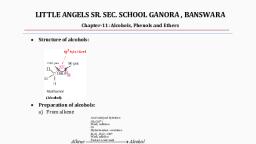
178 m New Approach to College Chemistry, , al, , sp’( )sp’, , 5, , , , Fig 6.1 (a) Orbital structure of methanol (b) Bond length and bond angle in methanol, 6.1.1 Classification of Alcohols :, , Alcohols are classified into mono, di, tri and polyhydric alcohols according to whether, have one, two, three or many hydroxy] groups, respectively. Monohydric alcohols are further, , classified into primary, secondary and tertiary, depending upon whether the -OH group is, attached to the 1°, 2° or 3° carbon atom. Thus, a primary alcohol is characterized by the group, , —CH,OH, a secondary alcohol by >>CHOH, and tertiary alcohol by >>C—OH., , , , , , ee, J } |, Monohydric Dihydric Trihydric Polyhydric, , CH,OHCH,OH CH,OHCHOHCH,OH CH,OH, , Glycol (Glycerol) |, , (Glycol) ly (Guoro,, Primary (1°) | Secondary (2°) Tertiary (3°) CH,OH, CH,CH,OH CH,CHOHCH, (CH,),COH (Sorbitol), (Ethanol) (Propan-2-ol) (2-Methylpropan-2-ol), , 6.1.2 Nomenclature of Alcohols, , According to the IUPAC system, alcohols are named by adding the suffix 7 arte, end of the name of the parent hydrocarbon chain (longest chain) of the molecule. ie iE ., the last letter ‘e” from the name of parent chain is dropped before adding the su vals (1, The position of the —OH group in the parent chain is indicated by appropriate ee vay, 2, 3, etc.) called locant numbers. For this, the carbon chain is to be numbered in the IUPAC, that the lowest possible locant number can be given to the —OH group. Thus,, name of, , CH,CH,CH,OH is propan-1-ol, CH, — CH — CH, is propan-2-ol, , |, , OH, , Scanned with CamScanner
Page 3 :
Chapter-6: Alcohols, Phenols, , and Ehters; Aldeh:, Aldehydes and Ketones m 179, , _-CH—CH,CH,CH, is pentan, , cH, 2-01, OH, re than one —OH group is Present, th i,, : re indicate their positions. © words di, tri, etc., are used before, ix, wes CH,—CH, , 2s, le, is ethane-1,2-diol,, or example b ij by iol, , Jd be noted that as the first letter of the ate, seal of the word ethane is retained, Suffix (diol) is a consonant, the letter, ¢ a, , The IUPAC and common names of some important alcohols are listed in Table 6.1, Table 6.1 TUPAC and common names of a few alcohols :, , , , , , , , , , Formulae — Common Name TUPAC Name, CH,OH Methyl alcohol Methanol, , C,H,OH Ethyl alcohol Ethanol, CH,CH(OH)CH, Isopropyl alcohol Propan-2-ol, (CH,),C-OH t-Butyl alcohol 2-Methylpropan-2-ol, CH,CH(OH)CH,CH, Sec-butyl alcohol Butan-2-0l, CH,OHCH,OH Ethylene glycol Ethane-1,2-diol, CH,OHCH,CH,OH a,y-Propylene glycol | _Propane-1,3-diol, CH,OHCHOHCH,OH Glycerol Propane-1,2,3-triol, , , , , , , , 6.1.3 General Methods of Preparation of Monohydric Alcohols, , Monohydric alcohols are prepared by the methods described below., |. Hydration of alkenes: Alkenes undergo addition of water in the presence of sulphuric, acid catalyst to form alcohols., , For example, CH,=CH, —-> CH,CH,OH, ‘When the alkene is unsymmetrical, the addition occurs in accordance with Markovnikoff, rule. Thus, hydration of propene results in the formation of propan-2-ol., , -—> CH,—CH—CH, Markovnikoff product, OH (Majorproduct), , CH,—cH= CH, a, , , , L_» CH,CH,CH,OH (Minorproduct), acids and esters: Aldehydes and, , ae ene keboness hols by a wide variety of reducing, , “ones can be reduced to the corresponding alco, , Scanned with CamScanner
Page 5 :
Chapter-6: Alcohols, Phenols and Ehters, > Aldehydes and Ki, etones @ 181, , , , , , Oo y R’, sé ¢ —»r_d_8u2 |, rity + RO —C—OMgx —Hot,, Mex Np ] R iene, R"” R”, ; 3-A, js of esters: Ester on acid or alkaline hydrolysis pmol, Heotel and, , rolyse i G lly, alkali i, 4 pyd fic acid or its salt. Generally, alkaline hydrolysis of ester is:, i tion of alcohols. . : ici oe, prepare x - +, RCOOR’ + NaOH —*-» RCOONa+ R/OH, RcooR’ + H,O —> RCOOH + R'OH, mines: Primary amines on treatment with nitrous acid (NaNO, + HCl), , ‘rom a - . °, ry alcohols with the liberation of nitrogen., , * oduces primal, RCH,NH, + HNO, —N:NO&:+HC_, RCH.OH + N, + H,O, , x14 Physical Properties of Alcohols, , () The lower monohydric alcohols are colourless, neutral liquids with characteristic smell, and burning taste., @ Lower alcohols like methanol, ethanol, and propanol are miscible with water. Alcohols, with four to eleven carbon atoms are oily liquids slightly miscible with water. Higher, alcohols are waxy solids insoluble in water. The solubility of lower alcohols in water, , is due to their ability to form hydrogen bonds with water., R H -R, 51, —H—-O—H— O0—, With an increase in the length of the carbon chain, the alcohols become unable, to form hydrogen bonds with water and therefore become insoluble in water., , (@) The boiling points of alcohols are considerably higher than those of the corresponding, ori This is because alcohol molecules can form strong intermolecular hydrogen, , R R R, | sal 3 8, Re O—H = O—H-—— O —H, hols e ue of energy is required to break the hy:, be this raises their boiling points. . higher boiling, Point th 8 isomeric alcohols, the normal or straight chain alcohols have e" Sonar, Secon, an those with branched chains. Thus, the boiling points of isomeric P' el, batching and tertiary alcohols vary in the order 1° 7 7° > 3° due to inc, 8 and reduced surface area in secondary and tertiary alcohols., , = drogen bonds existing in liquid, , Scanned with CamScanner