Page 2 :
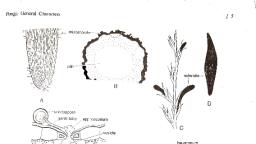
It is a cosmopolitan genus, but especially well represented in the tropics. It generally inhabits dead wood, rarely dung or dry fruits in wet and shady places., All the species vary somewhat in shape and size. However, the general habit is fairly characteristic. The stromata are erect, more or less stalked, simple or branched and sometimes forked, more or less Club-shaped, cylindrical or fusiform (Fig. 251A to C), flesh white or pale buff to black. Xylaria polymorpha is commonly known as dead man's finger for its typical stromata.
Page 6 :
Perithecia are with protruding tips (Fig. 251G to F); Asci are cylindrical 8-spored and are mixed with paraphyses (Fig. 251F, G). The ascus tip contains a blue-staining apical apparatus pierced by a narrow pore. Ascospores are uniseriate, fusiform, inequilateral (i.e., with one side more strongly curved than the other) and often with a hyaline equatorial germ pore, non-septate, dark-brown to black at maturity (Fig. 251G, H).
Page 7 :
From the ascospores develops an extended mycelium. Mycelial hyphae unite into thick strands; these, grow tall and show an intense heliotropism so that even when under bark or tree trunks they easily come to the outer surface. They are first differentiated into a black pseudoparenchymatic rind and a light fibrous core and then gradually develop to the cylindrical, clavate or branched black fructifications., The growing tip of the stroma remains white for a long time and is covered with a strikingly regular hymenium of palisade-like conidiophores which, if unicellular, cut off ovoid conidia; if they are multicellular, however, at any position they cut off fusiform conidia at their tips.
Page 8 :
The conidia form a white coating in marked contrast to the exposed portions of the black stroma, and justify the name “candle-snuff fungus”. After the disappearance of conidia, the stromatal branches swell clavately in the upper part and proceed to form perithecia. If the stroma is sectioned during the conidial stage, nests of small hyphae are found, and form the first indication of perithecia.














 Learn better on this topic