Page 3 :
> Zygomycota are also pathogens for animals, amebas,, plants, and other fungi. They form symbiotic, relationships with plants., , >In addition, they form commensalistic relationships, with arthropods, inhabiting the gut of the organism, and feeding on unused nutrients., , > However, Zygomycota can also be found in aquatic, ecosystems. While Zygomycota are largely known to, humans for the negative economic impact they have on, fruit, they also have some practical use., , >For example, certain species are used in Asian food, fermentations., , >In addition, people have used their pathogenic, powers to control insect pests.
Page 4 :
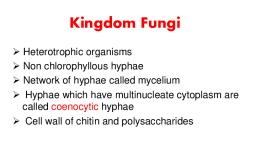
Characteristics of Zygomycota, , 1. Zygomycota ,all true fungi, produce cell wall contain, chitin, , 2. Somatic phase as mycelia, hyphae which are, generally coenocytic because they lack cross walls, of septa., , 3. Gametangial Copulation is a type of sexual, reproduction in zygomycota in general the, gametangia fuse with each other, lose their identity, and develop into a zygospore, , 4.most reproduce asexually by producing, sporangiospore., , 5. Chlamydospores are another type of asexual, spores different from sporangiospores
Page 5 :
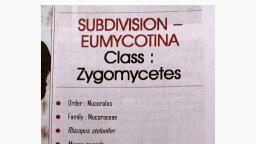
The Zygomycota is thought to be the most primitive of the, terrestrial fungi., , coenocytic mycelium, , asexual spores (=sporangiospores), in sporangia borne on stalks, (=sporangiophores)., These characteristics are shared with the divisions of flagellated, , fungi that were just studied. For this reason the Zygomycota were, once thought to be closely related to the aquatic fungi., , However, cell wall composition is chitin-chitosan and flagellated, spores and gametes are absent in this division as well as in the, remaining taxa of terrestrial fungi., , Sexual reproduction occurs with the fusion of, undifferentiated isogametangia or anisogametangia to produce a, zygote., , The zygote later develops into a thick-walled zygospore, the, diagnostic feature of this division., , Two classes are recognized in this division; the Trichomycetes and, Zygomycetes.