Page 1 :
nefinition and Composition of Soil :, Soil is defined as "any part of earth's crust in which plants root , Muddy, toms of ponds, porous rock surfaces, ravines or glacial deposits, bottoms of lakes,, ats etc., all are thus soils. But this is a limited definition'of soil, as we know that soil is, tually formed as a result of long-term process of complex interactions leading to the, Eoduction of a mineral matrix in close association with interstitial organic matter, living as well as dead., Soil is thus not merely a group of mineral particles. It has also a biological system of, living organisms as well as some other components. It is thus preferred to call it a soil, complex, which has the following five categories of components:, 1. Mineral matter. A matrix of mineral particles derived by varying degrees of, breakdown of the parent material-rock., 2. Soil organic matter or humus. An organic component derived from long and, short-term addition of material from organisms growing above and below ground, i.e. plants, animals, microoroganisms., 3. Soil water/Soil solution. All water contained in soil together with its dissolved, solids, liquids and gases. Soil water is held by capillary and absorptive forces, both between and at the surface of soil particles. Soil water in reality is a dilute, solution of many organic and inorganic compounds, which is the source of plant, mineral nutrients., 4. Soil atmosphere. It occupies the pore space between soil particles, which, at any, time, is not water-filled. Its composition differs from the above - ground, atmosphere in the sense that it is normally lower in oxygen and higher in carbon, dioxide content., 5. Biological system. To the above, there may also be added, the biological system,, as cach soil has a distinctive flora as well as fauna of bacteria, fungi, algae,, protozoa, rotifers, nematodes oligochactes, molluscs and arthropods., Fermation (Origin) of Soil, The whole process of soil formation is generally divided into two stages, weathering-breakdown of bigger rocks into fine, smaller mineral particles,, (i), soil development or pedogenesis - modification of the mineral matter, through interaction between biological, topographic and climatic effects,, which ultimately lead to the development of any of a great variety of, potential soil types., Weathering process:, Bare rock surfaces are exposed to various types of physical, chemical and, ogical processes which lead to physical and chemical disruption of their, Botany Semester V/145, Scanned by CamScanner
Page 2 :
limonite, the rock swells. This swelling causes the disruption of sandstones etc., 6. Sand blast In arid, desert conditions the rocks are disrupted by physical action, i Hydration. As a result of taking water, due to reversible change of haematite to, components. Physical processes of weathering include action of water, tempers, temperature, glaciers, gravity etc., which cause weathering of rocks through su, Iprocesses as wetting-drying, heating-cooling, freezing, glaciations, solution and tund, blast ete. The chemical processes of weathering include hydration, hydrolysis, oxidation, reduction, earbonation, chelation ete., which are due to chemical composition of rock, chemicals in the atmosphere, as well as those produced as a result of activity of living, organisms, such as lichens, fungi, bacteria, blue-green algae, bryophytes etc., In biological process, lichens are able to extract nutrients from bare rocks. Lichens, fungi, and bacteria on rock surface retain the water for a long period during which the chenical, processes can proceed, splitting the rock alumino- silicates by hydrolysis and carbonation, into the simpler clay alumino-silicates. Algal partner of lichen through photosynthesis,, increases the amount of available organic matter at rock surface. Various exudates from, these organisms and the carbon dioxide accelerate the process of weathering, as some of, the lichen acids (organic acids) generally dissolve mineral components. Rock weathering, is, therefore, for a short time, a physico-chemical process but soon it becomes biogenic,, increasing in its rate., The weathering processes are physical as well as chemical., A) Physical. These may be., 1. Wetting-drying It is the disruption of layer lattice minerals which swell on, wetting., 2. Heating-cooling It is disruption of heterogeneous crystalline rocks in which, inclusion have differential coefficients of thermal expansion. Particularly in dry, climates, due to sun heating, large boulders flake at surfaces., 3. Freezing This is the disruption of porous, lamellar or vesicular rocks by frost, shatter due to expansion of water during freezing., 4 Glaciation Larger masses of snow and ice-glaciers, while falling may cause, physical erosion of rocks through grinding process., S Solution - Some more mobile components of rocks, such as caleium chiorides,, sulphates etc., are simply removed by agents like water., of wind, sand etc., B) Chemical. These processes include., (ii) Hydrolysis. In this process, components like aluming, breakdown, during which elements such as, silicates of rock, potassium and surplus silicon are, Botany Semester V/146, Scanned by CamScanner
Page 3 :
whed out which give rise to simpler minersl matter like clay alumino-silicates,, For example, bydrolysis of orthoclase to kaolinite, Osidntion reduction. Some oxidation-reduction chemical reactions, I such as, vaversible changs of Fe" to Fe", cause disruption of rocks, because Fe is more, sohuble than Fe",, A Carbonation Some chemicals, produced in the atmosphere and those I during, the metabolism of mieroorganisms bring about carbonation. For example, reversible change of CaC0, to Ca (HCO,), leads to solution loss of limestone or, disnuption of CaC0, cemented rocks as the hydrogen carbonate is more soluble, than the carbonate,, (vi) Chelation. Some chemical exudates, produced through biochemical activity of, microorganisms like lichens, bacteria, etc., are able to dissolve out mineral, components of the rocks. These metals dissolved with organic products of, microbial activity are known as chelates. For example, acids produced by lichens, and bacteria haye strong chelating properties., dogenesis :, (During weathering, the rocks are broken down into smaller particles. But this is, it the true soil and plants cannot grow in this matter. The weathered material undergoes, rther a number of changes, which is a complex process, known as pedogenesislor soil, evelopment.) Whereas in weathering, mostly physical and chemical factors are involved,, edogenesis is largely a biological phenomenon. During this phenomenon, living, rganisms such as lichens, bacteria, fungi, algae, micro-arthropods, molluscs etc., as a, esult of secretion of organic acids, enzymes, CO2 production, addition of organic matter, ifter their death, bring about geochemical, biochemical and biophysical processes. Due to, All this the crusts of weathered rock debris are converted to true soils consisting of a, complex mineral matrix in association with a variety of organic compounds, and a rich, microorganism population., Thus during pedogenesis, there are added various organic compounds, dead, Drganic matter, living organisms etc., to the mineral matter. As a result of mineralization, of dead organic matter, the minerals are then gradually added to different layers of, developing soil. This soil, when fully developed can be seen having a number of layers-, Soil Profile:1, Soil profile is "the sequence and nature of the horizons (layers) superimposed, iar V/147, Scanned by CamScanner
Page 4 :
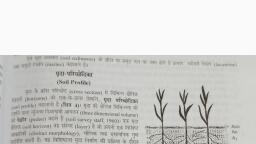
which is approximately parallel to the soil surface and that has propentes prod, soil forming proCesses but that are unlike those of adjoning layers." Hotizea, Hsually be identified yisually in the field but they also have chemsical and yy, begun. Thus organic matter is found under dierent stages of decompesiti, characteristics which can be diagnosed in the laboratory., Although,, different types of soil differ markedly, in yespect of thejr physico-chemical, and biological properties, principal, horizons not always true that all these, horizons are always present in each, profile., profiles, of, Organic, Te sol, 8,, The different horizons of a, soil profile historically in Russian, terminology, were classified into, ABC, terminology., However,, according to the present one in, general use, the soil profile consists, of the following five main horizons:, Fig. 5.3 A generalized profile of, soil ,01: Loose leaves and organic, debris, 02: organic debris party, decomposed or matted Al : A dark, colored horizon with high content, of organic matter mixed with mineral matter, A2 : A light colored horiam, maximum leaching, A3 : Transitional to B but more like A than B. B1: Transitiona, layer but more like A than B, B: A deeper coloured horizon of mzim, accumulation of clay minerals er of iron and organic matter; B tramsitunal, C: weathered material (regolith) : R:Consolidated bedrock, Badhock, %3D, [I] The 'O' horizons:, These are the organic horizons forming above the surface of the mineral I, mainly composed of fresh or partially decomposed organic matter. This harins, developed in forests and may be completely absent in grassilands, This horian is d, into following two sub-layers:, 1. O, (A0o) region - This is the uppermost layer consisting of freshly fallen, organic matter as dead leaves, branches, flowers and fraits, dend pats dl n, etc. These do not show evident breakdown, 2. O:(A) region It is just below I the-O, regon in, h decomposition, and microorganisms ike bacteria, fungi, actinoy, e beguanty Bou, Botany Semester V/148, Scanned by CamScanner, Mineral horizon
Page 5 :
A1, Az and B collectively are also known as mineral soil or solum, Upper layere eontein detrkus in initiel says of dan s, io which maerial, A faintly rnid, where dw lower layers wwawhn taishy de somposes, IAhorimns:, These e the mineral horizons which fonmed eier at ox adjacent to the surface, Wae ich in oganic matter dion thurw downard los (sluations) of soluble sals,, lay, jn or aluminium, being eonseuendy rich in silica or ether sosistant minerals. This, i also known as 49ns of eluviation-dowaward lose or leaching, This horizon is dividerd into following tw) b layers, 1 Apregion it is dark and rich in organic matter. The amorphous, findly divided, organic matter here becomes mixA widh the mineral matter, which is now kaown, As humus, which is dark brown or black coloured. This reRÝon having a minure, of finely divided organic matter and the mineral matter is also called humie or, melanized region, In forest soils this region is less deep than those of the, Erassiands,, 2. A, region This region is of light colour in which the mineral particles of huge, size as sand are more, with little amount of organic matter. Chiefly in areas with, heavy rainfall, the mineral elements and organic chemicals are rapidly lost, downwards in this region, making it light-coloured. This is thus also known as, podsolic or eluvial zone or zone of leaching., III)The 'B' horizons:, These are the mineral horizons forming below the surface in which one or more, of the following features can be present (i) enrichment with in washed clay (lessivation),, iron, aluminiumn, manganese or organic matter, (ii) residual enrichment with sesquioxides, or silicate clays which has occurred other than by the removal of carbonates or readily, soluble salts, (iii) sesquioxide coatings of mineral grains sufficient to give a more intense, colour than horizons above or below. (iv) alteration of the original rock material to give, silicate clays or oxides in conditions where (i), (ii) and (iii) do not apply., This is just below the 'A' horizon, and can also be divided into B, (A3), B2 and B:, regions, depending upon the stages of soil development in the area. B1A;), if present is in, process of successional development, the presence of which depends upon the extent, the, of development of horizons, above and below it., he "B' horizon is dark-coloured and coarse-textured due to the presence of silica-rich, y organic compounds, hydrated oxides of aluminium, iron etc. Since, the chemicals, aviation or illuvial zone. This zone is poorly developed in dry area., Botany Semester V/ 149, Scanned by CamScanner