Page 1 :
1521, , and cortex, whereas the lower most cell of the, quadrant from which the primary rhizoid, originates also forms secondary —_rhizoids, , Ultimately, a multicellular embryo with an apical, cell is differentiated., , Alternation of Generation, , The life cycle of Fucus does not show any, alternation of generation. The plant body is, diploid and sporophytic. The reproductive organs,, antheridia and oogonia, are produced within, special flask-shaped conceptacles. The reduction, division takes place at the time of gamete, formation. Thus, the haploid phase, in the, life-cycle of Fucus, is represented only by gametes, (antherozoids and eggs). The haploid male and, female gametes fust oid zygote. The, zygote germinates ) a diploid sporophyt, thallus., , , , , , , , , , Family Sargassaceae, , The members are very much complicated in their, morphology and anatomy and are cha ized by, the presence of lateral branch system. The f, includes five genera Of these Sargassum, known, and the most abundant sea weed in India., , , , , , , , , , Sargassum, , , , , , Systematic Position, , Class - Phacophyceae, Order oe, Fucales:, Earhily a Sargassaceae, , _Adceurrence, , Species, found chiefly in, subtropical seas of the southe, plants form huge. floating., ocean, off the.African_., and 35° north latitudg. Pi, Ailantic ocean is Calléd the Sargasso se;, of Sargassum are also found along the, Australia, India and, , is represented” by”, , , , Fucales : Sargassum, , 5, duplicatum, S. christifolivm,, ilicifolium, S. plagiophylium,, myriocystum, , S. carpophyllum,, S. tenerrium, S, S. wightii and S., , Thallus Structure, , [I] External structure, of Sargassum _is, , The _ thallus diploid ang, erect, , sporophytic. Its and branched and jg, , differentiated into holdfast and the main.axis; the, latter bears many leaf-like lateral branches and, , air bladders (Fig. 3 A, B) r arty sian, , The holdfast is a discoid OF § ure, with cet ip of which_the thallus —remains~, attached to the substratum.! In some species the, dfast is stolon-like.-The main axis_or ‘stem’ js?, erect, cylindrical or flattened, varying in height, from 15-25 cm. But sometimes it attains"@ height, of more than a meter as in S. filipendula. The main, axis bears large number of primary laterals in a, spiral phyllotaxy of 2/5. The primary laterals have, unlimited growth, hence they are also called long, shoots. The main axis as well as the primary, laterals bear flat leaf-like branches, known as, secondary laterals or ‘leaves, , The ‘leaves’ are flat and simple with distinct, mid-ribs. Sometimes the mid-rib is absent as in, S. enerve. The margins of the ‘leaves’ are serrate,, dentate or entire. On both surfaces of the, leaves’ small pores, known as ostioles, are, present. These nin i
Page 2 :
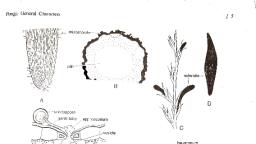
E233, leat-like, expansions, , , , ky Sryptomomats, , , , , receptacle, lateral, , (leaf), , ‘axillary, branch, , , , air bladder, , , , , An receptecular, or branch, , air bladder, F axis, , , , Fig. 3 A-B. Sargassum : A branch of thallus; A. S. tenerrim, B.S. longifolium aay Fig. 4. Sargassum : A part of the thallus with, receptacular branches., , (0) Internal structure, 1, Internal structure of the main axis. In, transverse section the main axis is almost, circular in Outline and is differentiated into three, distinct regions : (i) meristoderm, (ii) cortex, and, (iii) medulla (Fig, 5 A)., , The meristoderm (named so due to, meristematic nature of its cells) is the outermost, layer and functions as epidermis. It is made up of, compactly arranged columnar cells. These cells, are densely packed with chromatophores and, fucosan, a reserve food material. They form, assimilatory region of the thallus. In the mature, part of the axis meristoderm is covered with a thin, layer of mucilagenous cuticle., , The cortex forms the most part of the axis and, it has narrow and elongated cells. These cells are, loosely arranged with well developed intercellular, spaces, They are filled with reserve food material,, and as such the cortex forms the storage region, Of the axis., , The central part, Medulla. It is made up of thic!, tlongated cells. Senate these cells Be, Salariform thickenings. The function of m, Sto transport water and metabolites t0 CS, Parts of the thallus., , 2. Internal structure of the ‘leaf’. is ba, Main axis, the ‘leaf is also differentia”, Neristoderm, cortex and medulla (Fig. 6)., , , , , , , , , , , , , , , , , , , , , , , , , , , , , meristoderm, , , , of the main axis forms, k walled narrow and
Page 4 :
P|, 4, LC, |, fe} (2, fe] |, , , , teh, , , , Fig. 7. Sargassum : Vertical section of a sterile, conceptacle., , slower rate than the adjoining cells. Consequently,, the initial cell, which was at the surface of the, thallus in the beginning, is gradually pushed at the, base of the flask shaped cavity (Fig. 8 B). The, conceptacle initial divides by a curved septum,, forming an outer tongue cell and an inner basal, cell (Fig. 8 C). The tongue cell elongates and, divides transversely to form a small filament which, soon disappears. The basal cell, however., , antheridial, cell, fertile layer, , , , , , conceptacle, , <u, , , , , , Fig. 8 A-D. Sargassum ; Stages in the development of, conceptacle., , undergoes repeated vertical divisions and the, resulting cells form the basal fertile layer of the, conceptacle (Fig. 8 D). The reproductive organs, develop from the cells of this layer., , 2. Development of antheridium. As mentioned, above, antheridia develop from the cells of the, fertile layer of the conceptacle. The antheridial, initial is densely cytoplasmic and grows into a, papilla-like outgrowth (Fig. 9 A). It divides by a, transverse wall into a lower stalk cell and an, upper antheridial cell (Fig. 9 B). Each of these, cells has a diploid nucleus. The antheridial cell, , , , , , paraphysis
Page 5 :
theridial initial has i, ich undergoes 4 mcio’ a, mitotic aks Consequently, 32-64 haploid, nuclei are formed in the developing antheridium., The multinucleate protoplast of the young, antheridium divides into many uninucleate, segments (the number of these segments Is equal, to the number of nuclei) and each uninucleate, segment metamorphoses into a biflagellate, , antherozoid (Fig. 9 G)., , , , , , , oogonial, initial, , oogonia cell, , The mature antheridium is an oval stryc,,, surrounded by a two layered wall. The outer ., Jayer, the exochite, is firm, whereas the inner \,.., jayer, the endochite, is gelatinous (Fig. 9 F), 7,, antheridium remains attached 10 the base of j;,, conceptacle with the help of a stalk cell 4,, maturity, the antheridium is detached from ;},, stalk and comes out of the conceptacle throup),, the ostiole (Fig. 9 H, I). The antheridial wail ge;, gelatinized when in contact with water and the, flagellated antherozoids are liberated., , 3, Development of oogonium. Oogonia also, develop from the basal fertile layer of the, conceptacle. The cells of this layer function as, oogonial initials (Fig. 10 A, B). Each initial cell, divides by a transverse wall into two unequal cell., The smaller basal cell forms the stalk cell and the, upper larger cell, the oogonial cell (Fig. 10 C)., The latter gradually enlarges and becomes almos!, , functional, nucleus, , 8-nucleate stage, , , , , , , , degenerating, nuclei