Page 1 :
Parasexual Cycle in Fungi:, , In some fungi, true sexual cycle comprising of nuclear, fusion and meiosis is absent. These fungi derive the, benefits of sexuality through a cycle known as Parasexual, Cycle., • The Parasexual Cycle is defined as a cycle in which, plasmogamy, karyogamy and meiosis (haploidisation), take place but not at a specified time or at specified, points in the life-cycle of an organism., Generally parasexual cycle occurs in those fungi in which, true sexual cycle does not take place. The members of class, Deuteromycetes (Deuteromycotina) in which sexual cycle, does not occur, exhibit parasexual cycle generally., Parasexual cycle was first discovered by Pontecarvo and, Roper of University of Glasgow in 1952 in Aspergillus, nidulans, the imperfect stage of Emericella nidulans., Since then parasexual cycle has been discovered not only, in several members of Deuteromycetes but also in fungi, belonging to Ascomycetes and Basidiomycetes., , Steps Involved in Parasexual Cycle:, According to Pontecarvo (1958), parasexual cycle, in A. nidulans involves the following steps:, 1) Formation of heterokaryotic mycelium, (ii) Fusion between two nuclei (Karyogamy), (a) Fusion between like nuclei, (b) Fusion between unlike nuclei
Page 2 :
(iii) Multiplication of diploid nuclei, (iv) Occasional Mitotic crossing over., (v) Sorting out of diploid nuclei, (v) Occasional haploidisation of diploid nuclei, and, (vii) Sorting of new haploid strains.
Page 3 :
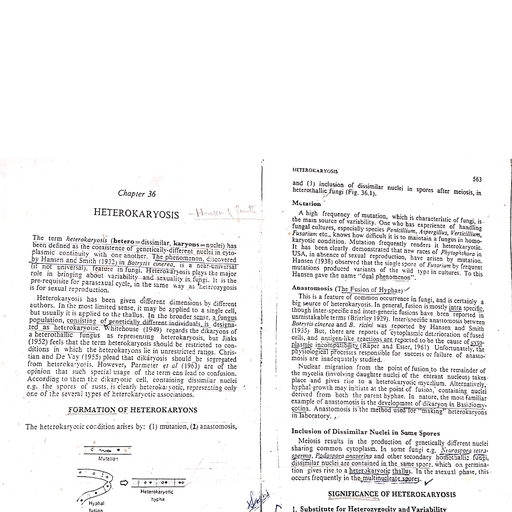
A brief account of these steps are being presented, below:, (i) Formation of heterokaryotic mycelium:, Heterokaryotic mycelium is formed in several ways., • The most common is by the anastomosis of somatic, hyphae of different genetic combinations., • The foreign nucleus or nuclei introduced into a, mycelium multiplies and its progeny spreads through, the mycelium rendering it heterokaryotic., • Mutation in one or more nuclei of a homokaryotic, mycelium also makes it heterokaryotic., • Still a third way is by the fusion of some of the nuclei, and their subsequent multiplication and spread, among the haploid nuclei., • In this type of heterokaryotic mycelium a mixture of, haploid and diploid nuclei occur., (ii) Fusion between two nuclei (Karyogamy):, The fusion of nuclei in the mycelium has been, demonstrated
Page 4 :
. The nucelar fusion may be of two types:, (a) fusion between like nuclei- Homozygous diploid, nucleus (AA), (b) fusion between unlike nuclei- heterozygous diploid, nucleus (AB), (iii) Multiplication of diploid nuclei:, The above mentioned nuclei multiply at about the same, rate but the diploid nuclei are present in much smaller, number than the haploid nuclei. Portecarvo (1958), estimates a proportion of one diploid heterozygous, nucleus to 1000 haploid nuclei., (iv) Occasional mitotic crossing over:, During multiplication of diploid nuclei, mitotic crossing, over may take place. This results in the formation of new, gene combinations. These recombinations, which are, dependent on the existence of heterokaryosis, give the, fungus some of the advantages of sexuality within the, parasexual cycle., According to Pontecarvo’s (1958) estimates, the amount of, recombinations which may be expected to occur in an, ascomycete through its parasexual cycle is 500 times, smaller than through its sexual cycle., However, in Penicillium chrysogenum and Aspergillus, niger, diploidisation and mitotic crossing over occur more, frequently indicating the importance of parasexual cycle in, evolution of new strains.
Page 5 :
(v) Sorting out of Diploid nuclei:, In those fungi which produce uninucleate conidia, sorting, out of the diploid nucleus occurs by their incorporation, into conidia which germinate to produce diploid mycelia., Diploid strains of several important imperfect fungi have, been isolated., Roper (1952) first synthesized and isolated diploid strains, of Aspergillus nidulans. The conidia of diploid strains are, somewhat larger than those of haploid strains., (vi) Occasional haploidisation of the diploid, nuclei:, Occasionally, some hyphae of diploid mycelium form, haploid conidia which form haploid mycelia on, germination. The formation of haploid conidia by diploid, mycelium indicates that haploidisation occurs in some, diploid nuclei., (vii) Sorting of new haploid strains:, Some diploid nuclei undergo haploidisation in the, mycelium and are sorted out by incorporation of haploid, nuclei in the uninucleate conidia. Some of these haploid, strains are genotypically different from their parents, because of their mitotic recombinations., Thus, after the parasexual cycle has operated for, some time, the mycelium may contain the, following types of nuclei:, (a) Haploid nuclei like those of both the parents,, (b) Haploid nuclei with various new genetic, recombinations,
Page 6 :
(c) Several types of diploid homozygous nuclei, (d) Several types of diploid heterozygous nuclei., Significance of Parasexual Cycle:, • Several fungi which are used in various industrial, processes belong to fungi imperfecti or, Deuteromycetes and in these fungi only parasexual, cycle operates., • New and better strains of these fungi are obtained by, mutation through parasexual cycle. The strains of, desirable characters can be developed through mitotic, recombinations., • Parasexuality can also be applied in the analysis of, genetic and physiological processes of perfect and, imperfect fungi., • Parasexual cycle has also been successfully employed, in genetic control of pathogenicity and host-range in, several species of Fusarium.