Notes of BSc 1 yr, Botany & Zoology M. J. P. Rohilkhand University, BSC Zoology syllabus.pdf - Study Material
Page 2 :
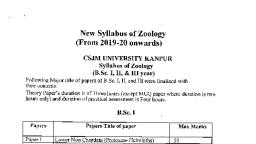
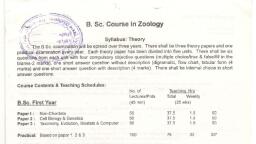
Unified Syllabus of Zoology for U.P.State Universities, (B.Sc. I, II, & III year), Following Major title of papers of B.Sc. I, II, and III were finalized with their, contents:, Theory Paper’s duration is of Three hours and duration of practicals is Four hours, , B.Sc. I, Papers, , Title of paper, , Max., Marks, 50, , Paper I, , Lower Non Chordata (Protozoa- Helminths), , Paper II, , 50, , Paper III, , Higher Non Chordata (AnnelidaEchinodermata), Cell Biology and Genetics, , Practical, , Practical Syllabus based on theory papers, , 50, , Papers, , Title of paper, , Paper I, , Chordata, , Max., Marks, 50, , Paper II, Paper III, , Animal distribution, Evolution and, Developmental Biology, Physiology and Biochemistry, , 50, , Practical, , Practical Syllabus based on theory papers, , 50, , Papers, , Title of paper, , Paper I, , Applied and Economic Zoology, , Max., Marks, 75, , Paper II, , Biotechnology, Immunology, Biological Tools, & Techniques and Biostatistics, Ecology, Microbiology, Animal Behavior,, Pollution and Toxicology, Practical Syllabus based on theory papers, , 50, , B.Sc. II, , 50, , B.Sc. III, , Paper III, Practical, , 75, 75, 75, , 1
Page 3 :
Unified Syllabus of Zoology for U.P.State Universities, Subject- Zoology, B.Sc. - First Year, Practical, 1-, , Dissection (Major), , 12 Marks, , 2-, , Dissection (Minor), , 05 Marks, , 3-, , One Temporary Mount, , 03 Marks, , 4-, , One Permanent Mount, , 05 Marks, , 5-, , Cytology & Genetics Preparation/Prepared slides, , 05 Marks, , 5-, , Identify and Comment upon spots (1-10), , 10 Marks, , 6-, , Viva-Voce, , 05 Marks, , 7-, , Practical class record, , 05 Marks, Total, , 50, , Marks, , Unified Syllabus of Zoology for U.P.State Universities, 2
Page 4 :
Subject- Zoology, B.Sc. -Second Year, Practical, 1-, , Dissection (Major), , 10 Marks, , 2-, , Permanent Mount, , 05 Marks, , 3-, , Comment upon Physiology Apparatus, , 05 Marks, , 4-, , (i) Suitable preparation of Hemin crystals from the blood, (ii) Detect the Sugar /albumin / acetone from urine sample, , 05 Marks, , 5-, , Stained Preparation of (i) Striped or Unstriped muscles, (ii) Cartilage (hand cut Section), (iii) Blood film/Aereolar tissue, , 05 Marks, , 5-, , Identify and Comment upon spots (1-10), , 10 Marks, , 6-, , Viva-Voce, , 05 Marks, , 7-, , Practical class record, , 05 Marks, Total, , 50, , Marks, , Unified Syllabus of Zoology for U.P.State Universities, 3
Page 5 :
Subject- Zoology, B.Sc. - Third Year, Practical, 1-, , Dissection (Major), , 12 Marks, , 2-, , Permanent Mounting, , 06 Marks, , 3-, , Temporary Mounting, , 05 Marks, , 4-, , Identify and Comment upon Spots (1-8), , 16 Marks, , 5-, , Economic Zoology (Comments on a suitable, Specimen/ life cycle of Silk worm, Honey bee,, Lac insect & Food Fishes) (02), , 06 Marks, , 6-, , Biological Tools and Techniques (Comment), , 06 Marks, , 7-, , Biostat / Microbiology / Immunology / Behavior, , 06 Marks, , 8-, , Ecology/ Pollution/ Toxicology (Exercise or Comment, , 06 Marks, , 9-, , Viva-voce, , 06 Marks, , 10-, , Practical Class record / Project / Collection, , 06 Marks, , Total, , 75, , Marks, , 4
Page 6 :
Unified Syllabus of Zoology for U.P. State Universities, B.Sc. Part I, II & III, There will be three written papers and one practical examination., Question No. 1 in each class will be compulsory & comprehensive based on, units I to IV and of short Answer type. This will carry 40% of total marks (i.e. 20, marks in I & II year and 30 marks in III year). There will be two questions from, each unit carrying 60% of the marks, of which one question from each unit has to, be attempted., , B.Sc. Part I, Paper I- Lower Non Chordata (Protozoa to Helminths), The habits, morphology, physiology, reproduction, development (in outline) and classification of the, following groups of animals including a detailed study of the types given in each:, , Protozoa, , Unit-I, - Euglena, Monocystis and Paramecium., , Porifera, , - Sycon, , Unit-II, , Unit-III, Coelenterata, Ctenophora, , - Obelia and Aurelia, - Salient features, Unit-IV, , Platyhelminthes, - Fasciola (liver fluke) and Taenia (tape worm), Nematehelminthes - Ancylostoma (hook worm), , Paper II- Higher Non Chordata (Annelida to Echinodermata), The habits, morphology, physiology, reproduction, development (in outline) and classification, of the following groups of animals including a detailed study of the types given in each:, Unit-I, Annelida, , - Nereis, Unit-II, , Arthropoda, , - Palaemon (prawn), Unit-III, , Mollusca, , -Pila (apple-snail), Unit-IV, , Echinodermata -Pentaceros (excluding development), , 5
Page 7 :
Paper III- Cell Biology & Genetics, Unit-I, Cell Biology I: Structure and function of cell, Ultra structure of Plasma membrane, Unit-II, Cell Biology II: Structure and function of cell organelles with special emphasis on mitochondria,, golgi bodies, nucleus, ribosome and endoplasmic reticulum., Unit-III, Genetics-I:, , Structure of Chromosomes, Watson & Crick Model of DNA, Differences between, DNA & RNA, Cell Division: Mitosis and Meiosis. Mendel’s principles of heredity on, chromosomal basis, Monohybrid cross, test cross, dihybrid cross, back cross, incomplete dominance, Multiple Alleles, Blood group inheritance. Linkage and, crossing over, interaction of genes. The role of DNA in heredity., Unit-IV, , Genetics II: Sex determination, sex differentiation, prenatal detection of genetic diseases, (amniocentesis), Sex-linked characters, Genetic diseases and abnormalities,, chromosomal aberrations, Eugenics., , 6
Page 8 :
B.Sc. Part I, ZOOLOGY PRACTICAL SYLLABUS, PROTOZOA, (a), , Amoeba : Examination of culture. Prepared Slide Amoeba proteus and A. verrucosa., , (b), , Euglena : Culture examination for Euglena. Prepared slides., , (c), , Monocystis : Examination of contents of seminal vesicles of Pheretima or Eutyphoeus, for different life- history stages and permanent preparation. Prepared slides., , (d), , Plasmodium : Preparation of blood film, the parasites., , (e), , Paramecium, Culture examination., , (f), , Demonstration of ciliary movements in Paramecium., Addition to mucilage to restrain active movement. Treatment with Methyl green for, staining. Feeding experiment with Congo Red and Yeast. Trichocysts (discharged),, Prepared slides for structure, binary division and conjugation., Examination of pond water for different kinds of protozoa with special reference to, Arcella and Vorticella., Study of prepared slides :, Polystomella, Gregarina, Trypanosoma and Noctiluca., , (g), (h), , (i), , (Leishmen’s stain). Prepared slides showing, , Examination of rectal protozoans Opalina, Balantidium and Nyctotherus., , PORIFERA, (a), , Sycon, General characters, Spicules glycerine preparation., Transverse and longitudinal sections-prepared slides., , (b), , Gemmule of Spongilla permanent preparation., , (c), , Different kinds of spnge spicules and sponging fibres of Euspongia-prepared slides., , (d), , Euplectella (Venus,s flower-basket) Spongilla (fresh-water sponge), Euspongia (bath, sponge)., , COELENTERATA, (a), , Hydra, Live specimens., Prepared slides of entire specimens., Longitudinal and transverse sections-prepared slides., , 7
Page 11 :
ECHINODERMATA, , (a), , Pentaceros:, External characters, Dissected specimens., Pedicellaria-prepared slides., Transverse section of arm-prepared slide., , (b), , Echinus (Sea urchin), Ophiothrix (brittle star), Holothuria (sea cucumber) and Antedon, (feather star)., , CYTOLOGY, , (a), , Cell-Structure – Prepared slides, , (b), , Cell Division – Prepared slides, , (c), , Preparation of giant chromosomes, , (d), , Preparation of onion root tip for the stages of mitosis, , 10
Page 12 :
B.Sc. Part II (THEORY) Zoology, There will be three written papers and one practical examination. The following courses are, prescribed., , Paper I: Chordata, Unit- I, Hemichordata: Classification and detailed study (habit, morphology, anatomy, physiology and, development) of Balanoglossus, Cephalochordata: Classification and detailed study (habit, morphology, anatomy and physiology), of Branchiostoma (Amphioxus)., Unit -II, Urochordata: Classification and detailed study (habit, morphology, anatomy, physiology and post, embryonic development) of Herdmania, Unit-III, Classification of different classes of vertebrates (Pisces, Amphibia, Reptilia,) up to order with, characters and examples. Poisonous and non poisonous snakes and biting mechanism., Neoteny, Unit-IV, Classification of different classes of vertebrates (Aves and Mammalian) up to order with characters, and examples. Dentition in mammals., , Paper II: Animal distribution, Evolution and Developmental Biology, Unit-I, Animal distribution: Geological and geographical distribution with their characteristic fauna; fossils., Unit-II, Origin of Life, concept of species (classical & modern concept), Evolution: Evidences (including physiological and serological); Theories of evolution (including, Neo-Lamarckism, Darwin-Wallace theory of natural selection, Neo-Darwinism, Modern, synthetic theory). Evolution of Man. Mutation, Unit-III, Developmental Biology I:Aims and scope of Developmental Biology., Gametogenesis, Fertilization, Egg: structure and types., Types & patterns of cleavage, 11
Page 13 :
Unit-IV, Developmental Biology II: Process of Blastulation & Gastrulation. Fate Map., Development of Chick up to formation of Primitive streak and mammal (in out line), Extra embryonic membranes of chick., Placentation and types of Placenta., , Paper III: Physiology and Biochemistry, General physiology (in outline) with special reference to mammals, Unit-I, Physiology of digestion, respiration, and blood and circulation, Unit-II, Physiology of excretion and osmoregulation, neural transmission, muscles, Unit-III, Physiology of endocrine system, thermoregulation, Unit-IV, General chemistry and classification of carbohydrates, lipids and proteins; Enzymes, , 12
Page 14 :
B.Sc. Part II, ZOOLOGY PRACTICAL SYLLABUS, Urochordata, (a) Herdmania, (i), (ii), (iii), , (iv), , External characters, Dissection, (a) Permanent preparation of branchial wall, (b) Section of test and glycerine prepration of spicules., Glycerine and permanent prepration on neural gland complex ( neural, gland, nerve ganglion and dorsal tubrcele)., Larva and metamorphosis- prepared slides., , (b) (i) Thaliacea : Pyrosoma, Doliolum, (ii) Larvacea : Oikopleura ., Cephalochordata, Branchistoma ( Amphioxus ), (i), (ii), , General features, (a) Permanent prepration of the pharyngeal wall, (b) Oral hood and velum- prepared slides, (c ) Transverse section through the body – prepared slides., (d) Models illustrating development, , Cyclostomata, Petromyzon ( Lamprey ) - External characters, Chondrichthyes, (a) Fish, (i), External characters, (ii), Exo-skeleton Glycerine and permanent preparation of placoid scales, (iii), Myotomes, (iv), Endoskeleton, (1), , Axial skeleton, (a) skull, (b) Visceral Skeleton, (c) Vertebral column, , (2), , Appendicular skeleton, (a) Pectoral girdle and fins, (b) Pelvic girdle, fins and claspers, (c) Median fins, Dissection, Digestive system, Examination of the folds of stomach and “ scroll valve”, Vascular system, , (v), (a), (b), , 13
Page 17 :
Histology, (i), (a), (i), (b), (i), (c), (i), (ii), (d), (e), (f), , Tissues: Preparation of the following, Epithelia:, Squamous (ii) Ciliated and (iii) Stratified, Muscular:, Striped muscles (ii) Unstriped muscles., Connective, Areolar tissue (ii) Tendon the leg muscles of frog (tease and examine in, glycerine), Adipose tissue from insect and frog (iv) cartilage (free hand sections of frogs, hyoid and suprascapula, train with haematoxyline and (v) Bone (Decalcified)., Blood; Preparation of Vertebrate blood film, stain with Leishmann’s stain., Nervous: Neurons, Histology of various organs-prepared slides., , Physiology, (i), , (ii), , Experiments to be performed by candidates: Test for amylase. Osmolarity of, blood, Hemin crystals and test for sugar and acetone in urine Determination of, haemoglobin % in blood sample (s)., Detection of amino acids in blood of an animal by paper chromatography., , General :, Candidates will be required, to show knowledge of the method of microscopic, techniques and to examine, describe or dissect the types prescribed. Candidates will, also be required to submit their notebooks containing a complete record of laboratory, work initiated and dated by the teacher for the determination of result of examination., , 16
Page 18 :
B. Sc. Part III (THEORY) Zoology, There will be three written papers and one practical examination. The following courses are, prescribed., PAPER-I, , Applied and Economic Zoology, Unit-I, , Parasitology:, (a) Structure, life cycle, pathogenicity, including diseases, causes, symptoms and control of, the following parasites of domestic animals and humans: Trypanosoma, Giardia and, Wuchereria,, Unit-II, Vectors and pests: Life cycle and their control of following pests:, Gundhi bug, Sugarcane leafhopper, Rodents., Termites and Mosquitoes and their control, Unit-III, Animal breeding and culture: Aquaculture, Pisciculture, Poultry, Sericulture, Apiculture,, Lac-culture., Unit-IV, Wild Life of India: Endangered species. Important sanctuaries; national parks of India; Different, projects launched for the preservation of animal species; in-situ and ex-situ conservation of, wild life., , PAPER-II Biotechnology, Immunology, Biological Tools and Techniques and Biostatistics, Unit-I, Biotechnology: Genetic Engineering (concept and recombinant DNA technology) and its, application in agriculture & medical areas and energy production. Biotechnology of foodprocessing, pharmaceuticals (e.g. use of microbes in insulin production) and fermentation., , Unit-II, Immunology. Concepts of immunity, types of immunity, Antigen and Antibodies, vaccines of, different diseases and immunological reactions., , 17
Page 19 :
Unit-III, Biological Tools and Techniques: Principles and uses of instruments: pH Meter, Calorimeter,, Microtome, Spectrophotometer & Centrifuge., Microscopy (light, transmission and scanning electron microscopy), Chromatography and Electrophoresis., , Unit-IV, Biostatistics: Sampling, Measures of central tendency (mean, median and Mode) and dispersion, (variance, standard deviation and standard error); Correlation and Regression, , PAPER-III, , Ecology, Microbiology Animal Behavior and Pollution and Toxicology., , Unit- I, Ecology:, , Ecosystem: Concept, components, fundamental operations, energy flow, food-chain,, foodwebs and trophic levels, ecological niche, abiotic and biotic factors. Population:, Characteristics and regulation. Ecological succession. Adaptation: Aquatic, terrestrial,, aerial and arboreal., Unit-II, , Microbiology: Morphology, physiology and infection (outline) of bacteria and viruses. Bacterial and viral, diseases., Unit-III, Animal Behavior: Introduction to Ethology, Patterns of behavior (taxes, reflexes, instinct and, motivation); biorhythms; learning and memory, Migration of fishes & birds., , Unit-IV, Pollution and Toxicology: Concept, sources, types (air, water, soil, noise & radiation), and control of, environmental pollution. Exposure of toxicants (routes of exposure, and duration and, frequency of exposure); dose -response relationship categories of toxic effects., , ., , :, , 18
Page 20 :
B.Sc. Part III, ZOOLOGY PRACTICAL SYLLABUS, •, , Permanent Preparation of: Euglena, Paramecium and rectal protozoans from frog., , •, , Stool examination for different intestinal parasites., , •, , Study of prepared slides/ specimens of Entamoeba, Giardia, Leishmania, Trypanosoma,, Plasmodium, Fasciola, Cotugnia, Taenia, Rallietina, Polystoma, Paramphistomum,, Schistosoma, Echinococcus, Dipylidium, Enterobius, Ascaris and Ancylostoma;, , •, , Permanent Preparation of Cimex (bed bug)/ Pediculus (Louse), Haematopinus (cattle louse),, fresh water annelids, arthropods; and soil arthropods., , •, , Larval stages of helminths and arthropods., , •, , Permanent mount of wings, mouth parts and developmental stages of mosquito and house fly., Permanent preparation of ticks/ mites, abdominal gills of aquatid insects viz. Chironomus, larva, dragonfly and mayfly nymphs, preparation of antenna of housefly., , •, , Collection and identification of pests., , •, , Life history of silkworm, honeybee and lac insect., , •, , Different types of important edible fishes of India., , •, , Prepared slides of plant nematodes., , •, , Demonstration of counting of cells (blood and protozoan) by haemocytometer,, haemoglobinometer, pH meter, Colorimeter, , •, , Microbiological Techniques: Media Preparation and sterilization, inoculation and, Monitoring., , •, , Study of an aquatic ecosystem, its biotic components and food chain., , •, , Preparation of chromosomes, Test for carbohydrate Photochemical demonstration of proteins, and lipids, using hand sections using hand sections, endocrine glands (Neurosecretory cells), of cockroach., , •, , Demonstration of developmental stages of chick., , •, , Project Report/ model chart making., , •, •, •, •, , Dissections :, Cockroach : Central nervous system, Wallago : Afferent and efferent branchial vessels, Cranial nerves, Weberian ossicles., Practical exercises based on Biostatistics, Microbiology, Immunology, Biotechnology,, Animal Behavior, Pollution & Toxicology., 19
Page 21 :
Recommendation, The unified syllabus is well-knit and is passed as such. However, following minor corrections should, be added;, 1. B.Sc. Part I, Paper I- Lower nonchordata (Protozoa -Helminthes ).- The habits, morphology, physiology, reproduction, development (in outline) and classification upto orders of the following groups of, animalsUnit-I : Protozoa- Euglena and Paramecium, Unit-II : Sycon, Canal system in sponges., Rest as such., Paper II- Higher Non-chordate (Annelida to Echinodermata)- The habits, morphology, physiology,, reproduction, development (in outline) and classification upto orders of the following groups of, animals., Unit-I : Annelida- Hirudeniaria, Unit-II : as such, Unit-III :as such, Unit-IV : Echinodermata-Asterias (sea-star) (excluding development), Paper III- Call Biology & Genetics, Unit-I : Cell Biology : Structure and function of cell, ultra structure and function of plasma, membrane., Unit-II : as such, Unit-III : Differences between DNA & RNA, cell division should be like this differences between, DNA, & RNA, cell cycle and cell division. Rest as such., Unit-IV : Geneties II Ist 2 times as such. + Genetic diseases and syndromes, structural and numerical, aberrations- Deficiency duplication, translocation, inversion, euploidy, aneuploidy, monosomic,, nullisomic, trisomic etc., Last Eugenics- should be cancelled., B.Sc. II, Paper I- as such, Paper II- as such, Paper II- Physiology and Biochemistry, Unit -I : Physiology of digestion, Breathing and internal respiration and blood: strucutre, junction, and clotting, physiology of heart beat., Unit-II : as such, Unit-III: as such, Unit-IV: as such, B.Sc. III, Paper I- Applied & Economic zoology, Unit-I : Parasitology-Giaradia should be cancelled. Rest as such., Unit-II: as such, Unit-III: as such, Unit IV: Wild life of India: Endanagered species. Important sanctuaries, national parks, biosphere, reserves, hot spots of India. Different projects.... as such., 20
Page 22 :
Paper II, Unit-I :as such, Unit-II :as such, Unit-III : pH meter, colorimeter. Rest as such, Unit IV :In the second line:- correlation and Regression can be cancelled. Graphical representation of, data- may be added., Paper III, Unit-I :as such, Unit-II :as such, Unit- III :as such, Unit-IV :In the last line- categories of toxic effects- Teratogenic, careinogenic and mutagenic effects,, Antidotes., Practical Syllabus is passed as such., , 21



 Learn better on this topic