Page 1 :
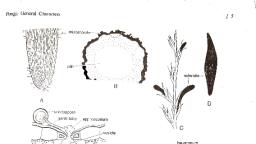
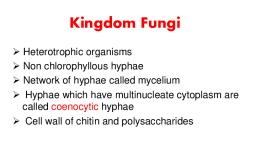
S., CHAPTER- 2, FUNGI, Biologists used the term fungus (pl. Fungi; in latin fungus, sphongos = sponge) to include eukaryotic, spore producing, achlorophyllus organisms that, generally reproduce asexually and sexuallý. Their vegetative structure is usually the, branched, filamentous hyphae having cell wall made up of chitin or cellulose or both., Being achlorophyllous, they show heterotrophic mode of nutrition, i.e., they cannot, prepare their own food material and hence, they are either parasitic or saprophytic or, symbiotic. Some of them are even predaceous. They are of great economic importance, having both beneficial and harmful activities. The study of fungi is called Mycology, (mycos = mushroom, logos, ways. The classification followed in this book is as given by G. M. Smith (1955)., mushroom, in Greek, discourse). Various mycologists classified fungi in various, GENERAL CHARACTERS OF PHYCOMYCETAE, The Phycomycetae are generally considered to be the most primitive fungi. Because, of their morphological similarity with algae, they were for a long time considered as 'algal, fungi' and were regarded as degenerate algae by loss of chlorophyll consequent loss of, ability to synthesize organic food. The supporters of this view emphasized only on the, morphological resemblances and ignored the most important physiological differences, between algae and fungi. The general characters of Phycomycetae are described under, different heads as follows :, Occurrence, The members of this class occur on a wide variety of substrata. Majority of the genera, are aquatic (both fresh water and marine). The aquatic ones are known as "water, molds"., 1., Some of them are parasitic on plants like algae and on änimals like fish and insects, and some are saprophytic on submerged plant and animal debris, whereas, others are, amphibious and still others are terrestrial., 3. Many of the advanced terrestrial species grow on Angiospermic plants and cause, diseases to them while some form 'mycorrhizal association with Pteridophytes,, Gymnosperms and almost all the families Angiosperms., 2., Hyphal Structure, Most of the primitive phycomycetae are unicellular, uninucleate, uniflagellate and, holocarpic thalli (entire protoplast forms spores or gametes) usually with or without, surrounding membrane., 1., In most of the advanced forms, vegetative phase has profusely branched, aseptate, 2., and multinucleate mycelium. The aseptate hypha, is a multinucleate tube with, continuous protoplasm and hence the thallus is coenocytic (Mucor, Rhizopus)., 3. Most of the mycelial thalli are eucarpic that is fertile portion is distinctly separated, from vegetative portion by formation of a septum at the base of the reproductive, structure (Albugo). But this septum is not perforated at the centre. The cell wall is, made of fungal chitin or cellulose. The protoplasm is vacuolated; with single, up