Notes of M.Sc -1, Botany chara algae.pdf - Study Material
Page 1 :
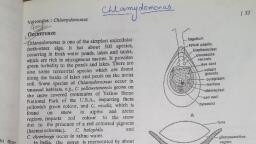
Distribution, , Chara has about 180 species whic!, the genus Chara is represented by about, gracilis, C. gymnoptis and C. zeylanica are, , salt water while, C. fragilis occur in, hot springs. They, are able to exist, with a small supply, of oxygen and can, thrive where there, is much decomposing matter, on, the other hand,, some require pure, water and are, scarcely to be, found in water, liable to become, turbid or where, there is only, contamination or, pollution due to, sewage. Most, species of Chara, extract calcium, carbonate from, the water and, deposit it in their, walls thereby, becoming rough, and brittle for, which reason they, are popularly, called stone., worts,, , , , C), , Fami, , , , , , Main axis, , Secondary rhizoid, , ly—Characeae, Genus—Chara, , bh grow submerge, 7 30 species of these, C. b, common. Chara baltica is found in, , , , Internode, , Node, , Branch of, unlimited growth, , Secondary laterals, , Genus—Chara, , d in fresh water. In India, C. braunii, ¢
Page 2 :
ndia, 4G., nd in, , , , , , , b A s;, ois ife Cycle of Various Genera-t | 104, us itr, , ant body (Fig. 25) is slend ith i, se pl o ender and flexuous with individual plant, , ; vaing 1eD hs 20 to 30 cm or more in height. T i, F yor ring the appearance of a miniature “a : he multicellular plant, , i : ail ha i i, tiated into a regular succession of nodes and Carabiien (Eastin We., ‘i ode is made up of a single, elongated, cylindrical cell. In majorit of, ies, it is ensheathed by a number of narrow but vertically elongated anise, called the corticating filaments. These filaments form the cortex which is not, , ore than 1 layer in thickness. The node of main axis remains short and consists, of two central cells in one tier, surrounded by 6-20 peripheral cells. From each, , ode arise the following four types of appendages :, , aw Branchlets—These are also called “laterals of limited growth” or, , “primary laterals” or “eaves”. A whorl of branchlets arise from each node of the, main axis. They develop from peripheral cells. Each branchlet consists of a limited, number of nodes and internodes, the number being fixed for each species., , (2) Long pranches—Only one long branch also called “axillary branch” or, “pranch of unlimited growth” may develop from a node. It develops from the, adaxial peripheral cells of the lowest node of the older branchlet. This peripheral, cell protrudes and forms the axillary branch., , (8) Stipulodes—Spine like, unicellular stipulodes also called secondary, laterals are present on the basal nodes of each type of branch (main axis, axillary, branch and branchlet)., , Descending, cortical filament, , , , , , , Oogonium, , SS Nucule, , NY SIN V7 (Cogonium), ROTI a, WY Globule 3, , (Antheridium), , , , , , , , , , , : (B), pranch, (B) Node bearing globule and nucule, the species internodal cell, is covered by @, i Such species, ed, e.g., C. wallichii,
Page 4 :
me “FC Of Various General | 133, , , , , , , , , , Fig. 29 : Chara sp. : (A) Vertical section through apex of the main, axis, (B-H) Division of apical cell of Chara and subsequent changes, leading to the growth of axis into node, internode and cortex, , Reproduction, , Chara reproduces by vegetative and sexual methods only. Asexual, reproduction by asexual spores is totally absent., , Vegetative Reproduction, , The common vegetative methods are :, (a) By amylum stars—Amylum stars are, with starch. They arise near the lower nodes, e.8-,, type, hence the name amylum stars, , , , , , , , i, , , , , , , , , , , , , the aggregates of cells, densely, C. stelligera. Starch is of, , , , , , , , , , protonema—, e the naked,, , ranches, Which, , , , secondary, onema ar, , na like b



 Learn better on this topic