Page 1 :
Plant Anatomy, B.Sc ( Hons.) Part ll, , Prof.(Dr.) Punam Jeswal, Head, Department of Botany, , Anomalous Secondary Growth In Boerhaavia, Boerhaavia is a member of family, Nyctaginaceae. They are generally, herbaceous plant., , Boerhaavia Stem Transverse section through the young stem of Boerhaavia show following, tissues : -, , Epidermis 1) Epidermis is single layered and consists of small, radially elongated, parenchymatous cells., 2) Multi-cellular epidermal hairs arise from some cell., 3) A thick cuticle is present on the epidermis., 4) Some stomata are also present., , Cortex 1) Cortex is well differentiated and consists of few layered collenchymatous, hypodermis followed by parenchyma., 2) Collenchyma is 3-4 cells deep, but generally near stomata it is only one, layered., 3) Parenchyma is present inner to collenchyma in the form of 3 to 7 layers., 4) Parenchymatous cells are thin walled, oval, full of chloroplast and enclose, many intercellular spaces., Endodermis is Clearly developed and made up of many tubular thick walled cells., Pericycle - Inner to the endodermis is present parenchymatous pericycle but at some, place it is represented by isolated patches of sclerenchyma., Pith - Well developed , parenchymatous, present in the centre.
Page 2 :
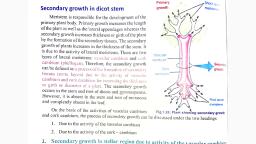
Vascular System Vascular bundles are collateral, conjoint and open with endarch xylem and, are arranged in three rings 1) Two large centrally placed medullary vascular bundles., 2) A middle ring of 6 to 14 loosely arranged and medium sized vascular, bundles., 3) The outer ring of 15 to 20 small vascular bundles just beneath the, pericycle., , Anomalous Structure In Boerhaavia a) Primary Anomaly - Presence of two large central medullary vascular bundles, encircled with a second ring of 6 to 14 loosely arranged vascular bundles lying in the, ground tissue., b) Non-adaptive type Anomaly - Normal indisposition of cambium with its unusual, activity., , Anomalous Secondary Growth The stem of Boerhaavia contain well defined anomalous secondary, growth which is characterized by the presence of successive rings of xylem and phloem, (vascular bundles)., After primary growth, the secondary growth is limited in the inner (Two medullary, vascular bundles) and the middle ring of vascular bundles (6 to 14) by a fascicular, cambium . As a result they slightly increase their size., Two vascular bundles (medullary vascular bundles) of the inner most ring are Large,, oval and lie opposite to each other with their xylem facing towards centre and phloem, outwards., In the stem , the secondary growth occurs by the activity of a complete cambium ring, formed in the outer ring of the vascular bundles in the normal position. Outer most ring of, the vascular bundles contain inter-fascicular cambium which is absent in other two rings., The outer ring consists of 15-20 vascular bundles, here the inter fascicular and intra, fascicular cambium strips join together to form a continuous cambial ring. The cambial, ring is functionally segmented into fascicular and intra fascicular region. This cambial, ring produce Internally : - Secondary xylem in the intra fascicular region and lignified, conjunctive tissue in the inter fascicular region on the inner side.
Page 3 :
Externally :- Secondary phloem in the intra fascicular region and parenchyma, from the inter fascicular region opposite the conjunctive tissue., After the formation of secondary tissue the cambium ceases its activity and a new fresh, cambial ring is arises by the joining of secondary parenchyma cells opposite to the, conjunctive tissue and the cells of pericycle outside the phloem. This accessory cambial, ring functions in a similar manner to the previous cambium. It produce secondary xylem, alternating with lignified conjunctive tissue on the inner side and secondary phloem, opposite to the secondary xylem and parenchyma above the conjunctive tissue. After, sometime, the activity of this cambium also cease., One or more cambium gets differentiated which also functions similar manner. During, the process, several such cambial rings may be formed. As a result of these successive, cambial differentiation several concentric rings of vascular bundles get embedded in the, thick walled lignified conjunctive tissue separated by thin walled parenchymatous zone, give the appearance of growth rings., The cambium is composed of fusiform initials only which gives to ray-less secondary, vascular tissue. Each successive ring of cambium is originated from the outer most, phloem parenchyma cell. This Anomalous type of secondary growth thickness takes, place by the means of successive ring of collateral vascular bundles., , Fig - Boerhaavia Stem - T.S. of Stem of Boerhaavia sp. ( Diagrammatic)
Page 4 :
Fig - The Stem Anomalous Structure - T.S. of a sectore of stem of Boerhaavia, diffusa showing anomolus secondary growth, thick-walled conjunctive, tissue, and medullary bundles.