Page 1 :
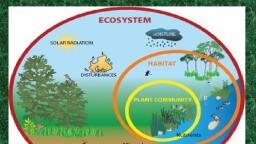
An ecosystem is a functional unit of nature, where living organisms interact each other and with the physical environment., , ECOSYSTEM – STRUCTURE & FUNCTION, • Autotrophic components: Phytoplankton, some algae, , Types of ecosystems, • Terrestrial ecosystem: Forest, grassland, desert etc., • Aquatic ecosystem: Pond, lake, wetland, river & estuary., • Man-made ecosystem: Crop fields and aquarium., , - Entire biosphere is regarded as global ecosystem., - In an ecosystem, biotic and abiotic components interact, and function as a unit., - Vertical distribution of different species occupying, different levels is called stratification. E.g. in a forest,, trees occupy top strata (layer), shrubs the second and herbs, & grasses the bottom layers., , Pond (Aquatic ecosystem), A pond is a shallow, simple, self-sustainable water body that, exhibits all basic components of an ecosystem., • Abiotic components: Water and soil deposit., • Climatic conditions: Solar input, cycle of temperature,, day-length etc., , and the floating, submerged and marginal plants., • Consumers (heterotrophs): Zooplankton, free swimming, and bottom dwelling forms., • Decomposers: Fungi, bacteria and flagellates., Pond performs all the functions of an ecosystem such as, o Conversion of inorganic into organic material using solar, radiant energy by the autotrophs., o Consumption of the autotrophs by heterotrophs., o Decomposition and mineralization of the dead matter to, release them back for reuse by the autotrophs., 4 basic components of functioning of an ecosystem:, 1) Productivity, 2) Decomposition, 3) Energy flow, 4) Nutrient cycling, , PRODUCTIVITY, - Solar energy is the basic requirement for an ecosystem to, function and sustain., - Amount of biomass (organic matter) produced per unit area, over a time period by plants during photosynthesis is called, primary production. It is expressed in weight (g–2 ) or, energy (kcal m–2 )., - The rate of biomass production is called productivity. It is, expressed in g–2 yr–1 or (kcal m–2 ) yr–1 ., - It is divided into gross primary productivity (GPP) and net, primary productivity (NPP)., - Gross primary productivity: It is the rate of production, of organic matter during photosynthesis. A considerable, amount of GPP is utilized by plants in respiration., - Net primary productivity (NPP): It is the available, biomass for the consumption to heterotrophs (herbivores &, , decomposers). i.e., NPP is the Gross primary productivity, minus respiration losses (R)., NPP = GPP – R, - Secondary productivity: It is the rate of formation of new, organic matter by consumers., - Primary productivity varies in different ecosystems, because it depends on, o The plant species inhabiting a particular area, o Environmental factors, o Availability of nutrients, o Photosynthetic capacity of plants, - Annual net primary productivity of whole biosphere is, about 170 billion tons (dry weight) of organic matter. Of, this, despite occupying about 70 % of the surface, the, productivity of the oceans is only 55 billion tons., , DECOMPOSITION, - It is the breakdown of complex organic matter by, decomposers into inorganic substances like CO2 , water and, nutrients. It is largely an oxygen-requiring process., - Raw material for decomposition is called Detritus. E.g., dead plant remains (leaves, bark, flowers etc.), dead, remains of animals, fecal matter etc., , d. Humification: Accumulation of humus (dark amorphous, substance) in soil. Humus is resistant to microbial action, and so decomposes very slowly. Being colloidal in nature, it serves as a reservoir of nutrients., e. Mineralization: It is the release of inorganic nutrients, due to the degradation of humus by some microbes., , Steps of decomposition, , Factors influencing decomposition, , a. Fragmentation: It is the breakdown of detritus into, smaller particles by detritivores (e.g. earthworm)., b. Leaching: Water soluble inorganic nutrients go down, into soil horizon and precipitate as unavailable salts., c. Catabolism: Degradation of detritus into simpler, inorganic substances by bacterial and fungal enzymes., , • Chemical composition of detritus: Decomposition rate is, , The above three processes occur simultaneously., , slower in detritus rich in lignin & chitin. It is quicker, if, detritus is rich in nitrogen and water-soluble substances, like sugars., • Climatic factors (temperature & soil moisture): Warm, and moist environment favour decomposition. Low, temperature and anaerobiosis inhibit decomposition, resulting in buildup of organic materials., , 1
Page 2 :
ENERGY FLOW, - Sun is the only source of energy for all ecosystems (except, deep sea hydro-thermal ecosystem)., - Of the incident solar radiation, less than 50% is, photosynthetically active radiation (PAR)., - Plants and photosynthetic bacteria (autotrophs), fix solar, radiant energy to make food., - Plants capture only 2-10% of the PAR. This energy, sustains the entire living world., - Ecosystems obey 2nd Law of thermodynamics. They need, a constant supply of energy to synthesize the molecules. It, helps to counteract the entropy., , Producers (Autotrophs):, - These are organisms that synthesize food., - In a terrestrial ecosystem, major producers are herbaceous, and woody plants. Primary producers in an aquatic, ecosystem are phytoplankton, algae and higher plants., - The energy trapped by the producer is either passed on to, a consumer or the organism dies., , - Detritus is made up of decomposers (saprotrophs) such, as fungi & bacteria. They secrete digestive enzymes that, breakdown detritus into simple, inorganic materials, which, are absorbed by them. Thus, they get energy & nutrients., - In an aquatic ecosystem, GFC is the major conduit for, energy flow., - In a terrestrial ecosystem, a much amount of energy flows, through the DFC than through the GFC., - DFC may be connected with GFC at some levels. Some, organisms of DFC are prey to the GFC animals. Some, animals (cockroaches, crows etc.) are omnivores. Such, interconnections of food chains make a food web., - A specific place of organisms in the food chain is known, as their trophic level., , Consumers (heterotrophs):, - These are animals that directly or indirectly depend on, plants for food. They include:, o Primary consumers (herbivores): Feed on plants. E.g., insects, birds, mammals, molluscs etc., o Secondary consumers (primary carnivores): Feed on, herbivores. E.g. frog, fox, man etc., o Tertiary consumers (secondary carnivores): Feed on, primary carnivores. E.g. tiger, lion etc., - The chain of feeding relationship between different, organisms is called a food chain. It is 2 types:, • Grazing Food Chain (GFC): Here, primary consumer, feeds on living plants (producer). E.g., , • Detritus Food Chain (DFC): Here, primary consumer, , feeds on dead organic matter (detritus). Death of, organism is the beginning of the DFC., , - The amount of energy decreases at successive trophic, levels. When an organism dies it becomes dead biomass, (detritus). It is an energy source for decomposers., - Organisms at each trophic level depend on those at the, lower trophic level for their energy., - Each trophic level has a certain mass of living material at, a particular time called as the standing crop. It is, measured as the biomass (mass of living organisms) or the, number in a unit area., - Biomass of a species is expressed in terms of fresh or dry, weight. It is more accurate measurement., - Number of trophic levels in GFC is restricted as it follows, 10% law (only 10% of energy is transferred to each trophic, level from the lower trophic level)., , ECOLOGICAL PYRAMIDS, - The representation of a food chain in the form of a pyramid, is called ecological pyramid., - The base of a pyramid represents producers (first trophic, level). The apex represents tertiary or top level consumer., - Ecological pyramids are 3 types: Pyramid of number,, Pyramid of biomass and Pyramid of energy., a) Pyramid of number: E.g. grassland ecosystem., Inverted pyramid of biomass: Small standing crop of, phytoplankton supports large standing crop of zooplankton., , b) Pyramid of biomass: It shows a sharp decrease in, biomass at higher trophic levels., , c) Pyramid of energy: Primary producers convert only 1%, of the energy in the sunlight available to them into NPP., , 2
Page 3 :
- Any calculations of energy content, biomass, or numbers, has to include all organisms at that trophic level., - The trophic level represents a functional level, not a, species as such. A given species may occupy more than, one trophic level in the same ecosystem at the same time., E.g. A sparrow is a primary consumer when it eats seeds,, fruits, peas. It is a secondary consumer when it eats insects, & worms., - In most ecosystems, all the pyramids are upright, i.e.,, producers are more in number and biomass than the, , herbivores, and herbivores are more in number and, biomass than the carnivores. Also, energy at a lower, trophic level is always more than at a higher level., - Examples for inverted pyramids:, o Insects feeding on a big tree, o Pyramid of biomass in sea is inverted because the, biomass of fishes far exceeds that of phytoplankton., - Pyramid of energy is always upright, because when energy, flows from a trophic level to the next trophic level, some, energy is always lost as heat at each step., - Limitations of ecological pyramids:, o It does not consider the same species belonging to two, or more trophic levels., o It assumes a simple food chain that almost never exists, in nature; it does not accommodate a food web., o Saprophytes are not included in ecological pyramids, even though they play a vital role in the ecosystem., , ECOLOGICAL SUCCESSION, - It is a gradual, slow and predictable change in the species, composition of an area leading to a climax community, (community that is in equilibrium with the environment)., - In this, some species colonize an area and increase in, number, whereas other species decline and disappear., - The entire sequences of communities that successively, change in an area are called sere. Individual transitional, communities are termed seral stages (seral communities)., - In the successive seral stages there is a change in species, diversity, increase in number of species and organisms and, an increase in the total biomass., - The present-day communities are due to succession of, millions of years. Succession and evolution would have, been parallel processes at that time., - Succession is 2 types:, o Primary: The succession taking place in areas where no, living organisms ever existed. E.g. newly cooled lava,, bare rock, newly created pond or reservoir., Before a biotic community is established, there must be, formation of fertile soil through natural processes. So the, primary succession is a very slow process., o Secondary: The succession taking place in an area after, the existed organisms are lost. E.g. abandoned farm, lands, burned or cut forests, lands that are flooded., Since some soil or sediment is present, succession is, faster than primary succession., The species that invade depend on the condition of the, soil, availability of water etc., - In succession, changes in vegetation affect food & shelter of, animals. Thus, as succession proceeds, the number and types, of animals & decomposers also change., , - Natural or human induced disturbances (deforestation, fire, etc.) convert a particular seral stage to an earlier stage., They create new conditions that encourage some species, and discourage or eliminate other species., , Succession of Plants, - Based on the nature of the habitat, succession of plants is, 2 types: hydrarch and xerarch., o Hydrarch succession: It takes place in wetter areas. The, successional series progress from hydric to the mesic, conditions., o Xerarch succession: It takes place in dry areas. The, series progress from xeric to mesic conditions., - Hence, both hydrarch & xerarch successions lead to, medium water conditions (mesic, the climax community)., - The species invading a bare area are called pioneer species., - Primary succession on rocks (xerophytic habitat):, Lichens (pioneer species. They secrete acids to dissolve, rock, helping in weathering & soil formation) → small, plants like bryophytes (they need only small amount of, soil) → bigger plants → stable climax forest community, (mesophytic)., The climax community remains stable as long as the, environment remains unchanged., - Primary succession in water:, Phytoplankton (pioneers) → rooted-submerged plants →, rooted-floating angiosperms → free-floating plants →, reed-swamp → marsh-meadow → scrub → trees (climax, community is a forest)., With time, the water body is converted into land., , NUTRIENT CYCLING, - The amount of nutrients like carbon, nitrogen, phosphorus,, calcium etc. present in the soil at any given time, is referred, , to as the standing state. It varies in different kinds of, ecosystems and also on a seasonal basis., , 3
Page 4 :
- Nutrients are never lost from the ecosystems. They are, , recycled again and again. The movement of nutrient, elements through various components of an ecosystem is, called nutrient cycling (biogeochemical cycles)., - Nutrient cycles are 2 types:, a. Gaseous cycle: For this, the reservoir exists in the, atmosphere. E.g. Nitrogen & Carbon cycles., b. Sedimentary cycle: For this, the reservoir is located in, Earth’s crust. E.g. Sulphur & Phosphorus cycles., - Environmental factors (soil, moisture, pH, temperature,, etc.) regulate the rate of release of nutrients into the, atmosphere. The reservoir meets with the deficit of, nutrients due to imbalance in the rate of influx and efflux., , Carbon Cycle, , - Reservoir of carbon: Atmosphere (about 1%), organisms, (49% of dry weight), oceans (71% dissolved carbon. It, regulates the amount of atmospheric CO2 ), fossil fuel etc., - Carbon cycling occurs through atmosphere, ocean and, through living and dead organisms., - 4×10¹³ kg of carbon is fixed in the biosphere through, photosynthesis annually., - A major amount of carbon returns to the atmosphere as, CO2 through respiration., , - Processing of wastes & dead organic matter by, decomposers also release CO2 ., - Some amount of the fixed carbon is lost to sediments and, removed from circulation., - Burning of wood, forest fire and combustion of organic, matter, fossil fuel and volcanic activity are other sources, for releasing CO2 in the atmosphere., - Role of human activities in carbon cycle: Deforestation,, burning of fossil fuel etc. has increased the rate of release of, CO2 into the atmosphere., , Phosphorus Cycle, - Phosphorus is a constituent of biological membranes,, nucleic acids & cellular energy transfer systems. Many, animals use phosphorus to make shells, bones and teeth., - The natural reservoir of phosphorus is rock (in the form of, phosphates)., - When rocks are weathered, minute amounts of phosphates, dissolve in soil solution and are absorbed by the plants., Herbivores and other animals obtain this from plants. The, waste products and the dead organisms are decomposed by, phosphate-solubilising bacteria releasing phosphorus., , Differences between carbon and phosphorous cycles, Carbon cycle, Atmospheric input is higher, There is gaseous exchange, b/w organism & environment, , Phosphorous cycle, Much smaller, Gaseous exchange is, negligible, , ECOSYSTEM SERVICES, - The products of ecosystem processes are called ecosystem, services., - E.g. healthy forest ecosystems purify air and water,, mitigate droughts and floods, cycle nutrients, generate, fertile soils, provide wildlife habitat, maintain biodiversity,, pollinate crops, provide storage site for carbon and provide, aesthetic, cultural & spiritual values., - Robert Constanza and his colleagues have tried to put, price tags on nature’s life-support services., , - Researchers have put an average price tag of US $ 33, trillion a year on fundamental ecosystems services. This is, nearly twice the value of the global gross national product, GNP (US $ 18 trillion)., - Out of this total cost, soil formation accounts for about 50%., - Contributions of other services like recreation & nutrient, cycling are less than 10% each., - The cost of climate regulation and habitat for wildlife are, about 6 % each., , 4
Page 5 :
MODEL QUESTIONS, 1., , 8., , Fill in the blanks by noticing the relationship of the given pair, a. Producer: plant, Consumer: ………………., b. Carbon cycle: gaseous cycle, Phosphorus cycle: …………………., Analyze the following food chain., Partially decomposed organic matter ⟶ Earthworm ⟶ Hen ⟶ Fox, a. Name the above mentioned food chain., b. How do the members in this food chain meet their energy and nutrient requirements?, “Pyramid of number is always upright.” Comment on this statement., In nature one species can occupy more than one trophic level. Is this possible? Comment., Even though biological pyramids are helpful in studying food chain, they have certain limitations. Acc ount them., While visiting the forest during a study tour, a teacher told the students that once this area was a barren rocky area., a. Name the ecological succession on a bare rock., b. Which was the pioneer species in that succession?, c. Write the changes that lead to the formation of forest from barren rocky place., Different stages of an ecological succession are given below., • Marsh - meadow stage, • Reed swamp stage, • Scrub stage, • Phytoplankton stage, • Submerged free floating stage, • Forest stage, a. Arrange them in the correct sequence., b. Name the type of ecological succession and mention the pioneer and climax communities in this succession, Given below is the pyramid of number of an ecosystem., , 9., , a. Identify the nature of pyramid., b. Give reason for this nature of pyramid., Observe the figure given below and answer the following questions, , 2., , 3., 4., 5., 6., , 7., , a., b., , Identify the ecological concept converged through the given figures., Name the group of organisms as pioneer community and climax community in this ecological process., , 5