Page 1 :
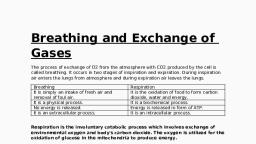
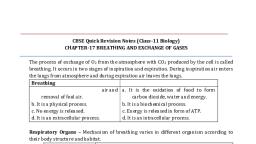
Breathing & Exchange of Gases, Parts of Human Respiratory System, All living organisms require energy to carry out vital functions of their body. Have you, ever wondered how this energy is obtained?, The energy requirements of our body are met by the process of, respiration. Respiration is a chemical process in which glucose is broke down to, release energy for carrying out other life processes. The basic respiration process, can be represented as:, C6H12O6 + 6O2 → 6CO2 + 6H2O + Energy, Types of Respiration, Respiration can occur either in presence or absence of oxygen. On the basis of, presence or absence of oxygen, respiration process is of two types:, •, , Aerobic respiration: Respiration occurring in presence of oxygen. Most common type, of respiration process in animals., C6H12O6 + 6O2 → 6CO2 + 6H2O + 38 ATP + Heat energy, , •, , Anaerobic Respiration: Respiration occurring in absence of oxygen. Very few animals, can respire anaerobically, example tapeworms., C6H12O6 → Lactic acid + 2 ATP + Heat energy, Anaerobic respiration is a slow process and produces very less energy as compared to, aerobic respiration. Anaerobic respiration can occur in our muscle cells also, though it is, a temporary process., During heavy exercises, our muscles work too fast, but do not receive enough oxygen, to derive energy. In such a case, they start respiring in the absence of oxygen. This, results in production of lactic acid, accumulation of which results in muscle cramps., Such a condition is known as oxygen-debt., Parts of Respiration, In humans, there are four major parts of respiration:, , •, , Breathing: It is a physical process in which oxygen-rich air is taken in and CO2 rich air, (from our body's internal organs) is expelled out.
Page 2 :
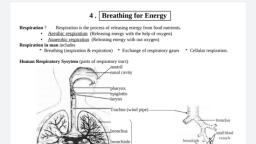
•, , Gaseous transport: Firstly, the exchange of gases occurs in the lungs. The oxygen, absorbed by the blood in lungs is then carried to other body parts as oxyhaemoglobin., The CO2 from the tissues is transported to the lungs through blood either, as bicarbonates dissolved in plasma, or as carbamino-haemoglobin (by combining, with haemoglobin)., , •, , Tissue respiration: The capillaries deliver the oxygen to the body cells and pick up the, carbon dioxide released by them. This exchange of gases occurs by diffusion through, thin walls of capillaries., , •, , Cellular respiration: It involves complex chemical reactions inside the cell in, which oxygen is utilised to break down the glucose to release energy., Which organs and structures help us in breathing? Let us explore., The process of breathing involves taking in oxygen-rich air and giving out carbon, dioxide-rich air. This entire process occurs through the action of the various organs of, the respiratory system., We all know that we take in air through our nostrils, and when we breathe in, air passes, through our nostrils into the nasal cavity., Parts of Human Respiratory System, The organs of the respiratory system extend from the nose to lungs. They include, the nose, pharynx, trachea, bronchi, and bronchioles., 1) Nostrils: The air from outside first enters the nostrils, which is divided into the left, and the right nostril. These nostrils lead to open spaces in the nose called the nasal, passage. This passage contains hair and mucus, which perform the functions of, filtering, moistening, and warming the air entering the nasal passage., 2) Pharynx: Air travels from the nasal passage to the pharynx, which is commonly, known as throat. The pharynx is lined with a protective mucus membrane and cilia,, which removes the impurities entering with air., 3) Larynx: The air from the pharynx enters the larynx or voice box. It contains two true, vocal cords, which are made up of cartilage and fibres. When air passes through this, area, the vocal cords vibrate and this produces different sounds. Human beings can, control this vibration. Thus, they can make various sounds and are capable of speech., 4) Trachea: From the larynx, the inhaled air moves into the wind pipe or trachea. The, trachea is a long narrow tube, which is lined with ciliated mucus membrane. The, trachea branches into two tubes, the left and right bronchi. The cilia move the mucus, containing dust particles back to the pharynx, where it is swallowed.
Page 3 :
5) Bronchi and bronchioles: The air from the trachea moves into the bronchi, which, are formed because of the division of the trachea. Each bronchus enters one of the, lungs. Inside the lungs, the bronchi further divide into bronchioles. The air moves, through these bronchioles., 6) Alveoli: The bronchiole divides many times in the lungs to create smaller branches., These branches ultimately terminate into tiny air-sacs known as alveoli. These cells are, surrounded by many blood capillaries., Do you know that each lung contains 300 – 350 million units called alveoli,, making a total of 700 million in both lungs?, , Mechanism of breathing, , Structure of Lungs, •, •, , Lung is a network of bronchi, bronchioles and alveoli., There is a pair of lungs located in the thoracic cavity. Both lungs are covered by doublelayered pleura with pleural fluid-filled between them. The fluid helps in reducing the, friction.
Page 4 :
•, , The outer pleura of the lungs is in contact with the thoracic lining and the inner pleura is, in contact with the lung surface., , •, , Cartilaginous rings are present in the trachea and they support tracheae, primary,, secondary, and tertiary bronchi, and initial bronchioles, , •, , The bronchioles on entering the lung divide further to form tiny air sacs called alveoli, where the exchange of gases takes place., , •, , Lungs are present in the chest cavity which is composed of different part of our body., The positions of these parts are illustrated in the given table., , •, , Dorsal side, , Ventral side, , Lateral sides, , Lower side, , Vertebral column lies here, , Sternum lies here, , Ribs lie here, , Diaphragm lies here, , This type of arrangement helps in providing the required space to lungs while inhalation, and exhalation. Any change in thoracic cavity will influence pulmonary cavity also., , Mechanism of Breathing, Mechanism of Breathing, •, , Pulmonary ventilation (breathing) − Taking in of oxygen-rich atmospheric air and, exhaling out of CO2-rich alveolar air, , •, , Diffusion of O2 and CO2 across alveolar membrane, , •, , Transport of gases by blood as oxyhaemoglobin and carbamino-haemoglobin, , •, , Diffusion of O2 and CO2 between blood and tissues
Page 5 :
•, , Cellular respiration − Utilization of oxygen by cells for reactions and resultant release of, CO2, Mechanism of Breathing, , •, , Breathing − two stages − inspiration and expiration, , •, , Inspiration − taking in of atmospheric air, , •, , Inspiration occurs if intra-pulmonary pressure (pressure within lungs) < atmospheric, pressure, , •, , Mechanism of inspiration, , •, , Diaphragm contracts., , •, , Volume of thoracic chamber increases in anterio-posterior axis., , •, , External inter-costal muscles contract and ribs and sternum lift up., , •, , Volume of thoracic chamber increases in dorso-ventral axis and results in overall, increase of thoracic volume, which in turn increases pulmonary volume., , •, , Intra pulmonary pressure becomes less than atmospheric pressure., , •, , Air from outside moves in the lungs., , •, , Expiration involves releasing out of alveolar air into the atmosphere., , •, , Expiration occurs when intra-pulmonary pressure > atmospheric pressure, , •, , Mechanism of expiration:, , •, , Phenomena opposite to inspiration, , •, , Involves relaxation of diaphragm, expansion of intercostal muscles, and decrease in, thoracic as well as pulmonary volumes, , Inspired Air vs Expired Air, Composition in Inspired, Air, Oxygen, 20.96%, Carbon dioxide, 0.04%, Nitrogen, 79%, Component, , Composition in Expired, Air, 16.4%, 4.0%, 79.6%
Page 6 :
Water vapours, Dust particles, , Low, Variably present, , High, Little, if any, , You might be aware that mountaineers when go for mountain climbing, carry oxygen, cylinders with them. Do you know why? As we go higher up from the sea level, the air, pressure decreases, and so do the oxygen content in it. On going to higher altitudes, (say, 4500 metres or above), one can suffer from air sickness, a condition that occurs, due to lack of oxygen, It results in dizziness, unsteady vision, lack of muscular, coordination, etc. This is the reason that mountaineers carry oxygen cylinders with, them., At high altitudes, where oxygen content is low, or while sitting in a poor ventilated room, for long hours, our tissues can get deficient in oxygen. This condition is known, as hypoxia., Asphyxiation is a condition in which the blood becomes venous by accumulation of, high amount of carbon dioxide and diminished oxygen supply. Such conditions can, prove fatal if not reversed quickly. Asphyxiation can occur due to drowning,, strangulation, or any obstruction in respiratory tract., Video(s) by teachers, Strengthen this topicTAKE A TOPIC TEST, SCROLL DOWN FOR THE NEXT TOPIC, Factors Affecting Gaseous Exchange in Tissues, Factors Affecting Gaseous Exchange in Tissues, The primary site of gaseous exchange are the alveoli and between blood and tissue., The method of the gaseous exchange involves simple diffusion based on pressure and, concentration gradient, Factors affecting diffusion of gases are•, •, , Solubility of gases, Thickness of membranes involved, , •, •, , Partial pressure − Pressure contributed by an individual gas in a mixture of gases, The pO2 in oxygenated blood is 95 mm Hg while it is 40 mm Hg in tissues. Similar, pressure gradient occurs for CO2 in opposite direction i.e., 40 mm Hg in oxygenated, blood and 45 mm Hg in tissues., Solubility of CO2 is 20 - 25 times higher than that of oxygen. Therefore, CO2 can diffuse, at comparatively lesser concentration gradient also., , •
Page 7 :
•, , These factors are favourable for diffusion of O2 from alveoli to tissue and CO2 from, tissue to alveoli., , Strengthen this topicTAKE A TOPIC TEST, SCROLL DOWN FOR THE NEXT TOPIC, Experiments Related to Respiration, Experiments on Respiration, Experiment to demonstrate that water is lost during breathing, Take a deep breath and gently expirate or breathe upon a cold surface such as a piece, of looking glass or a steel plate. The water vapour present in the expelled air condenses, and droplets of water appear on the glass/steel plate proving that water is lost during, breathing., Experiment to demonstrate the mechanism of breathing, Set up the experiment as shown in figure using a rubber sheet, thread, bell jar, one, holed rubber stopper, a pair of balloons and a ‘Y’ shaped glass tubing.
Page 8 :
The rubber sheet tied at the bottom edge of the bell jar represents the diaphragm and, the two rubber balloons the lungs present in our body. Pull the rubber sheet downwards, and note that the rubber balloons are expanded due to air rushing in through the glass, tubing. Now push the rubber sheet upwards. Note that the rubber balloons collapse as, the air present in them rushes out., Experiment to measure the volume of expired air, Set up an apparatus as shown in the figure. Fill up your chest with air to the maximum,, and then blow out through the short tube at point A expelling as much air as you can., Collect the water expelled from the other tube in a bowl. The water collected in the bowl, gives the volume of air exhaled., , Experiment to demonstrate that CO2 is given out during breathing, Takes some freshly prepared lime water in two test tubes., In the first test tube, use a syringe to pass air and in the second test tube, blow air, through a straw. You can observe that the lime water in both the test tubes turns milky.
Page 9 :
Why do you think the lime water turns milky?, Lime water is actually the common name for saturated calcium hydroxide solution. Its, chemical formula is Ca(OH) 2. When CO2 is passed through lime water, it turns milky, due to the formation of calcium carbonate. This reaction can be denoted by the given, definition:, Ca(OH)2 + CO2 → CaCO3 + H2O, The lime water in which of the two test tubes took longer to turn?, In the first test tube, the lime water turned milky faster because the air we exhale is, CO2, whereas in the second test tube we blew atmospheric air which has only 0.03%, CO2., Result of the activity, The air we exhale is CO2. Thus, the end product of respiration is CO2., Strengthen this topicTAKE A TOPIC TEST, SCROLL DOWN FOR THE NEXT TOPIC, Transport of Gases - Oxygen and Carbon dioxide, Transport of Gases − Oxygen and Carbon dioxide, Gases transported by blood, •, •, , Oxygen − 97% through RBC; 3% in plasma in dissolved state, Carbon dioxide − 20-25% through RBC; 70% as bicarbonate; 7% in plasma in dissolved, state
Page 10 :
Transport of Oxygen, •, •, •, •, •, •, •, •, , Oxygen binds with haemoglobin to form oxyhaemoglobin., 1 molecule of haemoglobin carries 4 molecules of oxygen., Formation of oxyhaemoglobin depends upon − pO2, pCO2, pH, temperature, In alveoli − pO2 (high), pCO2 (low), pH (high) temperature (low), Hence, oxyhaemoglobin forms., In tissues − pO2 (low), pCO2 (high), pH (low) temperature (high), Hence, oxyhaemoglobin dissociates., This relationship is represented by oxygen dissociation curve., , •, , For every 100 mL of oxygenated blood, 5 mL of oxygen is delivered to tissues., , Transport of Carbon Dioxide, •, •, •, •, •, , CO2 is carried as carbamino-haemoglobin by blood., When pCO2 (high), pO2 (low) − binding of CO2 occurs (as in tissues), When pCO2 (low), pO2 (high) − dissociation of CO2 occurs (as in alveoli), CO2 is bound with haemoglobin in tissue and dissociates in alveoli where it is released., CO2 is transported as bicarbonate as well., , •, •, , Most of the bicarbonate ions diffuse into the plasma. This creates an ionic imbalance, between plasma and erythrocytes., This ionic balance is restored by diffusion of chloride ions from plasma into the, erythrocytes. This phenomenon is known as chloride shift or Hamburger's, phenomenon., , •, •, , When pCO2 (high),, forms (in tissues), When pCO2 (low), CO2 + H2O forms (in Alveoli)
Page 11 :
•, •, , CO2 is trapped in tissue as, and released in alveoli., For 100 mL of deoxygenated blood, about 4 mL of CO2 is delivered to alveoli., Video(s) by teachers, , Strengthen this topicTAKE A TOPIC TEST, SCROLL DOWN FOR THE NEXT TOPIC, Respiratory Volumes and Capacities, Respiratory Volumes and Capacities, , Respiratory, volume, Tidal Volume (TV), , Description, , Volume of air inspired or expired during normal, respiration, , Inspiratory reserve Additional volume of air a person can inspire by, volume (IRV), forceful inspiration, , Amount, , 500 mL, , 2500 − 3000 mL, , Expiratory, Reserve Volume, (ERV), , Additional volume of air a person can expire by, forceful expiration, , 1000 − 1100 mL, , Residual Volume, (RV), , Volume of air remaining in the lungs even after, forceful expiration, , 1100 − 1200 mL, , Inspiratory, Capacity (IC), , Expiratory, Capacity (EC), , Total volume of air a person can inspire after, normal expiration, , 3000 − 3500 mL, , Total volume of air a person can expire after, normal inspiration, , 1500 − 1600 mL
Page 12 :
Functional, Residual Capacity, (FRC), , Volume of air that remains in the lungs after, , Vital capacity (VC), , Maximum amount of air a person can breathe, in/out after a forceful expiration/inspiration, , Total Lung, Capacity, , normal expiration, , Total volume of air accommodated in lungs at, the end of forceful inspiration, , 2200 − 2300 mL, , This may include, ERV, TV, and, IRV., , This may include, RV, ERV, TV, and, IRV., , Strengthen this topicTAKE A TOPIC TEST, SCROLL DOWN FOR THE NEXT TOPIC, Respiratory Volumes and Capacities, Regulation of Respiration, and Disorders of, Respiratory System, Regulation of Respiration, •, •, , Centre of Respiratory Regulation − Respiratory Rhythm centre, Pneumotaxic Centre, Location −Pons region of brain, Function − Moderates the function of Respiratory Rhythm Centre, , •, , Chemo Sensitive Area, Location − Adjacent to Rhythm Centre, Function − Highly sensitive to CO2 and H+, As CO2 and H+ increase, this area gets activated so as to provide signals to eliminate, them., , •, , Aortic arch and carotid artery associated receptors, Function - They also sense changes in CO2 and H+ concentration., Disorders of Respiratory System, , •, , Asthma
Page 13 :
•, •, •, , Bronchi and bronchioles get inflammated., Difficulty in breathing, Wheezing, , •, , Emphysema, , •, •, •, , Chronic disorder, Major cause − cigarette smoking, Alveolar walls damage and respiratory surface decreases, , •, , Occupational Respiratory Disorders, , •, •, •, •, , Particular industries such as grinding and stone breaking get affected., Long exposure to dust leads to inflammation ultimately resulting in fibrosis., Serious lung damage is caused., Prevention − wearing protective masks during work