Notes of B.Sc Classes, Biology Metamorphosis.pptx - Study Material
Page 3 :
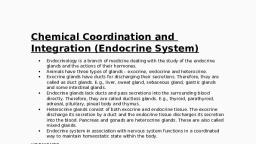
Hormones of Insects Body, Although hormones are mainly present in chordates, yet some hormones are also present in arthropods, that is insects. There are various hormones secreted in insects, which play role in metamorphosis. Some of the hormones are as follows., 1- Brain hormone (BH), The brain has neurosecretory cells. Neurosecretory cells of the brain secrete brain hormones. The chemical nature of brain hormone is lipid. These hormones activate corpora cardiaca, which is a part of the retro-cerebral complex of the stomatogastric nervous system., 2- Prothoracicotropic hormone (PTTH), The corpora cardiaca secrete this hormone, which stimulates the prothoracic glands for secretion. The corpora cardiaca are a pair of neuro-hemal organs, which are located on the walls of the aorta just behind the brain.
Page 4 :
3- Prothoracic gland hormone (PGH) / Ecdysone, This hormone is the secretion from the prothoracic gland, by the paired bilateral sheet of cells in the thorax, chemical nature of this hormone is ecdysteroid. This hormone plays role in moulting and metamorphosis in insects. Larva of insects can not metamorphose into the adult in absents of this hormone., , 4- Juvenile hormone (JH), Corpora allata, another component of the retro-cerebral complex, secrete this hormone. Chemically it is non-sterol lipid. This hormone plays role in metamorphosis because it regulates morphogenesis. Hence, play role in the development of larva to pupa, but not larva to adult. Corpora allata gland is located beneath the brain of insects.
Page 7 :
Metamorphosis in insect, Structural change in the body, from larva to adult form is called metamorphosis, In other words, we can say that larval change to adult form, which can be seen from Porifera to Chordata. So metamorphosis is also present in insects. , , Insects display mainly 4 types of metamorphosis., , 1-Ametabolous (No-metamorphosis), In this type of development, newly hatched organisms look like their adult, except differ in size and difference in the armature of spines. This means there is no need for metamorphosis, newly hatched organism resembles with their adult but small in size. Example – Silver-fish, Springs-tails.
Page 8 :
2-Hemimetabolous development or Incomplete metamorphosis, , In this type of development, newly hatched creatures do not completely look like their adult, so there is half metamorphosis needed. Some terrestrial arthropods have aquatic immature stages called nymphs. Which respire by tracheal gills, but their adult respire by trachea. So in this type of metamorphosis immature stages have only changed some systems, such as the tracheal gills system to the tracheal system. There are no complete larva and pupal stages. Example – Dragonflies, Mayflies, etc.
Page 9 :
3- Paurometabolous development or Gradual metamorphosis, In this type of metamorphosis, the newly hatched nymph resembles their adult but lacks wings and external genital aperture, growth and development of wings and genital aperture takes place gradually with increasing age. Nymph undergoes several nymph stages through moulting to become adult. So we can say that no sudden metamorphosis takes place. Example – Gross-hopper, Aphides, Stink.
Page 10 :
4- Complete metamorphosis or Holometabolous development, In this type of metamorphosis, all stages are present, egg, larva, pupa, and adult. Larva hatched from the egg, and this larva moults in pupa after some growth and development and later this pupa differentiate into the adult after some growth and development and finally young adult breaks puparium (upper covering of pupa) to come out. Example – Housefly, mosquito, butterfly.
Page 11 :
Amphibian Metamorphosis
Page 13 :
Metamorphosis can be defined as “a radical transformation from larval life to the adult stage involving structural, physiological, biochemical and behavioural changes”., 1. Changes of tadpole in habit and habitat:, (i) With the metamorphosis, the metamorphosed larva leaves aquatic medium and frequently visits the land., (ii) The herbivorous tadpole larva changes into carnivorous specially consume the insects (insectivorous)., (iii) The praying habits develop by the adults and the adult animals become more active and swift moving., (iv) In the first stage of adult toad, they jump into nearby pond and in other aquatic medium, and then jump on the land by their elongated hind limbs.
Page 14 :
2. Morphological metamorphic changes:, a. Regressive changes:, (i) The tissues of tail and tailfin are completely absorbed into the body., (ii) The horny jaws with teeth are shed and mouth becomes a large transverse slit., (iii) The external gills disappear and the gill slits communicate to the pharyngeal cavity., (iv) The length of the alimentary canal much reduces., (v) The changes of the blood vascular system take place and ultimately some blood vessels are reduced., (vi) The lateral line sense organ disappears., (vii) Operculum and spiracle disappear.
Page 15 :
b. Progressive changes:, (i) The fore and hind limbs increase in size., (ii) The tongue becomes long and more elastic which is free and bifid posteriorly., (iii) The eyes become large and prominent and develop eye-lids and nictitating membrane., (iv) External nostrils communicate with buccal cavity through internal nostrils., (v) Tympanum and middle ear develop., (vi) Liver becomes more enlarged., (vii) Three chambered heart develops from two-chambered heart., (viii) Pronephros is replaced by mesonephros.
Page 16 :
3. Biochemical changes during metamorphosis:, (i) The concentration of serum protein becomes about double during metamorphosis., (ii) Biosynthesis and concentration of haemoglobin are greater in adult than in larvae., (iii) In the liver, DNA synthesis, lipid synthesis, enzymes for ornithine urea cycle increase during adult stage., iv) Alkaline phosphatase and hydrolase decrease in adult stage of the anurans., , 4. Changes in Physiology:, (i) At the beginning of metamorphosis, the pancreas starts to secret insulin and glucagon hormones. This is related to the increased role of the liver., (ii) During the larval stage, the end product of nitrogen metabolism is ammonia. But after metamorphosis, the toads and frogs excrete most of their nitrogen in the form of urea. This is a shift from ammonotelism to ureotelism with the change of environment from aquatic medium to land.
Page 17 :
Hormonal Control for Metamorphosis:, Two hormones such as Triiodothyronine (T3) and Tetraiodothyronine (T4) or thyroxine are necessary for biochemical and morphological changes during anuran metamorphosis. , It is capable to synthesize a hormone, thyrotropin (Thyroid Stimulating Hormone, TSH) which acts on the thyroid, stimulating the production and secretion of triiodothyronine (T3) and thyroxine. , In pre-metamorphic stage the prolactin level is high but levels of thyroid stimulating hormone (TSH) and thyroid hormone (T3, T4) are low. , The hypothalamus – pituitary link is poorly developed. In pro-metamorphosis, the hypothalamus and pituitary link develops., The prolactin level is low but the levels of thyroid stimulating hormone (TSH) and thyroid hormones (T3, T4) are high. In metamorphic climax, the prolactin level increases suddenly, then maintains steady low level. The TSH is high until end of climax and the thyroid hormone (T4) level becomes low.
Page 18 :
Metamorphosis of Toad:, The young tadpole larva resembles a fish. It leads an independent and self-supporting life. This fish like tadpole larva completely metamorphoses into toad, is exclusively a progressive process. According to Mohanty-Hejmadi and Dutta (1978) – development is rapid being completed in 34-52 days. Daniel (1963) reports the hatching in about 4 days after laying.
Page 20 :
THANK YOU!



 Learn better on this topic