Page 2 :
Characters of animals, The animals are multicellular and eukaryotes., Cell lacks a cell wall., They show heteromorphic mode of nutrition , They are capable of locomotion., They posses nervous system and specialised sense organs for, co-ordination of different systems., 6. Reproduction is mainly sexual by formation of gametes.
Page 3 :
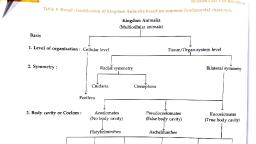
4.2 Animal body plan :, a. Cell aggregate plan : , 1. Cells do not form tissues or organs. , 2. Their is little differentiation and division of labour among, cells. , 3. It is found in Porifera., b. Blind sac body plan : , 1. Body is like a sac with single opening. , 2. Digestion is carried out in this sac., 3. ingestion and egestion takes place through same opening. , 4. Members of Phylum Cnidaria., c. Tube within tube body plan : , 1. Digestive system is present in tube-like body cavity., 2. Mouth and anus are present at two separate ends of digestive system. , 3. Annelida onwards all phyla show this type of body plan.
Page 4 :
Cell aggrigate plan, ex-Scypha-Sycon, Blind sac plan, ex- Hydra, Tube within tube body plan, ex. Fish
Page 5 :
Germ Layers
Page 6 :
4.3 Animal Classification :, 1. Phylum : Porifera , (pori-pores; feron-bearing), e.g. Scypha (sycon), Euspongia (Bath sponge),, Euplectella (Venus' flower basket), Characters:- (Pore bearing animals.- Sponges), 1.These are aquatic mostly marine animals ,few are fresh water(Spongilla)., 2. They are sedentary (fixed) animals., 3.They are radially symmetrical or asymmetrical., 4. They show cell aggregate body plan., 5. Body of these animals consists of many cells with little division of labour. –, 6. Body is perforated by number of small pores called as ostia and a at apical end called as osculum., 7. Water enters through ostia in the body cavity- spongocoel and leaves the body through osculum., 9. Spongocoel is lined by special flagellated cells called 'choanocytes' or 'collar, cells'. Beating of flagella creates water current.
Page 7 :
10. Water is circulated in the body through the 'canal system'. During its circulation, cells of the animal body absorb food, exchange respiratory gases and release excretory products., 11. Body of these animals is supported by calcareous or siliceous 'spicules' or, proteinaceous 'spongin fibers'. , 12.They reproduce asexually as well as sexually. , 13. Asexual reproduction is performed by fragmentation and gemmule formation., 14. These animals have ability of regeneration. , 15.Sexual reproduction is performed by formation of gametes. , 16. Fertilization is internal. , 17.Development takes place through indirect larval stage.