Page 4 :
of dwarf plants and pollen from flowers of dwarf plants to emasculated flowers, of all plants., Reciprocal crossTall plant (male), Dwarf plant (female), Dwarf plant (male), Tall plant (female), 4. The cross in which only two alternate forms of a single character are taken into, consideration is called monohybrid cross., 5. Mendel also performed crosses involving tow characters i. e. dihybrid cross, three, characters i. e. trihybrid cross etc., 6. Collection of seeds – The seeds of the cross or crosses where collected and shown next, year to raise hybrids or first filial generation or F1 generation., 3) Selfing or inbreeding of F1 to raise F2 generation – Step III, 1. Mendel allowed F1 hybrids to self pollinate and produced the offspring of next, generation., 2. The seed or plants raised from selfing of F1 constitute the second filial or F2, generation., 3. Further self pollination of F2 produced F3 or third filial generation and so on., 4. Mendel kept record of each generation and observes similar type of results., Observation, conclusion/Results1. Mendel found that in each cross all the F1 hybrid were similar to one parent., 2. The character of other parent was not seen in F1, 3. F1 plants were not intermediate between the two alternate traits of a character., 4. In F2 generation, both parental traits of a characters were expressed., 5. The organism should possess two factors o determiners of each characters., 6. Out of two factors or alleles representing alternate traits of a character, one is dominant, and express itself in F1 generation., 7. The other factor or allele is recessive and does not show it’s effect or do not express in, F1 generation, 8. When F1 hybrids are selfed to get F2 generation both the characters appears in F2 in the, ratio 3:, i.e. 3 tall: 1 dwarf. This is called monohybrid ratio, 9. When inheritance of two traits was considered i. in dihybrid cross, four types of plants, were form in F2 generation, two parental and two recombinants. The dihybrid ratio is, 9:3:3:1., On the basis of Mendel’s experiments an results, some laws were, assigned by Correns., Reasons for Mendel’s success:, (Secrete of Mendel’s success), 1. Mendel was careful in the selection of plant for hi experiments., 2. Mendel selected pea plant for his experiment because pea plant has many, advantages to make the experiment easier., 3. He studied only one character at a time., 4. He maintained a complete record (qualitative and quantitative) of every cross and, generation., 5. He used mathematical and statistical principles of the analysis of experimental, results, 6. He carried out his experiment with great care., 7. The selected contrasting characters were relate as dominant a1nd recessive and, were present different chromosomes., 8. Mendel’s approach was simple, logical an analytical towards the problem of, heredity., 9. Crossing was done between the parents of put lines having sharply contrasting, characters., 10. All the seven pairs of contrasting characters selected by Mendel showed complete, dominance., 12. All combinations of allelic pairs considered for dihybrid cross showed independent, assortment., 13. Mendel did not encounter linkage., Genetic Terminology, Genetic Terms and symbols:, 1. Dominant: The character (gene or allele) Which express itself in F1 generation is, called dominant character (gene or allele). The allele expresses its trait in heterozygous, condition also., Explanation: When tall pea plant is crossed with dwarf pea plant, all the F1, hybrids are tall i.e. character tallness is expressed. Hence, tallness is dominant, character. It is represented by capital letter., 2. Recessive: The character (gene or allele) which does not express itself in F1 generation, is called recessive character (gene or allele).
Page 8 :
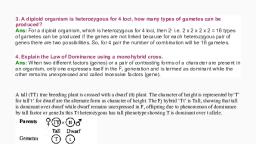
1., 2., 3., 4., 5., 6., 7., 8., 9., 10., 11., , 1., 2., 3., 4., 5., 6., 7., 8., , 9., , 10., 11., 12., , pure parents differing in single pair of contrasting characters., Explanation:, Mendel studied inheritance of one character by considering height of plant., When homozygous tall plant is crossed with homozygous dwarf plant, all the, individuals obtained in F1 are hybrid tall (Tt) (heterozygous)., Tallness is dominant over dwarfness as tallness is expressed in F1, Hybrid tall (Tt) produces two types of gametes on meiosis i.e. T and t in equal, proportions (50% with capital T and 50% with small t)., The two gametes randomly fuse to produce four combinations, . They fall genotypically into 3 and phenotypically into 2 categories., Thus selfing of F1 i.e. hybrid tall produce both tall and dwarf plants in F2 generation in, 3:1 ratio., So, phenotypic ratio of monohybrid cross is 3:1 i.e. 3 Tall: 1 dwarf., Genotypically, three types of individuals where produced in F2 generation as one, homozygous pure tall (TT), two heterozygous hybrid tall (Tt) and one homozygous, pure dwarf (tt)., Thus, out of 4 (i.e. 100%), 25% were pure tall (TT), 50% were hybrid tall (Tt) and 25%, were pure dwarf., Hence genotypic ratio of monohybrid cross is 1:2:1. 1 pure tall (TT): 2 hybrid tall (Tt):, 1 pure dwarf, All tall plants of F2 are not similar, are pure tall and, are hybrid tall., , II) Dihybrid cross and ratio:, The cross between two pure parents differing in two pairs of contrasting characters, is called dihybrid cross., The phenotypic ratio obtained in the F2 generation of dihybrid cross is called, dihybrid ratio., Dihybrid-It is heterozygous for two traits and produced in a cross between two, pure parents., Explanation:, Mendel studied inheritance of two characters by considering color of seed and shape of, seed., He selected seed color as yellow and green and seed shape as round and wrinkled., Mendel crossed a pea plant with yellow round (YYRR) seeds with a plant having green, wrinkled seeds (yyrr)., In F1 generation all plants produced only yellow round seeds (YyRr)., This means, yellow is dominant over green and round is dominant over wrinkled., Both the characters were expressed in F1 generation and all the plants were, heterozygous with yellow round seeds (YyRr)., The selfing of F1 plants i.e. Yellow Round (YyRr) produced four types of combinations, in F2., But of four combinations, two were parental and two were recombinants., They are, Yellow Round – 9 (Parental combination), Yellow Wrinkled – 3 (Nonparental combination), Green Round – 3 (Nonparental combination), Green Wrinkled – 1 (Parental combination), Total number of seeds produced in F2 generation are 556. The data obtained by Mendel, was as followsYellow and Round = 315/556 = 9/16, Yellow and Wrinkled = 101/556 = 3/16, Green and Round = 108/556 = 3/16, Green and Wrinkled= 32/556=1/16, The occurrence of four types of plants (two more than parental types) in F2 generation, of dihybrid cross shows that the factors of each of the two character assort independent, of the others., The gametes come to have all the possible combinations of different unit factors in, equal frequency-yellow round (YR), yellow wrinkled (Yr), green round (yR), and green, wrinkled (Yr)., Their random fusion during fertilization results in new combination of traits like, Yellow Wrinkled and green round.
Page 10 :
5. Hence, the factor for tallness is dominant over the factor for dwarfness. The, factor for dwarfness is recessive., 6. In pea plant, Mendel studied seven characters which show dominant and, recessive traits., 7. For cross between tall and dwarf pea plants refer monohybrid cross., The seven characters Mendel studied, (The dominant and recessive traits), Character, , Traits, , Dominant Recessive, 1. Length of stem, Tall, Dwarf, 2. Position of flower, Axial, Terminal, 3. Color of flower Red or purple, White, 4. Shape of pod, Inflated, Constricted, 5. Color of pod, Green, Yellow, 6. Shape of seed, Round, Wrinkled, 7. Color of seed, Yellow, Green, Other examples of organisms and their characters which show dominance are, Organism, Dominant, Recessive, Character, Character, 1. Jowar, Pearly grain, Chalky grain, 2. Maize, Full endosperm, Shrunken endosperm, 3. Sunflower Branched habit, Unbranched habit, 4. Guinea pig Black coat colour, White coat colour, 5. Mice, Black coat colour, White coat colour, Brown eyes, Green or blue eyes, Ability to clot blood, Inability to clot blood, Normal vision with respect to colour. Absence of normal vision, Ability to roll tongue., Inability to roll tongue,, Inflexible thumb., Flexible thumb, , , , , , , i), ii), iii), , Some points to remember, In complete dominance, only one of the two character appears., In many cases, the dominance is not complete or it is absent., It is called incomplete dominance., In incomplete dominance, none of the two characters appears in F1 generation but, intermediate character appear in the progeny e.g. In Four O’clock plant (Mirabilis),, when a plant with Red flowers (RR) is crossed with plant having white flowers (rr), the, F1 plant bear pink flowers (Rr)., The law of dominance significant asIt explains why individuals of F1 generation express trait of only one parent, Law of dominance is able to explain the occurrence of 3:1 ratio in F2 individuals., The law of dominance is significant as it masks or suppresses the harmful recessive, characters which are not expressed in presence of its normal dominant allele., e.g. Diabetes, hemophilia, a from of idiocy are recessive characters in humans., Thus, law of dominance is significant and true but it is not universally, applicable., 2., , , , , , , , Law of Segregation(Law of purity of gametes or Law of non-mixing of alleles), Law of segregation is the Mendel’s second law inheritance., Law of segregation can be explained with the he of monohybrid cross, experiments and ratio., Law of segregation is also called as law of purity gametes or law of non-mixing, of alleles., Statement:, Law of segregation states “The pairs of genes alleles for contrasting characters, present in F1 hybrid remains together without contaminating or mixing with, each other and separate at the time of game formation (gametogenesis)”., All sexually reproducing higher organisms a diploid (2n) i.e. with two sets of, chromosomes., The gametes formed after gametogenesis a haploid (n)., Thus, the gamete receives either dominant recessive (trait) character out of the two., A single gamete can not carry both the alleles same gene or their mix, therefore the, gametes a always pure for a particular trait. So this law also called as law of purity of, gametes., The gamete always contains the factor which determines the single trait pertaining to
Page 11 :
, , , , , , , , particular character., Example:, 1. Mendel crossed a homozygous tall pea plant (T) with a homozygous dwarf pea, plant (tt)., 2. The F1 plants were found to be all heterozygous tall (Tt) having factor from both, the parents I, one factor of tallness and one of dwarfness., 3. When F1 forms gametes, both the alleles ‘T’ and which remain together and, forms two types gametes., 4. Each gamete receives only one factor either ‘T’ ‘t’., 5. When F1 plants were self pollinated they product both tall and dwarf plants in 3:1, ratio in generation., The reappearance of dwarf plants in F2 generation proves the process of, segregation., It means dwarf character is only suppressed in F1 and not lost or mixed with, tallness., Reappearance of dwarfness in F2 generation is not possible until the plants in F2, generation are not formed by the fusion of pure dwarf plant gametes of F1, generation., In other words, the dwarf plants are formed only because of the fact that the, factors present for length of plant in F1 generation separated during gamete, formation to give different combination even the one which was not present in, F1 generation., Some points to remember., The law of segregation is also called as Law of non-mixing of alleles because both the, dominant and recessive alleles i.e. ‘T’ and ‘t’ remain associated with each other in, hybrid without mixing or contaminating each other and they separate as it in pure, condition at time of gamete formation., The law of segregation is universally applicable and has been found to occur in plants, and animals as gametes are always haploid with one set of chromosomes i.e. always, pure, Law of purity of gametes has sometimes been called as law of splitting of hybrids., 3. Law of independent assortment:, Law of independent assortment is the Mendel’s third law of inheritance., Law of independent assortment can be explained with the help of dihybrid cross, experiments and ratio., Statement:, Law of independent assortment states that “ When two homozygous individuals, (parents) differing in tow or more pairs of contrasting characters (traits) are, crossed, then the inheritance of one character is independent of the other, character”., In other words, it can be defined as – “ if the inheritance of more than one character is, studied simultaneously, the factors or genes for each character assort out independently, to the other gene or factor”, According to this principle or law, the two factors of each character assort or separate, independent of the factors of other characters at the time of gamete formation and get, randomly rearranged in the offspring producing both parental and new combinations of, traits., Example:, 1. The law of independent assortment can be studied by means of dihybrid cross, i.e. a, cross between pea plants having yellow round seeds (YYRR) with a plant having, green wrinkled seeds (yyrr)., 2. The plants of F1 or first filial generation have all yellow and round seeds (YyRr) –, i.e. heterozygous for both characters., 3. It is because yellow and round traits are respectively dominant over green and, wrinkled traits., 4. Then, F1 hybrid is allowed to self pollinate., 5. If the genes or factors are to assort independently, F1 organisms will produce four, types of male (, i.e. YR Yr, yR, yr) and four types of female gametes (, i.e. YR, Yr, yR, yr) with 16 types of gametic recombination, ., 6. On selfing of F1, in resultant F2 generation, four types of plants appeared as, follows., Yellow Round = 315/556 =9/16, Yellow wrinkled = 101/556 = 3/16, Green Round = 108/556 = 3/16, Green Wrinkled = 32/556 =1/16, 7. Thus, the phenotypic ratio of dihybrid cross is 9:3:3:1., 8. The occurrence of four types of plants (two more than parental types) in the F2, generation of dihybrid cross, shows that the factors of each of the two characters, assort independent of the others as if the other pairs of factors are not present., 9. It can also be proved by studying the individual characters of seed colour and seed, shape separately., Seed colour-
Page 12 :
416/556 or, Yellow : 140/556 or, green, Seed shape423/556 or, Round: 132/556 or, wrinkled, Seed color, Yellow (9+3=12.: Green ( 3+1=4) or 3:1, Round ( 9+3=12): Wrinkled (3+1=4) or 3:1, 10. The result of each character is similar to the monohybrid ratio i.e. 3:1, 11. This shows that the factors for each trait behave independent of the factors of the, other trait., 12. The gametes come to have all possible combinations of different unit factors in, equal frequency-yellow Round (YR), Yellow wrinkled (Yr), Green round (yR) and, Green wrinkled (yr)., 13. The random fusion of these factors during the process of fertilization results in new, combinations of traits like yellow wrinkled and green round., “AppearanceÊofÊnewÊcombinationsÊinÊF2 generationÊprovesÊtheÊlaw”., 14. Form the appearance of new combinations in the F2 generation, uniform pattern of, results of dihybrid cross and dihybrid ratio, Mendel established principle of, independent assortment., 15. He then concluded that, when a dihybrid forms gametes, each gamete receives only, one allele from each pair (due to segregation) and the assortment (distribution) of, alleles of different traits is totally independent of their parental combinations., 16. That means, each allele of any one pair of alleles is free to enter the gamete with, any allele from each of the remaining pairs of alleles., 17. for cross between yellow round and green wrinkled pea plants, refer dihybrid cross., Some points to remember, The law of independent assortment is not universally applicable., It is applicable to only those factors or genes which are either located distantly, chromosomes., A chromosome bears hundreds of genes and all the genes present on a, chromosome are inherited together these are called as linked genes. They tend, to remain together., The process in which the genes present on the chromosomes have a tendency to, inherit together is called linkage., Linkage is an exception to Mendelian principles., Independent assortment is not applicable for the genes located on the same, chromosome., i.e. linked genes, IV) Back cross and Test CrossBack cross:, “ The cross of F1 individual with any one of the parent is called back cross.”, “ A genetic cross between a hybrid organism and on of the original parent, types is called back cross.”, Results of a back cross:, 1. The result of the back cross depends on the parenta type., 2. A back cross between the heterozygous F individual and a homozygous dominant, trait only (Dominant back cross)., 3. A cross between heterozygous F1 hybrid and homozygous recessive parent, produces the offsprings with both the dominant and recessive characters(Recessive back cross), Example of dominant back cross:, “The cross between F1 hybrid and it’s dominant homozygous parent is called, dominant back cross”, 1. A monohybrid cross between a homozygous tal (TT) and a homozygous dwarf(tt) plant, gives F1 o heterozygous tall plant(Tt)., 2. The back cross between the F1 heterozygous tal (Tt) plant and the homozygous tall, (TT) plant will produce tall plants only., This is because dominant parent will produce only ne type of gamete ‘T; and hybrid, will produce T and t. Therefore, all the F2 plants will have ‘T’ in their genotype as, TT and Tt., This cross is called dominant back cross (Tt, TT). This cross is will produce all tall plants but 50% are pure or homozygous tall, and 50% are hybrid or heterozygous tall., Of back cross:, It is a rapid method used to improve crop varieties., It is easier and quicker method of obtaining a desirable characters in pure, homozygous condition Desirable characters of parents are introduced by successive, back crosses., It helps in production of pure line varieties., It is simple and requires less number of plants and less time., Back crosses are used in hybridization experiments as they are conduced and
Page 13 :
1., 2., 3., 4., 5., 1., 2., 3., 4., 5., 1., 2., 3., 1., 2., 3., 4., 5., 6., 7., , analysed easily because of its simple ratio., Recessive back cross or test cross:, “A cross between F1 hybrid and it’s homozygous recessive parent is called test, cross or recessive back cross”, OR, “A cross between organisms with unknown genotype and homozygous recessive, organism is called test cross.”, Purpose of test cross:, When the F1 hybrid is showing the recessive phenotype (dwarf), its genotype is, definitesly homozygous genotype for recessive allele (tt) because recessive character, expresses itself only in homozygous condition., But if F1 hybrid is tall, it is not possible to know its genotype., Because F1 hybrids are always heterozygous (Tt), but in F2 generation, the individuals, showing dominant phenotype may have a homozygous genotype., So, to find out whether the individual with dominant character is homozygous or, heterozygous, test cross is performed., Test cross is a simple method devised by Mendel to test the genotype of F1 (or F2, F3), hybrids., Results of test cross:, When the F1 hybrid is showing the recessive phenotype (dwarf), its genotype is, definitely homozygous genotype for recessive allele (tt) because recessive character, expresses itself only in homozygous condition., But if F1 hybrids is tall, it is not possible to know its genotype., (Tt), but in F2 generation, the individuals showing dominant phenotype may have a, homozygous genotype, So, to find out whether the individual with dominant character is homozygous or, heterozygous, test cross is performed., Test cross is a simple method devised by Mendel to test the genotype of F1 (or F2, F3), hybrids., Results of test cross:, If the test cross yields offsprings of which 50% show the sominant character and 50%, show the recessive character i.e F1 ratio is 1:1, the individual under test is, heterozygous., This is so because the individual showing the recessive trait (e.g. dwarf trait in pea, plant must have received one recessive allele (t in pea plant) from each parent., If all the offsprings of test cross show the dominant trait, the individual being tested in, the test is homozygous dominant with genotype TT for pea plant., Example of a test cross, In a monohybrid cross between pure tall (TT) and pure dwarf (tt) pea plant or Black, guinea pig (BB) and white guinea pig (bb), the F1 hybrids are all tall or black, resprectively., The F1 hybrids tall (Tt) or black (Bb) are crossed with recessive homozygous parent (tt), or (bb) respectively., Then, F1 produces two types of individuals in F2 generation i.e. tall and dwarf in 1:1, ratio in pea plants and black and white in 1:1 ratio in guinea pig, This is because recessive parent will produce only one type of gamete and hybrid will, produce two type of gametes (i.e. T and t for pea plant and B and b for guinea pig), Therefore, half the progeny will have heterozygous genotype and half progeny will, have homozygous recessive genotype., Thus, if F1 individual is heterozygous then the resulting progeny will be 50% dominant, (Tall in pea or black in guinea pig) and 50% recessive (dwarf in pea plant and white in, guinea pig)., Thus, dominants and recessives are in 1:1 phenotypic ratio and 1:1 gentypic ratio., , Type of test cross: Test cross is of two types, 1. Monohybrid test cross:, A monohybrid test cross deals with single character and give 1:1 ratio, e.g Cross between hybrid tall and dwarf plant., 2. Dihybrid test cross:, A dihybrid test cross deals with two characters at a time and give ratio of 1: 1:1:1, Eg. Cross between double heterozygote yellow round (YyRr) and double recessive, homozygote green wrinkled (yyrr) plants., Use of test cross:, 1. It is used to test or find out the unknown genotype of F1 individual., 2. It is used to determine homozygosity or heterozygosity of dominant individual., 3. It is used to introduce useful recessive character in the hybrids., Some points to remember, Back cross with dominant parent cannot be used to test the genotype., Every test cross is a back cross but every back cross is not a test cross., Outcross: Cross between F1 individuals and homozygous dominant parent to, improve or to produce hybrid plants which are more superior than parents i.e., dominant back cross is called as outcross., Deviations From Mendelism, OR Modifications Of Mendelian Ratio OR
Page 14 :
1., 2., 3., 4., , 1., 2., 3., 4., 5., 6., 7., 8., 9., 10., 11., , 1., 2., 3., 4., a), b), c), d), e), f), g), h), , Neo-Mendelian Genetics OR Gene Interaction OR, Post Menelian Genetics, Gene interaction, The modification of the normal phenotype of certain genes by other genes is known as, gen interaction., It is the influence of one gene (allele) over another which causes a change in, expression., It is the modification of the normal phenotypi expression of genes due to interaction of, their allele and non-allelic genes, Gene interaction is the influence of alleles and non alleles on the normal phenotypic, expression o genes., Type of gene interaction, It is of two types:, a) intragenic or interallelic interaction, b) Intergenic or non-allelic interactions, Intragenic or Interallelic Interactions, i) These interactions occur between the two alleles same gene., ii) The two alleles of a gene are present on the same gene locus on the two, homologous charomosomes, iii) These two alleles react with each other in such a way so as to produce and, expression different from the normal dominant – recessive phenotype., e.g. Incomplete dominance, co-dominance and multiple alleles., A) Incomplete dominance: (Correns,1903), (intermediate inheritance or partial inheritance or Mosaic inheritance), It is a post mendelian discovery., For the first time, incomplete dominance was reported in 4 – o’clock plant (Mirabilis, jalapa) by Carl Correns (1903)., In incomplete dominance, the genes of an allelomorphic pair are not expressed as, dominant or recessive., Incomplete dominance is the phenomenon where none of the two contrasting alleles or, factors is dominant., The expression of the character in a hybrid or F1 individual is intermediate or a fine, mixture of the expression of the two factors, (as found in the homozygous state)., In such cases, both the alleles of the contrasting conditions of a character express as a, blend or mixture., With the result, the hybrid produced by crossing two pure individuals does not, resemble either of them, but is midway between them., It is due to the fact that the dominant character or gene is not in a position to, completely syppress the recessive one., With the result, the heterozygote has a different phenotype (as well a different, genotype) from homozygotes for either allele., For incomplete dominance, phenotypic and genotypic ratios are same in F2 generation, i.e 1:2:1, Incomplete dominance is not an instance of pre-mendelian concept of blending, inheritance because the parental type or characters reappear in F2 generation., Examples, Incomplete dominance is found in both plants and animals., Good examples are Mirabilis Jalapa (Four o’clock plant) and Antirrhinum majus, (snapdragon or Dog flower) and Andalusian fowl., a) Mirabilis Jalapa (four o’clock plant) and Antirrhinum majus (snapdragon or Dog, flower), In Mairabilis jalapa or Gulbansi (correns 1903) and Antirrhinum majus, there are two, types of true breeding plants, red flowered (RR) and white flowered (rr)., When the two types of plants are crossed, the hybrid or plants of F1 generation have, pink flowers (Rr)., When these F1 plants with pink flowers are selfed, the plants of F2 generation are of, three types –red, pink and white in the ratio of 1:2:1., Pink flower colour is due to incomplete dominance of red flower trait over white flower, trait., This cross shows:, Incomplete dominance., The genes for red and white do not actually mix in the F1 hybrids as both the pure, characters (red and white) appears in F2, There is no specific gene for pink colour., The F2 genotypic ratio differs from the Mendelian ratio, being 1:2:1 (1RR:2Rr:1rr), The F2 genotypic ratio is same as Mendelian ratio, being 1:2:1 (1 red : 2 pink : 1 white), instead of 3:1 (3 Red: 1 White) i.e. 3 Dominant : 1 recessive., The phenotypic ratio is identical with genotypic ratio because heterozygous are, phenotypically intermediate between two homozygous types., Half of the F2 generation show F1 genotype instead of, generation., The phenotypic F2 ratio of 1:2:1 is characteristic of incomplete dominance., B) Codominance:
Page 15 :
1. Codominance is the phenomenon of two alleles lacking dominant recessive, relationship and both expresses themselves in the organism., 2. When the dominat characterl allele is not able to suppress even incompletely the, recessive character and both the characters apprears side by side in F1 hybrids, the, phenomenon is called co-dominance., 3. The alleles which are able to express themselves independently when present, together are called codominant alleles., 4. It is the equal and independent expression of two alleles of a trait when they are, present together in an individual., 5. The phenotype of heterozygous individual is different from either of the, homozygous genotypes., 6. No one of the trait is dominant over the other and both the traits are expressed, equally., 7. In codominacne also, the genotypic and phenotypic ratios are same., 8. Codominance differs from incomplete dominance. In codomince both genes, express them equally and in incomplete dominace there is intermediate expression, between the parents., 9. The symbols used for codomianant genes are different., 10. The upperacase or capital base symbols are used for both the alleles with different, superscripts eg. HbA, Hbs, IA, IB., The other method is to show them by their own capital letters eg. R (Red, colour) and W (White colour) in cattle., Examples:, Examples for codominance are coat colour in short horned cattle, ABO blood, group, MN blood group, sickle cell haemoglobin., a) Coat colour in short horned cattle:, 1. In cattles, there are two types of coat colour (skin hair colour), one with red coat, (skin with red hairs) and other with white coat (skin with white hairs)., 2. When Red (RR) and white (WW) coat coloured cattles are crossed, all the F1, hybrids have Roan colour of coat (RW), 3. Roan colour appear due to fine intermixing of small patches of Red and white, colourd hairs., 4. .Inbreeding of Roan cattles (F1) produce three types of animals in F2 generations i.e., 1 Red (RR), 2 Roan (RW) and 1 white (WW) in 1: 2: 1 ratio., ABO blood group, 1. Another good example for codominance is different types of red blood cells that, determine ABO blood grouping in human beings., 2. ABO blood groups are controlled by the gene I., 3. The gene I has three alleles IA, IB and i., 4. Alleles for blood group A (IA) and blood group B(IB) are codominant so that when they, come together in an individual, they produce blood group AB., 5. It is due to the presence of both antigen A (from IA) and antigen B (from IB) over the, surface of erythrocytes., Difference between Incomplete dominance and codominance, A) Incomplete dominance, Codominance, 1. Both the alleles falls to express their, 1. Both the alleles express their, typical phenotypes., typical phenotypes., 2. Effect of one of the two alleles is more, 2. The effect of both the alleles is, conspicuous., equally conspicuous., 3. Hybrid has a new phenotype which has no 3. Hybrid does no have a new, gene., phenotype. It is a combination of, two phenotypes, 4. The effect in hybrid is intermedaiate of the 4. Both the alleles produce their, expression of the two alleles., effect independently e.g. R and W,, IA and IB, HbA and Hbs., 5. Phenotypes of the two alleles mix up in the 5. Ohenotypes of two alleles do not, hybrid, mix up in the hybrid, 6. Alleles show quantitative effect. One, 6. There is no quantitative effect of, domiant allele produces half and two, the alleles., dominant alleles produce full phenotype., B. Difference between dominance and incomplete dominance., Dominance, 1. F1 hybrid is similar to the, dominat parent., 2. Phenotypic ratio is different, from genotypic ratio., 3. In F1 hybrid, the dominant trait, is completely expressed., 4. A single dominant gene (Tt), , Incomplete dominance, 1. F1 hybrid is different from either of the two, parents., 2. Phenotypic and genotypic ratio are the, same., 3. In F1 hybrid, dominant trait is incompletely, expressed., 4. Two dominant genes (RR) are required for
Page 16 :
gives the dominant expression, , 1., 2., 3., 4., 5., 6., 7., 1., 2., 3., 4., 5., 6., 7., 8., 9., 10., , 1., 2., 3., 4., 5., 6., 7., 8., 9., 10., 11., 12., 13., 14., 15., 16., 17., , 1., 2., , expression of complete dominant trait., , C) Multiple alleles:, “When any of the three or more allelic forms of a gene occupy the same locus on a, given gene pair of homologous chromosome, they are called as multiple alleles.”, OR, More than two alternative forms (alleles) of a gene in a population occupying the, same locus on a chromosome or it’s homologue are known as multiple alleles., Mode of origin of multiple allelism:, According to Mendel’s concept of inheritance each gene had two alternative forms or, alleles., The two alleles occupy the same locus on the homologous chromosomes., Out of two alleles one being dominant and other recessive i.e. one being wild/normal, form and the other mutant., These alleles of a pair segregate during meiosis and each gamete carry, only one allele, for a particular character., After Mendel, it has been found that, besides occurring in two alternative forms, one or, both the alleles may undergo mutation., There may be three or more kinds of alleles present at a single locus on the homologous, chromosomes., In other words, all the mutant forms of a single wild/normal type gene constitute a, series of multiple alleles., Characteristics of Multiple alleles:, There are more than two alleles of the same gene., Multiple alleles of the series always occupy same locus on the chromosome., All of the alleles are mutants of the same wild allele., A chromosome or gamete has only one allele of the group., There is no crossing over within the alleles of same multiple series because all alleles, occupy same locus., The wild type allele is always dominant over other alleles., The remaining alleles may show co-dominance, dominant-recessive behavior or, incomplete dominance among themselves., An individual possesses only two alleles of a gene, one on each chromosome, When two of the mutant alleles are crossed, the phenotype is mutant type and never the, wild type., All the alleles follow Mendelian pattern of inheritance., Example: Examples for multiple alleles are ABO blood group in humans, wing, abnormality in Drosophila, eye colour in Drosophila coat colour in rabbit etc, a) ABO blood group in humans:, ABO blood group system in human beings is an example of both codominant and, multiple alleles., There are four blood groups in human population as A, B, AB and O., ABO blood groups are controlled by gene I., The gene I has three different alleles IA, IB and i (also written as LA, LB, and LO after, Landsteiner)., The letters A, B, AB and O refer to a glycoprotein substance called antigen present on, the Surface of red blood corpuscles., People with blood group A produce A antigen, those with blood group B from B, antigen, those with blood group AB produce both antigens and those with blood group, O from no antigen., The four phenotypes A, B, AB and O are produced by three different alleles IA, IB, and, I of the isohaemagglutinogen gene I., The alleles IA and IB codes for two different enzymes, each of which attaches a, different sugar to a protein on the surface of red blood corpuscles forming a specific, glycoprotein (antigen)., The allele IA produce glycoprotein A, and allele IB produce glycoprotein B., The allele I does not code for an enzyme and does not produce any glycoprotein., Because humans are diploid organisms, each person possess any two of the three I gene, alleles, one from each parent., IA and IB are completely dominant over I, in other words when IA and I are present only, IA expresses (because I does not produce any sugar)., When IB and IB are present, only IB expresses., But When IA and IB are present together they both express their own kinds of sugars., This is because of codominance., The blood group A is produced by genotypes IAIA and IAi, the blood group B by the, genotypes IB IB and IBi, the blood group AB by the genotype IA IB and group O by the, genotype ii., Thus, three alleles of gene I produce six genotypes and four phenotypes., There is codominance as well as dominant recessive inheritance in case of alleles for, human blood groups. The alleles IA and IB are codominant and are dominant over allele, ‘i’ ( IA = IB > i)., b) Wing abnormality in Drosophila:, There are five types of wings in Drosophilanormal, nicked, notched strap and vestigial, The size of wings goes on decreasing in all types i.e. from normal wings to vestigial
Page 17 :
wings., 3. This variation in wing size is considered due to multiple alleles of the same gene., 4. The wild type is dominant over all other types. The normal wing is wild type and, denoted by Vg+., 5. The order of dominance and gene symbols for wing size in Drosophila is as6. these wing sizes are observed when the individuals are in homozygous condition, 7. In heterozygous condition, the expression is of intermediate type., 8. Crosses between different wing types exhibit intermediate expression in F1 and 1:2:1, segregation in F2., Intergenic or Non-allelic Interactions, 1. According to Mendel each phenotypic character of an organism get determined by a, single gene., 2. But it was later on porved that, there is no always one to one relation between a pair, of genes and characters., 3. A single character of an organism get controlled by the interaction of two or more, genes in different ways., 4. Therefore the normal Mendelian ratios of 3:1 and 9:3:3:1 are not obtained and, modified into various combinations of 9:3:3:1grouping., 5. The complete concept of interaction of genes was introduced and explanined by, Bateson., 6. In the intergenic or non-allelic interaction, two or more independent genes, belonging to same or different chromosomes interact to from a different expression, or alter the phenotype., e.g. Pleitoropy, complementary genes, supplementary genes, duplicate genes,, epistasis etc., A) Pleiotropy:, 1. The ability of a gene to have multiple phenotypic effect is called pleiotropy., 2. Responsibility of single gene for more than one phenotypic effect, is called pleiotropy, or pleiotropism., 3. Responsibility of a single gene for more than one phenotypic effect, is called pleiotropy, or pleiotropism., 4. When a single gene controls two or more different traits, it is called pleiotropic gene., 5. The gene having a multiple phenotypic effect because of its ability to control, expression of a number of characters is called pleiotropic gene., 6. Pleiotropic genes may not have eqal influence on all the traits they control., 7. A pleiotropic gene may cause a very evident expression in case of it’s specific trait, (major effect) and less evident in case of other (secondary effect), 8. When a number of related changes are caused by a pleiotropic gene, the phenomenon is, called as syndrome e.g. sickle cell anaemia in human beings., Sickle cell anaemia:, 1. Sickle cell anaemia is an autosomal hereditary disease., 2. The disease found widely in tropical Africa and also in American blacks whose, ancestors came from that part of Africa., 3. It is the disorder in which erytrocytes become sickle shaped under oxygen deficiency as, during vigorous exercise and at high altitudes., 4. Change in the shape of red blood copuscles is due to the presence of a defective type of, haemoglobin called sickle-cell haemoglobin or haemolobin S., 5. The disease is controlled by a single pair of allele, HbA and Hbs, 6. HbA produces normal haemoglobin while Hbs forms abnormal haemoglbin called, haemoglobin-S., 7. Ingram(1958) found that haemoglbin – S differs form normal haemoglbin in only one, amino acid – 6th amino acid of, - chain – glutamic acid is replaced by valine., 8. The substitution of glutamic acid by valine in the globin protein of hemoglobin results, due to single base substitution at the sixth codon of the beta globin chain from GAG to, GUG., 9. There is substitution of T by A in the second position of the triplet present on DNA, (CTC) which is changed to CAC in the, - haemoglobin gene situated on chromosoeme 11., The single base substitution is also called as transversion., 10. The codogene CTC is transcribed inot GAG (coding for glutamic acid) but due to, substitutions of T by A, the new codogene CAC is transcribed into GUG that codes for, valine., 11. Under conditions of oxygen dificieny, 6 – valine forms hydrophobic bonds with, complementar sites on adjasecent strands forming a helical polymer of upto 14 strands., 12. Thus, mutant haemoglobin molecule undergo polymerization under low oxygen, tension causing the change in the shape of the RBC from biconcave disc to elongated, sickle like structure., 13. When the red blood corpuscels containing haemoglobin molecules aggregate and from, stiff elongated fibres., 14. These sickled cells can not pass through narrow capillaries, they have a tendency to, clot and degenerate (i.e. haemolysis) decreasing the number of red blood cells leading, to anaemia., 15. They clog blood capillaries, blood circulation and oxygen supply are disturbed causing
Page 18 :
starvation of tissues ., 16. This also produces a variety of other symptoms such as tiredensess, headache, damage, of spleen and brian muscle cramps, poor growth low resistance to infection possible, failure of heart and kidneys., , 1., 2., 3., 4., 5., 6., , 1., , 2., 3., , 4., 5., 6., 7., 8., 9., 10., 11., 12., 13., 14., , oss:, The normal or healthy gne HbA is dominant., The three possible genotypes are formed by HbA and HbS alleles, the homozygotes, HbAHbA are normal., The heterozygotes HbA HbS alleles, the homozygotes HbA HbA are normal., The heterozygotes HbA HbS are apparently unaffected but they are carrier of the, sisease which show signs of mild anaemia in oxygen deficieny as their RBCs, become sickle shaped., The homozygotes HbS HbS show sickle cell anaemia as their RBCs become sickle, shaped even under normal conditions. Such individuals are called affected, individuals and they die before attaining maturity., When two sickle cell carriers or heterozygotes HbA HbS marry they produce three, types of children-homozygous normal HbAHbA, Heterrozygous carrier HbA HbS,, and homozygous sickle celled HbSHbS in 1:2:1 ratio., The homozygous (sickle celled individuals or sickle cell anaemics or affected, individuals) (HbSHbS) die by the age of 20 i.e before reproductive age or in, childhood due to acute anaemia., The gene which causes death of the bearer is called lethal gene and the effect of, lethal gene is called lethality., Thus, the ratio of this cross will be two carriers and one normal individual (instead, of 3:1). The heterozygotes can be identified by microscopic examination of their, blood., Advantages of sickle cell alleleDespite having harmful effect, some 20-40% of people in Tropical Africa have the, sickle allele in heterozygous condition., 2Presence of single sickle allele lowers the chances of developing malaria., The red blood corpuscles having abnormal haemoglobin become long, thin and sickle, shaped more rapidly when they are infected with malarial parasites., The malarial parasite is unable to penetrate the erythrocyte membrane and cause any, harm., The Sickle cell heterozygotes do not always suffer from syndrome. Their erythrocytes, appear normal till there is oxygen deficiency., Thus, the sickle allele in heterozygous condition proteces the person against malaria ., (Birth of children with fatal sickle cell anaemia can be avoided by discouraging, marriages among the heterozygotes (carriers), B) Elementary Ideas of polygenic Inhertance, OR Quantitative Inhertance, OR Multiple Factor Inheritance, “Quantitative inheritance is that type of inheritance in which the complete expression, of trait is controlled by two or more genes in which a dominant allele of each gene, contributes only a unit fraction of the trait and total phenotypic expression in the sum, total or additive effect of all the dominant genes”, The quantitive characters or traits are the measurable phenotypic traits which do not, have two distinct contrasting conditions., It was found that, there occur many other characters whose differences are not obvious, but they show a wide spectrum of phenotypes., e.g. yield of crop, milk yield in cattle, height intelligence, skin colour hair, colour, weigh in man etc., They bear difference in continuous scale of variations or measurements., It is not easy to put such characters into groups as they are related to large number of, individuals in population, such characters are called as quantitive characters and the, mechanism of their inheritance as quantitative inheritance., Such characters are usually controlled by two or more than two pairs of genes. These, genes are called as polygenes or multiple gene., So quantitative inheritance is also called as polygenic inheritance or multiple factor, inheritance., These genes from a special gene complex known as a polygenic system., A polygene is defined as a gene in which each dominant allele produces a unit fraction, of expression of trait., That means in multiple factor inheritance the character is expressed many genes, (alleles), each gene/allele has a small effect on the expression of a character., The phenotype becomes more prominent if more than one dominant alleles are present., That means all the dominant alleles adds up their effects to produce full phenotype i.e., they have additive or cumulative effect., Two or more pairs of non-allelic genes which produce a cumulative or additive effect, on same phenotypic quantitative character are called polygenes or multiple genes or, cumulative genes., The polygenes may occupy tow or more different loci on the same homologous, chromosome pair or on different non-homologous chrmomsomes.
Page 19 :
15. The dominant polygenic alleles which contribute to the expression of the trait are called, contributing alleles and the recessive polygenic alleles are know as non-contributing, alleles., 16. The quantitive traits are also known as Metric traits because they can be measured in, therms of unit of size, height weight length number etc., 17. Quantitative inheritance is further characterized by the occurrence is further, characterized by the occurrence of intermediate forms i.e continuous variations are, found in the progeny., 18. Here a cross between two pure breeding parents does not produce dominant trait of one, parents but instead an intermediate trait is exhibited., 19. In F2 generation also, apart from the two parental types there are several intermediate, types, which link the two parental traits., Examples:, 1. Quantitative inheritance or polygenic or polygenic inheritance was first studied by J., Karleuter (1760) on tobacco and F. Galton (1883) in case of human beings., 2. Nilsson- Ehle (1908) obtained the first experimental proof of polygenic inheritance in, case of kernel colour in wheat., 3. Other exan ples are certain human characters such, as height, weight, skin colour, hair, colour , face form, intelligence, susceptibility to diseases etc., 4. Many commercially important characters of animals and plants are – milk yield in, cattle, meat yield in pig, egg production in popultry, size of gruits, seed number and, size in bens, grain colour in wheat, cob length in maize etc., Comparison between phenotype and genotype of monogenic and polygenic, inheritance, 1. In monogenic inheritance or qualitative inheritance, the phenotypes are two, (3:1) in case of single gene pair and four ( 9: 3:3:1) in case of two pairs of gene., 2. In polygenic or quantitive inheritance, the number of phenotypes is three, (1:2:1) in case of one polygene, 3.Thus, the number of intermediate type increases with the increase in the, number of polygenes but the number of parental types remains the same i.e. two, in each above case., a) Kernel colour in Wheat (Nilsson-Ehle 1908), 1. A red kernelled wheat variety crossed with white kernelled whear variety yields F1, individuals with intermediate coloured kernels., 2. The kernel colour in wheat is controlled by two pairs of genes Aa and Bb., 3. Gene A and B are responsible for producing red pigment and hence determine the, red colour of kernel., 4. Gene A and B are dominant over their recessive alleles a and b., 5. Gene a and b do not produce red colour pigments and their expression is white if, dominant genes at absent., 6. Thus, genotype of parents with red kernels is AABB and that of parent with white, kernel is aabb., 7. In F1 genration, all plants had grains with intermediate colour between red and, white with genotype AaBb., 8. F1 hybrids were selfed to produce F2 generation, 9. F1 forms four types of gemetes (Mendelian segregation) as Ab, Ab, aB, ab., 10. In F2 generation, total 16 inidividuals are formed which shows five different, phenotypic expressions the ratio 1:4:6:4:1., 11. The shade of red colour (light or dark) depends on the number of dominant genes, present in genotype each dominant gene produce specific amount of pigment., 12. Genotype of F2 individuals show following results as, a) Only one out of sixteen have four dominant genes – it is darkest red., b) Four out of sixteen have three dominant genes – they are medium red., c) Six out of sixteen have two dominant genes = they are intermediate red, d) Four out of sixteen have one dominant genes – They are light red., e) Only one out of sixteen is without dominant gene- It is white colour, Continuous variation in phenotypic expression is are1. The darkest red – 1/16 (as red as the parent plant), 2. Medium red – 4/16 (less that parent plant but more than F1 hybrids, 3. Intermediated red – 6/16 (as F1 hybrids), 4. Light red – 4/16 (less than F1 hybrids), 5. White – 1/16 (as white as parent plant), Thus, the phenotypic ratio is 1:4:6:4:1 (Instead of red, intermediate and white in, 1:2:1 ratio). 1 dark red: 4 medium red:6 Intermediate red : 4 light red: 1 white., Human skin colour:, 1. Multiple gene inheritance of skin colour in humans was first demonstrated by, Davenport and Davenport (1910)., 2. He studied the inheritance of skin color in negro and white populations in U.S.A, 3. He found that marriages between negros (black) and whites produced F1 exactly,, intermediate in skin colour to both parents and thus the characters is quantitive one., 4. In man, ski colour (black) is due to presence of melanin pigment and white skin is, due to its absence., 5. Davenport nothed that skin colour in humans is controlled by three pairs of genes-
Page 20 :
8., 9., 10., 11., 12., 13., 14., 15., 16., 17., 18., , Aa, Bb and Cc. They are located on different chromosomes and inherited, indipendentyl., 6. Each genes contributes to a unit of darkness and total amount of melanin pigment, deposited in skin cell of a person depends upon gene., The negros have heavy amount of melanin in their skin cells., Marriages between negros and white (Caucasian) races result in the children which are, intermediate between both the parents and are called mullatoes., The balck colour is controlled by the action of dominant alleles A, B, and C., The white skin is deu to presence of recessive alleles a, b and c., Therefore, pure negro (very dark) has 6 dominant genes (AABBCC) for skin colour, A pure white (albino) has 6 recessive genes (aabbcc) for lack of skin colour., Therefore, a pure negro have AABBCC genotype and pure white have aabbcc genotype, and mullatoes have AaBbCc genotype., These mullatoes contains only three domiantn genes and produce only 50% melanin, pigment, in comparison to their negro parent who have all the six dominant gene., Intermarriages between mullatoes (F1 haybrids) produce F2 offsprings with various, shapeds of skin colour depending upon number of dominant genes present in the, individual., The F1 hybrids forms 8 different types of gametes which gives 64 combinations in F2, generation., There are seven different phenotypes due to cumulative effect of each dominant gene:, 18. The skin colours in F2 generation ranges from:, 1. Pure black – 6 dominant genes – 1/64, 2. Black – 5 dominant genes – 6/64, 3. Lesser black – 4 dominant genes – 15/64, 4. Mullato – 3 dominant genes – 20/64, 5. Fair – 2 dominant genes -15/64, 6. Very fair – 1 dominant gene 6/64, 7. Pure white – No dominate genes – 1/64 (albino)