Page 1 :
Class XI – Biology, Unit 3- CELL STRUCTURE AND FUNCTIONS (15 marks), , Chapter 8, , CELL THE UNIT OF, LIFE, , --- ---, , TAMPHASANA GIRLS' HIGHER SECONDARY SCHOOL, MANIPUR, , 1
Page 2 :
What is a cell?, Cell is the structural and functional unit of living organisms., , Cell theory, Matthias Schleiden (1838) observed that all plants are composed of different kinds of cells which form the tissues, of the plant., Schwann (1839) proposed the hypothesis that animals and plants are composed of cells and products of cells., Schleiden and Schwann formulated the cell theory. However, they did not explain how new cells were formed., Rudolf Virchow (1855) first explained that cells divided and new cells are formed from pre-existing cells and, modified the cell theory., Cell Theory states that, i. All living organisms are composed of cells and products of cells., ii. All cells arise from pre-existing cells., , Overview of cell, There are many types of cells, but there are a few key things most of them have in common:, ✓ All cells are bound by a plasma membrane., ✓ The interior of all cells consists of cytoplasm filled with a jelly-like substance called cytosol. Structures, inside the cell are suspended in the cytosol., ✓ All living organisms have cells that contain genetic material (DNA)., ✓ Cells contain ribosomes, which are structures that combine amino acids to create proteins., Cells differ greatly in size, shape and activities. Mycoplasma (0.3 μm in length) is the smallest cell. Ostrich egg is, the largest cell. Nerve cell is the longest cell., , Prokaryotic cell, A prokaryote is a unicellular organism that lacks a nuclear membrane-enclosed nucleus. Example - bacteria, bluegreen algae, mycoplasma and PPLO (Pleuro Pneumonia Like Organisms)., The four basic shapes of bacteria are, 1. bacillus (rod like),, 2. coccus (spherical),, 3. vibrio (comma shaped), 4. spirillum (spiral)., , Structure and function of prokaryotic cell, A prokaryotic cell structure is as follows:, 1. Glycocalyx/slim layer/capsule., It is an outer protective covering found in the bacterial cells, in addition to the cell wall. It helps in moisture, retention, protects the cell when engulfed, and helps in the attachment of cells to nutrients and surfaces., 2
Page 3 :
2. Cell Wall, It is the outermost layer of the, cell. The cell wall determines, the shape of the cell and, provides a strong structural, support to prevent the cell from, bursting or collapsing., 3. Cell membrane/plasma, membrane, This layer surrounds the cytoplasm. It is semi-permeable in nature and regulates the entry and exit of, substances in the cells., 4. Cytoplasm, The fluid matrix filling the cell is the cytoplasm. It is composed of enzymes, salts, cell organelles., 5. Nucleoid, A nucleoid is a region within a prokaryotic cell that contains the genetic material. The genetic material is not, enveloped by a nuclear membrane., 6. Plasmids, Plasmids are small, circular, extra DNA molecule present in addition to the genomic DNA in bacteria., 7. Ribosome, Ribosomes are the site of protein synthesis. In prokaryotes, it is made of two subunits - 50S and 30S. 50S and, 30S subunits combine to form 70S. It is the only organelle present in prokaryotic cell., 8. Mesosomes, These are membranous structure formed by the extensions of plasma membrane into the cell. They are in the, form of vesicles, tubules and lamellae., Mesosomes help in cell wall formation, DNA replication and distribution to daughter cells. They also help in, respiration, secretion processes, to increase the surface area of the plasma membrane and enzymatic content., 9. Flagella, Flagella are thin filamentous extensions from the cell wall, present in bacteria. Bacterial flagellum is composed of three, parts – filament, hook and basal body. The filament is the, longest portion and extends from the cell surface to the outside., It helps in locomotion., 10. Pili and fimbriae, ✓ The pili are elongated tubular structures., ✓ The fimbriae are small bristle like fibres projecting out of the cell., ✓ They help in attaching the bacteria to rocks in streams and also to the host tissues, 11. Inclusion bodies, , 3
Page 4 :
These are reserve material found in cytoplasm of prokaryotic cells, , Structure and function of eukaryotic cell, Eukaryotic cell is a cell that possesses a clearly defined nucleus in which the genomic DNA is enclosed inside, nuclear membrane. Protozoa, fungi, plants, and animals all have eukaryotic cells., The eukaryotic cell structure comprises the following:, 1. Cell membrane, Cell membrane is composed of lipids, proteins and carbohydrates., Lipids are arranged in bilayer. Polar head (hydrophilic) lie towards the outer sides and the hydrophobic tails, towards the inner part. This ensures that the nonpolar tail of saturated hydrocarbons is protected from the, aqueous environment., Membrane proteins are of two types, Peripheral proteins – They lie on the surface of membrane., Integral proteins – They are partially or totally buried in the membrane., , Structure of cell membrane, The most accepted structure or model of cell membrane is fluid mosaic model proposed by Singer and Nicolson, (1972). According to this, the quasi-fluid nature of lipid enables lateral movement of proteins within the overall, bilayer. This ability to move within the membrane is measured as its fluidity., The most important function of the plasma membrane is the transport of the molecules across it. The cell, membrane is selectively permeable or semi-permeable in nature., , Mode of transport in cell membrane, 1. Simple diffusion- Movement of solute from an area of high concentration to an area of lower, concentration across a membrane is called diffusion., 2. Osmosis - Movement of water/solvent from an area of high water/solvent concentration to an area of, lower water/solvent concentration across a semi-permeable membrane is called osmosis., 3. Passive transport- Movement of molecules across the membrane without any requirement of energy is, called the passive transport., 4. Active transport - Movement of molecules from a region of lower concentration to a region of higher, concentration against a gradient with the use of external energy is called active transport., 4
Page 5 :
5. Facilitated diffusion - In facilitated diffusion, molecules diffuse across the plasma membrane with help of, carrier proteins present in the membrane., 2., , Cell Wall, It is an outer covering, non-living rigid structure. It is, present in algae, fungi and plants. Algae have cell wall,, made of cellulose, galactans, mannans and minerals like, calcium carbonate. In plants, it consists of cellulose,, hemicellulose, pectins and proteins. Fungal cell wall is, made up of chitin., , Layers of cell wall, 1. Primary wall – It lies outside and is capable of growth, 2. Secondary wall – It lies inner to primary wall., 3. Middle lamella - It cements together the primary cell walls of two adjoining cells. It is made up of calcium, pectinate., The cell wall and middle lamellae have small channels which connect the cytoplasm of neighbouring cells by, plasmodesmata., Function of cell wall, ✓ Provides shape to the cell, ✓ Protects the cell from mechanical damage and infection,, ✓ Helps in cell-to-cell interaction, ✓ Provides barrier to undesirable macromolecules, , 4., , Endoplasmic Reticulum (ER), It is a network or reticulum of tiny tubular structures, scattered in the cytoplasm., ER is of two types:, Rough endoplasmic reticulum (RER), It bears ribosomes on their outer surface, therefore appears, rough., Function: Protein synthesis (due to presence of ribosomes), and secretion., Smooth endoplasmic reticulum (SER), Absence of ribosomes on their surface therefore appear, smooth, Function: It is the major site for synthesis of lipid, , 5
Page 6 :
5. Golgi apparatus, It consists of many flat, disc-shaped sacs or cisternae., Cisternae are concentrically arranged near the nucleus, with distinct convex cis or the forming face and concave, trans or the maturing face., Functions:, 1. Packaging of materials - It packs the material to be, delivered to the intra-cellular targets or secreted, outside the cell., 2. Modification of proteins- proteins synthesised by, ribosomes on ER are modified in the golgi apparatus before they are released from its trans face., 3. Golgi apparatus is the important site of formation of glycoproteins and glycolipids., 6. Lysosomes, These are membrane bound vesicular structures formed by the process of packaging in the golgi apparatus, It contains hydrolytic enzymes, ✓ Lipases – Digest lipids, ✓ Proteases – Digest proteins, ✓ Carbohydrases – Digest carbohydrates, ✓ Nucleases – Digest nucleic acid, Function, ✓ It is the digestive system of the cell, serving both to digest material taken up from outside the cell and to, digest worn out components of the cell itself., Why are Lysosomes known as Suicidal Bags?, ✓ Lysosomes are known as Suicidal Bags because sometimes, the, digestive enzymes may end up damaging the lysosomes, themselves, and this can cause the cell to die., , 7. Vacuole, The vacuole is fluid-filled sacs present in the cytoplasm. The fluid, present inside the vacuole is called cell sap. The vacuole is bound, by a single membrane called tonoplast., Function, ✓ In plants, tonoplast facilitates transport of ions and other materials into the vacuole., ✓ In Amoeba, the contractile vacuole is important for excretion, ✓ In protists, food vacuoles are formed by engulfing the food particles., 8. Mitochondria, Mitochondria are membrane-bound organelles present in the cytoplasm of all eukaryotic cells. Its size ranges, from 0.5 to 1.0 micrometre in diameter. Mitochondria have two membranes - outer membrane and inner, 6
Page 7 :
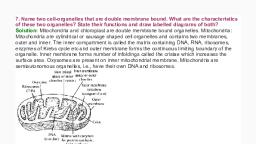
membrane. The area between the inner and outer, membranes is called intermembrane space. The, space within the inner membrane is called matrix., The inner membrane forms a number of infoldings, called cristae (sing.: crista). The cristae increase, the surface area. Mitochondria contain single, circular, , DNA, , molecule,, , RNA, , molecules,, , ribosomes (70S). The mitochondria divide by, fission., Mitochondria are the sites of aerobic respiration. They produce cellular energy in the form of ATP,, hence they are called ‘power house’ of the cell., 9. Plastids, Plastids are double-membrane organelles which are found in the cells of plants and algae. Based on the type of, pigments plastids are classified into chloroplast, chromoplast and leucoplast., , i. Chloroplast, It refers to a plastid in green plant cells which contains chlorophyll and carotenoid pigments. Chloroplasts are, responsible for photosynthesis., Chloroplasts are double membrane bound organelle - outer membrane and inner membrane. The area between, the inner and outer membranes is called intermembrane space. The space within the inner membrane is, called stroma. A number of organised flattened membranous sacs called the thylakoids, are present in the, stroma. Chlorophyll pigments are present in the thylakoids. Thylakoids are arranged in stacks called grana, (singular: granum). Stroma lamellae connect the thylakoids of the different grana. The membrane of the, thylakoids encloses a space called a lumen. Stroma contains double-stranded circular DNA molecules and, ribosomes., The most important function of the chloroplast is to synthesize food by the process of photosynthesis., ii. Chromoplast, , 7
Page 8 :
It refers to a colored plastid other than a chloroplast. It contains fat soluble carotenoid pigments like carotene,, xanthophylls and others are present which gives the part of the plant a yellow, orange or red colour., Chromoplasts synthesize and store pigments. They are found in flower and fruits., iii. Leucoplast, These are colourless plastids which are colourless., Leucoplasts store nutrients., ✓ Amyloplasts store carbohydrates (starch), e.g., potato, ✓ Elaioplasts store oils and fats, ✓ Aleuroplasts store proteins., , 10. Ribosomes, , Ribosomes are the granular structures. They are not surrounded by any membrane. They are composed of, ribonucleic acid (RNA) and proteins. Prokaryotic ribosome is 70S. Eukaryotic ribosome is 80S. ‘S’, (Svedberg’s Unit) stands for sedimentation coefficient; it measures density and size. Both 70S and 80S, ribosomes are composed of two subunits. 70S is composed of 30S subunit and 50S subunit. 80S is composed, of 40S subunit and 60S subunit. Ribosome is the site for protein synthesis., , 11. Cilia and Flagella, Cilia (sing.: cilium) and flagella (sing.: flagellum) are hair-like outgrowths of the cell membrane. Cilia are, small structures which work like oars. Flagella are comparatively longer than cilia. Both are responsible for, cell movement., , They are covered with plasma membrane. The core is called axoneme, possesses a number of microtubules., 8
Page 9 :
The axoneme has nine pairs of doublets of radially arranged peripheral microtubules, and a pair of centrally, located microtubules (9+2 array). The central tubule is connected by bridges and is also enclosed by a central, sheath, which is connected to one of the tubules of each peripheral doublet by a radial spoke (total 9, numbers). The peripheral doublets are also interconnected by linkers. Cilium and flagellum emerge from basal, bodies., 12. Centrosome and Centrioles, Centrosome is an organelle usually containing two cylindrical, structures called centrioles. A centriole possesses a whorl of nine, peripheral fibrils. Each of the peripheral fibril is a triplet. The, adjacent triplets are connected by linkers. The central part of the, centriole possesses a rod-shaped proteinaceous mass called the, hub, which is connected with the peripheral triplets by radial, spokes., The centrioles form the basal body of cilia or flagella, and spindle, fibres that give rise to spindle apparatus during cell division in, animal cells., 13. Nucleus, A nucleus is defined as a double-membraned eukaryotic cell organelle that contains the genetic material. The, nucleus consists of a nuclear membrane, nucleoplasm, nucleolus, and chromatin., 1. Nuclear membrane, The nuclear membrane is a double layered system that encloses the elements of the nucleus. The space, between the two layers of a nuclear membrane is called perinuclear space. The outer membrane is, continuous with the endoplasmic reticulum and also bears ribosomes on it. There are numerous pores, present at the nuclear membrane called nuclear pores. These nuclear pores are the passages through which, movement of RNA and protein molecules takes place in both directions between the nucleus and the, cytoplasm., 2. Nucleoplasm - It is the matrix present inside the nucleus., 3. Nucleolus -It is spherical structure present in the nucleoplasm. It is a site for, ribosomal RNA synthesis., 4. Chromatin, Chromatin is highly extended and elaborate nucleoprotein fibres present in, interphase nucleus. Chromatin contains DNA and some basic proteins called, histones. During different stages of cell division, cells show structured, chromosomes (which is formed by condensation of chromatin) in place of the, nucleus. A human cell has 46 chromosomes (23 pairs)., Each chromosome has a primary constriction or centromere on the sides of which disc shaped structures, called kinetochore are present., Based on the position of the centromere, the chromosomes can be classified into four types., 9
Page 10 :
1. Metacentric chromosome - It has middle centromere forming two equal arms of the chromosome., 2. Sub-metacentric chromosome - It has centromere slightly away from the middle, of the chromosome resulting into one shorter arm and one longer arm., 3. Acrocentric chromosome - In case of acrocentric chromosome the centromere, is situated close to its end forming one extremely short and one very long arm, 4. Telocentric chromosome – It has a terminal centromere., , Some chromosomes have non-staining secondary constrictions at a constant, location. This gives the appearance of a small fragment called the satellite., , Difference between plant and animal cell, Basis of Comparison, Meaning, , Plant Cell, , Animal Cell, , They are eukaryotic cells having a true It is a type of eukaryotic cell which lacks a, nucleus along with specialized structures cell wall and has a true, membrane-bound, known as organelles which perform nucleus, , along, , with, , other, , specific functions., , organelles., , Size, , Fixed-size which is generally larger., , Irregular and small in size., , Shape, , It is rectangular, , It is round, , Surrounded By, , Rigid wall cell and plasma membrane, , Flexible and thin plasma membrane, , Plastids, , Present, , Absent, , Nucleus, , Lies on one side, , Lies in the cell wall’s centre, , Cilia, , Absent, , Generally present, , Centrioles, , Absent, , Present, , Glyxoxysomes, , May be present, , Absent, , Vacuoles, , One huge vacuole, , Many vacuoles, , Reserve Food, , Present as starch, , Present as glycogen, , cellular, , 10
Page 11 :
Difference between prokaryotic and eukaryotic cell, , Type of Cell, Cell size, Cell wall, Nucleus, Ribosomes, DNA arrangement, Mitochondria, Cytoplasm, Endoplasmic, reticulum, Plasmids, Ribosome, Lysosome, Cell division, Flagella, Reproduction, Example, , Prokaryotic cell, , Eukaryotic cell, , Always unicellular, Ranges in size from 0.2 μm – 2.0, μm in diameter, Usually present; chemically, complex in nature, Absent. Instead, they have, a nucleoid region in the cell, Present. Smaller in size, 70S, Circular, Absent, Present, but cell organelles absent, Absent, , Unicellular and multi-cellular, Size ranges from 10 μm – 100 μm in diameter, , Present, Small ribosomes, Lysosomes and centrosomes are, absent, Through binary fission, The flagella are smaller in size, Asexual, Bacteria and Archaea, , Very rarely found in eukaryotes, Large ribosomes, Lysosomes and centrosomes are present, , When present, chemically simple in nature, Present, Present. Comparatively larger in size, 80S, Linear, Present, Present, cell organelles present, Present, , Through mitosis, The flagella are larger in size, Both asexual and sexual, Plant and Animal cell, , 11