Page 1 :
Class XI – Biology, Unit 3- CELL STRUCTURE AND FUNCTIONS (15 marks), , Chapter 8, , CELL CYCLE AND CELL, DIVISION, , --- ---, , TAMPHASANA GIRLS' HIGHER SECONDARY SCHOOL, MANIPUR, , 1
Page 2 :
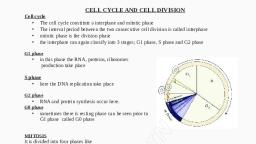
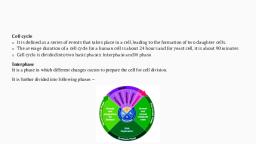
Cell cycle, Cell cycle is the sequence of events by which a cell duplicates its genome,, synthesises the other constituents of the cell and eventually divides into, two daughter cells., The growth of cell is a continuous process but synthesis of DNA occurs, only during one specific stage in the cell cycle. The replicated DNA, (chromosome) is then distributed to daughter nuclei by a complex series of, events during cell division., Phases of Cell cycle, The cell cycle is divided into two basic phases:, 1. Interphase, 2. M Phase (Mitotic phase), Interphase, Interphase is the phase between two M phase of cell cycle. Though called the resting phase, the interphase is the, time during which the cell is actively preparing for division by undergoing both cell growth and DNA replication, in an orderly manner., The interphase is divided into three further phases:, • G1 phase (Gap 1), • S phase (Synthesis), • G2 phase (Gap 2), 1. G1 phase, • It corresponds to the interval between mitosis and initiation of DNA replication., • Synthesis of RNA, proteins and other biomolecules such as nucleotides, carbohydrates, lipids, etc takes, place., • Cells increases in size., • Most variable period – may last hours, days, months or years., • Cells that do not divide further exit G1 phase to enter an inactive stage called quiescent stage (G0) of the, cell cycle., 2. S phase, • DNA synthesis or replication takes place., • Synthesis of RNA and protein continues., • The amount of DNA per cell doubles. If the initial amount of DNA is denoted as 2C then it increases to 4C., However, there is no increase in the chromosome number, i.e., the number of chromosomes remains the, same. So, the number of chromosomes after S phase (2n) is same as that at G1 (2n)., • Replication of centrioles completed., 3. G2 phase, • Proteins are synthesised in preparation for mitosis, 2
Page 3 :
• Mitochondria and chloroplast divide., • Biogenesis of other cell organelles takes place., • Cell continues to grow., , M Phase (Mitotic phase), • Major reorganisation of virtually all components of the cell takes place., • The M Phase starts with the nuclear division (karyokinesis), corresponding to the separation of daughter, chromosomes and usually ends with division of cytoplasm (cytokinesis)., • The nuclear division (karyokinesis) is divided into four stages –, I. Prophase, II. Metaphase, III. Anaphase, IV. Telophase, , I. Prophase, • The first stage of karyokinesis of mitosis, • It follows the G2 phases of interphase., • Prophase is marked by the initiation of condensation of chromosomal material as a result the, chromosomal material becomes untangled., • At late prophase, Chromosomal material condenses to form compact mitotic chromosomes., Chromosomes are seen to be composed of two chromatids attached together at the centromere, • The centrosome, now begins to move towards opposite poles of the cell. Each centrosome radiates out, microtubules called asters. The two asters together with spindle fibres forms mitotic apparatus., • Chromosomes become attached to the spindle microtubules through kinetochore., • Nuclear envelope disappear at the end of prophase., II. Metaphase, • Condensation of chromosomes is completed and they can be observed clearly under the microscope., • Chromosomes are arranged along the equatorial plane (metaphase plate)., , 3
Page 4 :
• One chromatid of each chromosome is connected by its kinetochore to spindle fibres from one pole and its, sister chromatid connected by its kinetochore to spindle fibres from the opposite pole, III. Anaphase, At the onset of anaphase, each chromosome is split at the centromere simultaneously and the two daughter, chromatids (now referred to as daughter chromosomes) begin their migration towards the two opposite poles., IV. Telophase, • Chromosomes that have reached their respective poles decondense., • Nuclear envelope develops and forms two daughter nuclei., • Nucleolus, golgi complex and ER reform., , Cytokinesis, Karyokinesis is followed by cytokinesis, in which the cell itself is divided into two daughter cells by the, separation of cytoplasm., In an animal cell, cytokinesis is achieved by the appearance of a furrow in the plasma membrane. The, furrow gradually deepens and ultimately joins in the centre dividing the cell cytoplasm into two., In plant cells, wall formation starts in the centre of the cell and grows outward to meet the existing lateral, walls. The formation of the new cell wall begins with the formation of a simple precursor, called the cell-plate, that represents the middle lamella between the walls of two adjacent cells., , Significance of mitosis, •, , It helps in maintaining the same number of chromosomes in daughter cells after division., , •, , It is responsible for growth and development of multicellular organisms., , •, , It helps in repairing damaged tissues., , •, , It helps the cell to maintain proper size., , Meiosis, Meiosis is the process in which a single cell divides twice to form four haploid daughter cells. Meiosis is also, called as reduction division because it reduces the number of chromosomes to half the normal number., Sperms in males and egg in females are produced by meiosis., The process of meiosis is divided into 2 stages: Meiosis I and Meiosis II., , Meiosis I, Meiosis I is divided into 4 phases: Prophase I, metaphase I, anaphase I and telophase I., , 4
Page 5 :
1. Prophase I, It is divided into five different stages: Leptotene, zygotene, pachytene, diplotene and diakinesis., i. Leptotene- Chromatin starts to condense., ii. Zygotene - During this stage, synapsis occurs between homologous chromosomes, accompanied by, formation of synaptonemal complex. The paired chromosome is called bivalent or tetrad., iii. Pachytene - Crossing over occurs between non-sister chromatids of the homologous chromosomes. Crossing, over is the exchange of genetic material between non-sister chromatids., iv. Diplotene - Diplotene is recognised by the dissolution of the synaptonemal complex. Homologous, chromosomes of the bivalents separate from each other except at the sites of crossovers. These X-shaped, structures are called chiasmata. In oocytes of some vertebrates, diplotene can last for months or years, v. Diakinesis - This is marked by terminalisation of chiasmata. The chromosomes are fully condensed and the, meiotic spindle is assembled for separation of the homologous chromosomes. Nucleolus disappears. The, nucleolus disappears and the nuclear envelope also breaks down by the end of diakinesis., , 2. Metaphase I, Pairs of homologous chromosomes aligned at equatorial plate, 5
Page 6 :
3. Anaphase I, Homologous chromosomes are separated and move to each pole., 4. Telophase I, Chromosomes reach the pole. The nuclear membrane and nucleolus reappear. Cytokinesis follows., The stage between the two meiotic divisions is called interkinesis., , Meiosis II, Meiosis II resembles a normal mitosis. Meiosis II is divided into 4 phases: Prophase II, metaphase II, anaphase, II and telophase II., i., , Prophase II, Nuclear envelop disintegrates. The chromosomes again become shortened., , ii., , Metaphase II, Chromosomes are aligned at equatorial plate., , iii., , Anaphase II, The simultaneous splitting of the centromere of each chromosome as a result the sister hromatids are, separated and move to opposite poles., , iv., , Telophase II, Chromosomes reach the pole. The nuclear membrane and nucleolus reappear. Cytokinesis follows., , Significance of meiosis, •, , Meiosis forms gametes that are required for sexual reproduction., , •, , It helps in maintaining constant chromosome number by halving the same. This is important because the, chromosome number doubles after fertilization., , •, , Crossing over produces a new combination of traits and variations., , •, , Reshuffling of chromosomes., , 6