Page 1 :
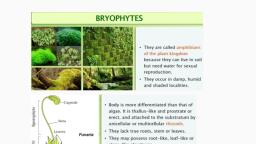
Bryophytes, Bryophytes are small, non-vascular land plants that require water for, reproduction., Land plants fall into two categories: those that have special tissues to transport, water and other materials, called vascular plants; and those that do not have, specialized tissues, called non-vascular plants., Bryophytes are non-vascular, so they do not have the right types of tissues to, develop roots, stems, or leaves., The term Bryophyta originates from the word ‘Bryon’ meaning mosses and ‘phyton’, meaning plants., Bryophyta includes embryophytes like mosses, hornworts and liverworts., These are small plants that grow in shady and damp areas., They don’t produce flowers and seeds, instead, reproduce through spores. The, study of bryophytes is called bryology., Bryophytes are called amphibians of plants., Bryophytes are called “amphibians of the plant kingdom” because they are, terrestrial plants but require water to complete their life cycle at the time of, sexual reproduction., General Characteristics of Bryophytes:, , , Plants occur in damp and shaded areas, , , , The plant body is thallus like, i.e. prostrate or erect, , , , It is attached to the substratum by rhizoids, which are unicellular or multicellular, , , , They lack true vegetative structure and have a root-like, stem-like and leaf-like, structure
Page 5 :
These spores develop into haploid gametophytes, which are free-living and, photosynthetic, B. Anthocerotopsida (Hornworts): There are around 300 species present in this class. They, are commonly known as hornworts. It has only one order i.e. Anthocerotales. Examples:, Anthoceros, Megaceros, Notothylas., The main features are:, , , The gametophytic body is flat, dorsiventral, simple thalloid without internal, differentiation, , , , Rhizoids are smooth-walled, , , , Each cell has one chloroplast with a pyrenoid, , , , Sex organs are present dorsally embedded in the thallus, , , , The sporophyte is differentiated into foot, meristematic zone and capsule, , , , Sporogenous tissues develop from amphithecium, , , , Pseudoelaters are present in the capsule, , , , The columella is present in the capsule, which originates from endothecium, , Reproduction:, Asexual reproduction: Vegetative propagation is by fragmentation of thallus and by, tubers, which are formed under unfavourable conditions, Sexual reproduction: They reproduce sexually by waterborne sperm, which travel, from antheridium to archegonium. A fertilised egg develops into sporophyte., Sporophyte splits lengthwise to release spores which develop into a gametophyte.
Page 7 :
Sexual reproduction: Antheridia and archegonia are present at the apical part of, leafy shoots. After fertilization sporophyte is produced, which is more differentiated, than liverworts. The gametophyte develops from the spores., Economic importance of Bryophytes:, 1. Protection from soil erosion:, Bryophytes, especially mosses, form dense mats over the soil and prevent soil erosion by, running water., 2. Soil formation:, Mosses are an important link in plant succession on rocky areas. They take part in binding, soil in rock crevices formed by lichens. Growth of Sphagnum ultimately fills ponds and lakes, with soil., 3. Water retention:, Sphagnum can retain 18-26 times more water than its weight. Hence, used by gardeners to, protect desiccation of the seedling during transportation and used as nursery beds., 4. Peat:, It is a dark spongy fossilized matter of Sphagnum. Peat is dried and cut as cakes for use as, fuel. Peat used as good manure. It overcomes soil alkalinity and increases its water retention, as well as aeration. On distillation and fermentation yield many chemicals., 5. As food:, Mosses are good source of animal food in rocky and snow-clad areas., 6. Medicinal uses:
Page 8 :
Decoction of Polytrichum commune is used to remove kidney and gall bladder stones., Decoction prepared by boiling Sphagnum in water for treatment of eye diseases. Marchantia, polymorpha has been used to cure pulmonary tuberculosis., 7. Other uses:, Bryophytes arc used as packing material for fragile goods, glass wares etc. Some bryophytes, act as indicator plants. For example, Tortell tortusa grow well on soil rich in lime.