Notes of Std 11,12 Science, Biology 1. living world.pdf - Study Material
Page 1 :
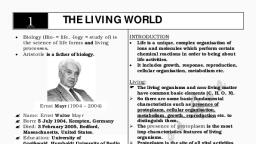
Prime Latur Pattern Classes, Georai., , 1, , , , , , THE LIVING WORLD, , Biology (Bio- = life, -logy = study of) is, the science of life forms and living, processes., Aristotle is a father of biology., , Ernst Mayr (1904 – 2004), Name: Ernst Walter Mayr, Born: 5 July 1904, Kempten, Germany, Died: 3 February 2005, Bedford,, Massachusetts, United States., Education: University of, Greifswald, Humboldt University of Berlin, Ernst Mayr showed an early interest in, ornithology & Ph.D. degree from the, University of Berlin in1926., He was a German-born American who made, decisive and, groundbreaking contributions to avian, taxonomy, evolution and population, genetics., Works/Last Title:, Mayr joined Harvard’s Faculty of Arts and, Sciences in 1953 as Alexander Agassiz, Professor of Zoology., He led Harvard’s Museum of Comparative, Zoology from 1961 to 1970., He retired in 1975, assuming the title, Alexander Agassiz Professor of Zoology, Emeritus., Awards: He awarded a three prizes so, regarded as the triple crown of biology:–, I. The Balzan prize in 1983,, II. The International prize for biology in, 1994 and, III. The Crafoord Prize in 1999., Widely credited as the world's greatest, evolutionary biologist in history, Mayr was, fondly called the “Darwin of the 20th, century”., He also pioneered the currently accepted, definition of a biological species., Ernst Mayr defined a species as follows:, "Species are groups of interbreeding, natural populations that are, reproductively isolated from other such, groups.", PLPC’s Biology Notes, , For All Competitive Exams, , INTRODUCTION, Life is a unique, complex organisation of, ions and molecules which perform certain, chemical reactions in order to being about, life activities., It includes growth, response, reproduction,, cellular organisation, metabolism etc., Living:, The living organisms and non-living matter, have common basic elements (C, H, O, N)., So there are some basic fundamental, characteristics such as presence of, protoplasm, cellular organisation,, metabolism, growth, reproduction etc. to, distinguish them., The presence of protoplasm is the most, imp characteristics features of living, organisms., Protoplasm is the site of all vital activities, therefore Huxley called it “Physical basis of, life”., Characters of Living:, 1. GROWTH:, – It is an irreversible increase in the, number of cells and increase in mass., – Increase in mass and increase in number of, individuals are twin characteristics of, growth., – In unicellular organisms, simply counting, the number of cells under the microscope in, in vitro cultures., – In unicellular organisms growth &, reproduction are synonymous., – In multicellular organism like plants and, animals, growth is considered to be increase, in mass., – Growth is either intrinsic or extrinsic., – In living things grow from inside and it is, defining property., – Intrinsic growth may be determinate, (limited) in animals at certain age or, indeterminate (unlimited) in plants, throughout the life., – In majority of higher animals and plants,, growth and reproduction are mutually, exclusive events., – Non-living objects also grow if we take, increase in body mass as a criterion for, growth., – Mountains, boulders and sand mounds do, grow., , By: Pralhad D. Khetre [M.Sc. (Microbiology)], , Page 2
Page 2 :
Prime Latur Pattern Classes, Georai., , However, this kind of growth exhibited by, –, non-living objects is by accumulation of, material on the surface., – Growth, therefore, cannot be taken as a, defining property of living organisms., – There are certain examples in which mass is 4., decreased during growth (-ve growth)., – Ex. Germinating potato tuber., 2. REPRODUCTION:, It is ability of organisms to produce new, organism like itself., In unicellular organisms growth &, reproduction are synonymous., Reproduction is of sexual & asexual type., a) Asexual reproduction:, - There is no gamete formation, (gametogenesis) and fusion of gametes, (fertilization)., - Involves uniparental condition and produce, genetically identical individual i.e. clone, Examples:, i) Fungi asexually produce spores like conidia, (non-motile) and zoospore (motile)., ii) Filamentous algae, fungi & protonema of, moss reproduce by fragmentation., iii) Planaria (Flat worm) is produces by, regeneration in which a fragment of body, forms whole new organism., –, , For All Competitive Exams, , Hence metabolism is defining property of, living beings., Some chemical reactions are also occurred, in cell free condition i.e. in vitro = in test, tube, CELLULAR ORGANISATION:, All living organisms consist of cells & their, products., It is also described by “Cell theory”., Cell organelles → cell → Tissue → Organ →, Organ system →Individual., It is defining property of living beings., , b) Sexual reproduction:, - There is gamete formation (gametogenesis), and fusion of gametes (fertilization)., - Involves biparental condition and produce, genetically different individual i.e., offspring, - Examples: Higher plants and animals, Certain organisms do not reproduce viz., mule, worker bees and infertile human, couple., Hence reproduction cannot be considered, as defining property of living beings., Photoperiod affects on reproduction in, seasonal breeders, both in plants &, animals., , 5. CONSIOUSNESS:, It is an ability to sense environment &, respond to environmental factors., Living beings sense& respond to, environmental factors viz. Light, water,, temperature, other organisms, pollutants, etc., It is defining property of organisms., 3. METABOLISM:, There is an exception i.e. person is in, – All the reactions in cell together called, comma., metabolic reactions., , So, living organisms can be considered as, – This process is called metabolism., self replicating, evolving & self-regulating, – About thousand of chemical reactions occur, interactive systems capable of responding to, in living organisms even they may be, external stimuli., unicellular or multicellular., – Some of these reactions are anabolic others, are catabolic., – There is no any exception., , PLPC’s Biology Notes, , By: Pralhad D. Khetre [M.Sc. (Microbiology)], , Page 3
Page 3 :
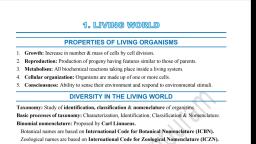
Prime Latur Pattern Classes, Georai., , DIVERSITY IN THE LIVING WORLD, Described number of species range in 1.71.8 million., Local names of organisms may not be, applied at global level., Scientific names are given to organisms, after identification, acceptable at global, level., Nomenclature is done as per criteria given, in:, ICBN = International code for botanical, nomenclature &, ICZN = International code for zoological, nomenclature., Binomial nomenclature was given by, Carolus Linnaeus (Father of taxonomy)., 1) First word is Generic name & second, word is Specific epithet in scientific name, of organism., 2) Names are in Latin or Latinized word., 3) Names, if hand written is separately, underlined & if printed, are italicized., 4) First word starts with capital letter &, second word with small letter., Ex: Mango = Mangifera indica Linn., Name of author(Citation) in last as, abbreviation i.e. Linn denotes Linnaeus who, first described this species, For ease of study organisms are classified, into groups or categories known as taxa., Ex. Taxon may be Dogs, Mammals, Rice etc., TAXONOMY, (Taxa – = arrangement, -nomos= law), The process of classification into different, taxa is called taxonomy., Term taxonomy was first introduced by A.P., de Candolle (Swiss Botanist)., Modern taxonomy takes an account of the, internal and external structures along with, the structure of cell, development process &, ecological information of organisms., Characterization, Identification,, Classification & Nomenclature are the, processes that are basic stages to, taxonomy., , For All Competitive Exams, , SYSTEMATICS, The word systematics is derived from the, Latin word ‘Systema’., It means systematic arrangement of, organisms., Linnaeus used Systema Naturae as the, title of his publication., He introduced system of binominal, Nomenclature described 4326 species of, animals in Systema Naturae and 5900, species of plants in Species Plantarum, book., It studies evolutionary relationship between, organisms., It is term used as interchangeable with, taxonomy., TAXANOMIC CATEGORIES:, - Each rank or category of classification is, termed as taxonomic category., - Taxonomic Hierarchy = Arrangement of, categories in sequence., KINGDOM, ↑, PHYLUM or DIVISION, ↑, CLASS, ↑, ORDER, ↑, FAMILY, ↑, GENUS, ↑, SPECIES, , TAXANOMIC HIERARCHY, 1. Species, The term species given by John Ray., It is a group of organisms with fundamental, similarities., Ex. Mangifera indica (Mango) the word, indica is a species name., Ernst Mayr defined a species as follows:, "Species are groups of interbreeding, natural populations that are reproductively, Types of taxonomy:, isolated from other such groups.", a) Alpha taxonomy or classical taxonomy: It, - Species has real existence., is based on external morphology, origin, 2. Genus:, and evolution of plants., - It is a group of closely related species with, b) Beta taxonomy or Explorative taxonomy:, common characters., Besides external morphology it also, - Ex. Panthera is a genus which includes, includes internal characters like, lion (Panthera leo), leopard (Panthera, embryological, cytological, anatomical, pardus) & Tiger (Panthera tigris)., characters etc., 3. Family:, c) Omega taxonomy: Omega taxonomy has, - It is a group of related genera., widest scope. It is based on all the, - Ex. Genus Solanum, Petunia & Datura, information or data available about plants., belong to one family Solanaceae., PLPC’s Biology Notes, , By: Pralhad D. Khetre [M.Sc. (Microbiology)], , Page 4
Page 4 :
Prime Latur Pattern Classes, Georai., , For All Competitive Exams, , Genus Panthera, Felis (Cat) belongs to, Felidae., - Alsatian (Dog) is belongs to Canidae., 4. Order or Cohort:, - It is a group of related families., - Ex. Families Convolvulaceae, Solanaceae, belong to one order- Polymoniales., - Felidae & Canidae are related with, Carnivora., 5. Class:, - It is a group of related orders., - Ex. Order Primata & Carnivora belong to, one class Mammalia., -, , 6. Phylum or Division:, It is a group of related classes., Ex: Class Amphibia, Reptilia, Aves (Pisces),, Mammalia belong to one phylum –, Chordata., Angiospermae includes two classes i.e., Dicotyledonae and monocotyledonae., 7. Kingdom:, - It is a highest taxonomic category composed, from all related phyla/divisions., - Ex. Kingdom Animalia - includes all, animals., - Kingdom Plantae includes all plants., Commo, n name, Man, House, Fly, Mango, Wheat, , Binomial, Name, Homo, sapiens, Musca, domestica, Mangifera, indica, Triticum, aestivum, , Family, , 3. Specimens along with description on, herbarium sheets constitute a storehouse or, repository of knowledge for future use., 4. Herbaria constitute quick referral house for, persons engaged in taxonomic studies., 5. They are used for maintaining type, specimens of newly described taxa., 6. Ecology of different places can be known., , Order, , Class, , Phylum/, Division, Chordata, , Kingdom, , Hominidae, , Primates, , Mammalia, , Muscidae, , Diptera, , Insecta, , Arthropoda, , Animalia, , Anacardiaceae, , Sapindales, , Dicotyledonae, , Angiospermae, , Plantae, , Poaceae, , Poales, , Monocotyledonae, , Angiospermae, , Plantae, , TAXANOMIC AIDS, An article helpful in correct identification &, classification of organisms are called, taxonomical aids., A) Herbarium ( Pl. Herbaria):, 1. It is store house of collected plant, specimens that are dried, pressed &, preserved on sheets., 2. Sheets are arranged according to universally, accepted classification system., 3. It was initiated by Italian taxonomist Luca, Ghini., 4. There is labelled written information about –, i. Date and place of collection,, ii. English, local, botanical names, family;, iii. Name of collectors etc., , PLPC’s Biology Notes, , Role of Herbaria:1. It is used as ready reference in scientific, studies, 2. Standard herbaria are used for, identification of plants., , Animalia, , Major Herbaria: Royal Botanical Garden, Kew (England), It has largest collection of more than, 30,000 specimens/preserved plants, and more than 7 million herbaria., Herbarium of forest: Research institute,, Dehradun, National Botanical Research institute,, Lucknow, B) Botanical Gardens:, The collection of various living plant species, in form of garden for identification purpose., It is used for identification of plants., Some imp. Botanical garden:, Royal Botanical Garden at Kew, England, Indian Botanical Garden Howrah,, , By: Pralhad D. Khetre [M.Sc. (Microbiology)], , Page 5
Page 5 :
Prime Latur Pattern Classes, Georai., , National Botanical Research Institute,, Lucknow (Kolkata has 255 years old, banyan tree)., Role of Botanical Gardens:, 1. Providing plant material for comparative, Taxonomic studies., 2. Functioning as acclimatization centres for, exotic plants of economic importance., 3. Growing and maintaining records of local, flora., 4. Growing plants of various types for, research., 5. Providing seeds & living materials to, different research centres., C) Museum:, It is collection of preserved plant &animal, specimens., Specimens may be preserved in preservative, solutions viz. Formalin (40% formaldehyde)., Specimens may also be preserved as dry, specimens eg. Insects and stuffed large, animals., Skeleton of animals may be also as museum, specimen., It is used as actual material for study and, identification., Some important museums are:, 1. American Museum of Natural History, U.S.A, 2. State Museum of Natural History, Stuttgart,, Germany, 3. Museum of natural History, Basel,, Switzerland, 4. Museum of Arthropoda, Pune., Role of Museums:, The roles are similar to those of herbaria:i. Standard Museums have collections of, plants and animals of various areas., ii. Museums provide information not only, about the local fauna and flora but also of, others areas., iii. They are used to deposit type specimens, whenever now taxa are described., , For All Competitive Exams, , Some imp. Zoological parks:, Alipur zoo, Kolkata,, West Bengal National Zoo. Park, New Delhi, , RECORDING DESCRIPTION, Key:, It is based on contrasting characters called, as couplet., Couplet has two opposite statements., Each statement is called as lead., The separate keys for separate taxonomic, categories are needed., It is used to classify organism., Flora:, It is actual account of habitat & distribution, of plant species in an area., It provides the index to the plant species, found in a particular area., Manual:, They have description of species in an area., It is used for getting information for, identification of names., Monograph:, It has information of any one taxon., It is used for classification purpose., Catalogue, A list that enumerates methodically all the, species found in an area with brief, description aiding identification., , D) Zoological Parks:, It is a place where wild animals are kept in, protected environment under human care., Role of zoological parks:, Zoological parks are prized assets., They are useful for:1. It is used as aid to learn about food habits,, behavior, & life cycle., 2. Familiarizing public, especially children, with wild animals., 3. Study of live animal types by students, 4. Sources of Tourist attraction., , PLPC’s Biology Notes, , By: Pralhad D. Khetre [M.Sc. (Microbiology)], , Page 6



 Learn better on this topic