Page 1 :
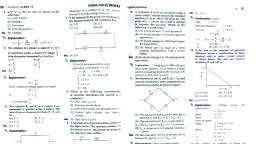
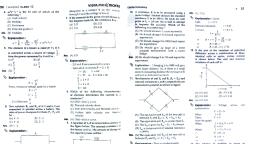
an, te, , Nn, ‘os, ;, , 56., , 7 J, , 58., , 39., , The Cquivale, ‘WWeen points Nand Bis Ae we tthe =, , (a) OR a, , ) QR, , (©) (42R 3, id) (SR, Six equal Pesistances are ‘, onnected between points P,Q, , and R as shown in figure. Then, , Ret resistance will bemaximum, , between :, , @) PandR, (©) Panda, (©) QandR, (ad) Any two Points, Topic 3: Kirchhoff's Laws and Cells, Kirchhoff’s first law, ie. 5, conservation of, (a) charge (b) energy, (c) momentum (d) angularmomentum, The Kirchhoffs Second law (ZiR = DE), where the symbols, have their usual meanings, is based on, (a) conservation of momentum, (b) conservation of charge, (c) conservation of potential, , (d) conservation of energy, Emf ofa cell is, , (a) themaximum potential difference between the terminals, ofa cell when no current is drawn from the cell., , (b) the force required to push the electrons in the circuit., , (c) the potential difference between the positive and, negative terminal of a cell ina closed circuit., , (d) less than terminal potential difference of the cell., , An energy source will supply a constant current into the, , load ifits internal resistance is, , (a) very large as compared to the load resistance, , (b) equal to the resistance of the load, , (c) non-zero but less than the resistance of the load, , (d) zero, , To draw a maximum current from a combination of cells,, , how should the cells be grouped?, , (a) Parallel, , (b) Series, , (c) Mixed grouping, , (d) Depends upon the relative values of internal and, external resistances, , A cell of internal resistance r is connected to an external, , resistance R. The current will be maximum in R, if, , fa) B-t @) Ber a Ror (d) R=r/2, , A capacitor is connected to a cell of emf E having some, , internal resistance r. The potential difference across the, , (a) cellis<E (b) cellisE, , (c) capacitoris>E — — (d)_ capacitor is<E, , A cell of internal resistance r is connected across an, , external resistance nr. Then the ratio of the terminal voltage, , nt PeSistance, , i= O ata junction, deals with the, , A tn the emf of the cell is, , 61,, , 62., , 63., , 64., , 65., , 66., , , , I (b) (c) : (d) N~y, (a) " n+l n+ |, if n cells each of emf & and internal FeSistancg, connected in parallel, then the total emf Nd inte,, , resistances will be 2», }, , 6, nr (c) ne, (6) a,, nt rt, , r, spe 00), (a) ae, , Under what condition will the strength of curren) ae, , of resistance R be the same for cOnNection is serie, , parallel of n identical cells each of the internal p<., , When, , (a) R=nr (b) R=r/n, , (c) R=r @ R>x,r59, , Assertion : Kirchhoff’s juction rule can be applied ;, , junction of several lines or a point in a line,, , Reason : When steady current is flowing, there jx ,, , accumulation of charges at any junction or a;, , in a line., , (a) Assertion is correct, reason 18 Correct; reason ;., correct explanation for assertion., , (b) Assertion is correct, reason is correct; FEASON ig nog, a correct explanation for assertion, , (c) Assertion is correct, reason Is Incorrect, , (d) Assertion is incorrect, reason is correct., , A cell having an emf € and internal resistance r ig, , connected across a variable external resistance R As the, , resistance R is increased, the plot of potential difference, , V across R is given by, , Nd, , ‘Stan,, , any Doin, , , , Two sources of say emf are connected to an external, resistance R. The internal resistance of the two sources, are Ry and R, (R, > Rj). Ifthe potential difference across, the source having internal resistance R, is zero, then, , (a) R=R)-R,, , (b) R=R, x(R} +Ra)AR, Bit, }, , (©) R=R)R2/(Rz-R,), , (d) R=R,R, KR, -R), , In the series combination of n cells each cell havin gemf, , € and internal resistance r. If three cells are wrongly, connected, then total emf and internal resistance of this, combination will be, (a) ne, (nr — 3r), , (b) (ne ~ 2c) nr, (Sc) Ge = 4s), nr, , (d) (ne — 68), nr, , ¥§ ;, F