Page 1 :
Humanistic Perspective in, Mulk Raj Anand’s Novel Untouchable, Tamanna, Research Scholar, Shri JJTU, Jhunjhunu, Rajasthan, India, ==================================================================, Abstract, Man and society form a polychrome structure of life. Goodness and wickedness are, the imperative part of the complex social milieu. Literature is an awesome platform for the, litterateur to highlight these traits of society. Many Indo-Anglian writers raise their voices to, eradicate the established impairment and to install nobleness among communities. Mulk Raj, Anand, being a socially committed writer, an art critic and an educationist skilfully develops, a new awareness to eject the social evils like-caste and class discrimination, poverty,, illiteracy and derogation of women that existed in the country from time immemorial. His, humanistic approach towards those deprived people who become the victim of hypocrisy of, upper class of the society is quite understandable. The themes which Anand has chosen are, based on the problems of casteism and human suffering caused by political, economical,, social and cultural factors. Here, this paper presents the soft corner of the novelist for the, lowborn people who remain devoid of their human rights. Mulk Raj Anand’s novels reflect, the fast-changing social climate of the pre and post independence India. The debut-novel of, Anand Untouchable highlights the realistic picture of existed Indian society from 1930’s to, 1940’s during which Indians struggle for freedom was at peak. This literary works, comprehends the sane readers about the physical and mental abomination of the untouchables, of the society. Through the characterization of the protagonist Bakha Anand succeeds in, exposing the harassment, inequality and tapping of the whole community of the outcast in, India., Keywords: Goodness and wickedness,, discrimination, derogation, humanism., , Indo-Anglian, , writer,, , socially, , committed,, , Introduction, It is largely known that literature demonstrates the idealistic and realistic aspect of, human society. Litterateur finds a ground through literature where he excretes all his, perspectives to contiguous social environments. Men and society play complimentary role., All the human traits develop in society. Primarily, man is the only animal who learns culture, and learns how to behave properly and live peacefully in the society. Lack of social life could, not make him a social being. So, everyone is bound to some duties, rights and, responsibilities. Our sacred Scriptures are also interpreted to the principal of moral values., The believer and opponent of the moral values make a man equal to divinity or animality. It, is human dignity to respect all peoples. Human beings strive to get freedom and honour in, =================================================================, Language in India www.languageinindia.com ISSN 1930-2940 20:3 March 2020, Prof. Dr. S. Chelliah, Editor: Select Papers of the International Conference on, Human Praxis and Modern Configuration through Literature -- VOLUME 2, Tamanna, Research Scholar, Humanistic Perspective in Mulk Raj Anand’s Novel Untouchable 197
Page 2 :
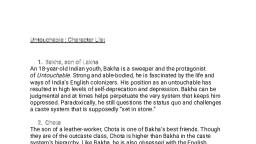
economic, social, cultural, political and civil areas. But after so many efforts, there still exist, many affinities in the social milieu that needs to eradicate them., Humanism is a system of belief with which we can uproot the all set up brutality of, human being. Mulk Raj Anand, a creative artist, belongs to a period in the history of India, when the nation was struggling hard to get rid of the burden of slavery. During the British, imperialism, the Indians were being behaved like dogs. On one side Dr Anand was sensitive, to what was happening at the political and cultural fronts where a class suffers a lot under the, grip of the colonist and high-class people in the Indian society. These factors compel the, novelist to present his ideas in a framework of philosophy in his literary works., Untouchable (1935), The untouchable by Mulk Raj Anand deals with the theme of untouchability, child, labour, caste system and other prominent issues. This novel brings worldwide popularity to, Anand and places him among the leading authors of the Indo-Anglian literature. Untouchable, follows a single day in life of the protagonist, an 18-year-old ‘bhangi’ boy Bakha. The setting, of this fiction is in the outcast colony of Bulandshar. The novel records good and bad, emotions of central character Bakha who suffers a lot because of his lower cast. Being an, outcast, they are not permitted to follow the high-class society. Outcast colony is a forbidden, place where they are forced to live in mud walled single room cottages. People like, scavengers, leather workers, washer men, barbers, water carriers and grass cutters lived in, thatched mud houses. These untouchables deprived from the basic fundamental needs and, rights and also compelled to live as a gutter like worms., From sunrise, Bakha has to bear his father’s cascade of abuses. His first chor of the, day is to clean the toilets of upper class. He is very responsible and dexterous workman. He is, praised to do all works skilfully. His father Lakha is old, selfish and ill-tempered as well as, brother Rakha who is a clever rogue and posses all qualities of untouchables. Both Lakha and, Rakha share the common abrupt qualities like laziness, shirking of work and have dirty, habits. Bakha works in the barracks of British regiment. He is much influenced by the living, style of the white men., The hero is extremely sensitive and wants to be treated as human being. Several, incidents in the novel explain the exploitation and dejection behaviour of upper-class people, of society towards him. The untouchables are not permitted even to take water from a well, and have to wait all day long for the mercy of superior people to fill their pitchers with water., Bakha wants to be educated and for this he offers money to another boy to teach him read and, writes. But due to the evil of untouchability, he is not allowed to go to school because it is, considered a sin for the upper-class children to study with the low-class students., One of the most pathetic scenes of the novel is the touching scene in the market when, the protagonist sets forth to sweep the roads in place of his father. He buys ‘jalabi’ and the, =================================================================, Language in India www.languageinindia.com ISSN 1930-2940 20:3 March 2020, Prof. Dr. S. Chelliah, Editor: Select Papers of the International Conference on, Human Praxis and Modern Configuration through Literature -- VOLUME 2, Tamanna, Research Scholar, Humanistic Perspective in Mulk Raj Anand’s Novel Untouchable 198
Page 3 :
shopkeeper throws it at him like the waste thrown at a pig on the ground. This event shows, that low caste people have no identity in the society. Even though, if they touch anybody by, accident they will be punished. For example, when Bakha unintentionally touched a high, society person, the crowd abuses and curses him. The priest also slaps him to satisfy his, egoism. Bakha, though impels to return the stroke, but he is restrained psychologically., Everywhere Bakha is greeted with such words like defiled, polluted, swine, dog and brute etc., The story, in fact, has many examples of the harsh treatment of untouchables. Bakha, tries to do all efforts to uplift his social strata., Despite being a Hindu, he is deported from Temple entry. He cannot approach any of, the Hindu God. While walking outside the temple he curiously peeps into the temple. He was, interrupted by the priest for polluting the temple. Soon a crowd gathers, and they all, humiliate Bakha. He runs down to the courtyard and finds his sister speech-less and, frightened where he comes to know the priest’s attempts to molest Sohini. Though he wants, to take the revenge for this harshness but both of them knows the limitations given by the, social structure. Bakha is always defeated in struggle between himself and society. It seems, that idea of impurity is only there to when it suits the higher caste people’s desire. He comes, home and tells his father about that incident. To console him, Lakha narrates him an odious, experience of his life. It helps Bakha to get sense again. He decides to go outsides to meet his, friends., The novelist shapes both saviour and offensive characters as a weapon to express his, idea that man has the potential to improve himself. The superiority and inferiority complex, are both deeply drenched in the up and low caste people. Bakha feels blessed with the kind, treatment of Havaldar Charat Singh who promises him to give a hockey stick as a reward to, do work well. After the noon time when Bakha goes to play hockey match, there arose a, scuffle between the boys and by chance Babu’s son gets hurt. Bakha takes the child to his, house. But catastrophe is happened with the hero. Instead of thinking Bakha’s kindness, the, lady abuses him for polluting her house. The suffering hero walks away with disgust and, anger. Bakha’s life is filled with difficulties and humiliation and yet he has some expectation, about his bright future. In despair he curses the day sitting under the tree. The Christian, missionary simply offers him to get rid of ‘untouchability’ through the conversion of his, religion. Bakha does not get the peace of mind. However, when he meets the missionary’s, wife, she shouts on the missionary to bring a ‘bhangi’ boy at home. Then the protagonist, understands that religion can’t change the attitude of a person., At the end of the day, he hears the news of Mahatma Gandhi to arrive in the town. He, listens to his speech on ‘untouchablity’. Gandhiji calls them ‘Harijan’ and ‘The cleaners of, the Hindus religion’. Bakha is highly influenced by these words. Here he comes to know that, the modern technology is the genuine solution to eradicate the problematic factor of, untouchability., =================================================================, Language in India www.languageinindia.com ISSN 1930-2940 20:3 March 2020, Prof. Dr. S. Chelliah, Editor: Select Papers of the International Conference on, Human Praxis and Modern Configuration through Literature -- VOLUME 2, Tamanna, Research Scholar, Humanistic Perspective in Mulk Raj Anand’s Novel Untouchable 199
Page 4 :
In this novel, Anand throws a light on different types of exploitations such as social,, economic, political, religious and sexual exploitation. Social exploitation is the main root of, other exploitation., Anand wants to awaken these exploited classes of the society who are denied all kinds, of rights-the right of think, speak and act. The novel demonstrates his sympathies for the, speechless and right less masses. He wants to uplift them from the depth of gloomy glades by, rejection of immoral Indian habits and social customs. Anand also paves an idea that man has, the potential to improve himself., Conclusion, Mulk Raj Anand believes in the dignity of man and work. His novels contain passive, for justice for every deprived section of the society. The novelist has used his imagination, and creative skills to present the authentic and realistic vision of life. Being a realist and, humanist, Anand’s fundamental aim is to establish the peaceful and cordial environment, among the all sections of society. He becomes a crusader against social discrimination and, manmade barriers which kills the humanity. Casteism is a crime against humanity and, everyone who believes in human dignity should actively try to eliminate this ailment. His, novels highlight a kind approach to wipe away social barricades and orthodoxy of Indian, society. He is against and favour the ism i.e. egoism and humanist respectively and this, approach make the novel Untouchable a historical work., ==================================================================, References, 1., Anand, M.R. Untouchable. New Delhi: Arnold-Heinemann Publication,1983, 2., R, Ajith. (2013) “Naturalism and Realism to Register social protest: A reading of, Mulk Raj Anand’s Untouchable”. Rock Pebbles: A Peer-Reviewed International Literary, Quarterly Journal, vol. XVII No.1, pp. 122-128., 3., Kaur, Narinder. (2015) “Humanism in Mulk Raj Anand’s novel “Untouchable”., IJELLH, vol.III, Issue IV, pp: 484-489., 4., Pise, Rajendra. M. (2015) “Mulk Raj Anand: A Champion of Human Rights”. Pune, Research: An International Journal in English, vol. 1, Issue 3, pp: 1-9., 5., Singh, Dr. Shrikant (2017) “Mulk Raj Anand: Humanism & His Art of Fiction”, Ashvamegh: The Literary Flight, vol.III, Issue. XXXII., , =================================================================, Language in India www.languageinindia.com ISSN 1930-2940 20:3 March 2020, Prof. Dr. S. Chelliah, Editor: Select Papers of the International Conference on, Human Praxis and Modern Configuration through Literature -- VOLUME 2, Tamanna, Research Scholar, Humanistic Perspective in Mulk Raj Anand’s Novel Untouchable 200