Page 1 :
Class 10 Science, Unit 14 Transportation in Plants and Circulation in Animals, I. Choose the Correct Answer, 1.Active transport involves ______., (a) movement of molecules from lower to higher concentration., (b) expenditure of energy., (c) it is an uphill task., (d) all of the above., 2. Water which is absorbed by roots is transported to aerial parts of the plant through:, (a) cortex, (b) epidermis, (c) phloem, (d) xylem, 3.During transpiration, there is loss of ______., (a) carbon dioxide, (b) oxygen, (c) water, (d) none of the above., 4.Root hairs are:, (a) cortical cell, (b) projection of epidermal cell, (c) unicellular, (d) both (b) and (c), 5.Which of the following process requires energy?, (a) active transport, (b) diffusion, (c) osmosis, (d) all of them., 6.The wall of human heart is made of:, (a) Endocardium, (b) Epicardium, (c) Myocardium, (d) All of the above, 7.Which is the sequence of correct blood flow ______., (a) ventricle – atrium – vein – arteries, (b) atrium – ventricle – veins – arteries, (c) atrium – ventricle – arteries – vein, (d) ventricles – vein – atrium – arteries.
Page 2 :
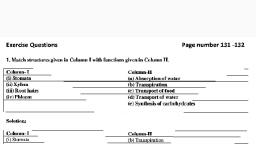
Class 10 Science, Unit 14 Transportation in Plants and Circulation in Animals, 8.A patient with blood group 0 was injured in an accident and has blood loss. Which blood group, the doctor should effectively use for transfusion in this condition?, (a) O group, (b) AB group, (c) A or B group, (d) all blood group, 9.‘Heart of heart’ is called ______., (a) SA node, (b) AV node, (c) Purkinje fibres, (d) Bundle of His., 10.Which one of the following regarding blood composition is correct?, (a) Plasma – Blood + Lymphocyte, (b) Serum – Blood + Fibrinogen, (c) Lymph – Plasma + RBC + WBC, (d) Blood – Plasma + RBC + WBC + Platelets, , II. Fill in the Blanks, 1.Transpiration involves evaporative loss of water from aerial parts., 2.Water enters the root cell through a Osmosis plasma membrane., 3 . Structures in roots that help to absorb water are Root hair., 4.Normal blood pressure is 120 mm / 80 mm Hg., 5.The normal human heartbeat rate is about 72 – 75 time per minute., , III. Match the following, 1. Symplastic pathway 2. Transpiration, 3. Osmosis, 4. Root Pressure, -, , Plasmodesmata, Leaf, Pressure gradient, Pressure in xylem.
Page 3 :
Class 10 Science, Unit 14 Transportation in Plants and Circulation in Animals, , 1. Leukaemia - Blood Cancer, 2. Platelets, - Thrombocytes, 3. Monocytes - Phagocyte, 4. Leucopenia - Decrease in leukocytes, 5. AB blood group- Absence of antibody, 6. O blood group - Absence of antigen, 7. Eosinophil - Allergic condition, 8. Neutrophils - Inflammation, IV. State whether True or False. If false write the correct statement., 1.The phloem is responsible for the translocation of food. True., 2.Plants lose water by the process of transpiration. True., 3.The form of sugar transported through the phloem is glucose. False., Correct Statement: The form of sugar transported through the phloem is Sucrose., 4. In the apoplastic movement, the water travels through the cell membrane and enters the cell., False., Correct Statement: In the apoplastic movement, the water travels through the intercellular, spaces and walls of the cell., 5. When guard cells lose water the stoma opens. False., Correct Statement: When guard cells lose water, the stoma closes., 6. initiation and stimulation of heartbeat take place by nerves. True., 7. All veins carry deoxygenated blood. False., Correct Statement: All veins carry deoxygenated blood except the Pulmonary vein., 8. WBC defends the body from bacterial and viral infections. True., 9. The closure of the mitral and tricuspid valves at the start of the ventricular systole produces, the first sound ‘LUBB’. True, , V. Answer in a word or Sentence., 1.Name two-layered protective covering of the human heart., Pericardium.
Page 4 :
Class 10 Science, Unit 14 Transportation in Plants and Circulation in Animals, 2.What is the shape of RBC in human blood?, RBC’s are biconcave and disc shaped., 3.Why is the colour of the blood-red?, The colour of the blood is red, due to the presence of respiratory pigment Haemoglobin., 4.Which kind of cells are found in the lymph?, Cells found in the lymphatics are lymphocytes., 5.Name the heart valve associated with the major arteries leaving the ventricles., Semilunar Valves., 6. Mention the artery which supplies blood to the heart muscle., Heart muscle receive oxygenated blood from coronary arteries that orginate from the, aortic arch., VI. Short Answer Questions., 1.What causes the opening and closing of guard cells of stomata during transpiration?, During transpiration, the movement of (Potassium) ions, in and out of the guard cells,, causes the opening and closing of stomate. When the water moves inside the guard cells,, causing them to swell up and become turgid, making the stomata open. When guard cells cause, water to move out of the cell, make guard cells shrunk, and the stomata pore closes., 2.What is cohesion?, The force of attraction between the water molecules is called cohesion., 3. Trace the pathway followed by water molecules from the time it enters a plant root to the time, it escapes into the atmosphere from a leaf., The upward movement of water and minerals from, roots to different plant parts is called ascent of sap. A, number of factors play a role in ascent of sap and it takes, places in following steps, i)Root pressure - root hair to start of stem, ii) Capillary Action - at the bottom part of the stem, iii) Adhesion and Cohesion of water molecules- Xylemto, different parts of the plants, iv)Transpirational pull - at the leaves
Page 5 :
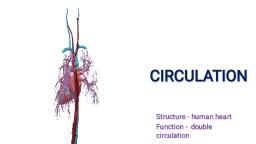
Class 10 Science, Unit 14 Transportation in Plants and Circulation in Animals, , 4.What would happen to the leaves of a plant that transpires more water than its absorption in, the roots?, If the transpiration of the leaves are more that the water absorbed in the roots, then the, guard cells shrinks and closes thus stoping excess transpiration., 5. Describe the structure and working of the human heart., Structure : The heart is enclosed in a double walled sac called pericardium. It contains, lubricating pericardial fluid which reduces friction during heart beat and protects it from, mechanical injuries., The human heart is four-chambered. The two upper thin-walled chambers, Auricle or, Atria and the lower thick-walled chambers ventricles. The chambers are separated by a septum., The two auricles are separated by an interatrial septum and the two ventricles are separated by, the interventricular septum, Working : The right atrium receives deoxygenated blood from different parts of the body, through superior vena cava, inferior vena cava and coronary sinus. Pulmonary veins bring, oxygenated blood from the lungs to the left atrium. Both the right and the left auricles pump, blood into the right and left ventricles respectively., From the right ventricle, the pulmonary arteries supply deoxygenated blood to the lungs. From, the left ventricle, the Aorta carries the Oxygenated blood to the various organs of the body. The, coronary arteries supply blood to the heart. This process is repeated again and again., 6.Why is the circulation in man referred to as double circulation?, When the blood circulates twice through the heart in one complete cycle it is called, double circulation. In double circulation the oxygenated blood does not mix with the, deoxygenated blood. on., 7.What are heart sounds? How are they produced?, The rhythmic closure and opening of the valves cause the sound of the heart. The first, sound LUBB is of longer duration and is produced by the closure of the tricuspid and bicuspid, valves after the beginning of ventricular systole. The second sound DUPP is of a shorter, duration and produced by the closure of semilunar valves at the end of ventricular systole, 8. What is the importance of valves in the heart?, The valves in the heart are muscular flaps that regulate the flow of blood in a single, direction and prevent backflow of blood., 9.Who discovered the Rh factor? Why was it named so?, The Rh factor was discovered by Landsteiner and Wiener in 1940 in the Rhesus, monkey. So it was named the Rh factor.
Page 6 :
Class 10 Science, Unit 14 Transportation in Plants and Circulation in Animals, 10. How are arteries and veins structurally different from one another?, , Artery, , Vein, , Distributing vessel, , Collecting vessel, , Pink in colour, , Red in colour, , Deep location, , Superficial in location, , Blood flow with high pressure, , Blood flow with low pressure, , Wall of an artery is strong, thick and, elastic, , Wall of a vein is weak, thin and non-elastic, , All arteries carry oxygenated blood except, pulmonary arteries, , All veins carry deoxygenated blood except, pulmonary veins, , Internal valves are absent, , Internal valves are present, , 11. Why is the Sinoatrial node called the pacemaker of heart?, Sino-atrial node acts as the ‘pacemaker’ of the heart because it is capable of initiating, impulse which can stimulate the heart muscles to contract. The impulse from the sinoatrial node, spreads as a wave of contraction over the right and left atrial wall pushing the blood through the, atrioventricular valves into the ventricles., 12. Differentiate between systemic circulation and pulmonary circulation., Systemic Circulation, , Pulmonary Circulation, , Circulation of oxygenated blood from the left, ventricle of the heart to various organs of the, body., , Circulation starts in the right ventricle of the, heart and reaches the lungs with, deoxygenated blood., , Return of deoxygenated blood to the right, atrium., , Pulmonary Artery collects the oxygenated, blood from the lungs., , Aorta carries oxygenated blood to all the, organs of the body., , The Oxygenated blood is supplied to the left, atrium of the heart by the Pulmonary.
Page 7 :
Class 10 Science, Unit 14 Transportation in Plants and Circulation in Animals, 13. The complete events of the cardiac cycle last for 0.8 sec. What is the timing for each event?, Auricular systole – Contraction of auricles = 0.1 sec, Ventricular systole – Contraction of ventricle = 0.3 sec, Ventricular diastole – Relaxation of ventricle = 0.4 sec, , VII. Give reasons for the following Statements., 1. Minerals cannot be passively absorbed by the roots., The minerals cannot be passively absorbed by the roots because, The minerals are present in the soil as charged particles (ion) and cannot move across the cell, membrane., The concentration of minerals in the soil is lower than the concentration of minerals in the root., 2. Guard cells are responsible for opening and closing of Stomata., Opening and closing of stomata takes place due to changes in turgidity of the guard cell., The turgidity changes in the guard cells are due to the amount of water in the guard cells., During the day, water from the subsidiary cells enter the guard cells making it fully turgid, causing the stomata to open. During night time, water from guard cells enters the subsidiary, cells thus making the guard cells flaccid which causes the stomata to close., 3. The movement of substances in the phloem can be in any direction., The movement of substance in the Phloem can be in any direction because, the food to, reach the plant parts like stem, leaves, flower, bud, seeds etc, the movement can be upwards or, downwards, that is bidirectional. Phloem Transports the food synthesised by the leaves to food, storage area depending on the plant type and also transports the stored food to various parts of, the plant when required., 4.Minerals in the plants are not lost when the leaf falls., Minerals are remobilised from older dying leaves to younger leaves. This phenomenon, can be seen in deciduous plants. Elements like phosphorus, sulphur, nitrogen and potassium, are easily mobilised, while elements like calcium are not remobilised. Small amounts of material, exchange takes place between xylem and phloem., 5 The walls of the right ventricle are thicker than the right auricles., The walls of the right ventricle are thicker than the right auricle because the right, ventricle has to pump away from the heart.
Page 8 :
Class 10 Science, Unit 14 Transportation in Plants and Circulation in Animals, 6.Mature RBC in mammals do not have cell organelles., The RBCs are devoid of nucleus, mitochondria, ribosome and endoplasmic reticulum., The absence of these organelles accommodates more haemoglobin thereby maximising the, oxygen carrying capacity of the cell. Biconcave shape increases the surface area for oxygen, binding, loss of mitochondria allows the RBC to transport all the oxygen to tissues and loss of, endoplasmic reticulum allows more flexibility for RBC to move through the narrow capillaries., VIII. Long Answer Questions., 1. How do plants absorb water? Explain., There are millions of root, hairs on the tip of the root, which, absorb water and minerals by, diffusion. Diffusion takes place across, cell membranes. Root hairs are a, thin-walled, slender, extension of, Epidermal cell, that increases the, surface area of absorption. Active, transport utilises energy to pump, molecules against a concentration, gradient. Active transport is carried out, by membrane – bound proteins. These, proteins, use, energy, to, carry, substances across the cell membrane., The cell wall of root hair is permeable and, allows the water and minerals to enter. The, cell membrane is semi – permeable. So it, allows movement of water molecules from the, region of higher concentration to the region of, lower concentration. Once the water enters, the root hairs, the concentration of water, molecules in the root hair cells become more, than that of Cortex. So the water from the root hair moves to the cortical cells by osmosis and, then reaches the xylem., Due to transpiration, the water is lost from the leaves and low pressure is created at the, top to pull more water from the xylem to the mesophyll cells, by the process of Transpiration, pull. This extends up to the roots causing the roots to absorb more water from the soil to ensure, the continuous flow of water from the roots to the leaves.
Page 9 :
Class 10 Science, Unit 14 Transportation in Plants and Circulation in Animals, 2.What is transpiration? Give the importance of transpiration., The loss of water from the aerial parts of plant in the form of vapours is called, transpiration., Importance of transpiration:, ● Creates transpirational pull for transport of water., ● Supplies water for photosynthesis., ● Transports minerals from soil to all parts of the plant., ● Cools the surface of the leaves by evaporation., ● Keeps the cells turgid; hence, maintains their shape., 3.Why are leukocytes classified as granulocytes and agranulocytes? Name each cell and, mention its functions., White blood corpuscles are colourless. They are nucleated cells. They are found in the, bone marrow, spleen, thymus and lymph nodes. They are grouped into two categories:, 1. Granulocytes: They contain granules in their cytoplasm. Their nucleus is irregular or lobed., The granulocytes are of three types:, Neutrophils: They are large in size and have a 2 – 7 lobed nucleus. Their numbers are, increased during infection and inflammation., Eosinophils: It has a bilobed nucleus. Their numbers increases during conditions of, allergy and parasitic infections. It brings about the detoxification of toxins., Basophils: Basophils have a lobed nucleus. They release chemicals during the process, of inflammation., 2. Agranulocytes: Granules are not found in the cytoplasm of these cells. Thy is of two types:, Lymphocytes: Lymphocytes produce antibodies during bacterial and viral infections., Monocytes: They are the largest of the leucocytes and are amoeboid in shape. They, are phagocytic and can engulf bacteria., 4. Differentiate between systole and diastole. Explain the conduction of the heart beat., Systole: The contraction of the heart is called systole., Diastole: The relaxation of the heart is called diastole., Conduction of heart beat : The heart in humans is myogenic. The cardiac cells with the fastest, rhythm are called the pacemaker cells. These cells are located in the right sino-atrial node. The, impulse from the sino-atrial node. spreads as a wave of contraction over the right and left atrial, wall pushing the blood through the atrioventricular valves into the ventricle. Two special cardiac, muscle fibres originate from the auriculo ventricular node and are called the bundle of his which, runs down into the interventricular septum and the fibres spread into the ventricles. These fibres, are called the Purkinje.
Page 10 :
Class 10 Science, Unit 14 Transportation in Plants and Circulation in Animals, , 5.Enumerate the functions of blood., Functions of blood:, ● Transport of respiratory gases (Oxygen and CO2)., ● Transport of digested food materials to different body cells., ● Transport of hormones., ● Transport of nitrogenous excretory products like ammonia, urea and uric acid., ● It is involved in the protection of the body and defence against diseases., ● It acts as a buffer and also helps in the regulation of pH and body temperature., ● It maintains proper water balance in the body., , IX. Assertion and Reasoning Questions., Direction: In each of the following questions a statement of assertion (A) is given and a, corresponding statement of Reason (R) is given just below it. Mark the correct statement, as:, (a) If both A and R are true and R is the correct explanation of A., (b) If both A and R are true but R is not the correct explanation of A., (c) A is true but R is false., (d) Both A and R are false., 1.Assertion : RBC plays an important role in the transport of respiratory gases., Reason: RBC does not have cell organelles and nucleus., (a) If both A and R are true and R is the correct explanation of A., 2.Assertion: Persons with AB blood group are called universal recipients because they can, receive blood from all groups., Reason: Antibodies are absent in persons with AB blood group., (c) A is true but R is false., X. Higher Order Thinking Skills (HOTS) Questions, 1.When any dry plant material is kept in water, they swell up. Name and define the phenomenon, involved in this change., Imbibition is a type of diffusion in which a solid plant material absorbs water and gets, swelled up. eg. absorption of water by dry seeds and grapes. If it were not for imbibition,, seedlings would not have been able to emerge out of the soil
Page 11 :
Class 10 Science, Unit 14 Transportation in Plants and Circulation in Animals, , 2.Why are the walls of the left ventricle thicker than the other chambers of the heart?, The left ventricle is longer and narrower than the right ventricle. The walls are about, three times thicker than the right ventricle. The left ventricle gives rise to aorta. The oxygenated, blood is supplied by the aorta to various organs of the body. The coronary arteries supply blood, to the heart., 3.Doctors use a stethoscope to hear the sound of the heart. Why?, The heart sound is heard by placing the stethoscope on the chest. It is a useful, diagnostic tool to identify and localize health problems and diagnose disease., 4.How does the pulmonary artery and pulmonary vein differ in their function when compared to, a normal artery and vein?, All arteries carry oxygenated blood except the pulmonary artery which carry, deoxygenated blood to the lungs., All veins carry deoxygenated blood except the pulmonary vein which carry oxygenated, blood from the lungs to the heart., 5. Transpiration is a necessary evil in plants. Explain., Transpiration is a necessary evil in plants because it is inevitable but potentially harmful., Loss of water from the plant results in wilting and causes the death of a plant if a condition of, drought is experienced., But transpiration is of great significance for the plant ;, • Creates transpirational pull for transport of water, • Supplies water for photosynthesis, • Transports minerals from soil to all parts of the plant, • Cools the surface of the leaves by evaporation., • Keeps the cells turgid; hence, maintains their shape