Page 3 :
Handwritten Notes, Paper 1, , Paper 2, (Management), , Soft Copy, , ₹ 100, , ₹ 300, , Hard Copy, , ₹ 150, , ₹ 450, , Call or Whatsapp for Notes : 7627096162, Note : Paper 1 includes 7 units except Comprehensions, Numerical Reasoning, and Data Interpretation because these units are practice based and theoretical, part of these units is covered in notes., For hard copies postal/courier charges are separate.
Page 4 :
Hypothesis Introduction, In social science, where direct knowledge of population, parameter(s) is rare, hypothesis testing is the often used, strategy for deciding whether a sample data offer such, support for a hypothesis that generalisation can be made., Thus hypothesis testing enables us to make probability, statements about population parameter(s). The hypothesis, may not be proved absolutely, but in practice it is accepted, if it has withstood a critical testing.
Page 5 :
Hypothesis, Hypothesis may be defined as a proposition or a set of, proposition set forth as an explanation for the occurrence, of some specified group of phenomena either asserted, merely as a provisional conjecture to guide some, investigation or accepted as highly probable in the light, of established facts.
Page 6 :
Characteristics of Hypothesis, 1., 2., 3., 4., , Hypothesis should be clear and precise., Hypothesis should be capable of being tested., Hypothesis should state relationship between variables., Hypothesis should be limited in scope and must be, specific., 5. Hypothesis should be consistent with most known facts., 6. Hypothesis must explain the facts that gave rise to the, need for explanation.
Page 7 :
Hypothesis - Basic Concepts, 1., 2., 3., 4., 5., , Null and Alternative Hypothesis., The Level of Significance., Decision rule or testing of Hypothesis., Type - I and Type - II errors, Two tailed and one tailed tests.
Page 8 :
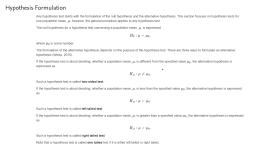
Hypothesis - Basic Concepts, 1. Null and Alternative Hypothesis : If we are to compare, method A with method B about its superiority and if we, proceed on the assumption that both methods are equally, good, then this assumption is termed as the null hypothesis., As against this, we may think that the method A is superior, or the method B is inferior, we are then stating what is, termed as alternative hypothesis. The null hypothesis is, generally symbolized as H0 and the alternative hypothesis, as H1
Page 9 :
Hypothesis - Basic Concepts, 2. Level of Significance : It is always some percentage, (usually 5%) which should be chosen with great care, thought, and reason. In case we take the significance level at 5 per cent,, then this implies that H0 will be rejected when the sampling, result has a less than 0.05 probability of occurring if H0 is true., In other words, the 5 per cent level of significance means that, researcher is willing to take as much as a 5 per cent risk of, rejecting the null hypothesis when it (H0) happens to be true.
Page 10 :
Hypothesis - Basic Concepts, 3. Decision rule or test of hypothesis : Given a, hypothesis H0 and an alternative hypothesis Ha, we make, a rule which is known as decision rule according to which, we accept H0 (i.e., reject Ha) or reject H0 (i.e., accept, Ha). We might test 10 items in the lot and plan our, decision saying that if there are none or only 1 defective, item among the 10, we will accept H0 otherwise we will, reject H0 (or accept Ha).
Page 11 :
Hypothesis - Basic Concepts, 4. Type I and Type II errors : In the context of testing of, hypotheses, there are basically two types of errors we can, make. We may reject H0 when H0 is true and we may, accept H0 when in fact H0 is not true. The former is, known as Type I error and the latter as Type II error.
Page 13 :
Hypothesis - Basic Concepts, 5. Two Tailed and One Tailed Tests : A two-tailed test, rejects the null hypothesis if, say, the sample mean is, significantly higher or lower than the hypothesised value, of the mean of the population. Such a test is appropriate, when the null hypothesis is some specified value and the, alternative hypothesis is a value not equal to the specified, value of the null hypothesis.
Page 15 :
Hypothesis - Basic Concepts, 5. Two Tailed and One Tailed Tests : A one-tailed test, would be used when we are to test, say, whether the, population mean is either lower than or higher than some, hypothesised value. For instance, if our H0 H0 : µ µ = and, Ha Ha : µ µ < 0 , then we are interested in what is known, as left-tailed test (wherein there is one rejection region, only on the left.
Page 17 :
Testing of Hypothesis, To test a hypothesis means to tell (on the basis of the data, the researcher has collected) whether or not the hypothesis, seems to be valid., In hypothesis testing the main question is: whether to, accept the null hypothesis or not to accept the null, hypothesis? Procedure for hypothesis testing refers to all, those steps that we undertake for making a choice between, the two actions i.e., rejection and acceptance of a null, hypothesis.
Page 18 :
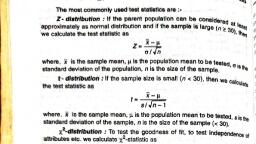
Procedure for Hypothesis Testing, The various steps involved in hypothesis testing are stated, below:, 1. Making a formal statement (HO and H1), 2. Selecting a significance level, 3. Deciding the distribution to use (Test), 4. Selecting a random sample and computing an, appropriate value, 5. Calculation of the probability, 6. Comparing the probability
Page 19 :
Limitations of Hypothesis Testing, 1. Testing is not decision-making itself; the tests are only, useful aids for decision-making., 2. Test do not explain the reasons as to why does the difference, exist, say between the means of the two samples., 3. Results of significance tests are based on probabilities and as, such cannot be expressed with full certainty., 4. Statistical inferences based on the significance tests cannot, be said to be entirely correct evidences concerning the truth, of the hypotheses.
Page 20 : Thanks for Watching, Like, Comment, Subscribe and Share, , “The Unlimited Struggler”, , Contact Details :Email :
[email protected], Call & Whatsapp : 7627096162, (Hard/Soft copy of Hand Written notes also available on paid basis)




 Learn better on this topic