Notes of BA MUSIC 3RD YR 2022-23, Tabla & Susidiary Tabla Study Material - Study Material
Page 3 :
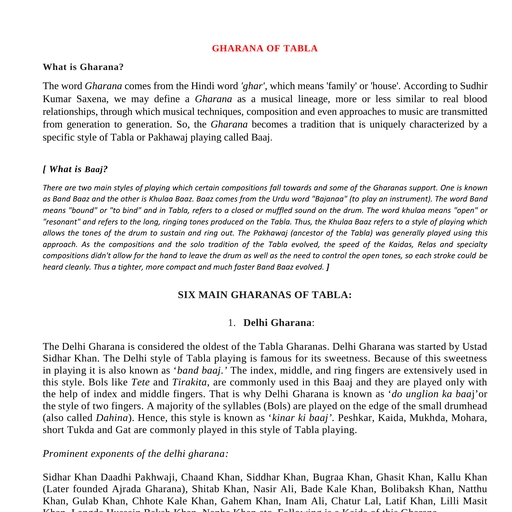
B) Gharana of Tabla, , - 10 marks, , What is Gharana ?, The word gharana comes from the Hindi word 'ghar', which means 'family' or 'house'., According to Sudhir Kumar Saxena, we may define a Gharana as a musical lineage, more or, less similar to real blood relationships, through which musical techniques, composition and, even approaches to music are transmitted from generation to generation. So, the Gharana, becomes a tradition that is uniquely characterized by a specific style of Tabla or Pakhawaj, playing called Baaj., SURCHANDRA, , [ What is Baaj ?, There are two main styles of playing which certain compositions fall towards and some of the Gharanas support., One is known as Band Baaz and the other is Khulaa Baaz. Baaz comes from the Urdu word "Bajanaa" (to play, an instrument). The word Band means "bound" or "to bind" and in Tabla, refers to a closed or muffled sound on, the drum. The word khulaa means "open" or "resonant" and refers to the long, ringing tones produced on the, Tabla. Thus, the Khulaa Baaz refers to a style of playing which allows the tones of the drum to sustain and ring, out. The Pakawaj (ancestor of the Tabla) was generally played using this approach. As the compositions and the, solo tradition of the Tabla evolved, the speed of the Kaidas, Relas and specialty compositions didn't allow for, the hand to leave the drum as well as the need to control the open tones, so each stroke could be heard cleanly., Thus a tighter, more compact and much faster Band Baaz evolved.], , SIX MAIN GHARANAS OF TABLA:, 1. Delhi Gharana:, The Delhi Gharana is considered the oldest of the Tabla Gharanas. Delhi Gharana was started by, Ustad Sidhar Khan. The Delhi style of Tabla playing is famous for its sweetness. Because of this, sweetness in playing it is also known as ‘band baaj’ The index, middle and ring fingers are, extensively used in this style. Bols like Tete and Tirakita,are very commonly used in this Baaj and, they are played only with the help of index and middle fingers. That is why Delhi Gharana is known, as ‘do unglion ka baaj’or the style of two fingers. A majority of the syllables (Bols) are played on, the edge of the small drumhead (also called Dahina). Hence, this style is known as ‘kinar ki baaj’., Peshkar, Kaida, Mukhda, Mohara, short Tukda and Gat are commonly played in this style of Tabla, playing., Some prominent exponents of the delhi gharana are as follows :Sidhar Khan Daadhi Pakhwaji, Chaand Khan, Siddhar Khan,Bugraa Khan, Ghasit Khan, Kallu Khan (Later founded Ajrada Gharana),Shitab Khan, Nasir Ali, Bade Kale Khan, Bolibaksh, Khan, Natthu Khan, Gulab Khan, Chhote Kale Khan ,Gahem Khan ,Inam Ali, Chatur Lal, Latif, Khan, Lilli Masit Khan, Langde Hussain Baksh Khan, Nanhe Khan
Page 9 :
E) A brief history of one of the following eminent artistes:, 1. Zakir Hussian 2. Ravi Sankar 3. Shiv Kumar Sharma, , – 10 marks, , (sources - https://www.culturalindia.net/indian-music/classical-singers/shivkumar-sharma.html), , Zakir Hussain, , Fast Facts, Date of Birth: 9 March, 1951, Place of Birth: Mumbai, Maharashtra, Birth Name: Zakir Hussain Qureshi, Profession: Tabla player, music producer, film actor and composer, Instruments: Tabla, Pakhawaj, Spouse: Antonia Minnecola, Children: Anisa Qureshi and Isabella Qureshi, Father: Ustad Allarakha Qureshi, Mother: Bavi Begum, Awards: Sangeet Natak Akademi Award, Padma Shri, Padma Bhushan, Popularly known as the Tabla Maestro, Ustad Zakir Hussain is arguably the most famous Tabla, player of our country in the post-independence era. Over the years, he has performed with many, talented musicians not just in India but also across the world. He became a famous international, celebrity after taking the sounds of Tabla to many international festivals and shows. This eventually, flooded him with opportunities to work in many international movies as well. This led to the creation, of brilliant works of fusion, which was new to both Indian and overseas audience. Overall, his, contribution towards popularizing the Indian percussion is immense., Early Life & Education, Zakir Hussain was born famous as he is the son of Ustad Allah Rakha, a renowned tabla player., Quite naturally, he was inclined towards Tabla since a very young age. Zakir was a child prodigy and, started touring to perform at concerts by the time he was just twelve. This gave him recognition and
Page 10 :
fame at a very young age. Along with his stage shows, he also focused on his education and went to, St. Michael's High School in Mahim and eventually graduated from St. Xavier's in Mumbai. He also, did his PhD and received a doctorate in music from the University of Washington. In his early, twenties, he started touring the United States frequently and performed in not less than 150 concerts, per year!, Career, Since he was a popular name in the US while he was still young, he collaborated with western, musicians and remained that way throughout. He mostly worked with American bands. His, partnership with the famous band, ‘The Beatles’ deserves a special mention. He also recorded with, an American psychedelic band ‘Shanti’ in the year 1971. In 1975, he worked with John McLaughlin, in a band ‘Shakti’. This band had John McLaughlin, Zakir Hussain, L. Shankar, T.H. ‘Vikku’, Vinayakam and R. Raghavan. ‘Shakti’ was disbanded by the late 70s. However, the band was, reunited a few years later by the name ‘Remember Shakti’ with the addition of new members. The, revived band went on to release many albums like ‘Saturday Night in Bombay’, and ‘The Believer’., They also performed in the 38th Montreux Jazz Festival. Zakir Hussain released his first solo album, ‘Making Music’ in the year 1987, which was proclaimed to be one of the most inspired East-West, fusion albums ever., Film Career, Zakir Hussain has composed music for many movies like ‘In Custody’, ‘The Mystic Masseur’, ‘Heat, and Dust’ etc. His composition for the Malayalam movie ‘Vanaprastham’, which was screened at the, prestigious Cannes Film Festival, earned him accolades. Some of the other films, for which he has, worked on the musical score include, ‘Apocalypse Now’, ‘Little Buddha’, ‘Saaz’, ‘Mr. and Mrs., Iyer’ and ‘One Dollar Curry’. Zakir has also acted in many movies, mostly showcasing his musical, performances. His portrayal of the character ‘Inder Lal’ in the film ‘Heat and Dust’ is unforgettable., He also starred in a couple of brilliant documentaries like ‘The Speaking Hand: Zakir Hussain and, the Art of the Indian Drum’ and ‘Zakir and His Friends’. While ‘Zakir and His Friends’ released in, the year 1998, ‘The Speaking Hand’ was released in 2003.
Page 11 :
Best Discographies, , , , , , , , , , , , , , , , , Rolling Thunder – This was the first solo album by drummer Mickey Hart. It featured the, music of classical Tabla, which was played by Zakir Hussain and his beloved father, the, legendary musician Alla Rakha., Karuna Supreme–Created by American saxophonist John Handy, this album has the likes of, Zakir Hussain, Ali Akbar Khan and Yogish S. Sahota. ‘Karuna Supreme’ was a major, success, both critically and commercially., Hard Work – After the success of ‘Karuna Supreme’, Zakir once again joined hands with, John Handy to work in this album. ‘Hard Work’ took the 43rd position in the top 200 albums, released by Billboard. It also broke into the top 5 ranking on the Billboard jazz chart., Diga – Zakir’s Tal Vadya Rhythm Band was renamed ‘Diga Rhythm Band’ in 1975 after the, inclusion of Mickey Hart. This band came up with an album called ‘Diga’ (1976) which, went on to achieve critical success. In the year 2008, a critic named John Metzger wrote that, ‘Diga’ was ahead of its time., Who's to Know – This album was put together by the famous violinist Shankar in the year, 1980. This too, was critically acclaimed by many western musicians., Song for Everyone - Featuring Zakir Hussain, Jan Garbarek and Trilok Gurtu, ‘Song for, Everyone’ was released by violinist L. Shankar. The album received four stars by Allmusic., Tabla Duet – In 1988, Zakir came up with his own album titled ‘Tabla Duet’. It featured, himself along with his father, Alla Rakha., At the Edge – This album by Mickey Hart featured only percussion instruments which paved, the path for Planet Drum., Supralingua – In 1998, Mickey Hart came up with this album which featured his percussion, ensemble Planet Drum. ‘Supralingua’ opened to mixed response by critics but was absolutely, lapped up by music lovers across the world., The Melody of Rhythm – Created by banjoist Bela Fleck, ‘The Melody of Rhythm’ had, Zakir Hussain on Tabla, Edgar Meyer on bass and the services of Detroit Symphony, Orchestra., , Contributions, Ustad Zakir Hussain is considered as one of the most important personalities in shaping the, contemporary world music movement. He is often credited for taking the Tabla to the world stage,, thanks to his numerous collaborations. He also showed to the world that Tabla, which was, considered a mere percussion before his era, could be used as a main instrument at concerts. This, belief that he instilled in many, changed the way we looked at concerts. His achievements as a Tabla, player inspired many young aspiring percussionists and opened the doors for many Indo-Western, collaborations., What Makes Zakir Unique?, Here are some of the facts that will make you understand why Zakir Hussain stands out from the rest, of contemporary musicians and percussionists.
Page 12 :
, , , , , Born Genius –Zakir Hussain learned to play Mridang (a classical percussion) from his father, when he was just three years old!, Tabla Beat Science–This unique musical group was founded by Zakir Hussain and Bill, Laswell in 1999. This gave rise to ‘Tala Matrix’ which is said to be one of the greatest, explorations of tabla fusion in the modern era., An invitation from the President – In 2016, Zakir Hussain became the first Indian musician, to be invited by the then American president Barack Obama. An elite list of musicians were, chosen and invited to attend the All-Star Global Concert held in the White House., , Awards, , , , , , , , , , , , , Padma Shree – He was awarded the Padma Shree by the Government of India in the year, 1988, thus making him the youngest percussionist ever to receive this award., Padma Bhushan – In 2002, Zakir Hussain once again became the youngest percussionist to, be honored with India’s third highest civilian award., Indo-American Award – This award was given to him in the year 1990 for his cultural, contribution., National Heritage Fellowship – In 1999, Zakir became the proud recipient of America’s most, prestigious honor in the field of traditional arts., Sangeet Natak Akademi Award – This award was given to him by the President of India in, the year 1991. He was one of the youngest musicians to have ever received this award., Grammy – He was also awarded the Grammy for the album ‘Planet Drum’ which was, produced and created by Zakir Hussain and Mickey Hart. This was his first ever Grammy., He won his second Grammy during the 51st Grammy Awards for his album ‘Global Drum, Project’ under the category, Contemporary World Music Album. For this project, he had, collaborated with Mickey Hart, Giovanni Hidalgo and Sikiru Adepoju., Kalidas Samman – In 2006, the government of Madhya Pradesh honored him with this, prestigious award, which is given for artistes with exceptional achievement in their, respective field., Lifetime Achievement Award – In 2012 at Konark Dance & Music Festival, he was, honoured with the Guru Gangadhar Pradhan (lifetime achievement) award., , , , Personal Life, , , , Zakir Hussain married an Italian-American Kathak dancer and teacher, Antonia Minnecola. She, earlier worked as his manager for some time. The couple has two daughters, Anisa Qureshi and, Isabella Qureshi. Anisa Qureshi, after graduating from UCLA, is now trying her luck in, filmmaking and video production. Zakir’s other daughter, Isabella, is doing her major in dance, at a college in Manhattan. Zakir recently became a proud grandfather and is currently residing, in San Francisco, USA.
Page 13 :
Ravi Shankar, Fast Facts, Date of Birth: April 7, 1920, Place of Birth: Varanasi, Birth Name: Rabindra Shankar Chowdhury, Date of Death: 11 December 2012, Place of Death: San Diego, California, Profession: Sitar player, composer, singer, Spouses: Annapurna Devi, Sukanya Rajan, Children: Shubhendra Shankar, Anoushka Shankar, Father: Shyam Shankar Chowdhury, Mother: Hemangini Devi, Siblings: Uday Shankar, Rajendra Shankar, Debendra Shankar, Bhupendra Shankar, Awards: Bharat Ratna, Padma Vibhushan, Padma Bhushan, Grammy Award, Pandit Ravi Shankar was an Indian musician and composer, best known for popularizing the Indian, classical instrument Sitar all over the world. Shankar grew up studying music and toured as a, member of his brother's dance troupe. After serving as the director of All-India Radio, he began to, tour India and the United States. In the process, he collaborated with many notable musicians,, including George Harrison and Philip Glass. He even collaborated with the famous band ‘The, Beatles’, popularizing Sitar to a greater extent. Honored with three highest Indian civilian awards,, Shankar passed away in California on December 2012, at the age of 92., Childhood, Ravi Shankar was born into a Bengali family. His father Shyam Shankar Chowdhury left to London, to work as a lawyer after serving as a local barrister under the British. Young Ravi Shankar was, raised by his mother and had not met his father until he was eight years old. In 1930, he moved to, Paris to be part of a musical troupe and later joined his brother, Uday Shankar’s dance troupe. He, toured with the troupe from the age of 10, and gave many memorable performances as a dancer., Ravi Shankar & Sitar
Page 14 :
Ravi Shankar was introduced to Sitar much later in his life when he was 18 years old. It all began at a, concert in Kolkata where he heard Amiya Kanti Bhattacharya play the classical instrument. Moved, by the performance, Shankar decided that he too, must learn Sitar under Bhattacharya’s guru, Ustad, Inayat Khan. This is how Sitar came into his life and remained with him until he breathed his last., Early Career and Association with AIR, After having learnt to play Sitar under his Guru, Ustad Inayat Khan, he went to Mumbai, where he, worked for the Indian People's Theatre Association. There he started composing music for ballets, until 1946. He then went on to become the director of New Delhi radio station All-India Radio, (AIR), a position he held until 1956. During his time at the AIR, Shankar composed pieces for, orchestra that mixed Sitar and other Indian instruments with classical Western instrumentation. Also, during this period, he began performing and writing music with American-born violinist Yehudi, Menuhin., Discography, Ravi Shankar has a long list of albums to his credit. Following are some of his best sellers:, , , , , , , Three Ragas – Released in the year 1956, ‘Three Ragas’ was his first LP album. It was rereleased in the digital format by Angel Records in the year 2000., Tana Mana – This album was originally credited to ‘The Ravi Shankar Project’ and was, released in 1987. ‘Tana Mana’ was an experimental work by the Pandit, who mixed, traditional instrumentation with electronic music of the 80s., Farewell, My Friend – When Shankar heard about Satyajit Ray’s death, he spontaneously, composed this album. It was subsequently recorded and released by HMV., The Sounds of India – Originally released in 1968 as a LP album, ‘The Sounds of India’ was, digitally re-released in CD format in 1989., , , , Association with George Harrison, , , , In June 1966, George Harrison, member of the famous band Beatles, met Ravi Shankar in, London. Harrison befriended him and began to take Sitar lessons from the Pandit himself. The, association immediately brought Shankar and Indian music unprecedented popularity in the, West. Harrison's introduction of the Sitar into the Beatles, gave rise to a new genre of music, known as raga rock. He later started working as Ravi Shankar’s producer. Harrison addressed, him as “The Godfather of World Music”. Twenty three years older than Harrison, Shankar, described their relationship as that of father and a son.
Page 15 :
, , Concert for Bangladesh, , , , In 1971, Bangladesh became a hotbed of armed conflict between the Indian and Muslim, Pakistani forces. Along with the issues of violence, the country was inundated with ferocious, flooding. Seeing the famine and hardship faced by the country's civilians, Shankar and Harrison, organized the Concert for Bangladesh. It took place at the Madison Square Garden on August 1, and featured performers such as Bob Dylan and Eric Clapton. Proceeds from the show, which is, largely considered to be the first major modern charity concert, went to the aid organization, UNICEF to help Bangladeshi refugees. Additionally, the recordings made by the performing, artists won the 1973 Grammy Award under the category, album of the year., , , , Mainstream Success, , , , In 1954, Ravi Shankar gave a recital in the Soviet Union. In 1956, he debuted in the United, States and Western Europe. Also helping his popularity was the score he wrote for the famous, Indian film director, Satyajit Ray. Already an ambassador of Indian music to the Western world,, Shankar embraced this role to a much larger extent in the 1960s. That decade saw Shankar's, performance at the Monterey Pop Festival, which further elevated his fame., , , , The Difficult Phase, , , , His association with the Beatles led to accusations that he was a hippie who promoted drug use., In fact, Shankar was intensely critical of the Marijuana addicts. Despite his affection for, Harrison, it proved a difficult period for Shankar, who wasn't keen on the rock music scene., During the 1970s he distanced himself from his hippie associations and began to refocus on, cementing his status as a classical Indian musician, but his friendship with Harrison endured., , , , Political Career, , , , For his great contribution to Indian music, he was nominated to the Rajya Sabha by the then, Indian Prime Minister Rajiv Gandhi. He served as a member of the Upper House of the Indian, Parliament from 12 May 1986 to 11 May 1992., , , , Recomposing ‘Saare Jahan Se Accha’
Page 16 :
, , The song ‘Saare Jahan Se Acchha’ was set to tune by Ravi Shankar. Written by Muhammad, Iqbal in 1904, it had a more drawn-out tune until Shankar was asked to reset it in 1945. Many, are unaware of this, including HMV, which attributes the tune as “traditional” in an album, featuring patriotic songs sung by Lata Mangeshkar., , Criticisms, Throughout his career, Shankar received criticism for not being a classical purist from some famous, Indian traditionalists. But Ravi Shankar tackled all the criticism gracefully and kept moving ahead on, his musical journey., Awards and Honors, , , , , , , , , , Sangeet Natak Akademi Award – In 1962, he as honoured with the Sangeet Natak Akademi, Award, given by India's National Academy of Music, Dance & Drama., Sangeet Natak Akademi Fellowship – This is the highest honor given away by the same, organization. He won this award in the year 1975., Padma Bhushan – In 1967, Ravi Shankar was honored with India’s third highest civilian, award., Padma Vibhushan - Padma Vibhushan, India’s second highest civilian award, was given to, him in the year 1981., Bharat Ratna – In 1999, the Sitar maestro was honored with the country’s highest civilian, award., Grammy Award – Ravi Shankar won five Grammy Awards in his lifetime. In 1967, his, collaborative album with Yehudi Menuhin won a Grammy under Best Chamber Music, Performance. In 1973, the ‘Concert for Bangladesh’ won the Album of the year award. In, 2002, his album, ‘Full Circle: Carnegie Hall 2000’ won the Best World Music Album award, and in 2013, ‘The Living Room Sessions’ once again bagged an award under the category, Best World Music Album., Lifetime Achievement Award – He was honoured with this prestigious award at the 55th, Annual Grammy Awards., , Personal Life, Ravi Shankar married Annapurna Devi in 1941. In the subsequent year, their son and Ravi Shankar’s, first child, Shubhendra Shankar, was born. During the late 1940s, Ravi Shankar had an affair with a, dancer named Kamala Shastri and this proved fatal to his marriage which eventually ended. In 1981,, he broke his relationship with Kamala Shastri and started an affair with Sue Jones, a concert, producer from New York. This relationship too ended in 1986. He then went on to marry Sukanya, Rajan. His daughter, Anoushka Shankar, was born in 1981 out of this union., In the year 1992, Ravi Shankar’s son Shubhendra Shankar died of pneumonia. Post his son’s death,, Ravi Shankar became more spiritual and in his later years, gave up on non-veg food.
Page 17 :
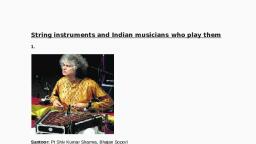
Death and Legacy, Ravi Shankar died on December 11, 2012 in San Diego, California, at the age of 92. The musician, had reportedly suffered from upper respiratory and heart ailments and had undergone surgery to, replace a heart valve in the days leading up to his death. His last performance was with his daughter, at the Terrace Theater in California. His daughter, Anoushka Shankar, is also a Sitar player and, composer. The legacy of Ravi Shankar is now being carried forward by this talented musician., Death and Legacy, Ravi Shankar died on December 11, 2012 in San Diego, California, at the age of 92. The musician had, reportedly suffered from upper respiratory and heart ailments and had undergone surgery to replace a, heart valve in the days leading up to his death. His last performance was with his daughter at the, Terrace Theater in California. His daughter, Anoushka Shankar, is also a Sitar player and composer., The legacy of Ravi Shankar is now being carried forward by this talented musician., Pandit Shivkumar Sharma, Pandit Shivkumar Sharma is a very famous classical musician who has acquired international fame, by playing the classical instrument, Santoor. The Santoor is a trapezoid-shaped hammered dulcimer, often made of walnut wood and has 72 strings, which are struck with two delicate carved wooden, mallets. The santoor is essentially a folk instrument that originated in the Kashmir Valley, which was, given the status of a classical instrument due to the persistent efforts of Pandit Shivkumar Sharma., Reaching at this level in life was not easy for him and it is because of the determination of, Shivkumar Sharma that the Santoor is a popular classical instrument. Know his life history in this, short biography of Pt. Shiv Kumar Sharma., Shivkumar Sharma was born on 13th January, 1938 in Jammu. He was introduced to the Santoor by, his father and teacher, Pandit Uma Dutt Sharma. He was renowned player of the instrument and also, a vocalist. He was a disciple of Pandit Bade Ramdasji of Banaras. Shivkumar Sharma learnt the tabla, and also vocal singing before dedicating himself to learn the Santoor extensively. The Santoor was, known as the Shata-Tantri Veena in earlier days. It was used to accompany a particular type of, singing known as Sufiana Mausiqi. Pandit Uma Dutt Sharma gave the responsibility of taking the, Santoor on the world stage to his son Shivkumar after extensive research on its possibilities.
Page 18 :
Today, Shivkumar Sharma and the Santoor are synonymous. Shivkumar Sharma has truly been, successful in giving the Santoor the position of a popular classical instrument. Shivkumar Sharma, modified the folk instrument in order to make it more suitable for classical music. He increased its, range to full three octaves and also created a technique for smoother gliding between music notes in, order to imitate human voice quality. Shivkumar Sharma also created a new way of playing it so that, the notes and sound continuity could be maintained for a long time., Shivkumar Sharma has collaborated with many musicians like Zakir Hussain and Hariprasad, Chaurasiya. He also composed music for Hindi films like "Darr", "Silsila", "Lamhe", etc. Some of, his famous albums are Call of the Valley, Sampradaya, Elements: Water, Music of the Mountains,, Megh Malhar, etc. His son Rahul is also a famous Santoor player. Shivkumar Sharma is the recipient, of many prestigious awards like Padmashree, Padma Vibhushan, Sangeet Natak Academy Award,, Honorary Doctorate from the University of Jammu, Ustad Hafiz Ali Khan Award, Maharashtra, Gaurav Puraskar, etc. He also has an honorary citizenship of the city of Baltimore, USA. This, flawless musician truly deserves these honors and more. His Santoor recitals shall keep us, mesmerized for many more years to come.



 Learn better on this topic