Page 1 :
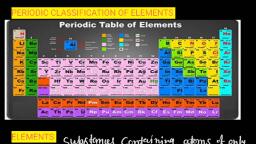
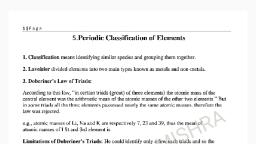
PERIODIC CLASSIFICATION OF ELEMENTS, Periodic Table of Elements, 18, He, 17, Li, Be, 10 xW, Ne, AI, 17 M sa, Na Mg, AI, Ar, 21 22, K, Sc, Cr Mn, 27 M, Fe, Co, Ni, Cu, Zn, Ga Ge, As, Se, Br, Kr, Rb, Zr, Nb Mo, Ru Rh Pd, Ag Cd, In, Sn, Sb, Te, Xe, Ва, Hf, Ta, Re, Os, Ir, Pt, Au Hg, Ti, Pb, At, Rn, 89-103, 104, 110, 111, 112, 115, Ra, Rf, Db Sg Bh Hs Mt DS Rg, Nd Pm Sm, Eu Gd, Tb, Dy, Ho, 102, 103, Ac, Th, Np, Pu Am Cm Bk, Cf, Es Fm Md No, ELEMENTS, Substames, one type eg: Na. mg, Au., Contaíning atoms f only, Al Cete., O There ahe around l18 elements known toug., o Elements are classified to make the Study, eary-, Lavoisier classification, O Lavoisier classifred elements in to too catigories-, ELEMEN TS, Che mistry, By- NAAZ RAFEEQ, METALS, e ko loss Krte hai, Electro positive, NON-METALS, e-Ko gain Krte hai, Elechionegative
Page 2 :
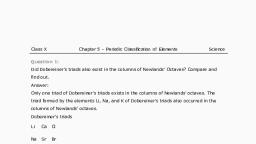
2, DOBERIENER'S LAW OF TRIADS, He arranged the elements in increasing, ordev f atomic werght., The afomic weryht f middle elements is, average of first and thind elements, → These elements resembled in their properties -, Table 5.2, Johann Wolfgang Döbereiner (1780-1849), Döbereiner's triads, Johann Wolfgang Döbereiner studied as a, pharmacist at Münchberg in Germany, and then, studied chemistry at Strasbourg. Eventually he, became a professor of chemistry and pharmacy, at the University of Jena. Döbereiner made the, first observations on platinum as a catalyst and, discovered similar triads of elements which led to, Li, Ca, CI, Na, Sr, Br, K, Ba, I, the development of the Periodic Table of elements., 7+39_= 46, 23, 2), Na, O I Li, 3, Chemistry, By- NAAZ RAFEEQ, At mass=7, At magy=39, 2), SY, yo+137= 17, 2, 2, 88.5, Ca, (3), Al matt =y0, Atmay = 137, (2, 35+187= 162, BY, 2, = (81), 135, 3 Atman=l27
Page 3 :
only three triads were recognised, from 0 the elements Known Et that, time., Limitations, By kq afomic, masy may be, Bo or B1, 19+8|, BY, (3, 50, Newlands LAW OF octaves, O octaves = 0ct=8, Based on increasing atomic mass felkments, O When elements are amonged it was found that, every eighth elements has, to that of the first elements ., similav Properties, Table 5.3 Newlands' Octaves, sa, re, ga, ma, pa, da, ni, Notes of music:, (do), (re), (mi), (fa), (so), (la), (ti), LI, Be, B, Na, Mg, Al, SI, CI, Co and NI, K, Ca, Cr, Ti, Mn, Fe, Cu, Zn, Y, In, As, Se, Br, Rb, Sr, Ce and La, Zr, 499999, 999999999999999, Are you familiar with musical notes?, In the Indian system of music, there are seven musical notes in a scale- sa, re, ga, ma, pa,, da, ni. In the west, they use the notations – do, re, mi. fa, so, la, ti. The notes in a scale are, separated by whole and half-step frequency intervals of tones and semitones. A musician, uses these notes for composing the music of a song. Naturally, there must be some repetition, of notes. Every eighth note is similar to the first one and it is the first note of the next scale., Do You Know?
Page 4 :
He starked with the element having the lowest, atomic mass (H) amel encled at thorium which, was the 56 elements,, Drawbacks of Newland's law, O Itwasfound that the law of octayes was, applicable only up to Calcium, as after ca, every eighth elements did mot possess propertiey, Simitar to that the finst., 2) It was assumed by newlandp that only 56, elements existed in nåture and ño more elements, Would be discoyered in the future, • But, later on, Several new element, weve discovered, whose properties did not, fit in to the law f octaves ., 3 New lands adjusted two elements in the some, Slot. Note that Cobalt and Nickel are in the, Same Slot and these are placed in the Same, Colmmn as fluorine , chlorine , and bromine which, have very different pooperties than theye, elements., Iron (fe) , Which resembles Co amd Ni in, Prperties , hay been placed far away from these, elements., ☺ New land octaves law's worked, well only with Lighter elementi., Chemistry, By- NAAZ RÁFEEQ, Fe Cu, Mn, Zn
Page 5 :
Applicable only up to Calcium., Mperties of new elements Could not, fit 'in it., 3 It some cases properties f the elements, were not same a's dlefined by octaves, O Worked well only iith lighter elements., He assumed 56 Elements exists only, in neture, ® He put elements together (Co,NiJuith BY, O Fe is same as Ni, Co put far from them, d up to Calcium., The mistry, By-NAAZ RÀFEEQ, MENDELEEV'S PERIODIC LAW, The main credit for classifying elements goes to Dmitri Ivanovich, Mendeléev, a Russian chemist. He was the most important contributor, to the early development of a Periodic Table of elements wherein the, elements were arranged on the basis of their fundamental property, the, atomic mass, and also on the similarity of chemical properties., Dmitri lvanovich Mendeléev (1834-1907), Dmitri lvanovich Mendeléev was, born in Tobolsk in Western Siberia,, Russia on 8 February 1834. After, his early education, Mendeléev, could join a university only due to, the efforts of his mother. Dedicating, his investigations to his mother he, wrote, “She instructed with, example, corrected with love and, travelled with me, to places, spending her last resources and, strength. She knew that with the, aid of science without violence, with love but firmness, all, superstitions, untruth and errors can be removed." The, arrangement of elements he proposed is called Mendeléev's, Periodic Table. The Periodic Table proved to be the unifying, principle in chemistry. It was the motivation for the discovery of, some new elements.