Page 1 :
Table of Contents, 1.Acid and base difference, 2. What is Acid?, 2.1. Classification of Acids, 2.1.1. Organic Acids, 2.1.2. Inorganic Acids, 2.1.2.1. 1.Monobasic Acid:, 2.1.2.2. 2.Dibasic Acid:, 2.1.2.3. 3.Tribasic Acid:, 2.1.2.3.1. Classification of Acids based on, , lonization, , concentration, 2.1.2.3.3. Properties of Acids, 2.1.2.3.4. Role of water in acid solution, 2.1,2.3.5. Uses of Acids, 3. What are the Bases?, 3.1. Classification of Bases Based on their, Acidity, 3.2. Classification Bases based on, Concentration, 3.3. Classification Bases based on lonisation, 3.3.1. Properties of Bases:, 3.3.2. Application and Uses of Bases, 3.3.3. Tests for Acids and Bases, 4. Test of Strength for Acid and Bases, 4.1. pH Importance, 5, Salts, 5.1. Types of Salts, 5.1.1. Properties of Salts, 5.1.2. Identification of Salts, 5.1.3. Uses of Salts, 6. Some Extra thing to Know about Acids

Page 2 :
Acid and base difference, , Acids, Bases, and Salts are used in daily life. Ex:, Soap, Juice, Detergent, etc. Our body, metabolism is carried out by stomach juice, called Hydrochloric acid (HCl)., , Acid is a compound that forms Hydrogen, lon(H+) in an aqueous solution. Based forms, Hydroxy! ions (OH-) in solution., , Acid and Base react with each other to forma, neutral product known as Salt., , What is Acid?, , All foods such as Curd, Fruit Juices, Fruit, and, Vinegar tastes similar i.e Sour Taste due to the, presence of acids., , Acid got its name from the Latin word "Acidus”, which means sour taste. A substance with a, sour taste is called Acids.
Page 3 :
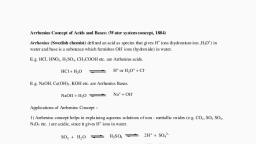
Curd Lactic Acid, , Apple Malic acid, Lemon Citric acid, Orange Ascorbic acid, Grape Tartaric acid, Tomato Oxalic acid, , Tea Tannic acid, , Vinegar Acetic acid, , Ant, Bee Formic acid, Stomach juice Hydrochloric acid, , Svante Arrhenius proposed, Arrhenius theory, of acids, a substance which furnishes H+ or, H30+ ions in an aqueous solution, contains, one or more replaceable hydrogen atoms., , Ex: Hcl when dissolved in water give H+ and Cl, — ions in water., , HCl(aq) + H+(aq)+ Cl-(aq)., , Thus, hydrogen ions must always be H+ (or), Hydronium (H30+), H+ +H20 =| H30+
Page 4 :
Table 6.2 Ions formed by acids, , , , , , , , , , , , , , , , , , , , , , , , , , lons formed by acids, , All acid contains hydrogen and all hydrogencontaining compounds are not acids. Ex:, Methane (CH4) and Ammonia (NH3) as they do, not produce H+ ions in an aqueous solution., , Classification of Acids, , Acids are classified based on their source as, , 1. Organic Acids, 2. Inorganic Acids, , Organic Acids, , Present in Plants and Animal Sources.Ex:, HCOOH, CH3COOH., , Inorganic Acids, , Prepared from rocks and minerals. Ex: HCl,, HNO3, H2S04