Page 1 :
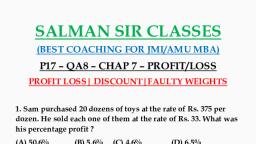
SALMAN SIR CLASSES, (BEST COACHING FOR JMI/AMU MBA), , P17 – QA8 – CHAP 7 – PROFIT/LOSS, PROFIT LOSS| DISCOUNT|FAULTY WEIGHTS, 1. Sam purchased 20 dozens of toys at the rate of Rs. 375 per, dozen. He sold each one of them at the rate of Rs. 33. What was, his percentage profit ?, (A) 50.6%, , (B) 5.6%, , (C) 4.6%, , (D) 6.5%, , 2. A shopkeeper expect a gain of 22 ½ % . If in a week, his sale, was of Rs. 392, what was his profit ?, (A) Rs.28, , (B) Rs. 70 (C) Rs. 72, , (D) Rs. 88.25, , 3. If the cost price of 12 pens is equal to the selling price of 8, pens, the gain percent is, (A) 66%, , (B) 33%, , (C) 50%, , (D) 25%, , 4. If the selling price of 50 articles is equal to the cost price of 40, articles, then the loss or gain percent is :, (A) 20% loss (B) 20% gain (C) 25% loss (D) 25% gain, 5. Find a single discount equivalent to the series of two, discounts of 15% and 4%., (A) 20% (B) 21.6%, , (C) 25% (D) 18.4%, , 6. A man buys eggs at 2 for Rs. 1 and an equal number at 3 for, Rs. 2 and sell the whole at 5 for Rs. 3. His gain or loss percent is, (A) 2 2/7 % loss (B) 3 6/7 %gain, FOR COACHING CLASSES OF JMI MBA & AMU MBA,CONTACT - 7042385093
Page 2 :
(C) 3 2/7 %loss (D) 2 6/7 % gain, 7. A man bought some oranges at Rs. 10 per dozen and bought, the same number of orange at Rs. 8 per dozen. He sold these, oranges at Rs. 11 per dozen and gained Rs. 120. The total, number of oranges bought by him was :, (A) 30 dozens (B) 40 dozens (C) 50 dozens (D) 60 dozens, 8. Padam purchase 30 kg of rice at the rate of Rs. 17.5/kg and, another 30 kg rice at a certain rate. He mixed the two and sold, the entire quantity at the rate of Rs. 18.60/kg and made 20%, overall profit. At what price per kg did he purchase the lot of, another 30 kg rice ?, (A) Rs. 12.50 (B) Rs. 13.50 (C) Rs. 14.50 (D) Rs. 15.50, 9. A dishonest dealer professes to shell his goods at cost price., But he uses a false weight and thus gain 6 18/47 %. For a kg, he, uses a weight of :, (A) 940 gm (B) 947 gm (C) 953 gm (D) 960 gm, 10. A man buys an article for 10% less than its value and sell it, for 10% more than its value. His gain or loss percent is :, (A) no profit, no loss, , (B) 20% profit, , (C) less than 20% profit (D) more than 20% profit, 11. The cash difference between the selling prices of an article, at a profit of 4% and 6% is Rs. 3. The ratio of the two selling, prices is :, (A) 51 : 52 (B) 52 : 53 (C) 51 : 53 (D) 52 : 55, 12. By selling an umbrella for Rs. 300, a shopkeeper gains 20%., During a clearance sale, the shopkeeper allows a discount of, 10% on the marked price. His gain percent during the sale is :, FOR COACHING CLASSES OF JMI MBA & AMU MBA,CONTACT - 7042385093
Page 3 :
(A) 7 (B) 7.5 (C) 8 (D) 9, 13. At what price should a shopkeeper mark a ratio that costs, him Rs. 1200 in order that the may offer a discount of 20% on, the marked price and still make a profit of 25%, (A) Rs. 1675 (B) Rs. 1875 (C) Rs. 1900 (D) Rs. 2025, 14. Peter bought an item at 20% discount on its original price., He sold it with 40% increase on the price he bought it. The new, sale price is by what percent more than the original price ?, (A) 7.5% (B) 8% (C) 10% (D) 12%, 15. Varun got 30% concession on the labeled price of an article, and sold it for Rs. 8750 with 25% profit on the price he bought., What was the labeled price ?, (A) Rs. 10,000 (B) Rs. 12,000 (C) Rs. 16,000 (D) Data inadequate, 16. In the selling price of 8 articles is equal to the cost price of, 10 articles, then the gain or loss percentage is, (A) 25% gain (B) 25% loss (C) 20% gain (D) 20% loss, 17. A sold a commodity to B with 10% profit. If B resold the, same commodity to A with a loss of 10%, then A will have :, (A) 1% loss (B) 11% loss (C) 1% profit (D) 11% profit, 18. If an article is sold for Rs. p, there is a loss of 15%. If, however, the same article is sold for Rs. q, there is a profit of, 15% then the ratio (q - p) : (q + p is) :, (A) 20 : 23 (B) 20 : 3 (C) 3 : 20 (D) 17 : 23, 19. A man bought an old typewriter for 1200 and spent 200 on, its repair. He sold it for 1680. His profit per cent is :, (1) 20% (2) 10% (3) 8% (4) 16%, FOR COACHING CLASSES OF JMI MBA & AMU MBA,CONTACT - 7042385093
Page 4 :
20. A man purchased a bedsheet for 450 and sold it at a gain of, 10% calculated on the selling price. The selling price of the, bedsheet was (1) 460 (2) 475 (3) 480 (4) 500, 21. If there is a profit of 20% on the cost price, the percentage of, profit on the sale price is, (1) 16 2 /3 % (2) 12 % (3) 15 1/ 3 % (4) 16 %, 22. A person sells 400 mangoes at the cost price of 320 mangoes., His percentage of loss is, (1) 10% (2)15% (3) 20% (4)25%, 23. A sold an article to B at 20% profit and B sold to C at 15%, loss. If A sold it to C at the selling price of B, then A would, make (1) 5% profit (2) 2% profit (3) 2% loss (4) 5% loss, 24. Oranges are bought at rate of 7 for 3. At what rate per, hundred must they be sold to gain 33%?, (1) 56 (2) 60 (3) 58 (4) 57, 25. The cost price of two dozen bananas is 32. After selling 18, bananas at the rate of 12 per dozen, the shopkeeper reduced the, rate to 4 per dozen. The per cent loss is, (1) 25.2% (2) 32.4% (3) 36.5% (4) 37.5%, 26. A man buys a certain number of oranges at 20 for 60 and an, equal number at 30 for 60. He mixes them and sells them at 25, for 60. What is gain or loss per cent ? (1) Gain of 4% (2) Loss of, 4% (3) Neither gain nor loss (4) Loss of 5%, 27. The ratio of cost price and selling price is 5 : 4, the loss per, cent is :, (1) 20% (2) 25% (3) 40% (4) 50%, FOR COACHING CLASSES OF JMI MBA & AMU MBA,CONTACT - 7042385093
Page 5 :
28. The cash difference between selling prices of an article at a, profit of 4% and 6% is 3. The ratio of the two selling prices is, (1) 51 : 52 (2) 52 : 53 (3) 51 : 53 (4) 52 : 55, 29. Find the selling price of an article if a shopkeeper allows, two successive discounts of 5% each on the marked price of 80., (1) 70.20 (2) 70.10 (3) 72.00 (4) 72.20, 30. A shopkeeper gains 20% while buying the goods and 30%, while selling them. Find his total gain per cent., (1) 50% (2) 36% (3) 56% (4) 40%, 31. Salary of a person is increased by 20%, then it is decreased, by 20%. Change in his salary is : (1) 4% decreased (2) 4%, increased (3) 8% decreased (4) neither decrease nor increase, 32. By selling an article for 240, a man incurs a loss of 10%. At, what price should he sell it, so that he makes a profit of 20% ?, (1) 264 (2) 288 (3) 300 (4) 320, 33. A man sells a car to his friend at 10% loss. If the friend sells, it for 54,000 and gains 20%, the original cost price of the car was, (1) 25,000 (2) 35,000 (3) 45,000 (4) 50,000, 34. The cost price of an article is 800. After allowing a discount, of 10%, a gain of 12.5% was made. Then the marked price of the, article is (1) 1,000 (2) 1,100 (3) 1,200 (4) 1,300, 35. A shopkeeper allows 23% commission on his advertised, price and still makes a profit of 10%. If he gains 56 on one item,, his advertised price of the item is, (1) 820 (2) 780 (3) 790 (4) 800, , FOR COACHING CLASSES OF JMI MBA & AMU MBA,CONTACT - 7042385093
Page 6 :
36. At what per cent above the cost price, must a shop–keeper, marks his goods so that he gains 20% even after giving a, discount of 10% on the marked price ?, (1) 25% (2) 30% (3) 33 1 /3 % (4) 37 1/ 2 %, 37. Profit after selling a commodity for 524 is the same as loss, after selling it for 452. The cost price of the commodity is, (1) 480 (2) 500 (3) 488 (4) 485, 38. A man sold 250 chairs and had a gain equal to selling price, of 50 chairs. His profit per cent is :, (1) 20% (2) 25% (3) 50% (4) 15%, 39. A man sold an article at a loss of 20%. If he has sold that, article for 12 more he would have gained 10%. Find the cost, price of that article : (1) 60 (2) 40 (3) 30 (4) 22, 40. A cooker is sold at a gain of 16%. If it has been sold for 20, more, 20% would have been gained. The cost price of the, cooker is (1) 350 (2) 400 (3) 500 (4) 600, 41. A businessman bought an article and sold it at a loss of 5%., If he had bought it for 10% less and sold it for 33 more, he, would have had a profit of 30%. The cost price of the article is, (1) 330 (2) 155 (3) 150 (4) 300, 42. A saleable article passes successively in the hands of three, traders. Each trader sold it further at a gain of 25% of the cost, price. If the last trader sold it for Rs. 250 then what was the cost, price for the first trader ? (1) 128 (2) 150 (3) 192 (4) 200, 43. A sells a suitcase to B at 10% profit. B sells it to C at 30%, profit. If C pays 2,860 for it, then the price at which A bought it, is (1) 1,000 (2) 1,600 (3) 2,000 (4) 2,500, FOR COACHING CLASSES OF JMI MBA & AMU MBA,CONTACT - 7042385093
Page 7 :
44. A shopkeeper sells two T.V. sets at the same price. There is, a gain of 20% on one TV and a loss of 20% on the other. State, which of the following statement is correct : (1) The shopkeeper, makes no net gain or profit (2) The shopkeeper loses by 2% (3), The shopkeeper gains by 4% (4) The shopkeeper loses by 4%, 45. A man bought two goats for 1008. He sold one at a loss of, 20% and other at a profit of 44%. If each goat was sold for the, same price, the cost price of the goat which was sold at loss,, was : (1) 648 (2) 360 (3) 568 (4) 440, 46. The total cost price of two watches is 840. One is sold at a, profit of 16 per cent and the other at a loss of 12 per cent. There, is no loss or gain in the whole transaction. The cost price of the, watch on which the shopkeeper gains, is, (1) 360 (2) 370 (3) 380 (4) 390, 47. The difference between the selling prices of an article at a, profit of 15% and at a profit of 10% is 10. The cost price of the, article is, (1) 100 (2) 120 (3) 150 (4) 200, 48. Rahul buys a book for 400 and sells it for 500. The, difference between his profit as a percentage of the buying, price and then as a percentage of the selling price is, (1) 25% (2) 5% (3) 0% (4) 20%, 49. A trader bought 10 kg of apples for 405 out of which 1 kg of, apples were found to be rotten. If he wishes to make a profit of, 10%, at what rate should he sell the remaining apples per kg?, (1) 45 (2) 49.50 (3) 50 (4) 51, , FOR COACHING CLASSES OF JMI MBA & AMU MBA,CONTACT - 7042385093
Page 8 :
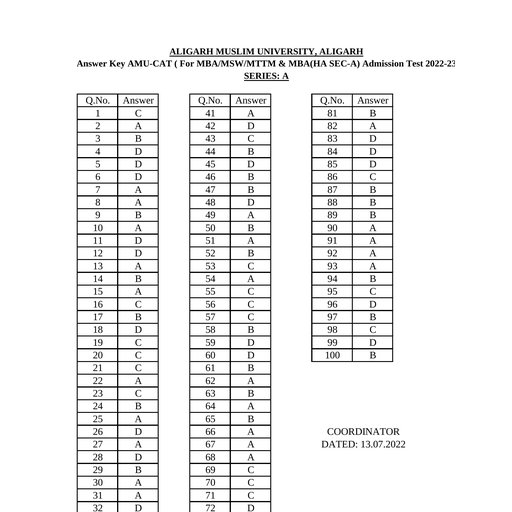
50. A reduction of 20% in the price of salt enabled a purchaser, to obtain 4 kg. more for 100. The reduced price of salt per kg is :, (1) 4 (2) 5 (3) 6.25 (4) 6.50, 51. An increase of 20% in the price of mangoes enables a person, to purchase 4 mangoes less for 40. The price of 15 mangoes, before increase was, (1) 10 (2) 15 (3) 20 (4) 25, 52. A house worth 1,50,000 is sold by X at a 5% profit to Y, Y, sells the house back to X at a 2% loss. Then in the entire, transaction? (1) X gains 4,350 (2) X loses 4,350 (3) X gains 3,150, (4) X loses 3,150, 53. A person sells a table at a profit of 10%. If he had bought, the table at 5% less cost and sold for 80 more, he would have, gained 20%. The cost price of the table is (1) 3,200 (2) 2,500 (3), 2,000 (4) 200, 54. Joseph’s salary is reduced by 10%. In order to have his, salary back to his original amount, it must be raised by, (1) 12.5% (2) 11 1 /9 % (3) 10% (4) 11%, 55. A milk-man sells milk after mixing water to it to such a, extent that water accounts for 20% of the mixture. If he sells at a, mark-up rate of 10%, find his actual profit percentage., 1. 30% 2. 32% 3. 33.33% 4. 37.5% 5. 40%, 56. A shop-keeper purchases 12 dozen eggs. But 1 dozen of, them are rotten and hence he has to throw them away. If he, sells the remaining at a mark-up of 8.33%, find his profit, percentage. 1. No profit No loss 2. 7.28% profit 3. 4.16% profit, 4. 1.44% loss 5. 0.7% loss, FOR COACHING CLASSES OF JMI MBA & AMU MBA,CONTACT - 7042385093
Page 9 :
57. A shop-keeper, unaware that his balance reads 900 gms for, 1000 gms, sells goods at a markup of 20%. Find his actual profit, percentage. 1. 8% 2. 10% 3. 11.11% 4. 12% 5. 12.5%, 58. A shop-keeper purchases his goods from a wholesaler, whose balance reads 1100 gms for 1000 gms. The shop-keeper, then sells his wares after marking up the prices by 10%. Find, his overall profit or loss percentage. 1. 0% 2. 1% loss 3. 1%, profit 4. 215 profit 5. 19% loss, 59. A trader uses a faulty 1 kg weight such that even after, selling his goods at a discounted price of 10% of his rate of, purchase, he manages to make a profit of 10%. Find the actual, weight that the faulty 1 kg weight measures. 1. 1100 gms 2. 900, gms 3. 888.88 gms 4. 800 gms 5. 818.8 gms, 60. In summers, the meter scale of a cloth merchant expands by, 25%. By what percentage should he mark up the cloth so that, even after giving a 10% discount on the list price, the merchant, still makes a profit of 8%?, 1. 20%, , 2. 25%, , 3. 33.33%, , 4. 40%, , 5. 50%, , ANSWERS, FOR COACHING CLASSES OF JMI MBA & AMU MBA,CONTACT - 7042385093