Page 1 :
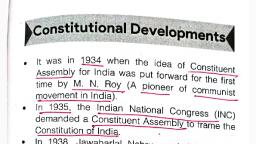
Making of the Constitution, , , , 4 %, M.N. Roy, the First, Person to Put Forward the Idea, , of Constituent Assembly, , « M.N. Roy first time put forward the idea of the Constituent Assembly in 1934., , * In 1935, the Indian National Congress for the first time demanded a Constituent, Assembly to frame the Constitution of India., , « In 1938 Jawahar Lal Nehru declared that the Constitution of free India must be, framed by a Constituent Assembly whose members to be elected based on adult, franchise. It should be free from any external interference., , * In 1940s August Offer the demand got accepted and in 1942 Cripps Mission was, sent to India with a draft proposal on the framing of an independent Constitution, to be adopted after WWII., , + Muslim league rejected the proposal as it demanded two dominion state with two, separate constituent assemblies., , + Later in 1946, the Cabinet mission put forward the idea of a Constituent Assembly, which satisfied both the INC and the Muslim League., , * In November 1946, Constituent Assembly was constituted under the scheme, formulated by the Cabinet Mission Plan., , Constituent Assembly, , , , The Cabinet Mission Plan provisioned for the following scheme for setting up the, Constituent Assembly of India:, , * The total strength of the Constituent Assembly was 389. Of these, 296 seats were, allotted to British India and 93 seats to the Princely States. Out of 296 seats, allotted to British India, 292 members were drawn from the eleven governors’, provinces and 4 from the four chief commissioners’ provinces and one from each., , * Each province and princely state were to be allotted seats in proportion to their, respective population. Roughly one seat was to be allotted for every million, population.
Page 2 :
* The representatives of each community were to be elected by members of that, community in the provincial legislative assembly and voting was to be by the, method of proportional representation using a single transferable vote., , « The representatives of the princely states were to be nominated by the heads of, the princely states., , Thus, under the above provisions, the Constituent Assembly became a partly elected, and partly nominated body. The members were indirectly elected by the members of, the provincial assemblies. It did not present the sentiments of the masses as the, , members of provincial assemblies themselves were elected on a limited franchise., , * The election for 296 seats allotted to the British Indian Provinces was held in JulyAugust 1946. Out of these seats, Indian National Congress won 208 seats, the, Muslim League won 73 seats, and the remaining 15 seats were held by, independent players., , * 93 seats allocated to princely states were not filled as they refrained from the, Assembly., , * Though the assembly did not reflect the mass verdict it had representatives from, every section of the society., , * Mahatma Gandhi was not a member of the Constituent Assembly., , Working of the Constituent Assembly, , , , The Constituent Assembly held its first meeting on December 9, 1946. Muslim League, boycotted the meeting and demanded a separate state of Pakistan. Only 211 members, attended the first meeting., , Dr. Sachchidananda Sinha was elected as the temporary/interim President of the, Assembly, following the French practice. Later Dr. Rajendra Prasad was elected as the, President of the Assembly and both H.C. Mukherjee and V.T. Krishnamachari became, the Vice-President of the Assembly., , Objective Resolution: On December 13, 1946, Jawahar Lal Nehru moved the ‘Objective, Resolution’ in the Constituent Assembly which was unanimously adopted by the, , assembly on January 22, 1947. The important provisions of the Resolution were:, , ¢ This Constituent Assembly declares it's firm and solemn resolve to proclaim India, as the Independent Sovereign Republic and to draw up for her future governance a, , Constitution.
Page 3 :
* Wherein the territories comprising present times British India, the territories that, now form the Indian State and such other parts of India as are outside India and, the States as well as other territories as are willing to be constituted into, independent sovereign India, shall be a Union of them all, , Wherein the said territories, whether with their present boundaries or with such, others as may be determined by the Constituent Assembly and thereafter, according to the law of the Constitution, shall possess and retain with the, residuary powers and exercise all powers and functions of the Government and, , administration implied in the Union or resulting therefrom, , Wherein all power and authority of Sovereign Independent India, its constituent, parts and organs of Government are derived from the people, , Wherein shall be guaranteed and secured to all the people of India justice, social,, economic and political; equality of status of opportunity, and before the law;, freedom of thought, expression, belief, faith, worship, vocation, association and, , action, subject to the law and public morality., , Wherein adequate safeguards shall be provided for minorities, backward and tribal, , areas, and depressed and other backward classes., , Whereby shall be maintained the integrity of the territory of the Republic and its, sovereign rights on land, sea, and air according to justice and the law of civilized, nations., , This ancient land attains its rightful and honoured place in the world and makes, its full and willing contribution to the promotion of world peace and the welfare of, , mankind., , Initially, the representatives of the princely states stayed away from the Constituent, Assembly. On April 28, 1947 representatives of the 6 states became part of the, assembly and after the acceptance of the Mountbatten Plan of June 3, 1947, most of, the other princely states entered the assembly. Later the members of the Muslim, , League from the Indian dominion also joined the assembly., , Changes after the Indian Independence Act, 1947: The act of 1947 made the following, changes:, , * The Assembly became the fully sovereign body and empowered to frame any, Constitution it pleased., , * It became the legislative body. It became responsible to frame the Constitution of, India and enact ordinary laws for the country. Whenever the assembly worked as, the Constitutional body, it was chaired by Dr. Rajendra Prasad and when it met as, a legislative body, G.V. Mavlankar became the chairman (this arrangement, continued till November 26, 1949)., , + Muslim League withdrew from the assembly and it reduced the total strength of, the assembly to 299 from 389. The strength of Indian provinces reduced to 229, from 296 and that of princely states to 70 from 93., , Other Functions performed by the Assembly:, , * Ratified India’s membership of the Commonwealth in May 1949., « Adopted National Flag of India on July 22, 1947., » Adopted National Anthem on January 24, 1950.
Page 4 :
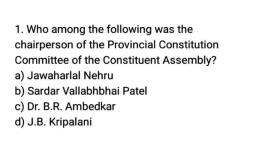
* Elected Dr. Rajendra Prasad as the first President of India on January 24, 1950., , On January 24, 1950, the Constituent Assembly held its final session but continued as, the provincial parliament from January 26, 1950, till the first general elections in 195152 were held., , Committees of the Constituent Assembly, , , , , , , , , , , , , , , , , , , , , , , , , , , , , , , , , , , , , , , , , , , , Committee Headed by, Union Powers Committee J.L. Nehru, Union Constitution Committee J.L. Nehru, Provincial Constitution Committee Sardar Patel, Drafting Committee Or B.R. Ambedkar, Advisory Committee on Fundamental Sardar Patel, Rights, Minorities and Tribal and Excluded, Areas, Fundamental Rights Sub-Committee J.B. Kriplani, Minorities Sub-Committee H.C. Mukherjee, North-East Frontier Tribal Areas and Gopinath Bardoloi, Assam Excluded & Partially Excluded Areas, , Major Sub-Committee, , Committee "Excluded and Partially Excluded Areas AN. Thakkar, (Other than those in Assam) SubCommittee, North-West Frontier Tribal Areas SubCommittee, Rules of Procedure Committee Dr Rajendra Prasad, States Committee (for Negotiation with J.L. Nehru, states), Steering Committee Or Rajendra Prasad, Finance and Staff Committee Or Rajendra Prasad, Credentials Committee A.K. Ayyar, House Committee B. Pattabhi, , Sitaramayya, , Order of Business Committee Or K.M, Munshi, Ad-hoc Committee on National Flag Or Rajendra Prasad, Committee on Functions of the G.V. Mavalankar, , Constituent Assembly, Ad-hoc Committee on the Supreme Court | S. Varadachari, , , , , , , , , , , , , , , , , , , , , , , , Committee on Chief Commissioners’ B. Pattabhi, Minor Provinces Sitaramayya, Committee | Expert Committee on the Financial Nalini Ranjan Sarkar, Provisions of the Union Constitution, Linguistic Provinces Commission S.K. Dar, Special Committee to Examine the Draft J.L. Nehru, Constitution, Press Gallery Committee Usha Nath Sen, Ad-hoc Committee on Citizenship S. Vallabhachari, , , , Drafting Committee, , On August 29, 1947, a Drafting Committee was set up to prepare a draft of the new, Constitution. It was a seven-member committee with Dr. B.R. Ambedkar as the, Chairman of the committee. Other 6 members include:
Page 5 :
Members of the Drafting, Committee, , « N. Gopalaswamy Ayyangar, , « Alladi Krishnaswamy Ayyar, , ¢ Dr. K.M. Munshi, , « Syed Mohammad Saadullah, « N.M. Rau, , « T.T. Krishnamachari, , The first draft prepared by the committee was published in February 1948. The second, draft published in October 1948., , Enactment of the Constitution, , * Dr. B.R. Ambedkar introduced the final draft of the Constitution in the Assembly on, November 4, 1948, for first reading. Second reading held on November 15, 1948,, and the third reading on November 14, 1949., , * The draft was passed on November 26, 1949 (thus, celebrated as the Constitution, day)., , « The Constitution as adopted on November 26, 1949, contained Preamble, 394, , Articles, and 8 Schedules., , TIMELINE OF FORMATION OF, "THE CONSTITUTION OF INDIA', , Formation of the Constitution, , A with ¢+—, , Assembly (n accordance 6 DEC 1946, , The first meeting was held in the, , tutional hall the C I, ODEC 1946 >> [> Sveruarteane cera, person to address - J.B. Kirpalani, , pret peat fe, Comer Mookenes & Constinutional *— 11 DEC 1946, Legal Advisor - B.N.Rau, , An ‘Obj Resolution’ was, nad by eae Nehru, 13 DEC 1946 > |-— ofind constuution wrichroter, became the President of the, Constitution, , Objective resolution, unanimously Adopted *—, , /—+ National Flag Adopted, , , , Achieved In nce India., Split into Dominion of India and, Dominion of Pakistan, Drafting Committee appointed, 29 AUG 1947 with DeBR. Ambedkar as the, airman.