Page 1 :
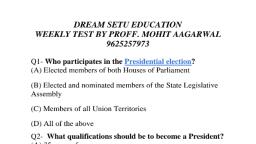
1. Which Article of the Indian Constitution says that there shall be a President of, India?, (A) 61, (B) 62, (C) 52, (D) 74, Answer C, Explanation: Article 52 to 78 in Part V of the Constitution deal with the Union, Executive. According to Article 52, India shall have a President., 2. Who participates in the Presidential election?, (A) Elected members of both Houses of Parliament, (B) Elected and nominated members of the State Legislative Assembly, (C) Members of all Union Territories, (D) All of the above, Answer A, Explanation: In the Presidential election, elected members of both houses of, parliament, elected members of the state legislature and only elected members of, Delhi and Puducherry Legislatures participate., 3. What qualifications should be to become a President?, (A) 35 years of age, (B) He should be eligible to be elected as a member of Rajya Sabha., (C) Must be an Indian citizen, (D) Only a and c, Answer D, Explanation: To become President of India, candidate must be 35 years old, must be, an Indian citizen and should be eligible to be elected as a member of Lok Sabha., 4. Which of the following statements is wrong?
Page 2 :
(A) Elected and nominated members of the State Legislative Assembly participate in, the presidential election., (B) The Union Executive includes the President, Vice President, Prime Minister,, Attorney General of India, (C) Impeachment may be initiated against the President for 'breach of constitution', (D) Article 56 envisages the tenure of the President, Answer A, Explanation: Only elected members of the State Legislative Assembly participate in, the presidential election, nominated members do not participate., 5. Which of the following is not matched?, (A) Article 54: Presidential election, (B) Article 55: manner of presidential election, (C) Article 60: Procedure for impeachment of the President, (D) Article 123: Power of the President to promulgate ordinance, Answer C, Interpretation: Article 60 is related to oath and affirmation of the President., 6. Which article of Indian constitution envisages that there shall be an Attorney, General of India?, (A) Article 78, (B) Article 76, (C) Article 67, (D) Article 113, Answer B, Interpretation: Article 76 envisages that India shall have an Attorney General., 7. How can the post of President be vacant?, (A) On expiry of his tenure
Page 3 :
(B) By his resignation, (C) Only on the commencement of impeachment in Rajya Sabha, (D) Only a and b, Answer D, Explanation: The post of the President will be vacant in the following ways: upon the, expiry of the tenure, on giving the resignation letter and the completion of the, impeachment process in the Parliament., 8. Which of the following statements is not correct?, (A) President is the head of military forces of India, (B)President can appoint a commission to investigate into the conditions of SCs and, STs., (C) Parliament can declare any area as scheduled area, (D) President of India chooses the chairman of the Finance Commission, Answer C, Explanation: President of India can declare any area as schedule area., 9. In which of the following article provision of National Emergency is, mentioned?, (A) Article 356, (B) Article 352, (C) Article 360, (D) Article 365, Answer B, Explanation: Article 352 envisages the National Emergency in the country., 10. Impeachment of the President can be initiated in............., (A) Only in Lok Sabha, (B) Only in Rajya Sabha
Page 4 :
(C) In either house of Parliament, (D) Supreme Court, Ans. C, Explanation: The impeachment charges against President can be initiated in either, house of Parliament.