Page 1 :
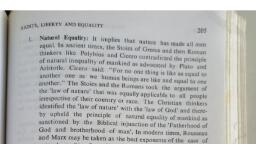
model Ura mewear sucIeLy and in con, i 2 st Y, , gud oO nomi system free from Metot desires ;, , man in any form. It means that i nitation Me, aasure the boons of equality to its i,, , uise of equali Ss Me, , oe Sepelat tHe ter ” the individ, , cra rmal or the | £eNeral, houroan:, , Cge » DOUrgeois demo, 4 the proletarian, tl Hy dual, an p Ne exploiter and the Hela ' inert, €d, thereby, grossly, , receiving the oppressed classes,**99, Relationship between Liberty liha Rods, , wotlk Subjece’ or félationship it aratt Now Wwe turn to the most, dificulty, in this direction, arises Henk the liberty and equality. The, ing, the glorification of liberty Sheetal he that, historically speak., recent times many thinkers can be seen wits a equality and until, position to the former. For instance sndild Ge a eae, of liberty were not coupled with the notin of ad - a, were free in Slave societies. Though the Stoics out wr i a, of natural equality of mankind, it received Ped 2 \ pie, over, ee thinkers like Polybius and Cicero of the Roan ae, MN REE. wilh th chaning conditios of the engin, The whim of difference between a ee caitanil sa ‘a, re and subs, equently between a Roman and a non-Roman continued until, Christianity became the official religion that preached the doctrine of, Fatherhood of God and brotherhood of man’., Liberty remained a privilege of the aristocratic section of the, Soviety. A great social contractualist like John Locke described tiberty, %a natural right, but he excluded the case of right to equality. It is, , the American Declaration of Independence of 1776 that, for the first, d that saw its shining repeti, time, incorporated the idea of equality an saw Ne, in the slogan of ‘Liberty, Equality, Fraternity during the days of, Tench Revolution of 1789. Since then the relationship between liberty, , ‘nd equality has been a matter of controversy that s, two sides:, "snd equality are incompatible, , 1. The negative view js that liberty, , mbers,, uals in, , , , , Pe Lenin: Collected Works, Vol. 31, p. 145,
Page 2 :
212, , nr, , , , , , , , , , , , , , , , , , , , , a, , PRINCIPLES OF MODERN POLITICAL SCIEN,, , ke strong], Matthew Arnold spo! rongly, rhe attitude of equality with the gp:, , . ignity of man as man which, ty and a sense of digni a, pene of a true civilised society. Lord Birkenhead, , that the doctrine that ‘all men are equal is @ poisonous, doctrine. Sir Ernest Benn writes that economic equality js :, , terms. An English poe, the incompatibility ©, , . ‘ Hitiey? 0 Tt is based on the Aristotelian, ‘scientific impossibility’. ; ,, activ’ that mankind are unequal by nature, that equals should, , be treated equally and unequals aneqeery *, protagonist of this view like F.A. Hayek = From the t, that people are very different, it follows that if we treats, equally, the result must be inequality in their actual Position,, and that the only way to place them in an equal po, would be to treat them differently.”"*? Lord Acton of En, and Alexis de Tocqueville of France subscribe to the, view that liberty is a privilege of the few that cam, reconciled with the liberty of all that means equality. A, American writer says that equality “can be reached only, massive external intervention in people's live.”? The >, such an affirmation can be traced in the interpretation that, Pursuit of equality has in practice led to inequality, tyranny. Bringing about a condition of equality results im!, coercion of the many at the hands of the few. “A sq ciety, which the choices fundamental to human existence are, ar ann ‘aot oa tana, equality,”"7s choot Detect in, be i view takes liberty and equality as cc, Was reiterated by the Stoics and the Roman, , mation, Hobhouse gar” Bands of many positive liberals, For inst, , ; Says that ‘liberty without equality is a ;, lyst with squalid results’, In the oe °y, Sure of equality, so far from being inimical |
Page 3 :
PRINCIPLES OF node potion SCIENCE, , a8 : enting over the ‘relj, liberty, is essential to it. While 5 “accepted the mona, . ey? s that the peop ;, , of inequality’, he say karakia (a magical influence) of sociaj, mysterious wisdom) and as same way that primitive people, , and economic inequality 5 : iety. There is no rational justi, accepted - nee i priate its survival is a matter of pre., , ion for so cae iia, , jodice"" So says Barker: “It remains to add ot cota, , not an isolated principle. It stands by the princip’, and fraternity.””® : a, eee. inci aim of normative, a Pe ae a. : nd pelle i eal relating to the, , political theory is to seek and analyse the he ideals, , development of human personality, it is required that the i ay, , liberty and equality should have a simultaneous flow despite a, , that in terms of historical evolution the latter is older than, and, matter now outshone by, the former. Both are necessarily Onn, with the supreme worth and dignity of human personality and {, spontaneous development of its capacities.. The modern:, prepared to tolerate that the boons of liberty and with that of e, remain confined to the world of the ‘peers’. While parap, ideas of Laski, Deane says: “‘Liberty and equality are not i, nor even separate, but are different facets of the same ideal..., since they are identical, there can be no problem of law |, extent they are or can be related to. This is surely the neat, , the most satisfactory, solution ever devised for a, in political philosophy,”76 F, , ke ot, Pepa eas,