Notes of passout batch, Physics 7. general 2d 3d projectile - Study Material
Page 2 :
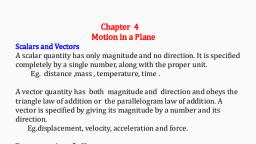
Kinematics Section 2 : MOTION IN,2&3DIMENTION, Some definition to specify motion in 2d & 3d, Displacement vector:, , z, , A particle is at location A (xo, yo, zo) at t = 0. It moves the position, B (x,y,z) in time, , (t = 0), A (xo, yo, zo), , Position vector at t = 0 is ro x o ˆi yo ˆj zo kˆ, Position vector at t = t is r xiˆ yjˆ zkˆ, , r, , ro, , The displacement vector in this interval will be, r r ro, , B (t = t), (x, y, z), , r, , y, , O, x, , Velocity vector:, Instantaneous velocity vector:-:, ., , Instantaneous velocity at that instant of time t = lim t 0, Average velocity vector of the trip -: =, , , r, t, , , displaceme nt vector of the body ( s ), total time taken by thebody (t ), , Change in velocity Vector vector: v : It is a vector quantity. It is specified, for an interval. Let the interval be AC. A is the initial point where the, , velocity vector is v A and C is the final point where the velocity vector is, , vA, , , v C . Change in velocity vector is defined as:, , v AC, , vA, A, C, , , , , *, v final vinitial vC v A, , v AC, , vC, , vC, vA, , Acceleration vector:, (a) Instantaneous acceleration, ation vector: We talk of the instantaneous acceleration at the dot position or at the dot time instant., v dv, Instantaneous acceleration vector for motion is defined as, a lim, , t 0 t, dt, (b) Average acceleration vector: It is specified for an interval., v vfinal vinitial, Average acceleration vector, a, , * for general motion, t, t, , Here V is velocity in vector form(unit vector notation),Direction of average acceleration is same as direction of v ., Note: The change in the vector velocity can be the change either in magnitude or in direction or both., , Again 2 & 3 Dimensional motion is discussed in two categories:, 1. Uniform Motion (constant speed motion), If a body is covering equal length along the path in equal interval of the time the motion of the body is, called uniform motion, , Formula used:, , , , , , Displacement ( s ) = velocity ( v ) X Time (t)
Page 3 :
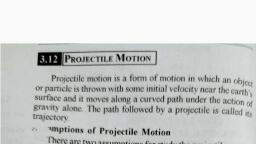
2. Non uniform motion (variable speed motion), If a body is not covering equal length in equal interval of the time the motion of the body is called non uniform, motion. This can further classified, i) Uniformly Accelerated & Retarded motion, ii)General approach of Straight line Motion, , i)Uniformly Accelerated & Retarded motion, Here a a x iˆ a y ˆj a z kˆ, ax, ay, az must be constant, Equations of motion, , v u at, 1, S u t at 2, 2 , , v v u u 2a s, , 1, Sth u a (2t 1), 2, , ii) General approach of 1D 2D & 3D Motion, General approach to discuss a motion includes all previous types of motion (uniform motion & accelerated motion) & now, we will discuss it for three dimensional motion i.e. now we are discussing most general form of motion., General motion in coordinate system:, A particle is at location A (xo, yo, zo) at t = 0. It moves the position B (x,y,z) in time at any general time t = t along a curved, path. Here x = f(t), y = f(t), z = f(t)., Instantaneous velocity at t = t:, dr d ˆ ˆ ˆ, v, (xi yj zk), dt dt, , dx dy dz , v ˆi ˆj kˆ, dt dt dt , , v v x ˆi v y ˆj vz kˆ, , Where v x , , dx, dy, dz, , v y , vz , dt, dt, dt, , | v | v2x v2y v2z = instantaneous speed, , PROJECTILE MOTION, y, , B, , By, , vAsin, , vA, , vA sin, A, , Ay, , , , vB, , vAcos, C, , Cy, u sin , , u, , vC sin, , , , vCcos, vC, , , u cos Ax, , O, For horizontal component:, Vx= u cos, ax=0, For vertical component:, Vx= u Sin, ay=0, ., , vAcos, , Bx, , Cx, , D, , x
Page 4 :
To find time of flight (Tf):, OBy : u = +u sin, s = 0, a = g, 0, 1, By s ut at 2 …, 2, , 0=+u sin.t-, , Tf , , 1, 2, gT f , 2, , 2uSin, g, For vertical motion: +ve, , To find maximum height (H):, OBy : u = +u sin, s = H, a = g, v = 0., , By equation, v² = u² + 2as 0 = u² sin² 2g H , , H max , , u 2 sin 2 , 2g, , To find range (R):, For horizontal motion: R = u cos. Tf, , , , 2u sin , R u cos , g, , R, , , , u 2 sin 2, g, , Note: All the above three formulae are valid only for ground to ground projectile., For R = R1, let = 1, u 2 sin 2, R1 , g, Keeping u fixed, let = 90 1 where the range is R = R2, u 2 sin 2(90 ), R2 , g, u 2 sin 2, u 2 sin(180 2 ), , , R2 = R1, R2 , g, g, Note: Thus, for a given range (< Rmax), there are two possible values for the angle of projection. If one value is 1, another is, (90° 1), that is, they are complementary angles provided the initial speed of projection is same., , , , R2 , , Equation of trajectory: t, , y x t an , , gx2, 2u2 cos 2 , , This is the equation of trajectory (equation of, , Different types of projectiles under gravity:, I) A ball is projected horizontally with initial velocity u from height H from the g, ground. Find the total time of flight (Tf) and the horizontal range (R)., For vertical motion: +ve, u = 0, a = +g, s = +H, t = Tf, 1, 1, By s ut at 2 H 0 Tf gTf2, 2, 2, , +ve, , , , Tf , , , , g, , g, , H, , g, g, , 2H, g, , 2H, g, II) A ball is projected with initial velocity u at angle with, the horizontal from height H from the ground. Find the, total time of flight (Tf) and the horizontal range (R)., , R = u × Tf, , u, , R, , Ru, , For vertical motion: +ve, u = +u sin, a = g, s = H, t = Tf, 1, By s ut at 2, 2, 1, H u sin Tf gTf2, , 2, , u, Initial, point, , , , g, , g, , , , g, , g, , u, +ve, , S, , Final, point, , H, , H, , g, , g, R
Page 5 :
III) A ball is projected with initial velocity u at angle with the vertical from height H from the ground. Find the total, time of flight (Tf) and the horizontal range (R)., u, , For vertical motion: +ve, g, u = +u cos, a = +g, s = +H, t = Tf, +ve, g, H, 1 2, g, By s ut at, 2, g, 1 2, , H u cos Tf gTf, g, 2, R, , OVERVIEW & PROBLEMS, , General 2D 3D tools, , 1. Suppose a body has an initial velocity of 30ms-1 along, horizontal direction. If the body is moving with a, constant acceleration of 10 ms-2 whose direction is at, 1350 with the horizontal, then calculate (i) velocity and, (ii) displacement of the body after 5 seconds., 2. A body present at the origin starts moving from, the state of rest on the straight line y = x , under, constant Acceleration of 2 m/s2. What is the, velocity vector of the body after 2 seconds from, the starting of the motion., 3. A particle moves in the X-Y plane with a constant, acceleration of 1.5 m/s² in the direction making an angle, of 37º with the X-axis. At t = 0 the particle is at the, origin and the velocity is 8 m/s along the X-axis. Find, the velocity and position of the particle at t = 4s.
Page 6 :
4. The initial velocity of a body is 10ms-1 in the north-east, direction and it moves under the action of an acceleration, of 2 ms-2 directed towards south. Find out the magnitude, and direction of the velocity of the body after 3 s., [ Ans: the velocity of the body after 3 s is 7.2 ms-1 at an, angle of 80 north of east.], 5. A body is moving towards east with a velocity of 20m/s., Find the magnitude and direction of the acceleration to, be given to the body so that it may attain a velocity of 20, m/s towards north in one second., [ Ans: An acceleration of 28.4 m/s2 should be, produced in the body from north to 450 west ], 6. A body is moving under the action of multiple, velocity vector given by the following relation, V1 = 2i + 3j + 5k, 0 ≤ t ≤ 2 sec, V2 = -1i + 3j + 0k, 2 sec ≤ t ≤ 4 sec, Find out the overall displacement vector if initially, the body was at the origin. What is the overall, average velocity vector., 7. A body moves on following velocity vector, V1 = 3i + 2j -7k, 0 ≤ t ≤ 3 sec, V2 = 4i – 1j + 4k, 3 sec ≤ t ≤ 5 sec, V3 = ai + bj + ck, 5 sec ≤ t ≤ 7 sec, Find out the value of a, b and c, if the body at t = 7, sec. reach the starting point., 8. A body is moving on the straight line y = 3x at a, constant speed of 3 m/s. What is the velocity of the, body., 9. At time t = 0 sec, body is moving with velocity 1i +2j., After 2 seconds, The velocity vectorbecomes 3i + 4j., What is the average acceleration vector of the body., 10. A body present at the origin starts moving from, the state of rest on the straight line y = x , under, constant Acceleration of 2 m/s2. What is the, velocity vector of the body after 2 seconds from, the starting of the motion, ˆ m/s., 11.Velocity of a particle at any time t is v (2iˆ 2tj), Particle is at origin at t = 0 Find acceleration and, displacement of particle at t = 1 s., 12 Velocity and acceleration of a particle at time t = 0 are, ˆ m/s and a (4iˆ 2j), ˆ m/s2 respectively, u (2iˆ 3j), where the particle is at the origin., 13. A particle moves so that its position as a function of time, , in SI units is r = î +4t² ĵ + t k̂ . Write expressions for (a), its velocity and (b) its acceleration as functions of time., 14. The variation of the x and y coordinate of a, particle moving in xy plane is as following x = t2, & y = t2 +t4 , where ‘a’ and ‘b’ are constant., (a) Find the path of the body., (b) Instantaneous velocity vector., (c) Instantaneous acceleration vector., (d) The average velocity and acceleration vector, on the time interval t = 0sec to t = 2 sec., 15.A particle starts from a point, Y, A and travels along the solid, A, 4m, curve shown in the figure., Find approximately the 2m, position B of the particle, such that the average 0, X, 2m, , 4m, , 6m, , velocity between the positions A and B has the same, direction as the instantaneous velocity at B., [Ans: x = 5 m , y = 3 m], , Single choice questions :(Level 0), 16. A particle starts from rest at the origin with a, , constant acceleration a 2iˆ 8 ˆj 6kˆ m / s 2, Its position at t = 5 s is, , ˆ, ˆ, ˆ, (a) (25i 100 j 75k )m, (b) (25iˆ 100 ˆj 75kˆ)m, (c) (100iˆ 25 ˆj 75kˆ)m, (d) (25iˆ 100 ˆj 75kˆ)m, , 17. The initial velocity of a particle, u 4î 3 ĵ . It is, , moving with uniform acceleration, a 0.4î 0.3 ĵ . Its, velocity after 10 seconds is, (a) 3 units (b) 4 units (c) 5 units (d) 10 units, 18. A particle is moving east-wards with a velocity of 15, m/s. In a time of 10 seconds, the velocity changes to 15, m/s north-wards. Average acceleration during this time, is, in m/s²., 3, (a), north-east, (b) 3 2 north-east, 2, 3, (c), north-west, (b) 3 2 north-west, 2, 19. A particle moves in the x-y plane according to the, equation x = 4t2 + 4t + 5 and y = - t3 + 12t + 3. At t = 1, s, the acceleration of the particle is, (a) 15 m/s2, (b) 5 m/s2 (c) 20 m/s2 (d) 10 m/s2, 20. The path of the particle is described by x = 5t2, + 2t +3, y = t + 4, z = 2et x, y and z are measured, in metres and t is measured in seconds. The, acceleration of the particle at t = 2 s is, , (a) 2e 2 iˆ 10kˆm / s 2, , ˆ, , (b) 10iˆ 2e 2 kˆm / s 2, , (c) 10iˆ 2 ˆj e 2 kˆm / s 2 (d) iˆ e 2 ˆj e 2 kˆm / s 2, 21. The co-ordinates of a moving particle at any time t are, given by x = t3 and y = t3. The speed to the particle at, time t is given by, (a) 3t 2 2, (c) t 2 2 2, , (b) 3t 2 2 2, (d), , 2 2, , 22. A particle has an initial velocity of 3iˆ 4 ˆj and an, acceleration of 0.4 iˆ 0.3 ˆj. its speed after 10 s is:, (a) 7 2 units, units, , (b) 7units, (d) 10 units, , Projectile motion:, , (c) 8.5
Page 7 :
1.A ball is thrown at a speed of 40 m/s at an angle of 60°, with the horizontal. Find, (a) the maximum height reached and, (b) the range of the ball. Take g = 10 m/s²., [ Ans: (a) 60 m (b) 80 3 m ], 2. The trajectory of a projectile in a vertical plane is, y= x bx 2 ,where , b are constant ,and x and y are, respectively the horizontal and vertical distances of, the projectile from the point of projection. The, maximum height attained is... and the angle of projection, from the horizontal is......., IIT 1987-Screening][Ans: a2/4b , θ= tan-1a ], 3. A cricketer of height 2 m throws a ball at an angle 30°, with the horizontal such that it is received by another, cricketer of same height standing at a distance of 50 m, from the first one. Find the maximum height attained by, the ball from the ground level., [, Ans: 2+, , 12.5, , ], , 3, 4. A ball is projected from a point on the floor with a speed, of 15 m/s at an angle of 60° with the horizontal. Will it, hit a vertical wall 5 m away from the point of projection, and perpendicular to the plane of projection without, hitting the floor? Will the answer differ if the wall is, 22m away., [ Ans: Yes , Yes ], 5. A staircase contains three steps each 10 cm high and 20, cm wide. What should be the minimum horizontal, velocity of a ball rolling off the uppermost plane so as to, hit, directly, the, lowest, plane., [ Ans: 2 m/s ], 6. A batsman hits a ball from the ground level with initial, , velocity u = 20 î + 10 ĵ m/sec (i) Find the velocity of, the ball at t = 1 sec, from the instant of projection (g = 10, m/s²). (ii) Find the velocity of the ball when it is at a, height of 3.2 m from the ground level., [, Ans: (i) 20iˆ (ii) 20iˆ 6 ˆj ], 7. A boy throws a stone with an initial speed of 10 m/s at an, angle of 30° to the horizontal (i) find the position vector, of the stone with respect to the point of projection at t =, 0.5 sec. (ii) Find the average velocity of the stone in this, time interval. (iii) Find the change in velocity during this, time., 8. A bomb is released from an aeroplane flying with a, horizontal velocity of 100 m/s at an altitude of 1 km.(a), What is the range of the bomb. (b) What is the, displacement during the time of its flight? (b) Find the, average velocity (d) What is the equation of trajectory of, the bomb. (e) What is the final velocity (magnitude and, direction) with which it hits the ground., 9. A body is projected from ground such that the position, , vector varies with time as r = 6t î + (8t5t²) ĵ m. Find, the (a) initial velocity of projection (b) time of flight and, (c) range of the projectile., 10. A person standing on the top of a cliff 171 ft high has to, throw a packet to his friend standing on the ground 228, ft horizontally away. If he throws the packet directly
Page 8 :
aiming at the friend with a sof 15 ft/s, how short will the, packet fall., [ Ans: 192 ft ], 11. A boy standing on a long railroad car throws a ball, straight upwards. The car is moving on the horizontal, road with an acceleration of 1 m/s² and projection, velocity in the vertical direction is 9.8 m/s. How far, behind the boy will the ball fall on the car., [ Ans: 2 m ], 12.A relief aeroplane is flying at a constant height of 1960 m, with speed 600 km/hr above the ground towards a point, directly over a person struggling in flood water as shown, in the figure. At what angle of sight, should the pilot, release a survival kit if it is to reach the person in water., (g = 9.8 m/s²), [ Ans: Φ = 600, ], 13.A, particle, is, A, thrown over a, vertical triangle, Φ, from one end of a, h, horizontal base, and grazing the, vertex falls on the, P, x, other end of the, base. If and , be the base angle and the angle of projection, prove, that tan = tan + tan ., , Single choice questions :( Level 0), 14. In a projectile motion the velocity:, (a) is always perpendicular to the acceleration, (b) is never perpendicular to the acceleration, (c) is perpendicular to the acceleration for one instant only, (d) is perpendicular to the acceleration for two instants., 15. A boy throws a ball with a velocity V0 at an angle α to, the ground. At the same instant the starts running with, uniform velocity to catch the ball before it hits the, ground. To achieve this, He should run with a velocity, of., (a) V0 cos2 α (b) V0 Sin α (c) V0 cos α(d) )V0 cot α, 16. The velocity at the maximum height of a projectile is half, of its initial velocity u. Its range on the horizontal plane, is, , 3u ², 2u ², 3u ², u², (b), (c), (d), 3g, g, 3g, 2g, 17. Which of the following is the essential, characteristic of a projectile?, (a) initial velocity inclined to the horizontal, (a) zero velocity at the highest point, (b) constant acceleration perpendicular to the velocity, (c) none of the above., 18. Two bullets are fired at angles and (90) to the, horizontal with the same speed. The ratio of their time of, flights is, (a) 1:1, (b) tan : 1 (c) 1:tan, (d) tan² : 1., 19. In the above qustion, the ratio of their maximum, vertical heights is., (a) 1:1, (b) tan : 1 (c) 1:tan (d) tan²:1, 20. The time of flight of a projectile is maximum when the, angle of projection is, (a) 90°, (b) 60°, (c) 45°, (d) 30°, (a), , 21. Which of the following remains constant for a, projectile fired from the earth?, (a) kinetic energy (b) horizontal component of velocity, (c)momentum (d) vertical component of velocity., 22. The range of a projectile fired at an angle of 15°, is 50 m. If it is fired with the same speed at an angle, of 45°, its range will be, (a) 25 m, (b) 37 m, (c) 50 m, (d) 100 m, 23. Two projectiles A and B are projected with angle of, projection 15° for the projectile A and 45° for the, projectile B. If RA and RB be the horizontal range for the, two projectiles, then, (a) RA < RB, (b) RA = RB, (c) RA > RB, (d) the information is insufficient to decide the relation, of RA with RB, 24. Two bullets are simultaneously, horizontally and, with different speeds from the same place. Which, bullet will hit the ground first?, (a)the faster bullet (b) both will hit simultaneously, (c)the slowest bullet (d) depends on the mass, 25. A body is thrown horizontally with velocity [2gh] from, the top of a lower of height h. It strikes the level ground, through the foot of the tower at a distance x from the, tower. The value of x is, (a) h, (b) h/2, (c) 2h, (d) 2h/3, 26. A particle is projected from the ground with initial, velocity 20 m/s at an angle 300 with horizontal. The, magnitude of change in velocity in 0.5 second is (g = 10, m/s²), (a) 5 m/s, (b) 2.5 m/s (c) 2 m/s, (d) 4 m/s, 27. A particle is given an initial velocity of î 2 ĵ . The, cartesian equation of its path is (g = 10 m/s²), (a) y = 2x 5x², (b) y = x5x², (c) 4y=2x5x², (d) y = 2x25x², [Here î is the unit vector along horizontal and ˆj is unit, vector vertically upwards], 28. If a man wants to hit a target, he should aim his rifle is in, a direction:, (a) higher than the target, (b) lower than the target, (c) of the target, (d) any of above, 29.If a body A of mass M is thrown with velocity v at an, angle 30° to the horizontal and another body B of same, mass is thrown at an angle of 60° to the horizontal, the, ratio of range of A and B will be, (a) 1:3, (b) (3): 1, (c) 1:3, (d) 1:1, 30. Two particles are projected upwards with the same initial, velocity vo at two different angles of projection such that, their horizontal ranges are the same. The ratio of the, heights of their highest points will be, (a) tan² 1 (b) vo sin 1 (c) vo/cos 1 (d) vo² sin² 1, [where 1 is the angle of projection of the first particle], 31. An aeroplane moving horizontally with a speed, of 180 km/h drops a food packet while flying at a, height of 490 m. The horizontal range is, (a) 180 m (b) 280 m (c) 500 m, (d) 670 m, 32.Which of the following quantity is maximum,, when the height attained by the projectile is, maximum?, (a) range, (b) time of flight
Page 9 :
(c) angle of projectile with the vertical, (d) none of the above., 33.A projectile is thrown at an angle of 40° with the, horizontal and its range is R1. Another projectile is, thrown at an angle of 40° with the vertical and its, range is R2. What is the relation between R1 and R2?, (a) R1 = R2 (b) R1 = 2R2 (c) R2 = 2R1 (d) R1 = 4R2/5, 34. A ball is thrown horizontally from the top of a, tower. What happens to the horizontal, component of its velocity?, (a) increases, (b) decreases, (c) remains unchanged, (d) first decreases and then increases., 35. A ball is projected from the top of a tower at an, angle 60° with the vertical. What happens to the, vertical component of its velocity?, (a) increases continuously (b) decreases continuously, (c) remains unchanged, (d) first decreases and then, increases, 36. A man has two spheres A and B. He is standing at the, top of a tower. He gently drops the sphere A vertically, downwards and throws the sphere B, horizontally at, the same time. Which of the, following is the, correct statement?, (a) both the sphere reach the ground simultaneously, (b) sphere A reaches the ground earlier, (c) sphere B reaches the ground earlier, (d) the question is incomplete because the masses of, the spheres are not given., 37. A ball whose kinetic energy is E, is projected at an, angle of 450 to the horizontal. The kinetic energy of, the ball at the highest point of its flight will be, (a) E, (b) E / 2, (c) E/2, (d) zero, 38. From a building two balls A and B are thrown such, that A is thrown upwards and B is thrown, Downwards (both vertically). If vA and vB are their, respective velocities on a reaching the ground, then, (a) vB > vA, (b) vA = vB, (c) vA> vB, (d) their velocities depend on their masses., 39. A boy playing on the roof of a 10 m high building, throws a ball with a speed of 10 m/s at an angle of, 30 with the horizontal. How far from the throwing, point will the ball be at the height of 10 m from the, ground? [g = 10 m/s2, sin 30 = ½, cos 30 = 3/2], (a) 5.20 m (b) 4.33 m (c) 2.60 m (d) 8.66 m., 40. A projectile can have the same range R for two, angles of projection. If T1 and T2 be the time of, flights in the two cases, then the product of the two, time of flights is directly proportional to, (a) R, (b) 1/R, (c) 1/R2, (d) R2, 41. A ball is thrown from a point with a speed ‘v0’ at an, elevation angle of θ. From the same point and at the, same instant, a person starts running with a constant, ', , speed, , ', , v0, to catch the ball. Will the person be able, 2, , to catch the ball? If yes, what should be the angle of, , projection θ?, (a) No, (b) Yes, 300 (c) Yes, 600 (d) Yes, 450, 42. A particle is projected at 600 to the horizontal with a, kinetic energy K. The kinetic energy at the highest, point is, (a) K/2, (b) K, (c) zero, (d) K/4, 43. The maximum range of a gun is 16km. If g=10m/s2., What must be the muzzle velocity of the shell, (a) 200 m/s (b) 400 m/s (c) 100 m/s (d) 50 m/s, 44. A stone is just released from the window of a train, moving along a horizontal straight track .The s\tone will, hit ground following, (a) Straight path, (b) Circular path, © Parabolic path, (d) Hyperbolic path, 45. A bomber plane moves horizontally with a speed of, 500m/s and a bomb released from it, strikes the ground, in 10sec. Angle at which it strikes the ground will be (g, = 10 m/s2 ), , 1, 5, , 1, 5, , (a) tan- (b) tan , , (c) tan-1(1), , (d) tan-1(5), , 46. The angle of projection at which the horizontal range, and maximum height of projectile are equal is, (a) 450, (b) = tan-1 (0.25), -1, 0, (c) = tan 4 or ( =76 ), (d) 600, 47. Aparticle of mass m is projected with velocity v making, an angle of 450 with the horizontal .The magnitude of the, angular momentum of the particle about the point of, projection when the particle is at its maximum height is, (where g = acceleration due to gravity), (a) Zero, 3, , (b) m v3 /( 4, , 2g), , 2, , ( c) m v /( 2 g), (d) m v /2g, 48. If two bodies are projective at 300 and 600 respectively,, with the same velocity, then, (a), Their ranges are same, (b), Their height are same, (c), Their times of flight are same, (d), All of these, 49. A ball is projected with velocity V 0 at an angle of, elevation 300 . mark the correct statement, (a) Kinetic energy will be zero at the highest point of the, trajectory, (b) Vertical component of momentum will be conserved, (c) Horizontal component of momentum will be conserved, (d) Gravitational potential energy will be minimum at the, highest point of the trajectory, 50. The maximum horizontal range of a projectile is 400. the, maximum value of height attained by it will be, (a)100m, (b)200m, (c)400m, (d)800m, , ..........by Praveen Gupta



 Learn better on this topic