Page 2 :
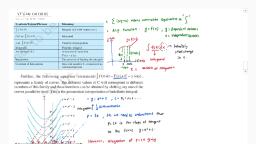
CALCULAS FOR PHYSICS, FORMULAE FOR DIFFERENTIATION:, 1., 3., , 5., 7., 9., , d, (sin x) cos x, dx, d, (tan x) sec 2 x, 4., dx, d, (sec x) sec x. tan x, 6., dx, d x, (e ) e x, 8., dx, , d n, ( x ) nx n 1, dx, d, (cos x) sin x, dx, d, (cot x) cos ec 2 x, dx, d, (cos esx ) cos ecx. cot x, dx, d, 1, (log e x) , dx, x, , 2., , Questions on Differentiation:, BASED ON FORMULAS & CHAIN RULE:, Differentiate the following:, 1, 1 x 5. 2 , 3 ,, 3. px2 + gx + r, 4. x-5 +3 loge x + 7ex + 2x, x, , 5) Cos Sinx 6logSinx 7 logSinCosx, , 8) (2x+1)3 (9) (2x2+1)3, MULTIPLICATION OF TWO FUNTIONS:, , Differentiate the following :, 1. x ex, , 2. ex sin x, , 4. xn logx, , 3. sin x log x, , 5. x ex sin x, , Answers :, (1) [ Ans: ex (x + 1) ] (2) [ Ans: ex (sin x + cos x) ], , (3)[ Ans: cos x. log x , , sin x, ], x, , (4) [ Ans: xn-1 ( n log x +1) ], , (5)[ Ans: ex ( sin x + x sin x + x cos x ) ], , DIVISION OF TWO FUNTIONS:, , Differentiate the following:, ex, 1, 1., 2., sin x, x, , 3., , 1, cos x, , 4., , sin x, cos x, , 5., , x, sin x, , 6., , x 1, x 1, , Answers :, (1)[ Ans:, , e x ( x 1), ], x2, , (3)[ Ans: secx tanx ], , (2)[ Ans: - cosec x cot x ], (4)[ Ans: sec2 x ], , (5)[ Ans:, , sin x x cos x, ], sin 2 x, , (6)[ Ans:, , 2, ], (1 x) 2, , --------------------------------------------------------------------------------------------------------------------------------------------------y y=f(x), tangent, GEOMETRICAL MEANING OF THE DERIVATIVE :, slp=dy/dx = tan, , 1. The derivative at a point P of a curve is the slope of the tangent to the curve at the point P., , dy, Slope tan θ of graph gives: Rate of change of y w.r.t x: Mathematically termed as, dx, Example:, , , , x
Page 3 :
Rate of displacement(s) w.r.t. time(t) is called velocity(v) in physics, , ds , , dt , , dv , Rate of velocity (v) w.r.t. time(t) is called Acceleration in physics , dt , dP , Rate of momentum(P) w.r.t. time is called Force(F) in physics , , dt , dU , Rate of change of potential (U) energy w.r.t. position r givers force , , dr , d , -ve of rate of change of flux gives Emf, , dt , -ve of rate of change of current multiply inductance gives induced emf, , di , L , dt , , Questions based on Maxima & Minima:, Find all the points of maxima and minima of the following functions, , Maximum value & Minimum value of the quantity:, , such question in physics are generally asked only when a finite maximum or minimum is, possible for a finite x, Example quantity containing tichonometric function, Congaing single algebric variable y=F(x), dy, 0, Using, dx, Get x for which y is max or min, Put value of x in function y=F(x) to get maximum or minimum, Examples, 1 . f ( x) x 3 6 x 2 9 x 8 ., [ Ans: at x = 1 is a point of local maximum, maximum value -6 x = 3 is a point of local minimum ,, minimum value -46], 2. Let f ( x) x 3 9 x 2 24 x 12 .[ Ans: at x 2 , maximum, maximum value 8 , for x 4 , minimum ,minimum, value 4 ], 3.x3 – 2x2 + x + 6, 4.2x3 – 15 x2 + 36x + 16, 5. (x – 1) (x – 2)2, , [ Ans: at x = 1/3 & x = 1 per minimum value 6 ], [ Ans:at x = 2 maximum value 44 & x = 3 per minimum value 43 ], , b, . Find the value of maximum & minimum., x, [ Ans: Maximum value 2 (ab) & minimum value 2 (ab) ], , 6. y ax , , INTEGRAL CALCULAS, FORMULAE FOR INTEGRATION:, 1. Integration is reverse process of differentiation., , , , n, 2. x dx , , x n 1, c; when n 1, n 1, , x, x, 3. e dx e c, , 4. sin x dx cos c c, , 5., , , , dx, log e x c, x
Page 4 :
, , 7. Co sec 2 xdx Cot x c, , 6. cos x dx = sin x + c, , 8., , dx, , 1 x, , tan 1 x c, , 2, , Questions based on integration, 1. Integrate the following functions with respect to x:, , x, , (1), , 15, , x, , dx (2), , 11 / 2, , dx (3), , x, , 7, , dx (4) x 1 dx (5) (5x ² 3x 2)dx (6) 4 sin x 2 dx, , , , [Ans: (1), , , , x, , 2, , 16, , x, x, 2 13 / 2, 1, x (3) x 6 (4), log e x, (2), 13, 6, 2, 16, , x, , 3, 2, (5) 5 x 3x 2 x c (6) 4 cos x 2 1n x c ], 3, 2, , Definite Integration, 2. Determine the values of the following, 1., , (1), , /2, , , , 0, , sin xdx, , (2), , /2, , , , cos xdx, , (3), , /2, , , , , , 0, , x 1 / 2 dx, , (4), , , , 5, , 1, , x 2 dx, , (5), , , , 2, , 1, , dx, x, , 1, , (6), , dx, , 1 x, 0, , 2, , [Determine the values of the following, (i), , , , r2, , r1, , k, , q1q2, dr, r2, , (ii), , v, , mvdv, u, , See Product category in class, Area, , 1 1, 1, (ii) m(v 2 u 2 ), 2, r2 r1 , , [ Ans: (i) kq1 q 2 , , Visualize Integration, A=, , Displacement, Change in velocity, , ydx, S= vdt = Area of v-t curve gives displacement, , ∆V=, , Area of F-s curve gives workdone, , W=, , adt = Area of a-t curve gives change in velocity, , ∫F Cos θ ds, , Where θ is angle between, , Area of F-s curve gives work done, =, , ∫F dt = Area of F-t curve gives impulse, = ∫P dV = Area of P-V curve gives Work done, , Impulse, , =, , Area of P-V curve gives Work done, Area of graph, , y, y=f(x), , y, y, y, , x, , x, , y, , b, , a, , x, , x1, , dx, , x2, , x
Page 5 :
i), , Area of rectangle lengthX width, 1, Area of triangle, baseX height, 2, , ii), iii), , Area of a curve can be calculated by integration, , x2, , , , ydx , , x1, , iv), v), , , , x2, , f (x)dx, , x1, , Area of ellipse= ab, Area of circle= r2, , Example, 3. Find the area bounded under the curve y = 3x² + 6x + 7 and the Xaxis with the ordinates at x = 5 and x = 10., [ Ans: 1135 ], 4. Find the area enclosed by the curve y = sin x and the xaxis between x = 0 and x = . [ Ans: 2 ], 5. Find the area bounded by the curve y = e x, the Xaxis and the Yaxis. [ Ans: 1 ], , Applications in physics, 1. A force F = a + bx acts on a particle in the x direction where a and b are constants. Find the work done by this force, , , , , during a displacement from x = 0 to x = d. [ Ans: a , , 1 , bd d ], 2 , , 2. Find work done on spring expanding it from 0 to x given a force kx needed to expand it, Force by the gas on piston is given by F= P 0A+ kx . find work done by the gas on, expanding piston from 0 to 10 cm, , m1, , 3. Find work by the particle on reaching r1 to r2 (very, slowly)force needed to move slowly is, , m2, , Gm1m2, , r1, , r2, , slowly)force needed to move slowly is, , , , q1q2, 4 0 r 2, , q2 r2, , q1, , 4. Find work by the particle on reaching r1 to r2 (very, , ., , r1, r2, , miscellaneous questions on Question based on calculus slope (Rate) &, area(integration) of Graph, 1. The displacement of a particle varies with time (t) as : s =, at2 – bt3. The acceleration of the particle at any given, time (t) will be equal to, , (a)2a-bt, , dv , ds , , vel v= }, dt , dt , , {acc= , , (b) 2a-6bt, , (c)2at2-3bt2, , (d) 2a, , 2. The displacement x of a particle along a straight line at, time t is given by x = a0 + a1 t + a2t2 . The acceleration of, the particle is, (a) a0, , (b) a1, , dv , , vel v=, dt , , {acc= , , ds , }, dt , , (c) 2a2, , ( b ) 18 cm/sec, (d) 32 cm /sec, , 4. The displacement of a particle , moving in a straight line,, is given by s =2 t2 + 2 t +4 where s is in metres and t in, , dv , ,, dt , , second. The acceleration of the particle is acc= , , ds , }, dt , , vel v= , , (a) 2 m/s2, , (b) 4 m/s2 ( c) 6 m/s-, , (d) 8 m/s2, , (d) a2, , 3. The motion of a particle is described by the equation x = a, + bt 2 where a =15 cm and b = 3 cm /s2. Its instantaneous, velocity at time 3 sec will be, , (a) 36cm /sec, (c) 16 cm/sec, , ds , }, dt , , {vel v= , , 5. The position x of a particle with respect to time t along, x-axis is given by x = 9t2 – t3 where x is in metres and t, in second. What will be the position of this particle when
Page 6 :
it achieves maximum speed along the +ve x direction?, , ds , }, dt , , 11. A particle shows distance-time curve as given in this, figure. The maximum instantaneous velocity of the, , {vel v= , , (b) 81 m, , 6. The v – t, graph of a, moving, object, is, given, in, figure. The, maximum, acceleration, is, {acc=, , Velocity (cm/sec), , (a) 54 m, , (c) 24 m, , (d) 32 m, , 60, 40, , (a) B, , 20, , 0, , 10 20 30 40 50 60 70 80, Time (sec), , (a) 1cm/ sec2 (b) 2cm/ sec2 (c)3cm/ sec2 (d)6cm/ sec2, 7. A position dependent force F = 7-2x+3x2 newton acts on, a small body of mass 2kg and displaces it from x = 0 to, x = 5m. The work done in joules is W = ∫Fx dx, (a) 70, (b) 270, (c) 35, (d) 135, 8. A spring of force constantK= 800N/m has an extension(x), of 5cm. The work done in extending it from 5cm to, 15cm is [Force F=Kx , W = ∫Fx dx ], (b) 8J, , (c) 32J, , 9. For the velocity time, graph shown in figure, below the distance, covered by the body in, last two seconds of its, motion is what fraction, of the total distance, covered by in all the, seven second {S=, , (d) 24J, , Velocity 9, (m/sec 8, , (c) D, , (d) A, , (a) 4.5 J, (b) 13.5 J (c) 9.0 J, 13. Force F on a particle moving in, a straight line varies with, distance d as shown in the, figure. The work done on the, particle during its displacement, of 12 m is [W = ∫Fx dx], (b) 21 J, , (d) 18.0 J, , [CBSE, , (c) 26 J, , (d) 13 J, , 14. The displacement of the particle varies with time, , 4, 2, , 2, (d), 3, , 10. The displacement time graph of a moving particle is, shown below, , , , , , k, 1 e bt . Then the, b, ds , velocity of the particle is [vel v= ], dt , k, (a) k(e-bt) (b) 2 bt (c) kbe-bt (d) None of these, b e, according to the relation x =, , 1 23 4 5 6 7, Time (sec), , 1, (c), 3, , 1, (b), 4, , (b) C, , 12. A force F acting on an object varies with distance x as, shown here. The, force, is, in, Newton and x in, metre. The work, done by the force, in moving the, object from x = 0, to x = 6m is:- [W = ∫Fx dx ], , (a) 18 J, , 10, , vdt }, 1, (a), 2, , ds , }, dt , , {vel v= , , 80, , dv , }, dt , , (a) 16J, , particle is around the point, , 15. The velocity of a car traveling on a straight road is given, by the equation v = 6 + 8t – t2 where v is in metres per, seconds and t in seconds. The instantaneous acceleration, when t = 4.5 is, (a) 0.1 m/s2 (b) 1 m/s2 (c) – 1m/s2 (d) – 0.1 mn/s2, 16. Starting from rest, acceleration of a particle is a = 2(t-1)., , ds , ], dt , , The velocity of the particle at t = 5s is [vel v= , , The instantaneous velocity of the particle is negative at, , ds , ], dt , , the point, , [vel v= , , (a) D, , (b) F, , (c) C, , (d) E, , ( a) 15m/s, , (b) 25m/s (c) 5m/s (d) None of these, , 17. The velocity of a particle is v = v0 + gt +ft2. If its position, is x = 0 at t =0, then its displacement after unit time (t =, 1) is, [displacement S= vdt ]
Page 7 :
(a) v0 + g/2 +f, (c) v0 + g/2 +f /3, , (b) v0 + 2g +3f, (d) v0 + g + f, , 22. A system changes, from the state (P 1,, V1) to (P2 V2) as, shown in the figure., What is the work, done by the system, [ W= ∫P dV ], , P(N/m2), 5 10, , (P2, V2), , 5, , 1 10, , P(N/m2), , 5, , (P1, V1), , 1 2 3 4 5 V(m3), , (a), , 7.5 10 5 joule, , (b) 7.5 10 5 erg, (d) 6 10 5 joule, , (c) 12 105 joule, , quasistatic process for which p = KV² where K is a, constant whose value is 5 atm/m6 as shown in the figure., The work done by the expanding gas is 1atm, =10^5, pascal[W= ∫P dV ], (a) 11.78 J (b) 1178 J (c) 11.78x10⁵ J (d) 11.78x10³ J, 28. Starting with the same initial conditions, an ideal gas, expands from volume V1 to, Y, V2 in three different ways, the, work done by the gas is W1 if, Isobaric, W2, the process is purely, p, Isothermal, W1, isothermal, W2 if purely, Adiabatic, W3, isobaric and W3 if purely, o, adiabatic, then, V1, V2, X, [W= ∫P dV ], , 23. An ideal gas is taken from point A to the point B, as shown, (a) W2> W1> W3, (b) W2> W3 >W1, in the P-V diagram, keeping the temperature constant. The, (c) W1 >W2 >W3, (d) W1 >W3 >W2, work done in the process is [W= ∫P dV ], (a) (PA –PB)(VB - VA), 29., Consider the process on a, P, 1, system, shown in the figure. P, (b) ( PB PA )(VB V A ), A, P, A, During the process, the work done, 2, by the system [W= ∫P dV ], 1, (c) ( Pa Pb )(VB V A ), (a) continuously increases, 2, B, (b) continuously decreases, P, B, 1, (d) ( PB PA )(VB V A ), (c) first increases then decreases, 2, (d) first decreases then increases, O, , VA, , VB, , 24. Work done per mol in an, isothermal change is from, volume V1 to V2 [W= ∫P dV], , 30 The flux linked with a coil at any instant ‘t’ is given by, φ= 10t2-50t+250 The induced emf at t = 3s is [emf=, , d , ], dt , , V, (b) RTlog10 1, V2, , V, (a) RT log10 2, V1, , (a) -190V, (c) RT loge, , V2, V1, , (d) RT loge, , V1, V2, , 25. The work done by a force F 6x N in displacing, a particle from x = 4 m to x = 2m is[W = ∫Fx dx ], 3, , (a) 240 J, (b) 360 J, (d) will depend upon the path, , (b) -10V (c) 10V, , Force (dyne), , P, P=KV², , 27. A sample of an ideal gas is, expanded to twice its, original volume of 1 m3 in a, , d , ], dt , , second will be [emf= , , 1 m3, , (b) 334x103 volt, (d) zero, , (a) 314 volt, (c) 284x103 volt, , 32 .The current-time (I-t) curve for, an inductance coil is as shown, in the figure. The voltage, variation will be [voltage=, , I, , dI , L ], dt , , t, , E, , E, , B, , (a), , (b), t, , A, , O, , (d)190V, , 31. The magnetic flux passing normally through a coil is, given by = 20sin5t + 5t² + 50 milliweber, where t is, in second. The value of induced emf in the coil at t = 2, , (c) 420 J, , 26. The, relationship, between force, 20, and position is, 10, shown in the, 0, figure given, 6, 1, 5, 2, 3, 4, x (cm), (in one, 10, dimensional, 20, case). The, work done by, the force in displacement a body from x = 1 cm to x = 5, cm is, [W = ∫Fx dx ], (a) 20 ergs (b) 60 ergs (c), 70 ergs, (d) 700, , V, , 2 m3, , V, , t
Page 8 :
E, , 34. From the graph between current I and voltage V shown, in figure, identify the portion corresponding to negative, resistance [ resistance R= dV ], , E, , dI , , (c), , (d), , t, , t, , (a)AB, 33. On displacement time graph, two straight line make, angle 600 and 300 with time axis. The ratio of velocities, represented by them, , ds , ], dt , , [vel v= , , x, , 600, , (a) 1 : 2, , (b) 1 : 3, , 300, , t, , (c) 2 : 1, , (d) 3, , (b) BC, , (c) CD, , (d) DE, ...By: Praveen Gupta