Page 2 :
Circular Motion, , Circular Motion, Section 1, Kinematics Of Circular Motion, Questions on uniform circular motion, 1. A particle is moving on a circular path radius 14 cm at, the rate of 2 revolutions per second . What is the, linear velocity of the particle. Ans: [1.76 m/s ], 2. a particle is moving with a speed 2m/s along the, circumference of a circle of radius .5 m fin, a) angular velocity of the particle, b) angular frequency of the particle, c)distance covered in half minute, d)angle covered in half minute, 3. a fan is rotating with angular velocity 3π radian per, second find, , [Circular motion], , b) angular frequency of the blades, a) linear velocity of the particle at a distance 5 cm from, centre, c)distance covered in half minute, d)angle covered in half minute, 4. A particle moves in a circle of radius 0.5 m with a, linear speed of 2 m/s. Find its angular speed., [ Ans: ω = 4 rad/s ], 5. The second’s hand of a clock is 2.0 cm long. Calculate, : (i) the speed of the tip of the hand , (ii) the velocity, at 0.0 second and at 15 second , (iii) the change in the, velocity from 0.0 to 15 second , (iv) average, acceleration ., Ans: (i) 0.21 cm/s; (ii) 0.21 cm/s, horizontally towards right , 0.21 cm/s vertically, downwards ; (iii) 0.30 cm/s downwards at 450, , Page 2
Page 3 :
towards left from the vertical ; (iv) 0.02cm/s2, downwards at 450 towards left from the vertical, Questions on accelerated circular motion, 6. A wheel rotating with uniform angular acceleration, covers 50 revolutions in the first five seconds after, the start. Find the angular acceleration and the, angular velocity at the end of five seconds., [ Ans: 4 rev/s2 , 20 rev/s ], 7. A wheel is making revolutions about its axis with, uniform angular acceleration. Starting from rest, it, reaches 100 rev/sec in 4 seconds. Find the angular, acceleration. Find the angle rotated during these four, seconds., [ Ans: 25 rev/s2 , 400 π rad ], 8. A wheel rotates with a constant acceleration of 2, rad/s². If the wheel starts from rest, how many, revolutions will it take in the first 10 seconds?, [ Ans: n = 16 ], 9. The wheel of a motor, accelerated uniformly from, rest, rotates through 2.5 radian during the first, second. Find the angle rotated during the next, second. [ Ans: α = 5 rad/s2 , first two seconds is = 10, rad, the 2nd second is 7.5 rad ], 10. A particle moves in a circle of radius 0.5 at a speed, that uniformly increases. Find the angular, acceleration of particle if its speed changes from 2, m/s to 4 m/s in 4 s.[ Ans α = 1 rad/s2 ], 11. A point moves along a circle with a speed v = kt,, where k = 0.5 m/s². Find the total acceleration of the, point at the moment when it covered the nth (n =, 0.10) fraction of the circle after the beginning of, motion., 12. The speed of a particle moving in a circle of radius r, = 2 m varies with time t as v = t² where t is in second, and v in m/s. Find the radial, tangential and net, acceleration at t = 2s., [ Ans: a = 80 m/s2 ], 13. A disc rotates about its axis with a constant angular, acceleration of 4 rad/s². Find the radial and tangential, accelerations of a particle at a distance of 1 cm from, the axis at the end of the first second after the disc, starts rotating., [Ans: 16 cm/s2 , 4 cm/s2 ], , (Objective Questions), 14. The magnitude of displacement of a particle moving, in a circle of radius a with constant angular speed , varies with time t as, (a) 2a sint, (c) 2a cost, , t, 2, t, (d) 2a cos, 2, (b) 2a sin, , 15. When a particle moves in a circle with a uniform, speed, (a) speeds velocity and acceleration are both, constant, , [Circular motion], , (b) its velocity is constant but the acceleration, changes, (c) its acceleration is constant but the velocity, changes, (d) its velocity and acceleration both changes, 16. A particle is moving on a circular path with, constant speed, (a) the velocity of the particle is constant, (b) the acceleration of the particle is constant, (c) the magnitude of acceleration is constant, (d) the magnitude of acceleration is decreasing, continuously., 17. The angular acceleration of a particle moving along, a circular path with uniform speed is, (a) uniform but nonzero (c) zero (c) variable, (d) such as cannot be predicted from the given, information., 18. A particle is moving along the circular path with a, speed v and its speed increases by g in one second. If, the radius of the circular path be r then net, acceleration experienced by the particle is :, v², v², (a), +g, (b), +g, r², r, 1/ 2, , v4, , v², , (c) g ² , (d) g , r, , r², , 19., Two cars C1 and C2 are going round concentric, circles of radii R1 and R2. They complete their, circular path in the same time. The ratio of speeds of, C1 and C2 is, R, R, (a) 1, (b) 1, (c) 2 (d) none of the above, R2, R1, 20. The speed of revolution of a particle going, around a circle of doubled and its angular speed is, halved. What happens to the centripetal acceleration?, (a) remains unchanged (b) halved, (c) doubled, (d) becomes four times the relation between T 1 and, T2 depends on whether the rod rotates clockwise, or anticlockwise., 1/ 2, , 21 . Which of the following statement is FALSE for a, particle moving in a circle with a constant angular, speed?, (a) The acceleration vector points to the centre of the, circle ., (b) The acceleration vector is tangent to the circle, (c) The velocity vector is tangent to the circle, (d) The velocity and acceleration vectors are, perpendicular to each other, 22. A particle is constrained to move in a circle with a, 10 meter radius. At one instant the particle’s speed is, 10 m/s and is increasing a rate of 10 m/s2. The angle, between the particle’s velocity and acceleration, vectors is, , Page 3
Page 4 :
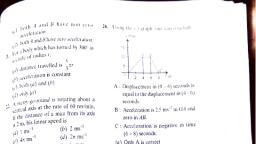
(b) 300 (c) 450, , (d) 600, , at (in m/s 2), , (a) 00, , 23. Tangential acceleration of, a particle starting from rest and, moving in a circle of radius, 1metre varies with time as in, graph . Time after which total, acceleration of particle makes an, angle of 300 with radial acceleration is:, (a) 4 sec, , (b) 4 3 sec, , (c) 22/3, , (d), , (b) FB is maximum of the three forces, (c) FC is maximum of the three forces, (d) FA = FB = FC, , 600, t (in sec), , 30., , 2 sec, , 24. The kinetic energy k of a particle moving along a, circle of radius R depends on the distance covered, as K ax 2 . The force acting on the particle is:, , x2, (a) 2a, R, (c) 2ax, , 29. The rubber band of length l has a stone of mass m, tied to its one end. It is whirled with speed v so that, the stone describes a horizontal circular path. The, tension T in the rubber band is, (a) zero (b) mv²/l, (c) > mv²/l, (d)< mv²/l, , 1/2, , , x2 , (b) 2ax 1 2 , R , R2, (d) 2a, x, , If the earth stops rotating, the apparent value of g, on its surface will, (a) increase everywhere, (b) decrease everywhere, (c) remain the same everywhere, (d) increase at some places and remain the same at, some other places, , 31. A person with his pocket is skating on ice at the rate, of 10 m/s and describes a circle of radius 50 m. What, is his inclination of the vertical? [g = 10 m/s²], (a) tan1 (1/2), (b) tan1 (1/5), 1, (c) tan (3/5), (d) tan1 (1/10), , Section 2, Lom Part Of Circuar Motion, 25. A string of length 1 m is fixed at one end and a mass, of 100 gm is attached at the other end. The string, makes 2 / rev/sec around a vertical axis through, the fixed point. The angle of inclination of the string, with the vertical is, (g = 10 m/sec2), , 5, 8, 8, (c) cos 1, 5, (a) tan 1, , 8, 5, 5, (d) cos 1, 8, (b) tan 1, , 26. A cyclist taking heads inwards white a car passenger, taking the same turn in thrown outward. The reason is, (a) that car is heavier than cycle, (b) that car has four wheels, while the cycle has only, two, (c) that cyclist has to counter act the centrifugal, force, while the passenger is only thrown by it, (d) the difference in the speeds of two., 27. A stone of mass m tied to a string of length l is, rotated in a circle with the other end of the string as, the centre. The speed of the stone is v. If the string, breaks, the stone will move, (a) towards the centre (b) away from the centre, (c) along a tangent, (d) will stop, 28. Three identical cars A, B and C are moving at the, same speed on three bridges. The car A goes on a plane, bridge, B on a bridge convex upward and C goes on a, bridge concave upward. Let FA, FB and FC be the, normal forces exerted by the cars on the bridges when, they are at the middle of bridges, (a)FA is maximum of the three forces, , [Circular motion], , 32. A rod of length L is pivoted at one end and is rotated, with a uniform angular velocity in a horizontal, plane. Let T1 and T2 be the tensions at the points L/4, and 3L/4 away from the pivoted ends., (a) T1 > T2, (b) T1 < T2, (c) T1 = T2, (d) The relation between T1 and T2 depends on, whether the rod rotates clockwise or anticlockwise., 33. A simple pendulum having a bob of mass m is, suspended from the ceiling of a car used in a stunt, film shooting. The car moves up along an inclined, cliff at a speed v and makes a jump to leave the cliff, and lands at some distance. Let R be the maximum, height of the car from the top of the cliff. The tension, in the string when the car is in air is, mv ², mv ², (a) mg (b) mg , (c) mg +, (d) zero, R, R, 34. Water in a bucket is whirled in a vertical circle, with a string attached to it. The water does not fall, down even when the bucket is inverted at the top, of its path. We conclude that in this position, mv ², mv ², (a) mg =, (b) mg is greater than, r, r, mv ², (c) mg is not greater than, r, mv ², (d) mg is not less than, r, 35. The slope of the smooth banked horizontal road is p., If the radius of curve be r, the maximum velocity, with which a car can negotiate the curve is given by, (a) prg (b) prg, (c) p/rg, (d) p/rg, 36. An automobile is turning around a circular road of, radius r. The coefficient of friction between the tyres, , Page 4
Page 5 :
and road is µ. The velocity of the vehicle should not, be more than, (a) µrg, (b) µg/r (c) µg / r, (d) µrg, , plumb bob is suspended from the roof of the car by a, light rigid rod of length 1.00m. The angle made by, the rod with the track is:, (a) zero, (b) 300, (c) 450, (d) 600, , 37. A car sometimes overturns while taking a turn., When it overturns, it is, (a) the inner wheel which leaves the ground first, (b) the outer wheel which leaves the ground first, (c) both the wheels leaves the ground, simultaneously, (d) either wheel leave the ground first., 38. A bucket tied at the end of a 1.6 m long string is, whirled in a vertical circle with a constant speed., What should be the minimum speed so that the water, from the bucket does not spill when the bucket is at, highest position? (take g = 10 m/sec²), (a) 4 m/s, (b) 6.25 m/s, (c) 16 m/s, (d) none of the above, , (c) (3g ), , (d) (5g ), , 43. A car is moving in a circular horizontal track of, radius 10 m with a constant speed of 10 m/sec. A, , [Circular motion], , (b) 10 3 rad/sec, , (c) 10 rad/sec, , (d), , (a) ML, (c) 4 ML, , 41. A body is kept on a horizontal disc of radius 2 m at, a distance of 1 m from the centre. The coefficient of, friction between the body and the surface of disc is 0.4., The speed of rotation of the disc at which the body starts, slipping is (g = 10 m/sec2), (a) 2 rad/sec, (b) 4 rad/sec, (c) 0.2 rad/sec, (d) 0.4rad/sec, , (b) (2 g ), , (a) 10/ 3 rad/sec, , 46. A string of length L is fixed, and carries a mass M at, end. The string makes, 2 / revolutions per second, around the vertical axis, through the fixed, end as shown in, the figure, the, tension in the, string is, , 40. A particle is acted upon by a force of constant, magnitude which is always perpendicular to the, velocity of the particle, the motion of the particle, takes place in a plane. It follows that, (a) its kinetic energy is constant, (b) its acceleration is constant, (c) its velocity is constant, (d) it moves in a straight line., , (a) ( g ), , P, 0.2m, , 20 rad/sec, , 45. Assuming the coefficient of friction between the, road and types of a car to be 0.5, the maximum speed, with which the car can move round a curve of 40.0 m, radius without slipping if the road is unbanked, should be:, (a) 25 m/s, (b) 19 m/s, (c) 14m/s, (d) 11 m/s, , 39. A vehicle can travel round a curve at a higher speed, when the road is banked then when the road is level., This is because, (a) banking increases the maximum friction, (b) banking increases the radius, (c) the normal reaction has a horizontal component, (d) when the track is banked the weight of the car, acts down the incline., , 42. A small body of mass m is placed on the top of a, hemisphere of radius r. Then the smallest, horizontal velocity v that should, be given to the body so that it, r, may leave the hemi –, spherical surface and not, slide down, is:, , 0.5m, , 44. A small mass of 10 gm lies in a, hemispherical bowl of radius, 0.5 m at a height of 0.2 m, from the bottom of the bowl., The mass will be equilibrium, if the bowl rotates at an angular, speed of: (g = 10 m/sec2), , at one end, the other, l, , , T, , T sin, , M, , r, , (b) 2ML, (d) 16 ML, , Section 3, Work energy part of circular motion, , v, , 47. A particle is moving in a horizontal circle with, constant speed. Which of the following statement is, correct?, (a) K.E. is constant, (b) P.E. is constant, (c) both K.E. and P.E. are constant, (d) neither K.E. and P.E. are constant., 48., , For a particle moving in a vertical circle, (a) K.E. is constant, (b) P.E. is, constant, (c) neither K.E. and nor P.E. is constant, (d) K.E. is constant but P.E. is not constant, 49. A particle is projected so as to just move along a, vertical circle of radius r. The ratio of the tension in, the string when the particle is at the lowest and, highest point on the circle is, , Page 5
Page 6 :
(a) 1 (b) finite but large, , (c) zero, , (d) infinite., , gl, , (b), , 5gl, , (c), , 3gl, , 2gl, , (d), , 51. A stone tied to a string of length L is whirled in a, vertical circle with the other end of the string at the, centre. At a certain instant of time the stone is at its, lowest position and has a speed u. The magnitude of, the change in its velocity as it reaches a position,, where the string is horizontal, is:, (a) √(u2-2gL) (b) √2gL (c) √(u2-gL) (d) √2(u2- gL), 52. The speed at the final vertical, position B of the bob of simple, pendulum, when the bob is released, from initial position A from rest is, (g = 10 m/s2), , gr on, , the horizontal frictionless surface as shown in the fig., the block leaves the surface at point C. the angel in, the figure is, , 50. A ball of mass m is attached, l, to one end of a light rod of, length l, the other end of, which is hinged. What, u, minimum velocity v should, be imparted to the ball downwards, so that it can, complete the circle, (a), , 56. A small block slides with velocity v0 = 0.5, , 370, , 4m, , 1, (a) cos, , 4, 9, , 1, (b) cos, , 3, 4, , (c) cos 1, , 1, 4, , (d) cos 1, , 4, 5, , 57. A small block is shot into each of the four tracks, as shown below. Each of the tracks rises to the, same height. The speed with which the block enters, the track is the same in all cases. At the highest, point of the track, the normal reaction is maximum, in, , A, , (a) 14 m/s, (c) 4 m/s, , (b) 12 m/s, (d) 6 m/s, , B, , (a), , 53. A stone of mass 1 kg is tied with a string and it is, whirled in vertical circle of radius 1 m. if tension at, the highest point is 50 N then velocity at lower most, point will be (g = 10 m/s2), (a) 10 m/s, (b) 4 m/s, (c) 6 m/s, (d) 8 m/s, , (b), , v, , (c), , v, , (d), v, , v, , M, , 54. If a particle of mass m resting at, the top of a smooth hemisphere of, R, radius R is displaced, then the angle, with vertical at which it losses contact with the, surface is, , 1, 3, 1 2 , (c) tan , 3, 1, (a) tan , , 1, 3, 1 2 , (d) cos , 3, 1, (b) cos , , 55. What minimum speed should be given to a particle, of mass ‘m’ tied to one end of a, massless rod fixed at another, end, so that it completes a, vertical circle? The length of the, m, u, rod is ‘L’ and initially it is in, vertical position with position with fixed end above, the free end, , 5gL, , (b), , 3gL, , (c) 2 gL, , (d), , 2gL, , (a), , [Circular motion], , Mislleneous, 58. If the equation for the angular displacement of a, particle moving on a circular path is given by, , 2t 3 0.5 , where is in radians and t in seconds,, then the average angular velocity of the particle after, 2 sec from its start is, (a) 8 rad/sec, , (b) 12 rad/sec, , (c) 24 rad/sec, , (d) 36 rad/sec, , 59. A 40 kg slab rests on a frictionless floor. A 10 kg, block rests on top of the slab in the figure. The static, coefficient of friction between the block and the slab, is 0.60 while the kinetic coefficient is 0.40, the 10 kg, block is acted upon by a horizontal force of 100 N. If, g = 9.8 m/s2 the resulting acceleration of the slab will, be:, (a) 0.98 m/s2, (b) 1.47 m/s2, 2, (c) 1.52 m/s, (d) 6.1 m/s2, 60. A body is moving in a circle at a uniform speed v., The magnitude of the change in velocity when the, radius vector describes an angle 600 is, , Page 6
Page 7 :
(a) 4v, (c), , (b) v/2, , 3, v, 2, , (d) v, , 61. A particle is given an initial speed u inside a smooth, spherical shell of radius R = 1m that it is just able to, complete the circle. Acceleration of the particle when, its velocity becomes vertical is, , (a) g 10, , (b) 0, , (c) g 2, , (d) g 6, , [Circular motion], , Page 7