Page 1 :
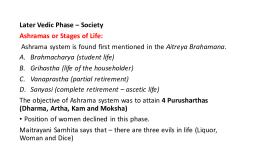
INDIAN ETHICS, UNIF-IV, N you, B.A. PART PAPER A (UNIT- IV), No. I Concept of Purusharthas-Artha, Kama, Dharma, Moksha., (Supreme Ideals of Life), Indian Culture recognizes four Supreme Ideals or values of human life, lues, Ans:-, called Purushathas, namely; rtha, Kama, Dharma and Moksha. These, are considered as important part of human life and the foundations of our, character. It is believed that the realization of these values is necessary for a, balanced life. Thus every human being ought to purstic them in order to attain to, his complete well-being. The meaning and nature of each of the value is, explained here under:-, Diarma -The word dharma is derived from the root term dhr' which means, to sustain or uphold". During the Vedic period another term Rta was also used, tor dharma in its moral sense), Oharma is the cosmic principle. It is the divine or cosmic law according to, which the objects of nature are working in their rhythmic uniformity. It is the, spiritual energy in the universe., (Luth) According to them dharma leads to Bruhman realization which is, impossible without moral upliftment), (Dharma is also regarded as the unconditional principle of morality. It has, been described in terms of universal virtue. It is Moral Good. It is the moral duty), * Qharma is also the performance of comn:on and specifie duties pertaining to our, Varna and Asram It is the noral foundation of our society.), (Dharma is higher than wealth (4rthia) and happiness (Kama). Wealth and, happiness are instrumental values; dharma is an intrinsic value. It is an end in, itself.), The Upanisads identify dharma with satya, Artha: - The next Purusartha after Dharma is Artha. It has been given an, important place in Indian Culture. Kautilya in his Artha-Sastra regards artha, (wealth) as one of the chief ends of life. He defines 'artha' as the livelihood of, human beings. It is the economic foundation of society. It satisfies the material,, biological and economic needs of human being (Kautilya writes, "Arth is the, highest since it is the means for the achievement of Dharma and KamaArtha, includes the primary needs of man Che fulfillment of Dhorma and Kamet is, based on Artha. Therefore one should makee sustained efforts to earn artha, but, not through unfair means. Thus Indian culture recognizes the attainment of arthr, by,lair means as one of the supreime I Heals of human life.
Page 2 :
Kama: - (The third Purusartha is Kama, Koma has been literally defined as, desire. In old Indian literature, Kama is understood as an energy motivating and, energizing all our activities. It is also used for the sexual urge in a particular, sense. Kama is a sexual pleasure arising out of the satisfaction of sex instinct. It., Is a biological need. All Kama desires are biological urges which demand their, satisfaction at proper times of the development. Refusal to acknowledge them, brings frustration. The Indians believe that the satisfaction of the desire for Kama, is, necessary for a balanced personality. Vatsyayana, in his Kama-sutra,, maintains that the enjoyment of Kama is as much necessary for the body as the, food. Thus the realization of Kama-desire by proper means has been given its due, importance in Indian ideology), Moksha: - Moksha is the fourth Purushartha. It is the ultimate end of human life., Moksha literally means deliverance. It is deliverance from all types of pains and, sufferings, worldly as well as other-worldly. It is a state devoid of all sufferings., It is thus pure bliss. It is deliverance from the cycle of birth, death and rebirth., Moksha is the unity of the Atman with Brahman. It is abiding in Brahmam., It is the extinction of the individual, his annulment in the Absolute. It is the, realization of ultimate Reality. It is thus the status of identity between Atman and, Brahman., Mokshe consists in realizing the pure spiritual natare of the self beyond its, physical, mental or intellectual nature. In other words Moksha, consists in, realizing the ranscendence of the self. It is the existence of the self in its, transcendental condition free from its empirical qualities. Moksha is thus the, attainment of the eternality and immorality of the self., To Sum Up: - In brief, Artha satisfies the material self,, Kama satisfies the bodily self,, Dharma satisfies the moral self, and, Moksha satisfies the spiritual self., Thus Arth, Kama, Dharma and Moksha are the four purusharthas or the, cardinal virtues of life according Indian thinkers. The first three i.e. Artha, Kama, and Dharma have extrinsic value; while the last i.e. Moksha has an intrinsic value., Artha, Kama and Dharma are the means for the attainment of the Moksha which-, is the ultimate end of human life., Courtesy: DR. P. P. SINGH
Page 3 :
B.A. Part 3" (Puper 'B') Unit-l, Q. No. 1 Buddhism-The Four Noble Truths, Buddhism-The Eight-folds Path, (Ruddhism, as a religion was founded by Buddha-the man who "Woke up"., in the 6th, century a.c. He was born around 560 B.C. in northern India approximately one, hundred miles from Benares. His father was a king of the Shakya clan. Buddha's full, name was Siddhartha Gautama of the Sakyas; Siddhartha was his given name, Gautama, his surname, and Sakya the name of the clan to which his family belonged. At sixteen he, married a neighboring princess named Yasodhara who bore him a son whom they called, Rahula. ), Prince Siddhartha renounced the princely life at a very young age and spent, years in study, penance and meditation. For six years he sought enlightenment through, ascetic practices; remaining unsuccessful, he resumed the life of a beggar living on alms, but observed himself fully in meditation. He is said to have spent seven weeks in a, posture of meditation under the Bo tree. At the end of this period he had become Buddha, "The Enlightened One" People came to him asking not "who are you?" but with respect, to name, origin, or ancestry "what are you?"-what order of being do you belong to,, what species do you represent? "Are you a god?" they asked. Siddhartha repfied, "No.", "An Angel?" "No". "A saint?" " No". "Then what are you?" Siddhartha answered, "I, am awake"- Buddha'. His answer became his title, for this is what Buddha means. In, the Sanskrit root budh denotes both to wake and to know. Buddha', then, means the, "Enlightened One" or the "Awakened One".), The Four Noble Truths (arya sutya), Buddha was primarily an ethical teacher and reformer, not a, metaphysician. When any one asked Buddha metaphysical questions as to whether the, soul was different from the body, whether it survives death, whether the world was finite., or infinite, eternal or non-eternal, ete. he avoided discussing them. Instead of discussing, metaphysica! questions, Buddha always tried to enlighten persons on the most important
Page 4 :
yueshons of human sufferings, their origin, cessation and the means to overcome them., *He answer to these questions constitutes the basic tenets of Buddhism which are best, encapsulated in what are known as the Four Noble Truths (catvari aryasatyani). These, are:, T. Life in the world is full of suffering (duhkha), 2. There is a cause of the suffering (duhkha-samudaya), 3It is possible to stop suffering (duhkha-nirodha), 4. There is a path which leads to the cessation of suffering. (duhkha-nirodha-marga), (The Four Noble Truths thus together constitute the axioms of his system. They, are the basic postulates from which almost everything in his teaching logically unfolds., The Four Noble Truths (arya satya) are: /, 4. The First Noble Truth about Suffering (duhkha) (GRa), ( The first noble truth is that life is suffering (duhkha). The sights of, suffering which upset the mind of young Siddhartha were of disease, old age and death., Birth and death, pain and pleasure, and life are all a suffering or duhkha. Buddha, maintains that suffering is not casual; rather it is causally present in all forms of existence, and in all kinds of experiences. Even what appears as pleasant is really a cause of pain, and sorrow. There can be no birth without death, nor pleasure without pain, nor love, without sorrow; both go hand in hand, being the two ends of the same process. ), Buddha's first noble truth is thus concerned with the nature of human suffering., Human life as a whole is full of suffering and suffering alone (Sarvam Duhkham). Birth,, different diseases, old age and death (Jaramarana) constitute the nature of human, suffering. Everywhere and at all stages of life, therefore, there is suffering., 2. The Second Noble Truth about the Cause of Suffering (duhkha-samudaya), The second noble truth about the cause of suffering maintains, that suffering is not casual but causal. Human suffering is not uncaused. Buddha's belief, in the theory of dependent origination makes him able to trace back the origin of, suffering finally in ignorance (Ajnema) through a twelve-litked chain (Dvadursa dana),, in which every consequent is depen lent for its origin on the adjoining ante edent.
Page 5 :
Buddha thus explain suffering as belonging to chain of twelve bricks or links; The first, (or, in a sense, the last) link in the chain is Jaramarana, i.e. suffering (duhkha) itself in, the nature of old age, diseases, death etc, The cause of this Jaramarana is jati, i.e. taking, birth. If one does not take birth at all, there would not have been suffering. So birth is the, most obvious cause of suffering. But the question is why one takes birth at all. What the, cause of Jati is. The cause of Jati, according to Buddha, is Bhava i.e. the will to be bom., So, birth is due to an inherent urge, a drive for that. But what is the cause of this Bhava?, The cause of this Bhava is Upadana i.e. one's clinging to the sensory enjoyments. This, clinging, again, is due to Trisna, i.e, thirst for such enjoyment. This thirst is due to, Vedana, i.e. memory of previous sense experiences, which in its turn, is due to Sparsha, i.e. sense-object contact. Further this contact or Sparsha is occasioned by Sadayatana,, i.e. six organs of cognition - mind and the five senses. The cause of this Sadayatana is, Nama-Rupa, i.e., the psycho-physical organism. This organism develops and comes into, existence because of Vijnana, i.e., initial consciousness. This consciousness (Vijnana) is, the effect of Sanskaras, i.e., impressions of our past existence or past karams. And these, Sanskaras which determine our present life and existence are due to Avidya, 1.e.,, ignorance about truth. Ignorance thus according to Buddha is the root cause of all human, sufferings., In short, 1. Avidya, 2. Sanskaras, 3. Vijnana, 4.Nama-Rupa, 5. Sadayatana,, 6. Sparsa, 7. Vedana, 8. Trisna, 9. Upadana, 10. Bhava, 11. Jati, and 12. Duhkha such is, the chain of cause and effect which is responsible human sufferings. These twelve links, of causation constitute the wheel of our existence birth and re-birth which is called, Bhave-chakar., 3. The Third Noble Truth about the Cessation of Suffering (duhkha-Nirodha), The Third Noble Truth follows logically from the second. If the cause of, life's sufferings is Avidya, i.e., ignorance or Tanha (a specific kind of desire) i.e. selfish, craving, its cure lies in the overcoming of Avidya and Tanha. If we could be released, from the narrow limits of self-interest into the vast expanse of universal life, we would be, free of our torment. The Fourth Noble Truth advises how this cure can be acconplished., The overcoming of our craving is thus through the Eight-fold Path.