Page 2 :
Introduction, It is a techniques to identify and/or quantify any sample, substances, compound by using manual, chemical and instrumental techniques by qualitative and quantitative methods., Types of analysis:, Qualitative analysis: technique of determining the presence or absence of any compound in completely unknown sample., Example: phenolphthalein indicator gives light pink color in alkaline solution., Quantitative analysis: determination of quantity in number, weight, length, or any other measurement parameter., Example: assay of NaCl is carried by volumetric method, Steps in chemical analysis:, Sampling: According to nature and size of substance sampling is carried out where small amount of sample is taken., Sample preparation: It include dealing with sample before analysis i.e., reduction of particle size, mixing of sample, etc., Processing of sample for analysis: accurate amount of above sample are processed for analysis i.e., dissolving, dilution, etc., Selection of analytical techniques: On basis of nature of sample and required output appropriate analytical method are selected., Analysis of sample by selected techniques: it involves the calibration, optimization, standardization and measurement of substance by selected analytical method., Calculation and results: Data available after analysis is processed for calculation, result compilation and conclusion., Presentation of data: Processed data and result are represented in table, chart, graphs
Page 3 :
Factors affecting selection of analytical techniques: , Nature of sample: different type of sample are analysed by different analytical techniques like acid and bases are analysed by acid-base titration., Type of analysis: Techniques are selected on basis of the what type of analysis you need to perform. , Physical state of sample: Physical state of sample i.e., solid, liquid, gas play a major role in selection of the instrument., Presence of impurities: As some instrument are not sensitive enough to determine the impurities in sample. , Concentration of analyte in sample: Different instrument requires different concentration of the sample., Accuracy required: Different instrument haves different accuracy thus for more accurate result highly sensitive techniques must be used. Example: pH paper and Ph meter for determining pH of solution., Availability of instrument: Availability of instrument for the selected techniques play a major role in analysis., Time required for analysis: It is important factor for selection of analytical techniques., Amount of sample: If less amount of sample is available then non-destructive method is used.
Page 5 :
Methods of expressing concentration
Page 7 :
Primary standard substances:, It should be easily available, purified and dried., It should be 100% pure and if impurities are present then not more than 0.01-0.02%., It should be stable at normal atmospheric conditions., Equivalent weight and molecular weight should be high to minimize the weighing errors., It should not be hygroscopic., Rarely gets contaminated., Example: sodium carbonate, oxalic acid, potassium dichromate, sodium chloride, etc., Secondary standard substances:, It should be easily available, purified and dried., Its purity is low as compared to primary standard., Has high reactivity in comparison to primary standard., It is hygroscopic in nature., Easily get contaminated due to high reactivity., Example: sodium hydroxide
Page 8 :
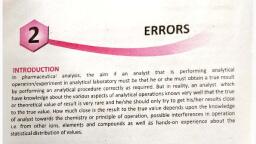
Error is defined as difference between the true value and the observed value in an analysis., Sources of error:, Sample preparation: error may occur during preparation of sample., Error by analyst: error can be produced by analyst called as human error., Equipment problem: improper or defective equipment may also cause error., Calibration: error may occur if proper calibration is not done., Reporting error: while writing reports error may be generated., Calculation error: error may generated during calculation of result., Error in method selection: wrong selection of method may generate error., Sampling error: improper sampling may cause error., Laboratory environment: improper laboratory environment may also cause error.