Page 1 :
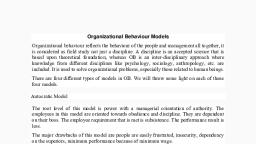
UNIT 1, Meaning of OB:, Organizational behavior describes how people interact with one another inside of an organization, such as a business. These interactions subsequently influence how the organization itself behaves and how well it performs., Definition of OB:, In words of K Aswathappa, “OB is the study of human behaviour in organisational setting, of the interface between human behaviour and organisation and of the organisation itself.”, According to L. M. Prasad, “Organisational behaviour can be defined as the study and application of knowledge about human behaviour related to other elements of an organisation such as structure, technology and social systems.”, Study of organisational behaviour helps in studying:, i. Why people behave in a particular way?, ii. Why one person is more effective than the other?, iii. Why one group is more effective than the other?, iv. Why one person is more effective in one organisation as compared to the other organisations?, Nature of OB:, The nature it has acquired is identified as follows:, 1. A Separate Field of Study and Not a Discipline Only:, O.B. has a multi- interdisciplinary orientation and is, thus, not based on a specific theoretical background. Therefore, it is better reasonable to call O.B. a separate field of study rather than a discipline only., 2. An Interdisciplinary Approach:, Organizational behaviour is essentially an interdisciplinary approach to study human behaviour at work. It tries to integrate the relevant knowledge drawn from related disciplines like psychology, sociology and anthropology to make them applicable for studying and analysing organizational behaviour., 3. An Applied Science:, O.B. involves both applied research and its application in organizational analysis. Hence, O.B. can be called both science as well as art., 4. A Normative Science:, O.B. prescribes how the findings of applied researches can be applied to socially accepted organizational goals. Thus, O.B. deals with what is accepted by individuals and society engaged in an organization., 5. A Humanistic and Optimistic Approach:, Organizational Behaviour applies humanistic approach towards people working in the organization. It, deals with the thinking and feeling of human beings., 6 A Total System Approach:, The system approach is one that integrates all the variables, affecting organizational functioning. The systems approach has been developed by the behavioural scientists to analyse human behaviour in view of his/her socio-psychological framework., Scope and importance of OB can be visible in following points:, Controlling and Directing Behaviour: After understanding the mechanism of human behaviour, managers are required to control and direct the behaviour so that it conforms to the standards required for achieving the organisational objectives., Use of Power and Sanction: The behaviours can be controlled and directed by the use of power and sanction, which are formally defined by the organisation., Leadership: Organisational behaviour brings new insights and understanding to the practice and theory of leadership., Communication: Communication helps people to come in contact with each other. To achieve organisational objectives, the communication must be effective., Organisational Climate: Organisational climate refers to the total organisational situations affecting human behaviour., Organisational Adaptation: Organisations, as dynamic entities are characterised by pervasive changes., Fundamental concepts of organisational behaviour, There are two basic concepts of organisational behaviour, such as, 1. The nature of people, 2. The nature of organization, 1) Nature of the People, i) Individual Differences: can motivate the employees of an organization in a better way by understanding that all individuals are different from each other and hence treating every person differently. The Law of individual differences also teaches us that each individual is different and unique., ii) : Every person has his own viewpoint regarding different objects and people, therefore they see different things in a different manner i.e., people may have different viewpoints for the same object. These viewpoints about the objects in an can be made clear by correct perception., iii) Motivation to Employees: If an employee is needed in an organization he feels belonging towards the organization and it motivates him to perform well in the organization. Sometimes, motivation is also necessary to pursue excellence or to improve the quality of work., iv) Whole Person: While hiring an employee the manager also hires various things that are associated with an employee like his nature, likes, dislikes, perception, behavior, preferences, background, hobbies, etc. But his personal life cannot be isolated from his professional life. Hence, a should try to make the workplace comfortable for him like a home so that the employee could feel good like he is working at his home with ease., V) Caused BehaviourThe can motivate employees in two different ways. Firstly, by showing them how their actions can raise their need fulfillment. Secondly, by threatening them that their undesirable action can negatively affect fulfillment of their needs., vi) The desire for Involvement: An employee who is purposefully involved in the working of an organization feels good about himself. Management should provide such opportunities to employees as it results in mutual growth of both the employees and the organization., vii) Human Dignity: Everyone wants to get respect, dignity and needs to be recognized in their workplace. employees should also be treated with respect in their workplace like managers., 2), i) Organisation is a Social System: Social system means an orderly arrangement of components that are interrelated to each other and every part has its fixed role to play. Similarly, an organization's employees, workers, managers have their definite roles and they all are connected to each other therefore they all are connected directly or indirectly to each other. An organization coordinates the activities of its employees to achieve its goals., ii) Mutuality of Interest: The relationship between an employee and organization are complementary to each other. The organization goals can only be achieved through both the efforts of an employee and the management, these results in the mutual growth of both the employee and the organization., iii) Ethics: Organizations must create such an ethical environment for the employees and the people who are directly or indirectly connected to the organization. This may improve the goodwill and trust towards the organization., Determinants of OB:, There are three major factors that affect OB. The working environment being the base for all three factors, they are also known as the determinants of OB. The three determinants are −, People, Structure, Technology, People, An organization consists of people with different traits, personality, skills, qualities, interests, background, beliefs, values and intelligence., Organizational Structure, Structure is the layout design of an organization. It is the construction and arrangement of relationships, strategies according to the organizational goal., Technology, Technology can be defined as the implementation of scientific knowledge for practical usage., MODELS OF ORGANISATION BEHAVIOUR, The following four models of organizational behaviour are as follows:, A. Autocratic model, B. Custodial model, C. Supportive model, D. Collegial model, 1.Autocratic Model: In an autocratic model', the manager has the power to command his subordinates to do a specific job., 2.Custodial Model: This model focuses better employee satisfaction and security. Under this model organizations satisfy the security and welfare needs of employees., 3.Supportive Model: The supportive model depends on 'leadership' instead of power or money., 4.Collegial Model :The term 'collegial' relates to a body of persons having a common purpose., OB –as an interdisciplinary approach, Let’s see how these disciplines are related to organizational behaviour,, A. Psychology: Psychology is the study of human behavior which tries to identify the characteristics of individuals and provides an understanding why an individual behaves in a particular way., B. Sociology: Sociology is the study of social behavior, relationships among social groups and societies, and the maintenance of social order., C. Social psychology: Social psychology is the study of human behaviour in the context of social situations., Anthropology: Anthropology is the science of mankind and the study of human behaviour as a whole., E. Economic: Any organization to survive and sustain must be aware of the economic viability of their effort., F. Political Science: Although frequently overlooked, the contributions of political scientists are significant to the understand arrangement in organizations., Thus, organisational behaviour can be understood at:, Interpersonal Level, Group Level, Inter-group Level, Emerging Challenges in the Field of OB, 1. Workforce Diversity:, Organizations are becoming increasingly cosmopolitan. Organization specialist must learn to live with diverse behaviors. Managers must learn to respect diversity., 2. Changed Employee Expectation:, Traditional allurements such as job security, attractive remuneration housing does not attract, retain and motivate today’s workforce. Employees demand empowerment and expect equality of status with the management., 3. Globalization:, Growing internationalization of business has its impact on people management. 1. Internationalization makes managers to increase their competencies., 2. Globalization increases the number of managers and professions., 4. Improving Productivity and Quality:, As organizations are exposed to competition, managers are seriously thinking of improving quality and productivity., 5. Changing Demographics Of Workforce:, Major challenges from changing demographics of workforce relate to dual-career couples. Couples where both partners are actively pursuing professional careers.